
Resources
Explore a wide range of valuable resources on GCED to deepen your understanding and enhance your research, advocacy, teaching, and learning.
1,951 Results found
 Día Internacional de la Educación 2025: Inteligencia Artificial y educación: preservar la autonomía humana en un mundo de automatización Year of publication: 2025 Corporate author: UNESCO El Día Internacional de la Educación 2025 tiene por objeto: Examinar las nuevas posibilidades que ofrece la inteligencia artificial, especialmente en la enseñanza, el aprendizaje, la evaluación y la gestión educativa. Promover el desarrollo de alfabetizaciones críticas en IA, dotando a educadores y estudiantes de las competencias necesarias para comprender, utilizar e influir en las tecnologías de IA, en línea con los marcos de competencias en IA de la UNESCO para docentes y alumnos. Garantizar que la IA complemente, y no reemplace, los elementos humanos esenciales del aprendizaje, incluyendo la construcción de relaciones interpersonales y el desarrollo de la inteligencia emocional.
 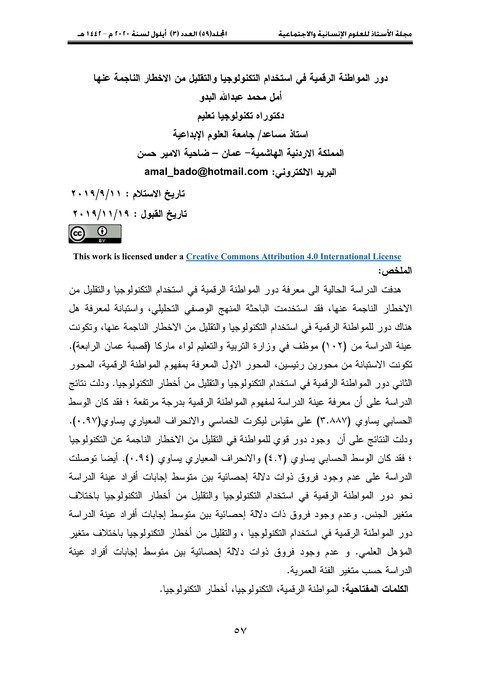 The Role of Digital Citizenship in the Use of Technology and Reducing the Risks Resulting from it (Alustath Journal for Human and Social Sciences; vol.59, no.3) Year of publication: 2020 Author: Amal Mohammed Abdullah Albado Corporate author: University of Baghdad. College of Education Ibn Rushd The current study aims to know the role of digital citizenship in the use of technology and reducing the risks resulting from it. The researcher uses the descriptive analytical approach and makes a questionnaire to know if there is a role for the digital citizenship in the use of technology and reducing the dangers caused by it. The study sample consists of (102) employees in the Ministry of Education Marka Brigade (the fourth Amman qasaba). The questionnaire consists of two main axes: the first axis, which is defined as the concept of digital citizenship, the second axis is the role of digital citizenship in the use of technology and reducing the dangers of technology. The results of the study show that the awareness of the sample of the study of the concept of digital citizenship is on a high level, on average that equals (3.887) of the Likert quinary scale and the standard deviation is equal to (0.97). The results also show a strong role for citizens in reducing the dangers caused by technology where the arithmetic mean equals (4.2) and the standard deviation was (0.94). دور المواطنة الرقمية في استخدام التكنولوجيا والتقليل من الاخطار الناجمة عنها (الاستاذ للعلوم الانسانية والاجتماعية; no.3, vol.59) Year of publication: 2020 Author: Amal Mohammed Abdullah Albado Corporate author: University of Baghdad. College of Education Ibn Rushd هدفت الدراسة الحالية الى معرفة دور المواطنة الرقمية في استخدام التكنولوجيا والتقليل من الاخطار الناجمة عنها، فقد استخدمت الباحثة المنهج الوصفي التحليلي، واستبانة لمعرفة هل هناك دور للمواطنة الرقمية في استخدام التكنولوجيا والتقليل من الاخطار الناجمة عنها، وتكونت عينة الدراسة من (102) موظف في وزارة التربية والتعليم لواء ماركا (قصبة عمان الرابعة). تكونت الاستبانة من محورين رئيسين، المحور الاول المعرفة بمفهوم المواطنة الرقمية، المحور الثاني دور المواطنة الرقمية في استخدام التكنولوجيا والتقليل من أخطار التكنولوجيا. ودلت نتائج الدراسة على أن معرفة عينة الدراسة لمفهوم المواطنة الرقمية بدرجة مرتفعة ؛ فقد كان الوسط الحسابي يساوي (3.887) على مقياس ليكرت الخماسي والانحراف المعياري يساوي(0.97). ودلت النتائج على أن وجود دور قوي للمواطنة في التقليل من الاخطار الناجمة عن التكنولوجيا ؛ فقد كان الوسط الحسابي يساوي (4.2) والانحراف المعياري يساوي (0.94).
  Greening Curriculum Guidance: Teaching and Learning for Climate Action Year of publication: 2024 Corporate author: UNESCO This Guidance responds to the calls from young people for a holistic approach to climate change and sustainability in the curriculum. It outlines a common language on how quality climate change and sustainability can be reflected in the curriculum by setting expected learning outcomes per age group (from 5-year olds and up to 18+ age group, including a lifelong learning approach).This is crucial for accelerating country-level action and ensuring joint monitoring of progress. The objective is to have 90 per cent of all countries include climate change in their curricula by 2030, as established by the Greening Education Partnership.This Guidance aims to support countries, schools or individual practitioners in reassessing their ongoing practices to adopt a more action-oriented, holistic, scientifically accurate, justice-driven and lifelong learning approach to climate change.
  Guía para hacer verdes los currículos: enseñanza y aprendizaje para la acción climática Year of publication: 2025 Corporate author: UNESCO Hacer verdes los currículos con el fin de preparar a todos los estudiantes para el cambio climático. La educación es una herramienta poderosa para transformar el mundo e impulsar la acción contra el cambio climático a largo plazo.Esta guía responde a los llamados de las juventudes en favor de un enfoque holístico del cambio climático y la sostenibilidad en los planes de estudio. Define un lenguaje en común sobre cómo debe reflejarse con calidad el cambio climático y la sostenibilidad en los planes de estudio, mediante el establecimiento de los resultados de aprendizaje esperados por grupo etario (grupos de 5 años hasta mayores de 18 años, incluyendo un enfoque de aprendizaje a lo largo de toda la vida).Esto es crucial para acelerar la acción a nivel de los países y garantizar el seguimiento conjunto de los progresos. La meta es lograr que el 90 por ciento de todos los países incluyan el cambio climático en sus planes de estudio para el año 2030, según lo establecido por la Alianza para una Educación Verde.Esta guía tiene el propósito de apoyar a países, escuelas y profesionales en la revisión de las prácticas que tienen en marcha para adoptar un enfoque del cambio climático más orientado a la acción, holístico, científicamente preciso, impulsado por la justicia y con una perspectiva de aprendizaje a lo largo de toda la vida.
  Citizens as Users of Languages and Digital Technology Year of publication: 2021 Corporate author: European Centre for Modern Languages (ECML) | Council of Europe A recent meta-analysis of the literature portrays male and female citizens who are users of languages and digital technologies. This helps to understand the goals of an education aimed at developing male and female citizens capable of using digital technology in a competent, informed, safe, responsible, ethical, and critical manner. Citoyens et citoyennes usagers et usagères des langues Year of publication: 2021 Corporate author: European Centre for Modern Languages (ECML) | Conseil de l'Europe Une méta-analyse de la littérature récente dresse le portrait des citoyens et citoyennes usagers et usagères de langues et du numérique. Cela permet de connaitre les objectifs d’une éducation qui vise le développement de citoyens et citoyennes capables d’utiliser le numérique d’une façon compétente, informée, sûre, responsable, éthique et critique.
 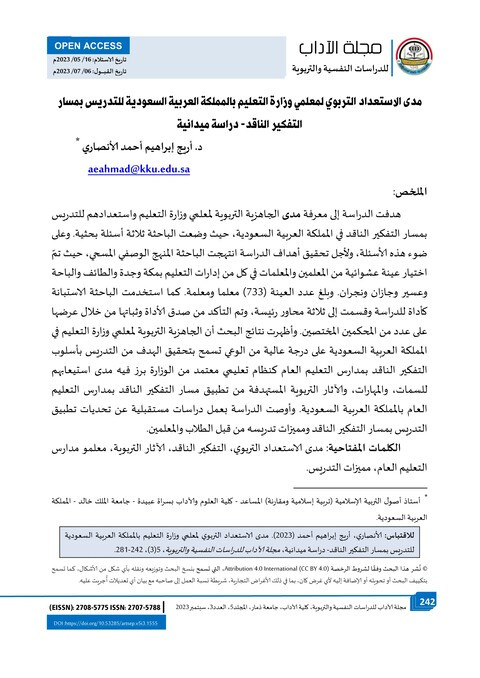 The Extent of Educational Readiness of Using Thinking Skills Strategy among Teachers at the Ministry of Education, Saudi Arabia: A Field Study (Arts for Educational & Psychological Studies; Vol.5, No.3) Year of publication: 2023 Author: Areej Ibrahim Ahmed Al Ansari Corporate author: Dhamar University This study aimed to identify educational readiness and willingness of teachers affiliated to the Ministry of Education to use critical thinking in their teaching, in Saudi Arabia. To achieve the study objectives, the descriptive survey method was adopted, and a questionnaire was used to collect data from the study sample which consisted of (733) male and female teachers, randomly selected from education directorates of Makkah, Jeddah, Taif, Al-Baha, Asir, Jazan, and Najran. The questionnaire included three main dimensions;and after testing its validity, and reliability, it was administered to the sample. The study results showed that teachers’ educational readiness scored a high degree of awareness that would allow achieving the goal of teaching by using critical thinking in schools as a teaching strategy approved by the Ministry of Education. The teachers also showed their understanding of the characteristics, skills and educational effects of the application of the critical thinking strategy in schools. The study recommended conducting future studies on the challenges and advantages of applying the critical thinking strategy from the perspective of students and teachers.Keywords: Extent of educational readiness, Critical thinking, Educational effects, School teachers. مدى الاستعداد التربوي لمعلمي وزارة التعليم بالمملكة العربية السعودية للتدريس بمسار التفكير الناقد- دراسة ميدانية (مجلة الآداب للدراسات النفسية والتربوية; Vol.5, No.3) Year of publication: 2023 Author: Areej Ibrahim Ahmed Al Ansari Corporate author: Dhamar University هدفت الدراسة إلى معرفة مدى الجاهزية التربوية لمعلمي وزارة التعليم واستعدادهم للتدريس بمسار التفكير الناقد في المملكة العربية السعودية، حيث وضعت الباحثة ثلاثة أسئلة بحثية. وعلى ضوء هذه الأسئلة، ولأجل تحقيق أهداف الدراسة انتهجت الباحثة المنهج الوصفي المسحي، حيث تمّ اختيار عينة عشوائية من المعلمين والمعلمات في كل من إدارات التعليم بمكة وجدة والطائف والباحة وعسير وجازان ونجران. وبلغ عدد العينة (733) معلما ومعلمة. كما استخدمت الباحثة الاستبانة كأداة للدراسة وقسمت إلى ثلاثة محاور رئيسة، وتم التأكد من صدق الأداة وثباتها من خلال عرضها على عدد من المحكمين المختصين. وأظهرت نتائج البحث أن الجاهزية التربوية لمعلمي وزارة التعليم في المملكة العربية السعودية على درجة عالية من الوعي تسمح بتحقيق الهدف من التدريس بأسلوب التفكير الناقد بمدارس التعليم العام كنظام تعليمي معتمد من الوزارة برز فيه مدى استيعابهم للسمات، والمهارات، والآثار التربوية المستهدفة من تطبيق مسار التفكير الناقد بمدارس التعليم العام بالمملكة العربية السعودية. وأوصت الدراسة بعمل دراسات مستقبلية عن تحديات تطبيق التدريس بمسار التفكير الناقد ومميزات تدريسه من قبل الطلاب والمعلمين.
 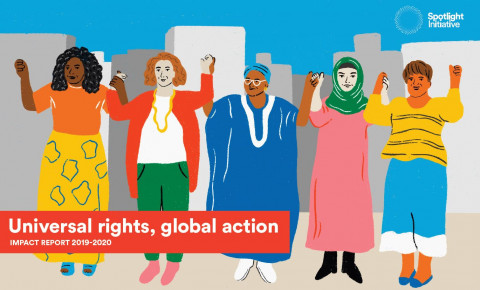 Universal Rights, Global Action: Impact Report 2019-2020 Year of publication: 2020 Corporate author: Spotlight Initiative Universal rights, global action is a shortened, visual adaptation of the 2019 Global Annual Narrative Progress Report. The Spotlight Initiative is a global, multi-year partnership between the European Union and the United Nations to eliminate all forms of violence against women and girls by 2030. This report outlines the Spotlight Initiative’s key signature results from 2019.The 32-page document highlights the ways the Spotlight Initiative country and regional programmes have meaningfully reached women and girls, including those facing multiple and intersecting forms of discrimination.