
Resources
Explore a wide range of valuable resources on GCED to deepen your understanding and enhance your research, advocacy, teaching, and learning.
1,983 Results found
 L'éducation à la citoyenneté Year of publication: 2008 Author: Audric Vitiello Corporate author: Raisons politiques Notion récente, l'éducation à la citoyenneté se présente comme une inflexion de la formation civique, visant un renouvellement de sa forme pour mieux assurer sa fonction institutionnelle d'intégration des individus au collectif. Mais, l'éducation ôtant une praxis où moyens et fins sont interdépendants, une modification des modalités de l'éducation induit logiquement celle de la finalité. De fait, l'éducation à la citoyenneté s'indexe à une conception originale du politique pensé non plus comme lieu, mais comme moment spécifique dédié à la régulation de tout collectif. Le mécanisme d'abstraction civique perdure, mais il s'effectue à partir des situations concrètes dans lesquelles l'individu est inscrit, et par une réflexion à fondement dialogique. Se dessine alors une forme de démocratie générale et dialogique, où le politique est déconcentré et démultiplié mais où la décision prise en commun après délibération reste le mode de structuration privilégié du collectif. Mais la démocratie procédurale et dialogique a des limites, dans la mesure où elle suppose d'être fondée dans un corpus substantiel de valeurs qui lui confère sa légitimité.
  Quick Guide to Education Indicators for SDG 4 Year of publication: 2018 Corporate author: UNESCO Institute for Statistics (UIS) This guide serves as a quick reference on how to monitor progress towards Sustainable Development Goal 4 (SDG 4) on quality education. It provides basic explanations of SDG 4 targets, their indicators, how they are created and where to find the information needed for these indicators.
 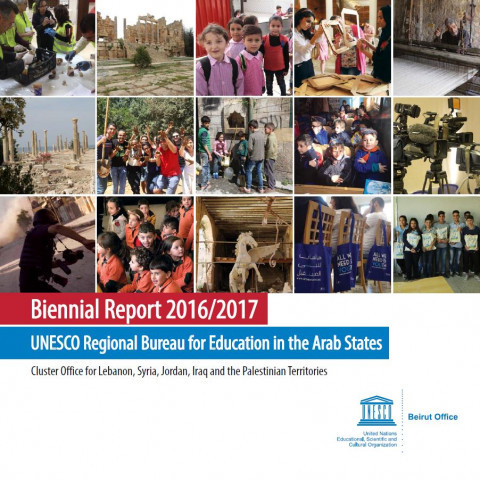 Biennial Report 2016/2017: UNESCO Regional Bureau for Education in the Arab States Year of publication: 2018 Corporate author: UNESCO Beirut As Regional Bureau for Education, UNESCO Beirut is the lead coordinator for SDG 4 in the Arab Region. We strive to provide tangible support for each Member State in the region, taking into account national needs and priorities, thereby employing nationally relevant approaches. More specifically, our work aims to address both the humanitarian and development aspects brought about by the protracted crisis in Syria through bridging the learning gaps for the youth, both for Syrian refugees and vulnerable youth in host communities. Our response also targets teachers, mentors and facilitators as well as Ministries’ technical officials. The crisis in Syria has created a need for specific support in education in emergencies and quality education to which we actively engage from both, upstream analytical and capacity building and downstream operational levels. UNESCO Beirut has also strengthened its leadership to respond to the deliberate destruction of cultural heritage, illicit trafficking, and attacks against individuals on religious or cultural grounds. We raise the alarm to protect heritage in danger, assessing damages to World Heritage sites in conflict. We also raise awareness among the public about the values of cultural heritage and the need to protect it for future generations. In today’s diverse societies, the Organization’s fundamental humanist mission guides us to support people, especially the youth, in understanding each other and working together to build lasting peace and enables people to create and use knowledge for just and inclusive societies. We continue to advocate free, independent and pluralistic media in print, broadcast and online to enhance freedom of expression as a contributor to peace, sustainability, poverty eradication and human rights. This biennial report summarizes the work and achievements accomplished between 2016 and 2017 by our office.
  [Vidéo] L'école apprend la citoyenneté Year of publication: 2016 Corporate author: Mission laïque française Organisé au Maroc en mai 2016, le congrès du réseau d'enseignement français à l'étranger mlfmonde a réuni 300 personnes autour du thème "l'école apprend la citoyenneté", élément central du projet éducatif de la Mission laïque française.
 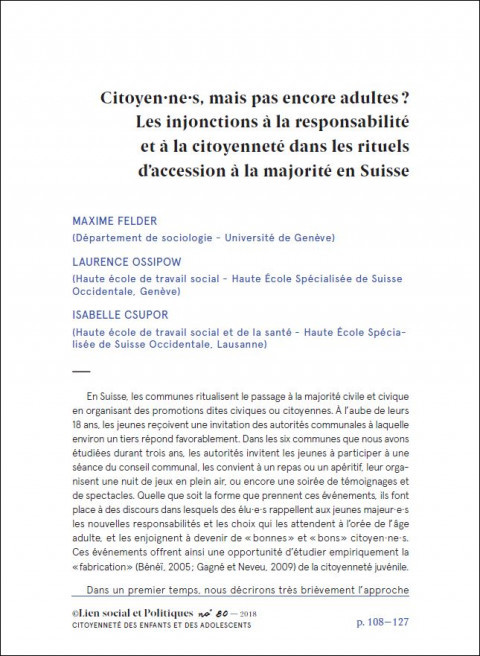 Citizens but not Adults? Injunction to be Responsible and Citizens in Official Coming of Age Rituals in Switzerland Year of publication: 2018 Author: Maxime Felder | Laurence Ossipow | Isabelle Csupor Corporate author: Lien social et Politiques Swiss municipalities organize ceremonies for their residents reaching the official age of full citizenship. In the six studied municipalities, local authorities invite them to a municipal council’s meeting, offer them a dinner or an aperitif, or organize them a show and a debate with role models. Speeches are central to these ceremonies, and authority representatives encourage their audience to be “good” citizens. Call to vote is the leitmotiv, but discourses reveal broader definitions of citizenship, insisting sometimes on a local commitment and volunteering, and sometimes on the necessity to fight climate change and inequalities. Comparing officials’ speeches to statements of young people participating in these events reveals “tensions”. Indeed, authority representatives address young citizens without considering them as fully adult, and they do not consider themselves as such neither. However, some of them are already involved in forms of vernacular citizenship, and are progressively leaving the municipality to study, work or travel. Ultimately, these ceremonies allow officials to stage their interest in the youth, which they consider as both uncompleted and essential to the renewal of democracy. Citoyen·ne·s, mais pas encore adultes ? Les injonctions à la responsabilité et à la citoyenneté dans les rituels d’accession à la majorité en Suisse Year of publication: 2018 Author: Maxime Felder | Laurence Ossipow | Isabelle Csupor Corporate author: Lien social et Politiques Les communes suisses organisent un rituel pour célébrer l’accession à la majorité civile et civique de leurs résident·e·s qui atteignent l’âge de dix-huit ans. Dans les six communes que nous avons étudiées, les autorités invitent les jeunes à participer à une séance du conseil communal, les convient à un repas ou un apéritif, ou leur organisent une soirée de témoignages, de spectacle ou encore de jeux en plein air. Ces événements font place à des discours dans lesquels des représentant·e·s des autorités enjoignent les jeunes à être de « bonnes » et « bons » citoyens. Si l’appel au vote est toujours le leitmotiv, les discours se centrent aussi sur des définitions plus larges de la citoyenneté, insistant tantôt sur l’engagement associatif et local, tantôt sur la nécessité d’agir pour l’écologie ou contre les inégalités. Le croisement de ces analyses avec celles des entretiens menés avec de jeunes participant·e·s fait émerger des tensions. En effet, les autorités s’adressent à des jeunes qu’elles ne considèrent pas tout à fait comme des adultes (et qui ne se considèrent pas non plus comme tel·le·s), qui sont pour certain·e·s déjà engagé·e·s dans ces formes de citoyenneté vernaculaire, et qui s’apprêtent à quitter leur commune pour étudier ou voyager. Ces promotions citoyennes permettent ainsi de mettre en scène l’intérêt des élu·e·s pour les jeunes, considéré·e·s comme des citoyen·ne·s en apprentissage dont dépend le renouvellement de la démocratie.
 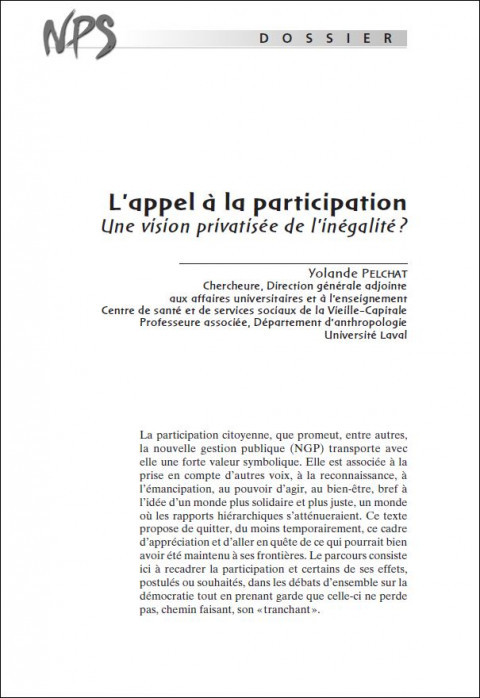 The Call for Participation: A Vision Exempt from Inequality? Year of publication: 2010 Author: Yolande Pelchat Corporate author: Nouvelles pratiques sociales Citizen participation, which is promoted by the New Public Management, conveys a high symbolic value. Citizen participation is generally associated with the consideration of others’ voices, recognition, emancipation, empowerment and well-being. In short, it carries the promise of a more just world with greater social solidarity and less hierarchic social relations. This paper proposes to leave aside this fashionable rhetoric, at least temporarily, and to search for what might have been left at its borders. This exploratory journey aims to reframe, within larger debates about democracy, the call for participation and its assumed or desired effects. The invitation to beware of losing, on the way, the radical nature of democracy, is issued. L’appel à la participation: Une vision privatisée de l’inégalité ? Year of publication: 2010 Author: Yolande Pelchat Corporate author: Nouvelles pratiques sociales La participation citoyenne, que promeut, entre autres, la nouvelle gestion publique (NGP) transporte avec elle une forte valeur symbolique. Elle est associée à la prise en compte d’autres voix, à la reconnaissance, à l’émancipation, au pouvoir d’agir, au bien-être, bref à l’idée d’un monde plus solidaire et plus juste, un monde où les rapports hiérarchiques s’atténueraient. Ce texte propose de quitter, du moins temporairement, ce cadre d’appréciation et d’aller en quête de ce qui pourrait bien avoir été maintenu à ses frontières. Le parcours consiste ici à recadrer la participation et certains de ses effets, postulés ou souhaités, dans les débats d’ensemble sur la démocratie tout en prenant garde que celle-ci ne perde pas, chemin faisant, son « tranchant ».
 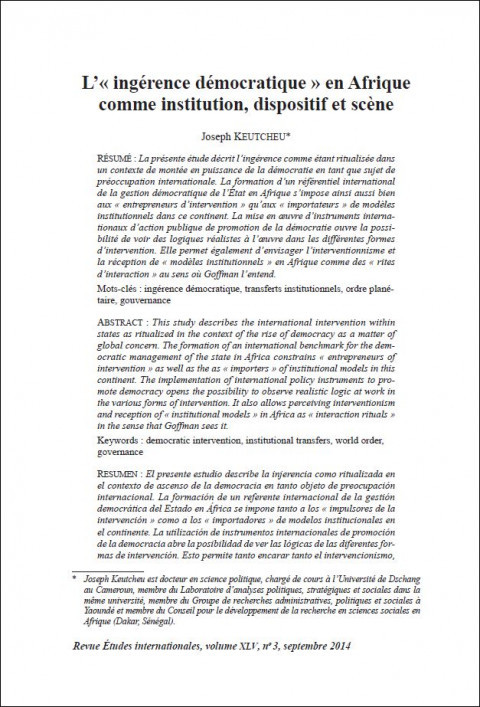 Democratic Interference in Africa as Institution and Context Year of publication: 2014 Author: Joseph Keutcheu Corporate author: Études internationales This study describes the international intervention within states as ritualized in the context of the rise of democracy as a matter of global concern. The formation of an international benchmark for the democratic management of the state in Africa constrains « entrepreneurs of intervention » as well as the as « importers » of institutional models in this continent. The implementation of international policy instruments to promote democracy opens the possibility to observe realistic logic at work in the various forms of intervention. It also allows perceiving interventionism and reception of « institutional models » in Africa as « interaction rituals » in the sense that Goffman sees it. L’« ingérence démocratique » en Afrique comme institution, dispositif et scène Year of publication: 2014 Author: Joseph Keutcheu Corporate author: Études internationales La présente étude décrit l’ingérence comme étant ritualisée dans un contexte de montée en puissance de la démocratie en tant que sujet de préoccupation internationale. La formation d’un référentiel international de la gestion démocratique de l’État en Afrique s’impose ainsi aussi bien aux « entrepreneurs d’intervention » qu’aux « importateurs » de modèles institutionnels dans ce continent. La mise en oeuvre d’instruments internationaux d’action publique de promotion de la démocratie ouvre la possibilité de voir des logiques réalistes à l’oeuvre dans les différentes formes d’intervention. Elle permet également d’envisager l’interventionnisme et la réception de « modèles institutionnels » en Afrique comme des « rites d’interaction » au sens où Goffman l’entend.