
Resources
Explore a wide range of valuable resources on GCED to deepen your understanding and enhance your research, advocacy, teaching, and learning.
948 Results found
 Protection of Victims of Sexual Violence in Côte d'Ivoire: Progress Made, but Many Gaps Remain (FIDH; no. 818f) Year of publication: 2023 Author: Alice Mogwe | Eléonore Morel Corporate author: International Federation for Human Rights (FIDH) The International Federation for Human Rights (FIDH) has published a follow-up report on sexual violence protection measures in Côte d'Ivoire, in association with several other local associations. The aim of this note is to study these new measures in the light of the recommendations in the FIDH report, in order to gain an overall view of the situation, draw up an initial assessment of the progress made, and highlight the points to be strengthened in order to improve the status of women in the country. Protection des victimes de violences sexuelles en Côte d’Ivoire : des avancées mais encore de nombreuses lacunes (FIDH; n° 818f) Year of publication: 2023 Author: Alice Mogwe | Eléonore Morel Corporate author: International Federation for Human Rights (FIDH) La Fédération internationale pour les droits humains (FIDH) publie une note de suivi des dispositifs de protection des violences sexuelles en Côte d’Ivoire avec plusieurs autres associations locales associées. Cette note vise à étudier ces nouveaux dispositifs à l’aune des recommandations du rapport de la FIDH afin d’avoir une vision globale de la situation, de dresser un premier bilan des avancées réalisées et de souligner les points à renforcer pour améliorer la condition des femmes dans le pays.
 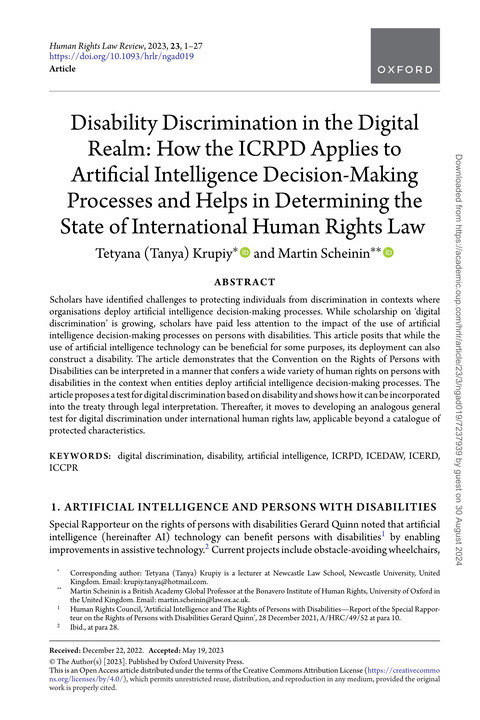 Disability Discrimination in the Digital Realm: How the ICRPD Applies to Artificial Intelligence Decision-Making Processes and Helps in Determining the State of International Human Rights Law (Human Rights Law Reivew; Volume. 23, Issue. 3) Year of publication: 2023 Author: Tetyana Krupiy | Martin Scheinin Scholars have identified challenges to protecting individuals from discrimination in contexts where organisations deploy artificial intelligence decision-making processes. While scholarship on ‘digital discrimination’ is growing, scholars have paid less attention to the impact of the use of artificial intelligence decision-making processes on persons with disabilities. This article posits that while the use of artificial intelligence technology can be beneficial for some purposes, its deployment can also construct a disability. The article demonstrates that the Convention on the Rights of Persons with Disabilities can be interpreted in a manner that confers a wide variety of human rights on persons with disabilities in the context when entities deploy artificial intelligence decision-making processes. The article proposes a test for digital discrimination based on disability and shows how it can be incorporated into the treaty through legal interpretation. Thereafter, it moves to developing an analogous general test for digital discrimination under international human rights law, applicable beyond a catalogue of protected characteristics.
  حالة حقوق الإنسان في العالم: أبريل/نيسان 2024 Year of publication: 2024 Corporate author: Amnesty International Le Rapport d’Amnesty International décrit la situation des droits humains dans le monde en 2023 dans 155 pays différents. Les équipes de journalistes et d’enquêteurs de l'ONG peignent un portrait plutôt sombre, avec notamment un recul du droit des femmes, les conséquences dramatiques du réchauffement climatique sur les populations les plus vulnérables, le recul du droit de manifester, ou encore la prolifération de la haine en ligne dans le monde. La multiplication des conflits armés et le choc du 7 octobre ont également eu des conséquences dramatiques. Cependant, quelques bonnes nouvelles sont aussi à noter, avec des avancées pour les droits des personnes LGBTI par exemple. Amnesty International Report describes the human rights situation worldwide in 2023 in 155 different countries. TheNGO's teams of journalists and investigators paint a rather gloomy picture, with, in particular, a decline in women's rights, the dramatic consequences of global warming on the most vulnerable populations, a decline in the right to protest, and the proliferation of online hate around the world. The multiplication of armed conflicts and the shock of October 7 have also had dramatic consequences. However, there is some good news too, with advances in LGBTI rights for example. 世界人权状况:2024年4月 Year of publication: 2024 Corporate author: Amnesty International Le Rapport d’Amnesty International décrit la situation des droits humains dans le monde en 2023 dans 155 pays différents. Les équipes de journalistes et d’enquêteurs de l'ONG peignent un portrait plutôt sombre, avec notamment un recul du droit des femmes, les conséquences dramatiques du réchauffement climatique sur les populations les plus vulnérables, le recul du droit de manifester, ou encore la prolifération de la haine en ligne dans le monde. La multiplication des conflits armés et le choc du 7 octobre ont également eu des conséquences dramatiques. Cependant, quelques bonnes nouvelles sont aussi à noter, avec des avancées pour les droits des personnes LGBTI par exemple. Amnesty International Report describes the human rights situation worldwide in 2023 in 155 different countries. TheNGO's teams of journalists and investigators paint a rather gloomy picture, with, in particular, a decline in women's rights, the dramatic consequences of global warming on the most vulnerable populations, a decline in the right to protest, and the proliferation of online hate around the world. The multiplication of armed conflicts and the shock of October 7 have also had dramatic consequences. However, there is some good news too, with advances in LGBTI rights for example. 세계 인권 현황 보고서: 2024년 4월 Year of publication: 2024 Corporate author: Amnesty International Le Rapport d’Amnesty International décrit la situation des droits humains dans le monde en 2023 dans 155 pays différents. Les équipes de journalistes et d’enquêteurs de l'ONG peignent un portrait plutôt sombre, avec notamment un recul du droit des femmes, les conséquences dramatiques du réchauffement climatique sur les populations les plus vulnérables, le recul du droit de manifester, ou encore la prolifération de la haine en ligne dans le monde. La multiplication des conflits armés et le choc du 7 octobre ont également eu des conséquences dramatiques. Cependant, quelques bonnes nouvelles sont aussi à noter, avec des avancées pour les droits des personnes LGBTI par exemple. Amnesty International Report describes the human rights situation worldwide in 2023 in 155 different countries. TheNGO's teams of journalists and investigators paint a rather gloomy picture, with, in particular, a decline in women's rights, the dramatic consequences of global warming on the most vulnerable populations, a decline in the right to protest, and the proliferation of online hate around the world. The multiplication of armed conflicts and the shock of October 7 have also had dramatic consequences. However, there is some good news too, with advances in LGBTI rights for example.
  A Comprehensive Methodology for Monitoring Social Media to Address and Counter Online Hate Speech Year of publication: 2024 Corporate author: UN. Office on Genocide Prevention and the Responsibility to Protect This report introduces a standardized methodology for monitoring online hate speech, to identify, assess, and mitigate risks, including when it constitutes risks of genocide, war crimes, and crimes against humanity. This methodology is based on an extensive review of existing methodologies used for this purpose across academia, technology companies, governments, the United Nations, and NGOs, and synthesizes those approaches into a standard set of practices that best fit the use cases relevant to the UN and its partners.
 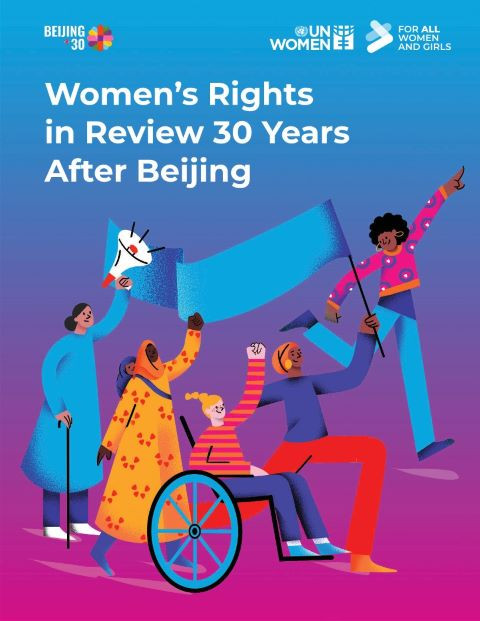 Women’s Rights in Review 30 Years after Beijing Year of publication: 2025 Corporate author: United Nations Entity for Gender Equality and the Empowerment of Women (UN Women) In 2025, the world celebrates 30 years of achievement on the Beijing Declaration and Platform for Action, a visionary 1995 plan agreed by 189 governments to achieve the equal rights of all women and girls. The UN Secretary-General’s report on the 30-year review and appraisal of the Beijing Declaration and Platform for Action reflects global, regional, and national reviews of 159 countries, summarizing progress and priorities for further action. It finds that many countries have made strides on gender equality and women’s empowerment, from banning discrimination in employment to adopting gender-responsive climate action plans. Innovation is accelerating progress, and opportunities are opening to scale up proven strategies. Yet gender discrimination remains deeply embedded in all economies and societies, imposing chronic constraints on the rights and hopes of women and girls.
 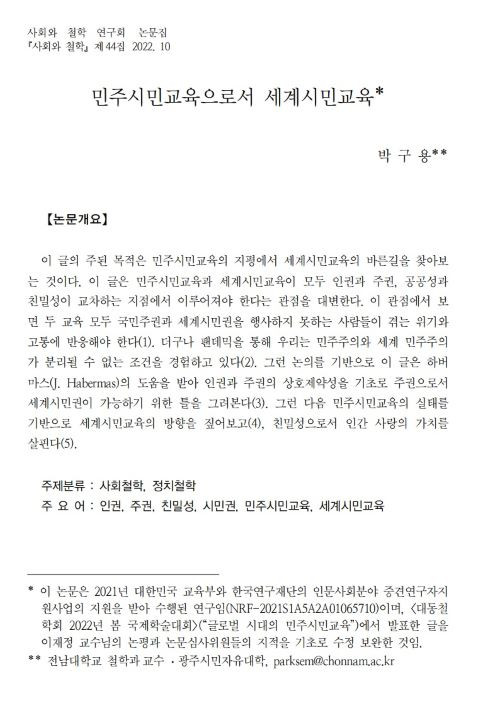 민주시민교육으로서 세계시민교육(사회와 철학; Vol 44) Year of publication: 2022 Author: 박구용 Corporate author: 한국사회와철학연구회 이 글의 주된 목적은 민주시민교육의 지평에서 세계시민교육의 바른길을 찾아보는 것이다. 이 글은 민주시민교육과 세계시민교육이 모두 인권과 주권, 공공성과 친밀성이 교차하는 지점에서 이루어져야 한다는 관점을 대변한다. 이 관점에서 보면 두 교육 모두 국민주권과 세계시민권을 행사하지 못하는 사람들이 겪는 위기와 고통에 반응해야 한다(1). 더구나 팬데믹을 통해 우리는 민주주의와 세계 민주주의가 분리될 수 없는 조건을 경험하고 있다(2). 그런 논의를 기반으로 이 글은 하버마스(J. Habermas)의 도움을 받아 인권과 주권의 상호제약성을 기초로 주권으로서 세계시민권이 가능하기 위한 틀을 그려본다(3). 그런 다음 민주시민교육의 실태를 기반으로 세계시민교육의 방향을 짚어보고(4), 친밀성으로서 인간 사랑의 가치를 살핀다(5).
 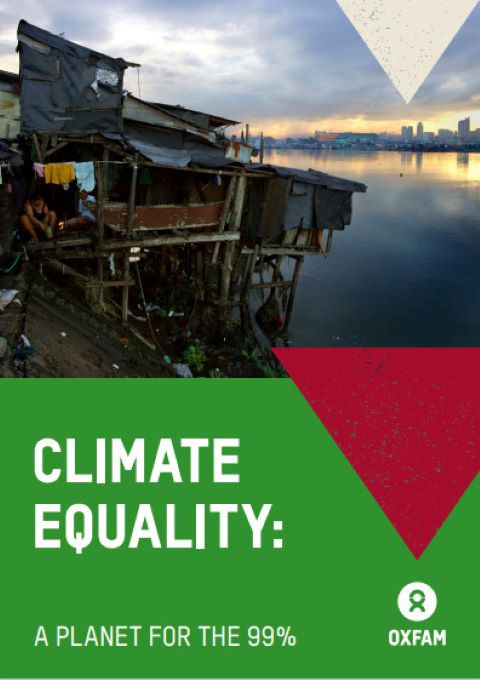 Climate Equality: A Planet for the 99% Year of publication: 2023 Author: Ashfaq Khalfan | Astrid Nilsson Lewis | Carlos Aguilar | Max Lawson | Safa Jayoussi | Jacqueline Persson | Nafkote Dabi | Sunil Acharya Corporate author: Oxfam International The world faces twin crises of climate breakdown and runaway inequality. The richest people, corporations and countries are destroying the world with their huge carbon emissions. Meanwhile, people living in poverty, those experiencing marginalization, and countries in the Global South are those impacted the hardest. Women and girls, Indigenous Peoples, people living in poverty and other groups experiencing discrimination are particularly at a disadvantage. The consequences of climate breakdown are felt in all parts of the world and by most people, yet only the richest people and countries have the wealth, power and influence to protect themselves. With that power comes huge responsibility.If no action is taken, the richest will continue to burn through the carbon we have left to use while keeping the global temperature below the safe limit of 1.5°C, destroying any chance of ending poverty and ensuring equality. The world needs an equal transformation. Only a radical reduction in inequality, transformative climate action and fundamentally shifting our economic goals as a society can save our planet while ensuring wellbeing for all.