
Resources
Explore a wide range of valuable resources on GCED to deepen your understanding and enhance your research, advocacy, teaching, and learning.
948 Results found
 «Светлая» сторона пандемии: будет ли переосмысление гражданского общества в Таджикистане? Year of publication: 2020 Author: Muslimbek Buriev Corporate author: Central Asian Bureau for Analytical Reporting (CABAR) | Institute for War and Peace Reporting (IWPR) «Неправительственные организации, СМИ, волонтерские группы и инициативы за время изоляции начали проявлять себя как субъекты, активно ведущие свою деятельность в рамках помощи населению и преодоления кризисных ситуаций», – политолог Муслимбек Буриев пишет о важности гражданского общества для Таджикистана в статье, специально для CABAR.asia.
  A Coherent European Approach to SDG Target 4.7 Year of publication: 2021 Author: Ana Teresa Santos Corporate author: Bridge 47 This document aims to showcase why a coherent approach to Target 4.7 of the Sustainable Development Goals’ (SDG) will strengthen the European Union’s role in achieving the targets and goals set out in Agenda 2030. The report suggests some pathways to follow in order to make this coherent approach a reality.It explores: Relevance of a coherent European approach to SDG Target 4.7 and connections with other EU processes Funding lines Possible pathways to make the coherent approach a reality
  Becoming a Global Citizen: Proceedings of the International Symposium on Competencies of Global Citizens (Espoo, Finland, 5-7th October 2011) Year of publication: 2011 Author: Liisa Jääskeläinen | Taina Kaivola | Eddie O’Loughlin | Liam Wegimont Corporate author: Global Education Network Europe (GENE) | Finnish National Board of Education (FNBE) The international symposium on competences of global citizens, entitled Becoming a Global Citizen, was held in Espoo, Finland on 5 – 7. October, 2011. The symposium was organized by the Finnish National Board of Education (FNBE), the Finnish Ministry for Foreign Affairs, GENE (Global Education Network Europe) and the Hanasaari Swedish- Finnish Cultural Centre.The symposium focused on three main questions, namely:• what is global education?• what are key competences of global citizens in general education?• how can the priorities of global education be supported nationally?This publication contains the proceedings and main information gathered in the symposium. From Finland’s point of view the Symposium provided a substantial contribution to the publication called Schools Reaching out to a Global World. The publication comprises several articles on competencies of global citizens serving the next curricular reform of the entire general education sector for Finland, to be fully implemented by 2016. From the international perspectives the Symposium meant a most relevant input into the pan-European debate on perspectives for Global Education.
  Formalism, Tribalism, and Nationalism in the Protection of Children’s Rights in Kazakhstan Year of publication: 2020 Author: Aigerim Musabalinova Corporate author: Central Asian Bureau for Analytical Reporting (CABAR) | Institute for War and Peace Reporting (IWPR) Aigerim Musabalinova, an expert on children’s rights tries to find an answer to the question of how the social and cultural aspect of the country affects the well-being of children and the observance of their rights and interests, in an article for CABAR.asia. Формализм, трайбализм и национализм в вопросах защиты прав детей в Казахстане Year of publication: 2020 Author: Aigerim Musabalinova Corporate author: Central Asian Bureau for Analytical Reporting (CABAR) | Institute for War and Peace Reporting (IWPR) Айгерим Мусабалинова, казахстанский эксперт по правам ребенка в статье для CABAR.asia пробует найти ответ на вопрос как социальный и культурный аспект страны влияет на благополучие детей и соблюдение их прав и интересов.
 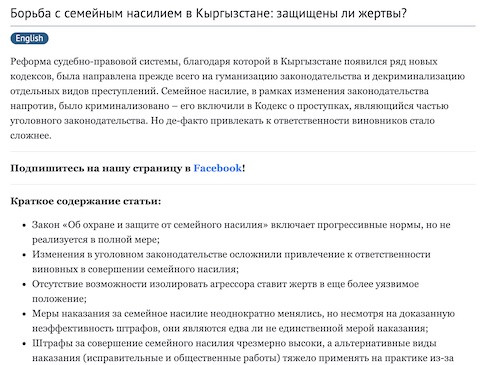 Борьба с семейным насилием в Кыргызстане: Защищены ли Жертвы? Year of publication: 2020 Author: Anna Zubenko Corporate author: Central Asian Bureau for Analytical Reporting (CABAR) | Institute for War and Peace Reporting (IWPR) В данной статье автор анализирует некоторые результаты реформ судебно-правовой системы, благодаря которым в Кыргызстане появился ряд новых кодексов, была направлена прежде всего на гуманизацию законодательства и декриминализацию отдельных видов преступлений. Семейное насилие, в рамках изменения законодательства напротив, было криминализовано – его включили в Кодекс о проступках, являющийся частью уголовного законодательства. Однако по мнению автора де-факто привлекать к ответственности виновников стало сложнее.
 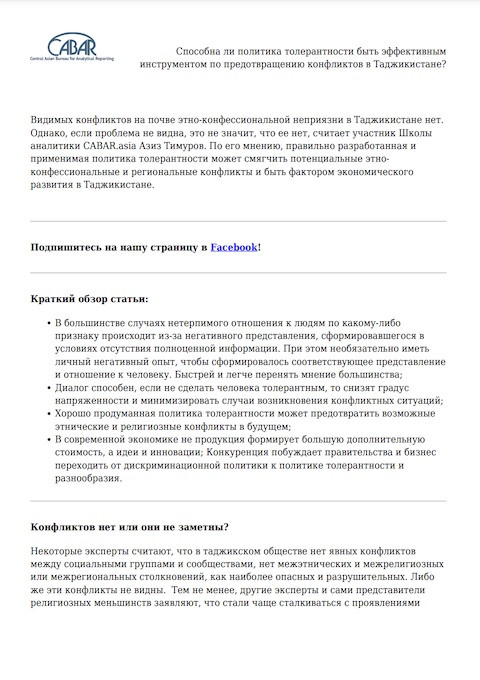 Can Tolerance Policy Be an Effective Tool for Conflict Prevention in Tajikistan? Year of publication: 2020 Author: Aziz Timurov Corporate author: Central Asian Bureau for Analytical Reporting (CABAR) | Institute for War and Peace Reporting (IWPR) There are no visible conflicts on the basis of ethnic-religious hostility in Tajikistan. However, if the problem is not visible, this does not mean that it does not exist, said Aziz Timurov, participant of the CABAR.asia School of Analytics. In his opinion, a well-developed and applicable tolerance policy can mitigate potential ethnic-religious and regional conflicts and be a factor in economic development in Tajikistan. Способна ли политика толерантности быть эффективным инструментом по предотвращению конфликтов в Таджикистане? Year of publication: 2020 Author: Aziz Timurov Corporate author: Central Asian Bureau for Analytical Reporting (CABAR) | Institute for War and Peace Reporting (IWPR) Видимых конфликтов на почве этно-конфессиональной неприязни в Таджикистане нет. Однако, если проблема не видна, это не значит, что ее нет, считает участник Школы аналитики CABAR.asia Азиз Тимуров. По его мнению, правильно разработанная и применимая политика толерантности может смягчить потенциальные этно-конфессиональные и региональные конфликты и быть фактором экономического развития в Таджикистане.
  Learning to Live Together in Community: Training of Trainers Program for Community Organization; Guide 1 Year of publication: 2007 Author: Adolfo Aguilar Ávuila | María Consulo Sánches Plazas Corporate author: Columbia. Ministry of the Interior and Justice | National Pedagogical University The purpose of this guide is to generate conditions that contribute to identifying conceptual and methodological elements that contribute to the strengthening, integration and creation of an environment of coexistence in the community organization, so that it can be projected with greater probability of success. Aprendiendo a vivir juntos en comunidad: Programa formación de formadores para la organización comunal; Guía 1 Year of publication: 2007 Author: Adolfo Aguilar Ávuila | María Consulo Sánches Plazas Corporate author: Columbia. Ministry of the Interior and Justice | National Pedagogical University El proposito de esta guía es generar condiciones que contribuyan a identificar elementos conceptuales y metodologicos que aporten al fortalecimiento, la integración y la creación de un ambiente de convivencia en la organización comunal, para que está pueda proyectarse con mayores probabilidades de éxito.