
Resources
Explore a wide range of valuable resources on GCED to deepen your understanding and enhance your research, advocacy, teaching, and learning.
948 Results found
 Школьное полиязычное образование в Казахстане (тюркско-русское, тюркско-английское, тюркско-русско-английское) Year of publication: 2015 Author: Dzhusupov M. В статье исследуется проблема би- и полилингвального образования в школе, лицее и колледже тюркоязычных республик СНГ на примере Казахстана; проводится параллель между современным полиязычным образованием в системе среднего и среднего специального образования с языковым образованием советского периода; анализируется активное вхождение английского языка в систему школьного образования; доказывается доминирование русского языка в полилингвальном образовательном процессе; определяется образовательный статус русского языка как неродного, но как обязательной общеобразовательной дисциплины в школе и в вузе, а также образовательный статус английского языка как иностранного.
  Looking into the Future Development of Central Asian Civil Society 2025 Year of publication: 2020 Corporate author: Civil Society Development Association (ARGO) “Looking into the future Development of Central Asian Civil Society - 2025” is a vision that reflects the role, trends and prospects for the development of civil society in Central Asia for 5 years. The Vision represents an image of civil society (‘We are the ones who’) and defines strategic priorities for the development of civil society in Central Asia. Взгляд в будущее развития гражданского общества в Центральной Азии 2025 Year of publication: 2020 Corporate author: Civil Society Development Association (ARGO) «Взгляд в будущее развитие гражданского общества Центральной Азии – 2025» — это видение, в котором отражены роль, тренды и перспективы развития гражданского общества в Центральной Азии на 5 лет. Видение представляет собой портрет гражданского общества в образе «Я» и определяет приоритеты развития гражданского общества в Центральной Азии.
  Analytical Report on the Rights of People With Disabilities in Central Asia and Azerbaijan Year of publication: 2017 Author: Lyazzat Kaltayeva | Nurzhamal Prenova Corporate author: Civil Society Development Association (ARGO) | United States Agency for International Development (USAID) This analytical report is the culmination of a research study conducted in four countries of Central Asia (Kazakhstan, Kyrgyzstan, Tajikistan, and Turkmenistan) and Azerbaijan in spring 2017. The primary focus of the study was disability rights, which have a direct impact on the quality of life experienced by people with disabilities, and analysis of potential strategies and opportunities for civil society organizations to improve disability rights in target countries.Through the study, the research team followed the latest legislative and policy changes relevant to disability rights, and identified and documented best practices, lessons learned, and key challenges related to the promotion and protection of disability rights in the region. Аналитический доклад в сфере прав людей с инвалидностью стран Центральной Азии и Азербайджана Year of publication: 2017 Author: Lyazzat Kaltayeva | Nurzhamal Prenova Corporate author: Civil Society Development Association (ARGO) | United States Agency for International Development (USAID) Данный аналитический доклад выпущен по результатам экспертного исследования, проведенного в странах ЦА и Азербайджан весной 2017 года. В фокусе исследования - права людей с инвалидностью, которые напрямую влияют на качество жизни людей с инвалидностью и анализ подходов, потенциал и возможности организации гражданского общества для улучшения положения с правами людей с инвалидностью в выбранных странах.Исследование позволило отследить последние изменения в области политики и законодательства по правам людей с инвалидностью, выявить и зафиксировать лучшие практики, уроки и вызовы, связанные с продвижением прав людей с инвалидностью в регионе.
  Innovating Technical and Vocational Education and Training: A Framework for Institutions Year of publication: 2020 Corporate author: UNESCO International Centre for Technical and Vocational Education and Training (UNEVOC) Global developments including the transition to greener economies, the application of digital technologies in the world of work, and the COVID-19 pandemic, amongst others, are changing the way we live and work. These developments are driving technical and vocational education and training (TVET) systems to improve their capacity to identify the future skills demands and to expand access to skills development opportunities. As TVET adapts itself to the impacts of significant social, environmental, and economic disruptions, innovative practices emerge with the potential to rejuvenate the future of skills development. Schools, training centres and colleges have the potential to play a leading role to drive innovation in their local skills and innovation ecosystem.This practical guide provides a systematic, institution-wide, measurable and evidence-based methodology that enables TVET institutions to streamline innovation into their strategic planning, products and services, ecosystem engagement, and teaching and learning processes.
  Ministerial Forum: Global Dialogue on ICT and Education Innovation – Towards Sustainable Development Goal for Education (SDG 4); Proceedings Year of publication: 2019 Corporate author: UNESCO Institute for Information Technologies in Education (IITE) The present publication contains articles based on the outcomes of the Ministerial Forum “Global Dialogue on ICT and Education Innovation – Towards Sustainable Development Goal for Education (SDG 4)”, organized by UNESCO IITE in cooperation with the Ministry of Education and Science of the Russian Federation in Moscow (Russia) on 18-19 March, within the Moscow International Education Fair 2018 (MIEF 2018).The publication covers the flagship topics such as ICT potential for future teachers and future schools, digital pedagogy and OER, collaboration between public and private sectors in the use of ICT in education, digital technologies for quality and equity in education.
  민주시민이 미래다 Year of publication: 2017 Corporate author: 중앙선거관리위원회 선거연수원 이 책자에 실린 내용은 중앙선거관리위원회 선거연수원의 「이종희 정치살롱」 (http://blog.naver.com/jongheesalon)에 지난 1여 년간 블로그에 축적된 다양한 선거·정치이야기 등을 모아서 제작한 것이다.
  C'est quoi une information? Year of publication: 2015 Author: Olivier Marquézi | Mathieu Decarli Corporate author: Radio France | Réseau Canopé | France Télévisions | La Generale de Production Un film d’animation qui aborde des questions telles que « Qu’est-ce qu’un média », « Qu’est-ce qu’une information », « Qu’est-ce qu’une source ?... ». Autant de sujets pour amener les élèves à une pratique raisonnée autour des écrans, de l’information, du métier de journaliste.
 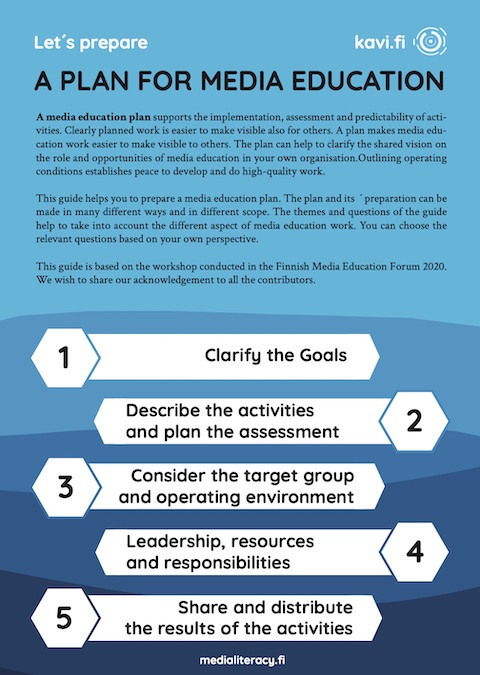 Let's Prepare: A Plan For Media Education Year of publication: 2020 Corporate author: KAVI National Audiovisual Institute (Finland) This guide helps you to prepare a media education plan. The plan and its preparation can be made in many different ways and in different scope. The themes and questions of the guide help to take into account the different aspect of media education work. You can choose the relevant questions based on your own perspective. This guide is based on the workshop conducted in the Finnish Media Education Forum 2020.