
Resources
Explore a wide range of valuable resources on GCED to deepen your understanding and enhance your research, advocacy, teaching, and learning.
948 Results found
 Construcción de paz en escenarios de violencia intracomunitaria: Estudio de caso Sierra de la Macarena (Meta-Colombia) Year of publication: 2017 Author: Keren Xiomara Marín Gonzales Corporate author: Universidad de Antioquia Tras la firma de los acuerdos de paz entre el Gobierno nacional y Las FARC-EP uno de los principales retos para el país es la construcción de paz en los territorios, especialmente en aquellos lugares donde la violencia ha sido, a su vez, política e intracomunitaria. Para explorar los retos que este tipo de violencia supone en escenarios de transición y posconflicto, este artículo analiza las dinámicas locales de la violencia y los diversos procesos de victimización que surgen al interior de las comunidades. Para esto se exponen algunos casos y testimonios recolectados en un trabajo etnográfico realizado en la Sierra de la Macarena, departamento del Meta, en los cuales se ilustran las dinámicas de la violencia comunitaria y sus efectos sobre el tejido social de las comunidades. A partir de estas consideraciones se plantean algunos límites que enfrenta la construcción de paz en esta región y se propone como alternativa la articulación entre la justicia transicional y la justicia local para tramitar estos escenarios de violencia.
 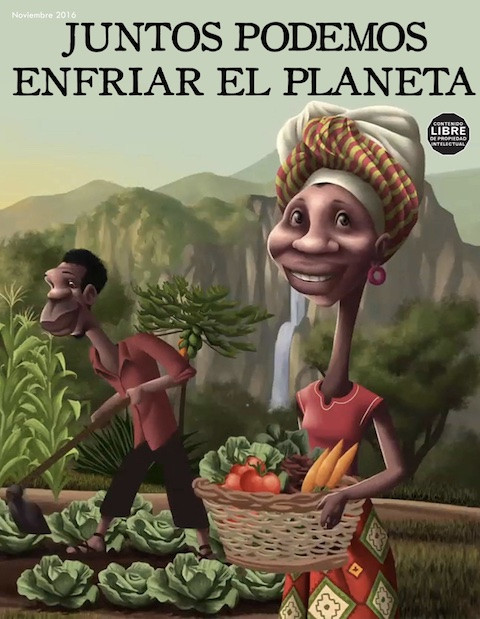 Juntos podemos enfriar el planeta Year of publication: 2016 Corporate author: GRAIN | La Via Campesina Es una historia basada en el video " juntos podemos enfriar el planeta" que habla sobre el calentamiento global, sus causas y consencuencias, Reporta el cómo la producción industrial de alimentos afecta este fenomeno. Relata cada paso de producción industrial de alimentos, el uso de tierras fértiles, la quema de árboles que produce dióxido de carbono,el uso de maquinarias, uso de fertilizantes y agrotóxicos,la producción de excremento de animales que produce gas metano, así como el transporte que debe ser usado para que esta producción llegue a donde debe ser vendida. Posteriormente proponen una serie soluciones que constan de 5 pasos.
  Boosting Gender Equality in Science and Technology: A Challenge for TVET Programmes and Careers Year of publication: 2020 Corporate author: UNESCO International Centre for Technical and Vocational Education and Training (UNEVOC) While technical and vocational education and training (TVET) has the potential to bolster the participation of women in the labour market, this potential is not always well understood and capitalized on. In general, female students are lowly represented in TVET compared to general programmes, and in particular girls and women tend to be under-represented in the fields that require science, technology, engineering and mathematics (STEM) skills and knowledge. In addition to being required for ‘traditional’ and ‘emerging’ occupations, STEM skills and knowledge are often needed for the so-called ‘jobs of the future’, driving innovation, inclusive growth and sustainable development. This report examines the key issues concerning girls and women’s participation and achievement in STEM-related TVET programmes and their transition STEM related careers.
  Quality TVET for the Successful Training to Employment Transition of Africa’s Youth Year of publication: 2020 Corporate author: UNESCO International Institute for Educational Planning (IIEP) | Agence luxembourgeoise pour la coopération au développement (LuxDev) | Institut de la Francophonie pour l'éducation et la formation (IFEF) This report constitutes the analytical synthesis of the 2nd Regional Workshop for Exchange between Vocational Training Actors in Africa and their Mutual Strengthening, held in Nairobi from 18-20 June 2019, on the theme of “Quality TVET for the successful training to employment transition of Africa’s youth”. Des systèmes d’EFTP de qualité pour une transition formation-emploi réussiedes jeunes en Afrique Year of publication: 2020 Corporate author: UNESCO International Institute for Educational Planning (IIEP) | Agence luxembourgeoise pour la coopération au développement (LuxDev) | Institut de la Francophonie pour l'éducation et la formation (IFEF) Ce rapport constitue la synthèse analytique du 2e atelier régional de partage et de renforcement mutuel des acteurs de la formation professionnelle en Afrique, tenu à Nairobi du 18 au 20 juin 2019 sur le thème : « Améliorer la gestion de la qualité des systèmes d’EFTP pour une transition formation-emploi des jeunes d’Afrique réussie ».
  School Online Safety - Self review tool Year of publication: 2016 Corporate author: South West Grid for Learning Trust (SWGfL) The Self Review Tool is intended to help schools to review their current online safety policy and practice. It provides management information and stimulus that can influence the production or review of online safety policies and develop good practice and process for identifying strengths and weaknesses. It also focuses on opportunities for commitment and involvement from the whole school as well as a continuum for schools to discuss how they might move from a basic level provision for online safety to practice that is aspirational and innovative. School Online Safety - Self review tool Year of publication: 2016 Corporate author: South West Grid for Learning Trust (SWGfL) Le Self Review Tool a pour objectif d'aider les écoles à réviser leurs politiques de sécurité en ligne et leurs pratiques actuelles. Cet outil contient des informations et des conseils de gestion qui peuvent influer sur la production ou la révision des politiques de sécurité en ligne et sur le développement de bonnes pratiques et processus permettant d’identifier les points forts et les faiblesses de ces systèmes. Il étudie également les possibilités d’engagement et d’implication pour l’ensemble de l’école, et la mise en place d’un espace de discussion en vue de passer d’une politique basique à des pratiques ambitieuses et innovantes.
 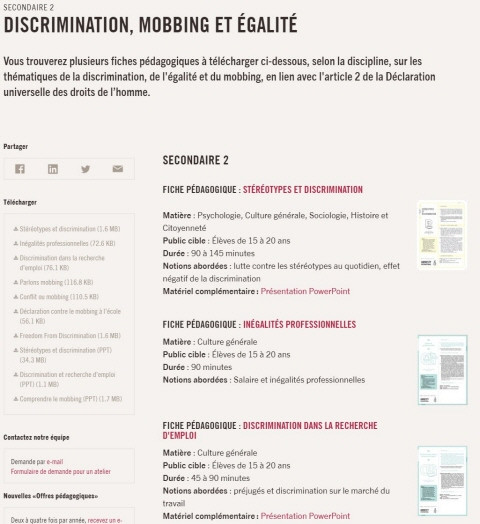 Discrimination, Mobbing and Equality Corporate author: Amnesty International. Swiss Section These 7 education sheets(Stereotypes and Discrimination, Occupational Inequalities, Discrimination in Job Searching, Let’s Talk about Mobbing!, Conflict or Mobbing?, Declaration against Mobbing at School, Freedom from Discrimination) cover the themes of discrimination, equality and mobbing(conflictual relations in the workplace, both between colleagues and between superiors and subordinates), in relation to article 2 of the Universal Declaration of Human Rights. Discrimination, mobbing et égalité Corporate author: Amnesty International. Swiss Section Ces 7 fiches pédagogiques(Stéréotypes et discrimination, Inégalités professionnelles, Discrimination dans la recherche d'emploi, Parlons mobbing!, Conflit ou mobbing? Déclaration contre le mobbing à l'école, Freedom from discrimination) portent sur les thématiques de la discrimination, de l'égalité et du mobbing (relation conflictuelle sur le lieu de travail, aussi bien entre collègues qu'entre supérieurs et subordonnés), en lien avec l'article 2 de la Déclaration universelle des droits de l’homme.
  À l'école des droits de l'enfant Year of publication: 2020 Corporate author: Asmae Association Soeur Emnanuelle Basée sur la même pédagogie que le "projet Yalla ! Pour les droits de l’enfant", nous retrouvons un ensemble d’outils pédagogiques clés en mains, évolutifs et interactifs. Les enfants pourront apprendre en s’amusant avec : des vidéos, des jeux, des quizz, des défis à relever. Une surprise se cache également dans les leçons …. le parrain de notre projet, Joan Faggianelli, anime les vidéos pédagogiques. La plateforme est utilisable en classe par l’enseignant.e ou à la maison. L’objectif de cet outil est de maximiser l’impact de notre action avec plus d’enfants sensibilisés, étant à même de comprendre leurs droits, dénoncer des situations de danger et devenir acteurs de la solidarité. Based on the same pedagogy as the Yalla! Pour les droits de l'enfant (Children's Rights) project, we offer a set of turnkey, scalable and interactive teaching tools. Children can learn while having fun with videos, games, quizzes and challenges. A surprise is also hidden in the lessons .... Our project sponsor, Joan Faggianelli, animates the teaching videos. The platform can be used in class by the teacher or at home with parents. The aim of this tool is to maximize the impact of our action, with more children aware of their rights, able to denounce dangerous situations and become actors in solidarity.