
Resources
Explore a wide range of valuable resources on GCED to deepen your understanding and enhance your research, advocacy, teaching, and learning.
948 Results found
 [Resumen] Rendir Cuentas en el Ámbito de la Educación: Cumplir Nuestros Compromisos, Resumen del Informe de Seguimiento de la Educación en el Mundo, 2017/8 Year of publication: 2017 Corporate author: UNESCO El segundo Informe de Seguimiento de la Educación en el Mundo (el Informe GEM) presenta las pruebas más recientes de los progresos alcanzados en el mundo en cuanto a la consecución de las metas relativas a la educación de los Objetivos de Desarrollo Sostenible de las Naciones Unidas.Puesto que hay centenares de millones de personas que todavía no están escolarizadas y muchas que no adquieren unas competencias mínimas en la escuela, es evidente que los sistemas educativos no llevan camino de alcanzar los objetivos mundiales. Las personas marginadas son quienes sufren actualmente la mayoría de las consecuencias, pero también son las que más se beneficiarán si los encargados de formular políticas prestan suficiente atención a sus necesidades. Ante estos retos, junto con presupuestos muy ajustados y una mayor importancia concedida a obtener rendimiento del dinero en forma de resultados, los países están buscando soluciones, entre las cuales a menudo la rendición de cuentas ocupa el primer lugar.Este resumen del Informe GEM 2017/18 muestra todos los diversos enfoques de la rendición de cuentas en el ámbito de la educación. Abarca desde los países que no están acostumbrados al concepto, en los que no se cuestionan las violaciones del derecho a la educación, hasta aquellos en los que la rendición de cuentas se ha convertido en un fin en sí misma, en lugar de un medio para alcanzar una educación y un aprendizaje a lo largo de toda la vida para todos que sean inclusivos, equitativos y de gran calidad.En el informe se recalca que la educación es una responsabilidad compartida.Aunque son los gobiernos los principales responsables de ella, a todos los actores – las escuelas, los docentes, los padres, los estudiantes, las organizaciones internacionales, los prestatarios del sector privado, la sociedad civil y los medios de comunicación – les corresponde desempeñar un papel en la mejora de los sistemas educativos. El informe recalca la importancia de la transparencia y la disponibilidad de la información, pero exhorta a manejar con prudencia los datos. Explica por qué debemos evitar unos sistemas de rendición de cuentas que den una importancia desproporcionada a unos resultados definidos de manera demasiado restringida y a sanciones punitivas. En una época en la que existen y se emplean múltiples instrumentos para rendir cuentas, el informe demuestra palmariamente con pruebas empíricas cuáles funcionan y cuáles no dan buenos resultados.
 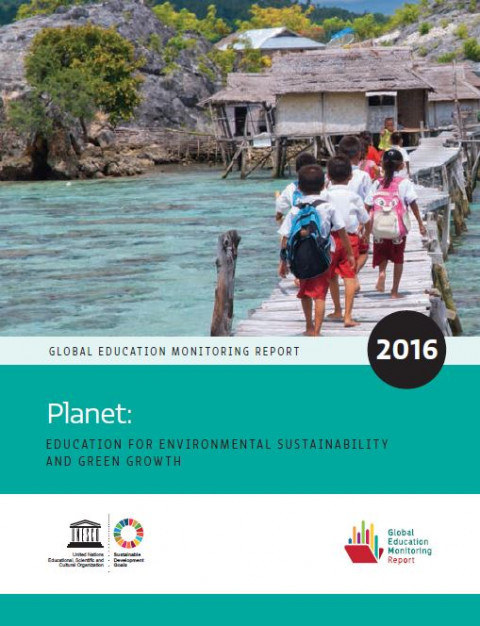 Global Education Monitoring Report, 2016: Planet: Education for Environmental Sustainability and Green Growth Year of publication: 2016 Corporate author: UNESCO PLANET: Education for environmental sustainability and green growth, a publication taken from the full 2016 Global Education Monitoring Report, explores the knowledge and skills needed for sustainable and inclusive economic growth that does not damage our planet.This publication demonstrates how education can help people understand and respond to environmental issues and climate change. Environmental education can increase green knowledge and build sustainability practices. The publication warns that while education contributes to economic growth, education systems must be careful not to encourage unsustainable lifestyles and all learners must acquire the knowledge and skills needed to promote sustainable development.It also argues that we must continue to learn throughout our lives in order to make production and consumption sustainable, and to provide green skills for green industries. Creating green industries relies on high-skill workers with specific training, yet by 2020 there could be 40 million too few workers with tertiary education relative to demand. Higher education and research should also be oriented towards green innovation and growth; innovation depends on cooperation in higher education and investment in research and development to transform production in vast swaths of the economy.It also recognises that education must change in order to keep up with the changing face of work. Green and transferable skills should be taught in both school and the workplace. The greening of industries requires not only the production of more high-skill workers, but the continued training and education for low and medium skill workers, often on the job. “To ensure the Sustainable Development Goals are implemented, everyone involved needs to think, to work, to organise, to communicate and to report in ways that are completely different from what has been done up till now. Education truly is key to a wide appreciation not just of the SDGs but the new ways of thinking and working that are going to be necessary to fulfil them. So the challenge to all of us is to re-learn, and that does not just apply to educators, but it applies to all of us.”
  UNESCO and Gender Equality in Sub-Saharan Africa: Innovative Programmes, Visible Results Corporate author: UNESCO For over twenty years, UNESCO’s work in Africa has been undertaken in a specific framework with a range of institutional mechanisms designed to help translate into action its priorities: Africa and gender equality. During this period, UNESCO achieved important results in the areas covered by its mandate to promote gender equality.This publication highlights UNESCO’s contribution to the implementation of the African Union’s Agenda 2063 and the 2030 Agenda for Sustainable Development of the United Nations, in the field of gender equality in Africa, through examples of good practice, lessons learnt as well as suggestions and recommendations for the future. L'UNESCO et l'égalité des Genres en Afrique Subsaharienne: Des Programmes Novateurs, des Résultats Perceptibles Corporate author: UNESCO Depuis plus d’une vingtaine d’années l’UNESCO a inscrit son action dans un cadre spécial assorti d’un ensemble de mécanismes institutionnels conçus pour appuyer l’opérationnalisation de ses Priorités: l’Afrique et l’égalité des genres. Au cours de cette période, l’UNESCO a été à l’origine d’importantes réalisations dans les domaines relevant de son mandat à travers la mise en oeuvre des programmes et activités novateurs.La présente publication met en exergue la contribution de l’UNESCO à la mise en oeuvre de l’Agenda 2063 de l’Union africaine et du Programme de développement durable à l’horizon 2030 dans le domaine de l’égalité des genres en Afrique, à travers des exemples de bonnes pratiques, de leçons apprises ainsi que des suggestions et recommandations pour le futur.
 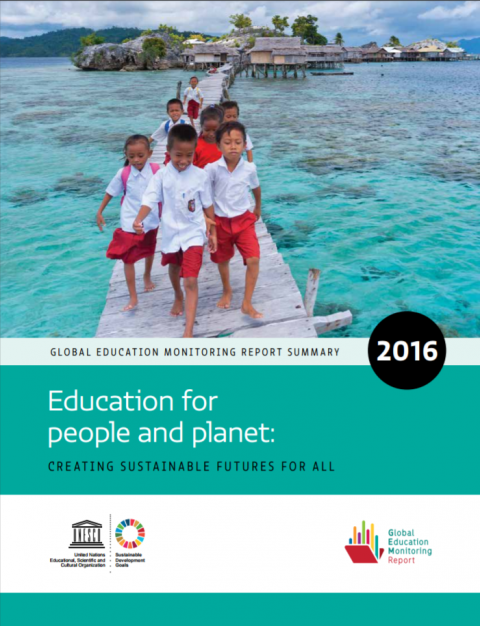 L'Education pour les peuples et la planète: créer des avenirs durables pour tous, résumé du rapport mondial de suivi sur l'éducation, 2016 Year of publication: 2016 Corporate author: UNESCO The GEM Report provides an authoritative account of how education is the most vital input for every dimension of sustainable development. Better education leads to greater prosperity, improved agriculture, better health outcomes, less violence, more gender equality, higher social capital and an improved natural environment. Education is key to helping people around the world understand why sustainable development is such a vital concept for our common future. Education gives us the key tools – economic, social, technological, even ethical – to take on the SDGs and to achieve them. These facts are spelled out in exquisite and unusual detail throughout the report. Yet the report also emphasizes the remarkable gaps between where the world stands today on education and where it has promised to arrive as of 2030. La Educación al servicio de los pueblos y el planeta: creación de futuros sostenibles para todos, resumen del informe de seguimiento de la educación en el mundo 2016; Year of publication: 2016 Corporate author: UNESCO The GEM Report provides an authoritative account of how education is the most vital input for every dimension of sustainable development. Better education leads to greater prosperity, improved agriculture, better health outcomes, less violence, more gender equality, higher social capital and an improved natural environment. Education is key to helping people around the world understand why sustainable development is such a vital concept for our common future. Education gives us the key tools – economic, social, technological, even ethical – to take on the SDGs and to achieve them. These facts are spelled out in exquisite and unusual detail throughout the report. Yet the report also emphasizes the remarkable gaps between where the world stands today on education and where it has promised to arrive as of 2030. Образование в интересах людей и планеты: ПОСТОЕНИЕ УСТОЙЧИВОГО БУДУЩЕГО ДЛЯВСЕХ, РЕЗЮМЕ ВСЕМИРНОГО ДОКЛАДА ПО МОНИТОРИНГУ ОБРАЗОВАНИЯ, 2016 Year of publication: 2016 Corporate author: UNESCO The GEM Report provides an authoritative account of how education is the most vital input for every dimension of sustainable development. Better education leads to greater prosperity, improved agriculture, better health outcomes, less violence, more gender equality, higher social capital and an improved natural environment. Education is key to helping people around the world understand why sustainable development is such a vital concept for our common future. Education gives us the key tools – economic, social, technological, even ethical – to take on the SDGs and to achieve them. These facts are spelled out in exquisite and unusual detail throughout the report. Yet the report also emphasizes the remarkable gaps between where the world stands today on education and where it has promised to arrive as of 2030.
 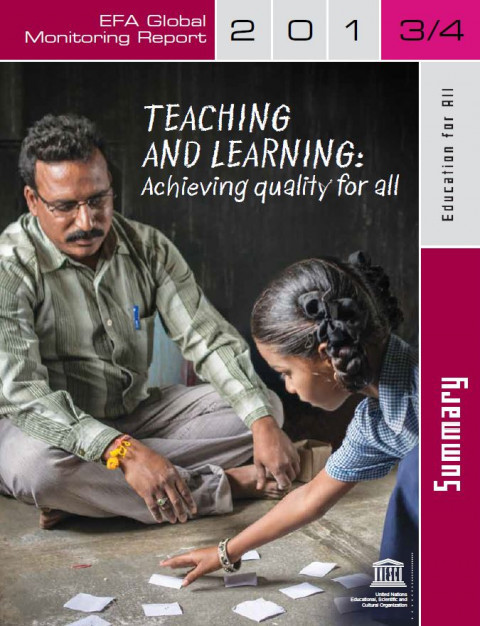 Teaching and Learning: Achieving Quality for All (EFA Global Monitoring Report, 2013-2014; Summary) Year of publication: 2014 Corporate author: UNESCO This Report is an independent publication commissioned by UNESCO on behalf of the international community. It is the product of a collaborative effort involving members of the Report Team and many other people, agencies, institutions and governments. This 11th EFA Global Monitoring Report provides a timely update on progress that countries are making towards the global education goals that were agreed in 2000. It also makes a powerful case for placing education at the heart of the global development agenda after 2015.An education system is only as good as its teachers. Unlocking their potential is essential to enhancing the quality of learning. Evidence shows that education quality improves when teachers are supported – it deteriorates if they are not, contributing to the shocking levels of youth illiteracy captured in this Report. This Report identifies four strategies to provide the best teachers to reach all children with a good quality education. The Report shows also that teachers can only shine in the right context, with well-designed curricula and assessment strategies to improve teaching and learning. This Report’s evidence clearly shows that education provides sustainability to progress against all development goals. Educate mothers, and you empower women and save children’s lives. Educate communities, and you transform societies and grow economies. This is the message of this EFA Global Monitoring Report. Преподавание и обучение: Обеспечение качества для всех Year of publication: 2014 Corporate author: UNESCO Настоящий доклад представляет собой независимую публикацию, подготовленную по заказу ЮНЕСКО для международного сообщества. Он является результатом совместной работы, в которой участвовали члены Группы по подготовке Всемирного доклада по мониторингу "Образование для всех" (ОДВ), а также многие другие специалисты, учреждения, институты и правительства.Настоящий 11-й Всемирный доклад по мониторингу ОДВ представляет обновленную информацию о прогрессе стран на пути к достижению глобальных целей в области образования, согласованных в 2000 г. В докладе также приводятся серьезные доводы в пользу обеспечения приоритетного внимания вопросам образования в рамках глобальной повестки дня в области развития на период после 2015 г.Система образования напрямую зависит от учителей. Раскрытие их потенциала играет ключевую роль для повышения качества обучения. Факты говорят о том, что качество образования повышается при оказании поддержки учителям и понижается при ее отсутствии, что влияет на шокирующий уровень неграмотности молодежи, отраженный в настоящем докладе.В данном докладе представлены четыре стратегии по обеспечению школ лучшими учителями в целях предоставления всем детям качественного образования. В докладе также отмечается, что учителя могут действительно добиваться успеха только в благоприятных условиях при использовании хорошо разработанных стратегий в области учебных программ и процедур оценки, направленных на повышение уровня преподавания и обучения. В настоящем докладе представлены четкие доказательства того, что образование обеспечивает устойчивые условия для достижения всех целей в области развития. Просвещение матерей позволяет не только расширить права и возможности женщин, но и сохранить жизни детей. Просвещение общин способствует преобразованию обществ и развитию экономики. В этом и заключается главная идея настоящего Всемирного доклада по мониторингу ОДВ. 教育造福 人类与地球:为全民创造可持续的未来, 2016 全球教育监测报告; 摘要 Year of publication: 2016 Corporate author: UNESCO The GEM Report provides an authoritative account of how education is the most vital input for every dimension of sustainable development. Better education leads to greater prosperity, improved agriculture, better health outcomes, less violence, more gender equality, higher social capital and an improved natural environment. Education is key to helping people around the world understand why sustainable development is such a vital concept for our common future. Education gives us the key tools – economic, social, technological, even ethical – to take on the SDGs and to achieve them. These facts are spelled out in exquisite and unusual detail throughout the report. Yet the report also emphasizes the remarkable gaps between where the world stands today on education and where it has promised to arrive as of 2030.