
Resources
Explore a wide range of valuable resources on GCED to deepen your understanding and enhance your research, advocacy, teaching, and learning.
2,275 Results found
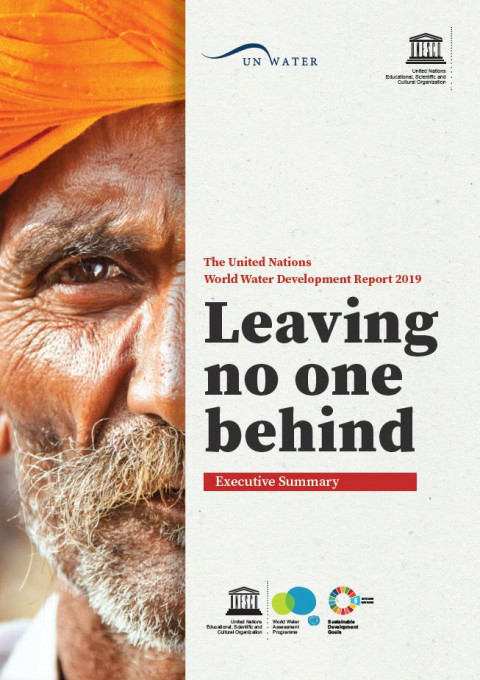 [Pабочее резюме] Всемирный доклад Организации Объединенных Наций о состоянии водных ресурсов, 2019 г. : Не оставляя никого в стороне, рабочее резюме Year of publication: 2019 Author: Richard Connor | Stefan Uhlenbrook | Engin Koncagül Corporate author: UNESCO World Water Assessment Programme (WWAP) Представители различных групп «бывают забыты» по разным причинам. Дискриминация, отчуждение, маргинализация, укоренившаяся асимметричность в распределении власти, материальное неравенство – все это относится к числу основных препятствий на пути соблюдения права человека на безопасную питьевую воду и санитарию для всех, а также реализации связанных с водными ресурсами целей, поставленных в Повестке-2030.Плохо разработанная и неумело осуществляемая политика, бесхозяйственное и нецелевое использование финансовых ресурсов, а также пробелы в политике подпитывают сохранение неравенства в сфере доступа к водным ресурсам и санитарии. Если для решения проблем отчуждения и неравенства в политике и на практике не будут приниматься конкретные и ответственные меры, связанные с водными ресурсами мероприятия по-прежнему не будут отвечать интересам наиболее нуждающихся слоев и тех, кто должен быть их основными бенефициарами.Совершенствование управления водными ресурсами и обеспечение всеобщего доступа к безопасной и финансово доступной питьевойводе и санитарии имеет существенно важное значение для искоренения нищеты, созидания мирных и процветающих обществ и обеспечения такого положения, при котором «никто не будет забыт» на пути, ведущем к устойчивому развитию. При наличии коллективной воли эти цели вполне достижимы. 2019年联合国世界水发展报告 : 不让任何人掉队; 执行摘要 Year of publication: 2019 Author: Richard Connor | Stefan Uhlenbrook | Engin Koncagül Corporate author: UNESCO World Water Assessment Programme (WWAP) 不同群体的人,都因为不同的原因而“掉队”。受歧 视、被排除在外、被边缘化、权力不对等根深蒂固,以及物 质上的不平等是保障人人获得安全饮用水和卫生设施这一人 权、实现2030年可持续发展议程与水相关目标的主要障碍之 一。政策设计不合理、落实不到位、资金不足和使用不当及 政策缺位加剧了获取安全饮用水和卫生设施的不均等。除非 在政策和实践层面旗帜鲜明、积极有效地应对被排除在外、不平等的现状,否则与水相关的解决方案仍将以失败告终,无法触及最需要和最能受益的人群。改善水资源管理,确保人人获得安全、可负担的饮用水 和卫生服务是消除贫困、构建和平繁荣的社会、确保实现可 持续发展路上“不让任何人掉队”的重要条件。只要同心协 力,这些目标一定可以实现。
  [Video] The Global Goals Food Project: Every Plate Tells a Story Year of publication: 2017 Corporate author: World’s Largest Lesson The World’s Largest Lesson brings the Global Goals to children all over the world, reaching over 130 countries and millions of children since its launch in September 2015.Produced by Project Everyone and delivered in partnership with UNICEF and many NGOs, private sector organisations and foundations, the World’s Largest Lesson reaches students through multiple channels. Ministries of Education are invited annually to take part. NGOs distribute digital content through their networks and education organisations, both for and non-profit, encourage participation through their communities.
  [Video] The World’s Largest Lesson Part 2 - With Thanks to Sir Ken Robinson and Emma Watson Year of publication: 2016 Corporate author: World’s Largest Lesson Sir Ken Robinson, Emma Watson and Aardman Animations invite children to get involved in the Global Goals for Sustainable Development by inventing, innovating and campaigning.To show the version with English subtitles please go to: vimeo.com/181766755
  [Video] Citizenship and Human Rights Education for Change Year of publication: 2019 Corporate author: Global Campus of Human Rights In increasingly selective, violent and intolerant times, it becomes crucial to reinforce our capacities to deal with topical, controversial and contested issues undermining our human dignity and to promote the supportive values of non-discrimination, democracy, intercultural dialogue and peace. Teaching and learning about democratic citizenship, human rights and EU common values represents an opportunity to react and counter the negative forces of our time.This MOOC aims to foster the promotion of Human Rights Education and EU common values through the transfer of knowledge about the definitions, frameworks and content of Human Rights Education as well as the analysis of existing and innovative practices on teaching styles, approaches and methods.
  [Video] Learning about SDG 4 Year of publication: 2017 Corporate author: United Cities and Local Governments (UCLG) Life is continual learning, we learn to read to understand a constantly changing role, to participate and to live together. We learn in the classroom and beyond its world. Cities are places of opportunity but they can be also be places of exclusion. There are 758 million people over the age 15 in the world who can't read or write. Two out of three of them are women. Local governments because they are close to the people are able to respond to their needs and contribute to create equal educational opportunities. They work to ensure that facilities are ideal for learning and community life. They promote the adoption of sustainable life styles and provide education in values. Local government work with educators and administrations to ensure adequate resources and to improve education. In all these ways local governments contribute to achieve sustainable development goals for ensuring inclusive and quality education for all and promote lifelong learning.
 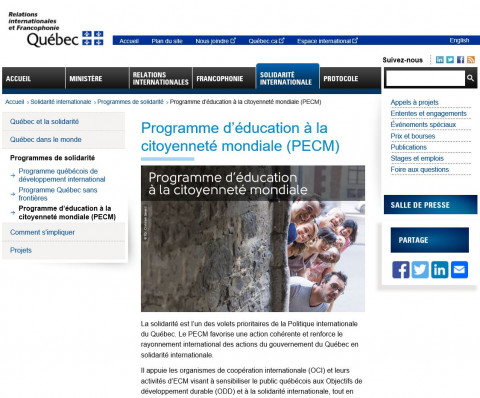 Programme d’éducation à la citoyenneté mondiale (PÉCM) Year of publication: 2018 Corporate author: Ministère des Relations internationales et de la Francophonie La solidarité est l’un des volets prioritaires de la Politique internationale du Québec. Le PECM favorise une action cohérente et renforce le rayonnement international des actions du gouvernement du Québec en solidarité internationale.Il appuie les organismes de coopération internationale (OCI) et leurs activités d’ECM visant à sensibiliser le public québécois aux Objectifs de développement durable (ODD) et à la solidarité internationale, tout en favorisant l’acquisition de connaissances, de valeurs et de comportements qui contribuent à la mise en place d’un monde plus juste, durable et équitable.
 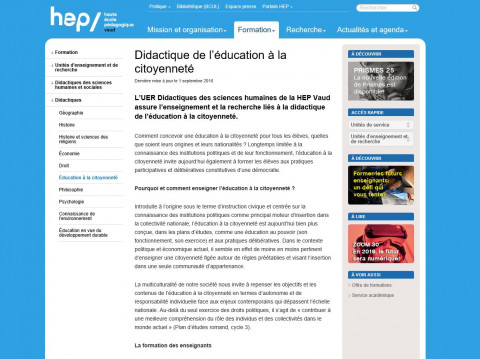 Didactique de l’éducation à la citoyenneté Year of publication: 2016 Corporate author: Haute école pédagogique Vaud L’UER Didactiques des sciences humaines de la HEP Vaud assure l’enseignement et la recherche liés à la didactique de l’éducation à la citoyenneté.Comment concevoir une éducation à la citoyenneté pour tous les élèves, quelles que soient leurs origines et leurs nationalités ? Longtemps limitée à la connaissance des institutions politiques et de leur fonctionnement, l’éducation à la citoyenneté invite aujourd’hui également à former les élèves aux pratiques participatives et délibératives constitutives d’une démocratie. Introduite à l’origine sous le terme d’instruction civique et centrée sur la connaissance des institutions politiques comme principal moteur d’insertion dans la collectivité nationale, l’éducation à la citoyenneté est aujourd’hui bien plus conçue, dans les plans d’études, comme une éducation au pouvoir (son fonctionnement, son exercice) et aux pratiques délibératives. Dans le contexte politique et économique actuel, il semble en effet de moins en moins pertinent d’enseigner une citoyenneté figée autour de règles préétablies et visant l’insertion dans une seule communauté d’appartenance.
 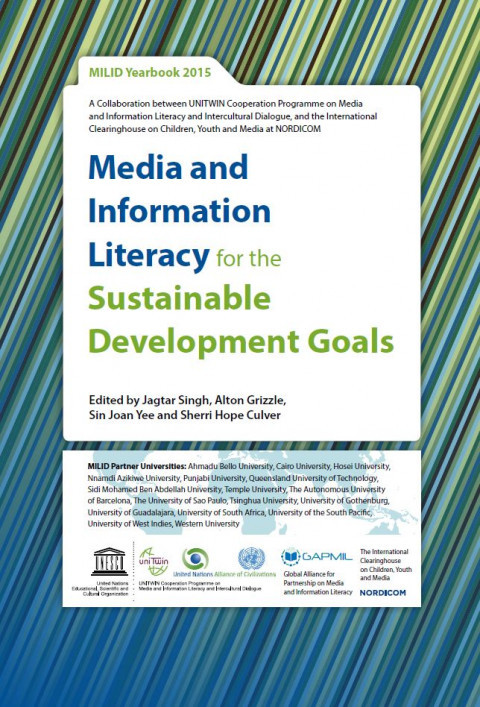 Media and Information Literacy for the Sustainable Development Goals (The MILID Yearbook 2015) Year of publication: 2015 Author: Jagtar Singh | Alton Grizzle | Sin Joan Yee | Sherri Hope Culver Corporate author: International Clearinghouse on Children, Youth and Media (Sweden) In the year 2000, governments and development partners all over the world agreed on eight global development targets called the Millennium Development Goals (MDGs). The year 2015 is a pivotal year as it marks the end of the period during which the MDGs were to be reached and the year in which new global development targets are to be set. These new targets are referred to as the Post-2015 Sustainable Development Goals (SDGs). This process is in its highest gear with ongoing debates and consultative meetings/initiatives globally both online and offline. While much progress has been made, achievement of the MDGs has been mixed across countries. The centrality of information and communication to development is irrefutable. The MILID Yearbook provides a case for media and information literacy (MIL) as a tool for open and inclusive sustainable development.The 2015 edition of the MILID Yearbook displays how media and information literacy can be helpful in facilitating progress and achievement of the sustainable development goals. It is sincerely hoped that the articles in this yearbook will go a long way to sensitize the stakeholders about the role and value of MIL in sustainable development of one and all across frontiers.
  Global Citizenship Education: How Much Do We Care? Year of publication: 2018 Corporate author: European confederation of Relief and Development NGOs (CONCORD) While Global Citizenship Education is recognised by many as a powerful tool to resolve the current global challenges our world is facing, the level of investment by national governments remains limited. Why is that? To answer this situation, CONCORD launches its new report “Global Citizenship Education – How much do we care?“. Based on a research across all EU Member States (+ Norway), this publication reveals the level of funding dedicated to Global Citizenship Education (GCE) in Europe between 2011 and 2015. Analysing the quantitative sources of investments by national governments as well as the qualitative narrative around GCE (How is GCE named? What is its framework of action?), this report digs into the complex world of GCE and provides a full picture of its current states in Europe. The report is composed of 2 parts:– a general overview and analysis– a comparative part made of an analysis per country of all EU member states (+ Norway), including interesting details on GCE definitions, concepts, funding trends.Strong of these analysis, the report draws conclusions and recommendations on where possible improvements at policy and advocacy level can be made.