
Resources
Explore a wide range of valuable resources on GCED to deepen your understanding and enhance your research, advocacy, teaching, and learning.
2,275 Results found
 Éducation à la Citoyenneté Mondiale en Europe: Combien compte-t-elle pour nous? Year of publication: 2018 Corporate author: European confederation of Relief and Development NGOs (CONCORD) Cette étude analyse le niveau des financements de l’éducation à la citoyenneté mondiale par les gouvernements nationaux à travers les États membres de l’UE, ainsi que la Norvège, entre 2011 et 2015. Le postulat de l’idée transparaît dans son intitulé « combien compte-telle pour nous ». En effet, un des indicateurs déterminants de l’engagement d’un pays en faveur d’une solidarité mondiale et d’une sensibilisation de ses propres citoyens aux interdépendances mondiales est le montant de financements publics dédiés à l’Education à la Citoyenneté Mondiale (mentionnée ci-après ECM). Le montant des fonds nationaux dédiés à l’ECM est directement lié à d’autres facteurs aux niveaux national et international, qui conditionnent l’ampleur du soutien et des engagements des gouvernements en faveur de l’ECM. Ainsi, au-delà de l’analyse des données liées aux financements, cette étude vise à explorer les contextes dans lesquels opèrent les gouvernements et les ONG, afin de brosser un tableau complet de l’état de l’ECM en Europe.
 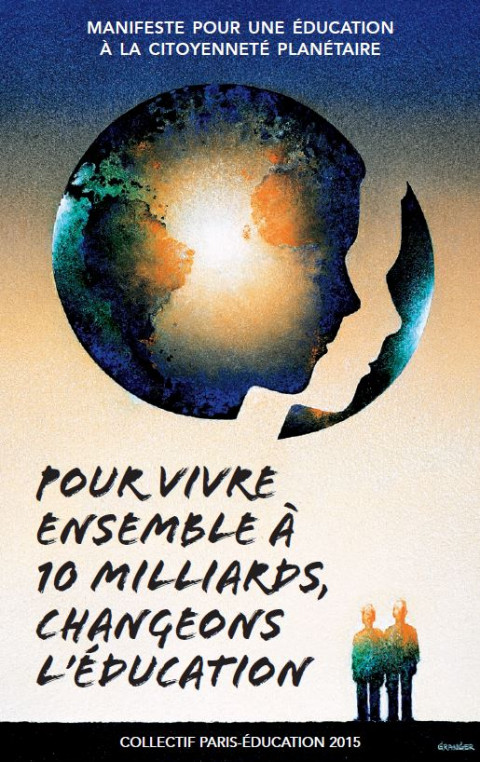 Manifeste pour une éducation à la citoyenneté planétaire: Pour vivre ensemble à 10 milliards, changeons l'éducation Year of publication: 2015 Corporate author: Collectif Paris-Education 2015 Face à l’ampleur, l’urgence, la diversité et la complexité des problématiques engendrées par le modèle de développement de nos sociétés contemporaines, nous sommes donc obligés, dans l’urgence, de nous pencher sur les questions d’éducation et de formation des générations futures qui devront affronter des réalités biophysiques, économiques et politiques inédites, dont nous commençons à peine à entrevoir l’ampleur. Ce qui est dès lors en jeu, avec l’avenir de l’homme et de la Terre, c’est l’humain, ce qu’il deviendra, ce qu’il sera capable de porter comme projet pour l’humanité.Quelles qualités d’humains devons-nous faire advenir pour que ces réalités inédites puissent être rencontrées demain, sans que l’humanité bascule dans la violence et le dépeçage égoïste de la planète? Quels enfants voulons-nous laisser à notre Terre?Cette urgence impose un changement d’échelle dans la transformation des systèmes éducatifs, des contenus et des méthodes d’enseignement. Malgré la volonté et la compétence de nombreux acteurs de l’école, force est de constater que les actions menées pour une éducation plus en cohérence avec les enjeux climatiques et, plus largement, sociétaux restent à la marge. Elles sont réalisées par des individus clairvoyants. Il est temps d’enclencher la vitesse supérieure.
  [Video] GLOBAL CITIZENSHIP EDUCATIONAL PROGRAM Year of publication: 2018 Corporate author: EducacionBA To build a fairer, more equitable and sustainable future, the "Global Citizenship" educational program is created to promote the Sustainable Development Goals through quality education enhanced by digital technologies and by fostering 21st century skills. Through a digital platform, school contents and monitoring, evaluation and planning tools, children learn by playing, carrying out missions, creating strategies and being protagonists of their learning.It has an extensive potential to reach an ambitious scope of 2.000 teachers and 50.000 students. During 2018 a pilot test was carried out with 6 precursory schools. In the platform, teachers are provided with tools to develop and undertake meaningful and innovative educational projects with their students. Students are offered school contents that challenge and empower them as key players. They are encouraged to learn through play, to carry out missions, to devise strategies, and to lead projects which reinforce learning processes and encourage their creativity and commitment. PRESENTACIÓN DE CIUDADANÍA GLOBAL Year of publication: 2018 Corporate author: EducacionBA Para construir un futuro más justo, equitativo y sustentable se crea el programa "Ciudadanía Global", cuyo objetivo es promover los Objetivos de Desarrollo Sostenible a través de una educación de calidad potenciada por las tecnologías digitales y fomentando las habilidades del siglo XXI. A través de una plataforma digital, contenidos de calidad y herramientas de planificación seguimiento y evaluación, niñas y niños aprenden jugando, emprendiendo misiones, creando estrategias y siendo protagonistas de sus aprendizajes.
  Que valent les apprentissages en histoire, géographie et éducation à la citoyenneté ? : Colloque international des didactiques de l'histoire, de la géographie et de l'éducation à la citoyenneté Year of publication: 2014 Author: Caroline Leininger | Angelina Ogier | Sylvain Genevois Corporate author: Institut national de recherche pédagogique L’histoire et la géographie scolaires, de même que l’éducation à la citoyenneté, sont des domaines sensibles, liés au politique et au contexte social et sociétal dans lequel ils s’inscrivent. Si les recherches en didactique ont constaté dans les années 1990 une grande stabilité de l’histoire et la géographie scolaires, elles interrogent aujourd’hui plus spécifiquement les changements curriculaires et les recompositions qu’ils entraînent (thèmes des deux dernières éditions du colloque (Nantes, 2008, Lausanne 2009). Ces changements découlent de choix politiques et de savoirs universitaires, et redéfinissent le projet de ces disciplines et ses finalités. L'élève devient ainsi à l'issue de sa scolarité : un acteur de la société, un citoyen, un acteur économique, membre de communautés culturelles et politiques, un individu épanoui etc.Ce choix de finalités est aussi un choix de valeurs, explicites ou non dans les prescriptions, assumées ou non par les enseignants, par les élèves, les parents. Ce constat amène à questionner les articulations entre les apprentissages disciplinaires d’une part, et les apprentissages sociaux et politiques d’autre part. Les définitions de ces apprentissages, leur légitimité et leurs évaluations posent également question. Enseignants, décideurs, formateurs, didacticiens peuvent ainsi se demander ce que valent les apprentissages en histoire, en géographie et en éducation à la citoyenneté, tant du point de vue de leur reconnaissance disciplinaire et sociale que du point de vue des valeurs qui leur sont associées. Cet ouvrage cherche à questionner les articulations entre les apprentissages disciplinaires et les apprentissages sociaux et politiques.
 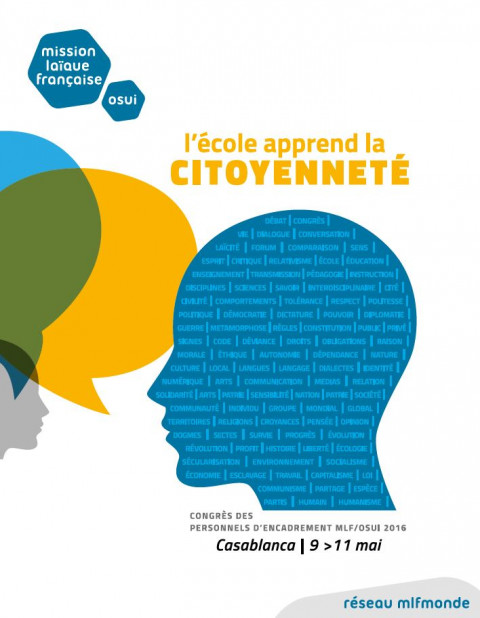 L’école apprend la citoyenneté (Congrès des personnels d’encadrement MLF/OSUI 2016) Year of publication: 2017 Corporate author: Mission laïque française Le groupe scolaire Louis-Massignon à Bouskoura (Casablanca, Maroc) a accueilli du 9 au 11 mai 2016 près de 300 acteurs de l’enseignement français, représentants des établissements du réseau mlfmonde, du réseau de l’AFLEC, des académiespartenaires (Dijon, Paris, Poitiers et Reims), des représentants du MAEDI, du MENESR, de la DNE, de la DGESCO et de l’AEFE, des grands établissements de l’Éducation nationale (CNED, Canopé, ESENESR, CIEP), des représentants de l’organisation du baccalauréat international, de l’Unesco et de la société civile.Les mesures qui entrent en vigueur sur l’éducation à la citoyenneté concernent les «valeurs de la République».Parce que l’enseignement moral et civique est conçu et établi pour et dans un contexte strictement national, se pose dès lors la question d’une adaptation à l’usage de l’enseignement français à l’étranger qui ne soit pas en contradiction avec l’intention et l’esprit de cette partie du programme.
 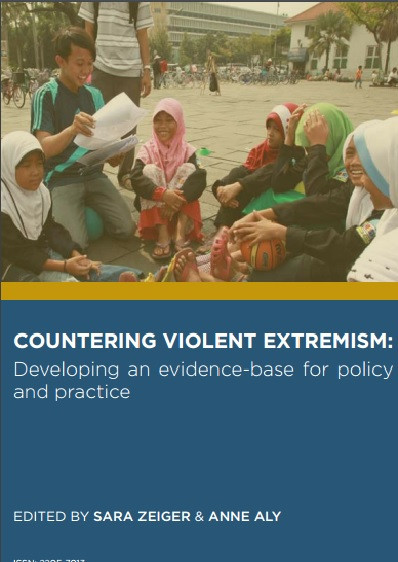 COUNTERING VIOLENT EXTREMISM: Developing an evidence-base for policy and practice Year of publication: 2015 Author: Sara Zeiger | Anne Aly Corporate author: Hedayah and Curtin University This volume reports on the range of papers presented at the Annual Countering Violent Extremism (CVE) Research Conference 2014 from 7-8 December 2014 in Abu Dhabi, United Arab Emirates. It presents two case studies on engaging with non-state actors within the community, namely families, community leaders and youth. COUNTERING VIOLENT EXTREMISM: Developing an evidence-base for policy and practice Year of publication: 2015 Author: Sara Zeiger | Anne Aly Corporate author: Hedayah | Curtin University Ce rapport présente une gamme des documents présentés à la Conférence annuelle de recherche sur la lutte contre l’extrémisme violent (CVE), qui a eu lieu du 7 au 8 décembre 2014 à Abou Dhabi, aux Emirats Arabes Unis. Il présente deux études de cas sur l’implication des acteurs non étatiques au sein de la communauté, à savoir les familles, les dirigeants communautaires et les jeunes.
  Realization of the Sustainable Development Goals by, for and with Persons with Disabilities (UN Flagship Report on Disability and Development 2018) Year of publication: 2018 Corporate author: United Nations (UN) Realization of the Sustainable Development Goals by, for and with persons with disabilities 'Disability and the 2030 Agenda for Sustainable Development' this report represents the first UN systemwide effort to examine disability and the Sustainable Development Goals (SDGs) of the 2030 Agenda for Sustainable Development at the global level. The report reviews data, policies and programmes and identifies good practices; and uses the evidence it reviewed to outline recommended actions to promote the realization of the SDGs for persons with disabilities. The report shows that despite the progress made in recent years, persons with disabilities continue to face numerous barriers to their full inclusion and participation in the life of their communities. It sheds light on their disproportionate levels of poverty, their lack of access to education, health services, employment, their under-representation in decision-making and political participation. This is particularly the case for women and girls with disabilities. Main barriers to inclusion entail discrimination and stigma on the ground of disability, lack of accessibility to physical and virtual environments, lack of access to assistive technology, essential services, rehabilitation and support for independent living that are critical for the full and equal participation of persons with disabilities as agents of change and beneficiaries of development. Data and statistics compiled and analysed in the present report indicate that persons with disabilities are not yet sufficiently included in the implementation, monitoring and evaluation of the SDGs.
 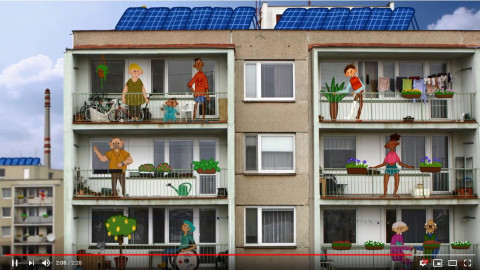 [Video] The future we need – and how we get there Year of publication: 2018 Corporate author: Friends of the Earth Europe Friends of the Earth groups across Europe are working for a socially-just, safe and peaceful future for all – and this is how they do it.