
Resources
Explore a wide range of valuable resources on GCED to deepen your understanding and enhance your research, advocacy, teaching, and learning.
2,275 Results found
 Beit Lohamei Haghetaot Educational materials produced by the Ghetto Fighters’ House are available for purchase. Teachers and planners thus have access to workshops, programmes, ceremonies and exhibitions. / Les matériels pédagogiques produits par la Maison des Combattants du Ghetto sont disponibles à l'achat. Les enseignants et les planificateurs ont ainsi accès à des ateliers, des programmes, des cérémonies et des expositions. Haus der Wannsee-Konferenz The Memorial and Educational Centre of the House of the Wannsee Conference provides school teachers with diverse ways to broach the persecution and murder of European Jews, the history of National Socialism and the aftermath. A permanent exhibition under expert guidance is proposed, multi-day seminars are conducted and online or downloadable activities and advice are available for helping teachers to approach this topic in class. / Le Centre commémoratif et éducatif de la chambre de la conférence de Wannsee fournit aux enseignants des écoles avec diverses façons d'aborder la persécution et assassiner des Juifs d'Europe, l'histoire du national-socialisme et les conséquences. Une exposition permanente sous la direction d'experts est proposé, des séminaires de plusieurs jours sont menées et des activités et des conseils en ligne ou téléchargeables sont disponibles pour aider les enseignants à aborder ce sujet en classe.
 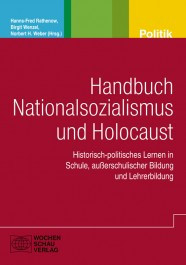 Handbuch Nationalsozialismus und Holocaust. Historisch-politisches Lernen in Schule, außerschulischer Bildung und Lehrerbildung. The educational field of National Socialism and the Holocaust is an indispensable part of historical-political learning in schools, non-formal education and teacher training. This manual gives new impetus to the theoretical discussion as well as to the practical educational work. Basic theoretical texts are complemented by methodological suggestions as well as by accounts based on personal experience and presentations of projects with national and international perspectives. The fact that today, more than sixty years after the events, adolescents have hardly any direct access to this phase of German and European history, and the question of how to deal with this challenge, are here of central importance. The contributions in the manual focus on the following themes: The fundamentals of National Socialism and the Holocaust as an educational field. School practices: Learning from classroom instruction. School practices: Learning from projects. Practices in teacher education. Practices in memorial sites and non-formal educational institutions. International approaches. (By the publisher)
 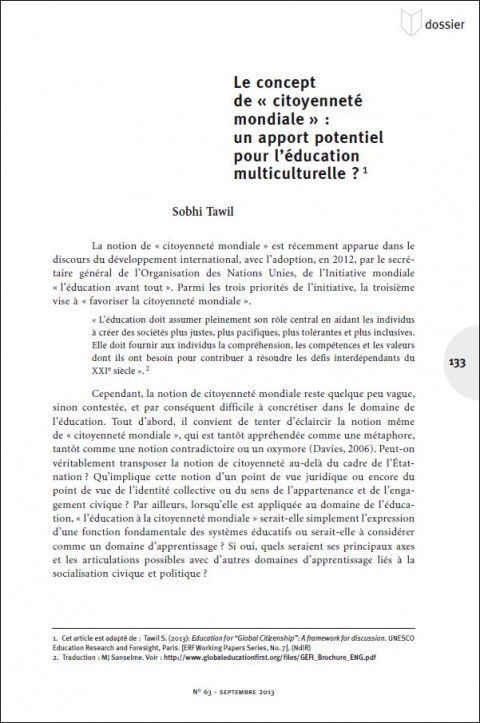 Does the Concept of ‘Global Citizenship’ Have the Potential to Input in Multicultural Education? Year of publication: 2013 Author: Sobhi Tawil Corporate author: Revue internationale d’éducation de Sèvres One of the three priorities of the Global Education First Initiative launched in 2012 by the United Nations is fostering global citizenship. However, this concept remains vague if left unchallenged, and as a result is difficult to implement in the field of education. It may be true that the growing globalisation and multiculturalism of contemporary societies is gradually transforming the concept and traditional role of citizenship, the legal reality of citizenship and its practises, but they still remain largely rooted in the idea of Nation-State. This article attempts to clarify the concept of global citizenship, its possible application in the field of citizenship education and its potential contribution to the enrichment of multicultural education. El concepto de “ciudadanía mundial” : ¿una posible aportación para la educación multicultural ? Year of publication: 2013 Author: Sobhi Tawil Corporate author: Revue internationale d’éducation de Sèvres Entre las tres prioridades de la iniciativa mundial “la educación ante todo” (Education first) lanzada en 2012 por las Naciones Unidas, podemos encontrar la idea según la cual conviene “favorecer la ciudadanía mundial”. Sin embargo, esta noción es de las más imprecisas, si no discutida y, por tanto, difícil de concretizar en el campo de la educación. Si no cabe duda de que la mundialización y la creciente multiculturalidad de las sociedades contemporáneas transforman paulatinamente la concepción y la práctica tradicional de la ciudadanía, la realidad jurídica de la ciudadanía así como su práctica, quedan establecidas fundamentalmente a nivel del Estado-Nación. Este artículo procura aclarar la noción de “ciudadanía mundial”, su posible aplicación en el dominio de la educación a la ciudadanía y su contribución potencial al enriquecimiento de la educación multicultural. Le concept de « citoyenneté mondiale » : un apport potentiel pour l’éducation multiculturelle ? Year of publication: 2013 Author: Sobhi Tawil Corporate author: Revue internationale d’éducation de Sèvres Parmi les trois priorités de l’initiative mondiale « l’éducation avant tout » (Education First) lancée en 2012 par les Nations-Unies, on trouve l’idée de « favoriser la citoyenneté mondiale ». Cependant, cette notion reste vague sinon contestée, et par conséquent difficile à concrétiser dans le domaine de l’éducation. S’il est vrai que la mondialisation et la multiculturalité croissante des sociétés contemporaines transforment progressivement la conception et la pratique traditionnelle de la citoyenneté, la réalité juridique de la citoyenneté, ainsi que sa pratique, restent encore largement ancrées au niveau de l’État-nation. Cet article tente de clarifier la notion de « citoyenneté mondiale », son application possible dans le domaine de l’éducation à la citoyenneté et sa contribution potentielle à l’enrichissement de l’éducation multiculturelle.
 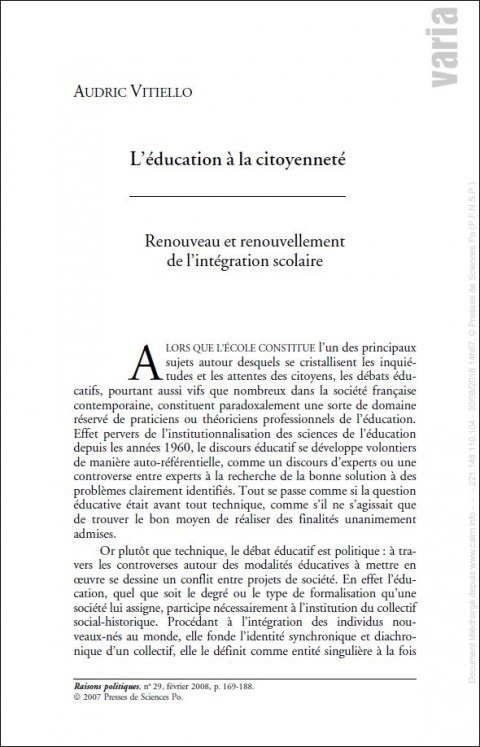 L'éducation à la citoyenneté Year of publication: 2008 Author: Audric Vitiello Corporate author: Raisons politiques Notion récente, l'éducation à la citoyenneté se présente comme une inflexion de la formation civique, visant un renouvellement de sa forme pour mieux assurer sa fonction institutionnelle d'intégration des individus au collectif. Mais, l'éducation ôtant une praxis où moyens et fins sont interdépendants, une modification des modalités de l'éducation induit logiquement celle de la finalité. De fait, l'éducation à la citoyenneté s'indexe à une conception originale du politique pensé non plus comme lieu, mais comme moment spécifique dédié à la régulation de tout collectif. Le mécanisme d'abstraction civique perdure, mais il s'effectue à partir des situations concrètes dans lesquelles l'individu est inscrit, et par une réflexion à fondement dialogique. Se dessine alors une forme de démocratie générale et dialogique, où le politique est déconcentré et démultiplié mais où la décision prise en commun après délibération reste le mode de structuration privilégié du collectif. Mais la démocratie procédurale et dialogique a des limites, dans la mesure où elle suppose d'être fondée dans un corpus substantiel de valeurs qui lui confère sa légitimité. Dallas Holocaust Museum Center for Education and Tolerance The Dallas Holocaust Museum Center for Education contains resources for teaching about the Holocaust : questions/answers, a timeline, key definitions, etc. Fortunoff Video Archive for Holocaust Testimonies of the Yale University Library In the 1970s the Holocaust Survivors Film Project began videotaping Holocaust survivors and witnesses in New Haven. Since then, the Fortunoff Archive has worked to record, collect and preserve Holocaust witness testimonies, and to make its collection available to researchers, educators and the general public. The Fortunoff Archive currently holds more than 4,400 testimonies, which are comprised of over 10,000 recorded hours of videotape. The Fortunoff Archive and its affiliates recorded the testimonies of willing individuals with first-hand experience of the Nazi persecutions, including those in hiding, survivors, bystanders, resistants and liberators. Testimonies are recorded in whatever language the witness prefers, and range in length from one-half hour to over 40 hours. Fortunoff Archive vidéo pour l'Holocauste Témoignages de la bibliothèque de l'Université Yale Dans les années 1970, le projet de film survivants de l'Holocauste a commencé l'enregistrement vidéo des survivants et des témoins de l'Holocauste à New Haven. Depuis lors, les Archives Fortunoff a travaillé pour enregistrer, recueillir et conserver les témoignages de la Shoah, et de rendre sa collection aCECssible aux chercheurs, les éducateurs et le grand public. Les Archives Fortunoff détient actuellement plus de 4.400 témoignages, qui sont composées de plus de 10.000 heures enregistrées de la bande vidéo. Les Archives Fortunoff et ses filiales ont enregistré les témoignages de personnes qui veulent une expérience de première main des persécutions nazies, y compris ceux dans la clandestinité, les survivants, les spectateurs, les résistants et libérateurs. Les témoignages sont enregistrés dans la langue du témoin préfère, et la gamme de longueur d'une demi-heure à plus de 40 heures.