
Resources
Explore a wide range of valuable resources on GCED to deepen your understanding and enhance your research, advocacy, teaching, and learning.
2,275 Results found
 Migration, citoyenneté et inégalités globales Year of publication: 2012 Author: Martin Provencher Corporate author: Les ateliers de l'éthique | Centre de recherche en éthique de l’Université de Montréal La migration est un phénomène qu’on ne peut comprendre qu’à partir d’une perspective globale. Les êtres humains se sont toujours déplacés pour améliorer leur sort, c’est-à-dire dès qu’ils ont eu des raisons de croire que le fait d’aller vivre ailleurs leur procurerait de meilleures chances. On s’entend cependant pour admettre que l’ampleur de ce phénomène est aujourd’hui inédite. Certes, seul un faible pourcentage de la population mondiale se déplace encore, à peine 3 %, mais cela représente plus de 214 millions d’individus. Et l’on estime que ce nombre augmentera. Qui plus est, plusieurs de ces individus migrent et continueront de migrer vers les pays riches du Nord dans lesquels la proportion de personnes nés à l’étranger a augmenté de 10% au cours des dernières années. Cette intensification de la mobilité internationale des individus intervient dans un contexte économique dominé par la globalisation néolibérale du monde qui accentue les inégalités entre les pays et où les États riches rivalisent entre eux pour attirer les migrants qualifiés et non qualifiés. Ces circonstances auraient pu inciter les gouvernements à reconnaître la migration comme un phénomène normal que rien ne saurait arrêter et à adapter leurs politiques publiques en conséquence. Mais elles se sont produites à un moment où la souveraineté des États, mise à mal par le développement des technologies de la communication, la densification des réseaux transnationaux, l’émergence d’une multitude de nouveaux acteurs sur la scène internationale et la formation d’entités politiques inédites, effectuait un retour en force. L’obsession de la sécurité, alimentée par les attentats terroristes, la récession économique et le populisme, a en effet servi de prétexte aux États pour resserrer le contrôle de leurs frontières en adoptant des mesures très restrictives qui ont contribué à fragiliser la condition des migrants les plus vulnérables, notamment les irréguliers et les demandeurs d’asile.
  Values of Kazakhstan Society in the Sociological Dimension Year of publication: 2020 Author: Gulnara Ismukhanova | Dina Sharipova | Botagoz Turekhanova | Botagoz Rakisheva | Gulnar Nasimova | Saltanat Ermakhanova | Shugla Kylybayeva | Tolganai Umbetalieva | Leonid Gurevich Corporate author: Friedrich-Ebert-Stiftung Kazakhstan Office The book provides a structured analysis of the values of modern Kazakhstani society, based both on well-known classical models and on original author’s approaches. The book is based on a sociological study conducted on a national representative sample and which allowed us to describe the value portrait of Kazakhstanis taking into account the specifics of social groups and regions. The key vectors of transformation of values in Kazakhstan are identified against the backdrop of global trends and in the context of the national strategy of spiritual modernization.The book is addressed to scientists, politicians, government and public figures, representatives of the business community, journalists, teachers and university students and is of interest to anyone who seeks to understand the complex structure of social and cultural processes in modern Kazakhstan. Ценности казахстанского общества в социологическом измерении Year of publication: 2020 Author: Gulnara Ismukhanova | Dina Sharipova | Botagoz Turekhanova | Botagoz Rakisheva | Gulnar Nasimova | Saltanat Ermakhanova | Shugla Kylybayeva | Tolganai Umbetalieva | Leonid Gurevich Corporate author: Фонд имени Фридриха Эберта в Казахстане В книге предпринят структурированный анализ ценностей современного казахстанского общества, базирующийся как на известных классических моделях, так и на оригинальных авторских подходах. В основе книги – социологическое исследование, проведенное на национальной репрезентативной выборке и позволившее описать ценностный портрет казахстанцев с учетом специфики социальных групп и регионов. Определены ключевые векторы трансформации ценностей в Казахстане на фоне мировых трендов и в контексте национальной стратегии духовной модернизации.Книга адресована ученым, политикам, государственным и общественным деятелям, представителям деловых кругов, журналистам, преподавателям и студентам вузов и представляет интерес для всех, кто стремится понять сложную структуру социальных и культурных процессов в современном Казахстане.
  Registration or Block? Year of publication: 2020 Author: Dilmurod Yusupov | Oybek Isakov Registration of a non-governmental non-profit organization in Uzbekistan can still be a long and painful affair. The article discusses why it is so difficult to open an NGO, what and whom it depends on. Регистрировать нельзя отказать Year of publication: 2020 Author: Dilmurod Yusupov | Oybek Isakov Регистрация негосударственной некоммерческой организации в Узбекистане до сих пор может быть долгим и мучительным делом. В статье рассматривается, почему так сложно открыть ННО, от чего и от кого это зависит.
  What is Genocide? (Arabic Edition) Year of publication: 2017 Author: Martin Shaw Corporate author: Obeikan Publishing This book translated into Arabic, written by Martin Shaw, in which he talks about genocide, its roots and where it occurred. The book is an original reference in matters of genocide.This fully revised edition of Martin Shaw’s classic, award-winning text proposes a way through the intellectual confusion surrounding genocide. In a thorough account of the idea’s history, Shaw considers its origins and development and its relationships to concepts like ethnic cleansing and politicide. Offering a radical critique of the existing literature on genocide, he argues that what distinguishes genocide from more legitimate warfare is that the ‘enemies’ targeted are groups and individuals of a civilian character. He vividly illustrates his argument with a wide range of historical examples - from the Holocaust to Rwanda and Palestine to Yugoslavia - and shows how the question ‘What is genocide?’ matters politically whenever populations are threatened by violence.
  Cultivating Ecological Citizens: Education for Building Ecological Civilization (Research in Educational Development; No. 12) Year of publication: 2019 Author: Liu Xia Corporate author: Shanghai Academy of Educational Sciences | Shanghai Higher Education Mankind is heading for a new era of ecological civilization. The construction of ecological civilization requires education to cultivate the ecological citizens of the times. This requires the traditional citizenship theory to accept the challenge of Eco-Citizenship theory, from dealing with the relationship between people and the state to the relationship between man and nature, from focusing only on the public sphere to the private sphere of citizen life, citizen exchanges also need to expand from the nation-state to the human community. Education needs to cultivate eco-citizens with ecological awareness, ecological thinking, ecological virtues, and ecological action with ecological literacy. 培养生态公民:建设生态文明的教育担当 (生态文明教育; No. 12) Year of publication: 2019 Author: Liu Xia Corporate author: Shanghai Academy of Educational Sciences | Shanghai Higher Education 人类正在走向生态文明新时代。建设生态文明需要教育培养出时代需要的生态公民。为此,传统公民理 论需要接受生态公民理论的挑战,从处理人与国家的关系扩展到人与自然的关系,从只关注公共领域扩展到关注私 人领域的公民生活,公民交往也需要从民族国家扩展到人类共同体。教育也需要培养出具有生态意识、生态思维、生 态美德和生态行动的生态公民。
  The Person Beyond Migration: Psychosocial Intervention Manual With Migrants Year of publication: 2010 Author: Luisa Melero Valdéz Corporate author: Compromiso Social Bancaja This book collects different views on psychosocial intervention around the issue of migration and provides theoretical and practical tools to work on this topic.
 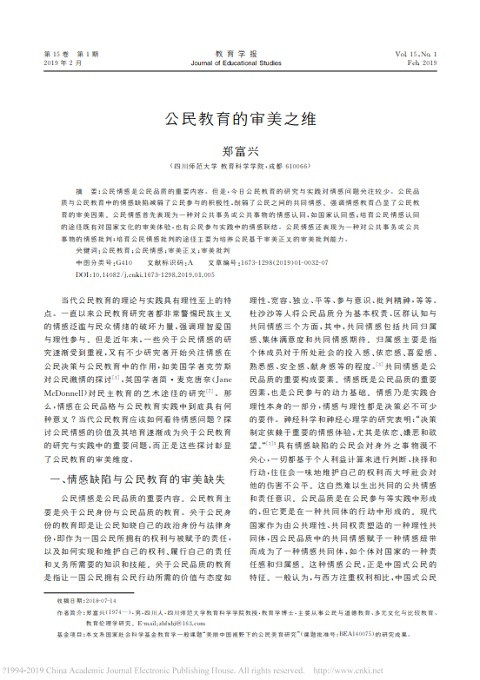 The Aesthetic Dimension of the Civic and Citizenship Education (Journal of Educational Studies; Vol. 12, No. 1) Year of publication: 2019 Author: Zheng Fuxing Corporate author: Beijing Normal University Civic emotion is an important part of citizenship. However, the contemporarily research and practice of the civic and citizenship education pay less attention to emotional issues. This defect in the civic quality and the civic and citizenship education weakens the enthusiasm of civic participation and the common feelings among citizens. Emphasis on emotional education highlights the aesthetic factors of the civic and citizenship education. Citizen’ emotions are first represented as the emotional identification to public affairs or public things, such as national identity; the way to cultivate citizen’s emotional identity not only can be through the aesthetic experience of national culture but also the emotional connection among citizens in the practice participation. Citizen’s emotions are also manifested as an emotional critique of public affairs or public things. The way to cultivate the citizen’s emotional criticism is mainly to cultivate citizen’s ability of aesthetic criticism based on aesthetic justice.