
Resources
Explore a wide range of valuable resources on GCED to deepen your understanding and enhance your research, advocacy, teaching, and learning.
2,275 Results found
 Media Literacy in Finland: National Media Education Policy Year of publication: 2019 Corporate author: European Training and Research Centre for Human Rights and Democracy (Austria) | UNESCO Media literacy in Finland is the media literacy policy and the national media education policy document, published by the Ministry of Education and Culture in 2019. The document updates and extends the cultural policy guidelines for media literacy published in 2013. The need to update the policy arose from the changes that have taken place in media culture and the broader than before target groups of media education in particular. The Program of the Government also highlights the need for media skills for all age groups, from children to seniors. The vision of the policy is to improve everyone’s opportunities to develop their media literacy. 핀란드의 미디어 리터러시: 국가 미디어교육 정책 Year of publication: 2019 Corporate author: Finand. Ministry of Education and Culture 《핀란드의 미디어 리터러시》는 교육문화부에서 2019년 발간한 미디어 리터러시 정책 및 국가 미디어교육 정책 문서를 한국어로 번역한 자료이다. 이 문서는 2013년에 발간된 미디어 리터러시 가이드라인을 개정하고 확장한 것이다. 미디어 문화가 변화하고 미디어교육 대상 집단이 이전보다 확대되면서 정책 개정의 필요성이 대두됐다. 정부 정책 프로그램(The Program of the Government) 역시 아동에서부터 노년까지 모든 연령 집단에서 미디어 기량(media skills)이 필요함을 강조했다. 이 정책의 목표는 모든 사람이 미디어 리터러시를 개발할 기회를 늘리는 것이다.
 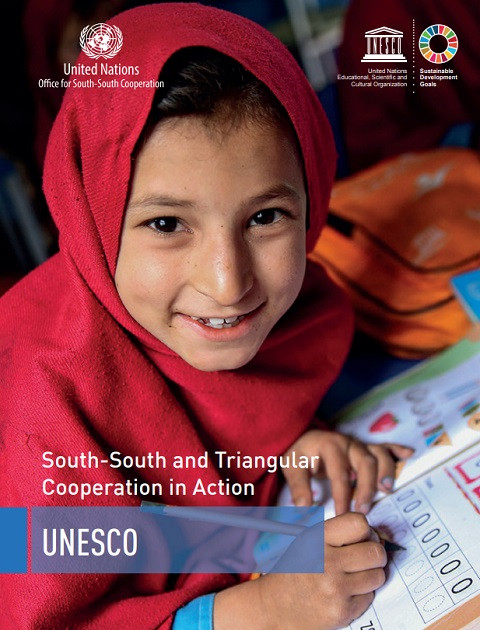 South-South and Triangular Cooperation in Action Year of publication: 2018 Corporate author: UNESCO | UN. Office for South-South Cooperation (UNOSSC) This publication is UNESCO’s first dedicated report on South-South cooperation and triangular cooperation. It presents an overall picture of the progress achieved to support technical cooperation, capacity building and knowledge sharing through South-South and triangular cooperation in UNESCO’s areas of competence with highlights of specific examples. It paves the way for deepening future cooperation in this area.
  Promoting Media and Information Literacy in Uzbekistan Year of publication: 2015 Corporate author: UNESCO The manual presents in popular visual form the fundamentals of Media and Information Literacy (MIL), using UNESCO's teacher education programs and other materials from the organization. This manual was developed within the framework of the joint program of the UN and the Government of the Republic of Kazakhstan "Improving the well-being and quality of life in the Kyzylorda region through the introduction of innovative approaches to the provision of economic, social and environmental services to the local population, including the most vulnerable", carried out jointly by the Government of the Republic Kazakhstan and UN agencies in Kazakhstan: UNESCO, UNDP, UNFPA, UN Women, WHO and UNICEF until December 2016. Узбекистан по пути развития медиаобразования Year of publication: 2015 Corporate author: Организация Объединенных Наций по вопросам образования, науки и культуры (UNESCO) Пособие представляет в популярной визуальной форме основы медийной и информационной грамотности (МИГ), используя программы обучения ЮНЕСКО для педагогов, а также другие материалы организации. Данное пособие разработано в рамках совместной программы ООН и Правительства Республики Казахстан «Повышение благосостояния и качества жизни в Кызылординской области через внедрение иннова-ционных подходов к оказанию экономических, социальных и экологи-ческих услуг местному населению, включая наиболее уязвимые слои», выполняемого совместно Правительством республики Казахстан и агентствами ООН в РК: ЮНЕСКО, ПРООН, ЮНФПА, ООН Женщины, ВОЗ и ЮНИСЕФ до декабря 2016 года.
  Media and Information Literacy: Training Materials Year of publication: 2015 Corporate author: UNESCO This compendium contains the reports of four studies on religion and democracy conducted by the International Alert project "Constructive Dialogues on Religion and Democracy". The studies were carried out by young professionals trained in the framework of the project in 2017 and 2018. Медийная и информационная грамотность Year of publication: 2015 Corporate author: Организация Объединенных Наций по вопросам образования, науки и культуры (UNESCO) Данный сборник содержит отчеты четырех исследований по вопросам религии и демократии, проведенных в рамках проекта International Alert "Конструктивные диалоги по религии и демократии". Исследования были проведены молодыми специалистами, обученными в рамках деятельности проекта в 2017 и 2018 гг.
 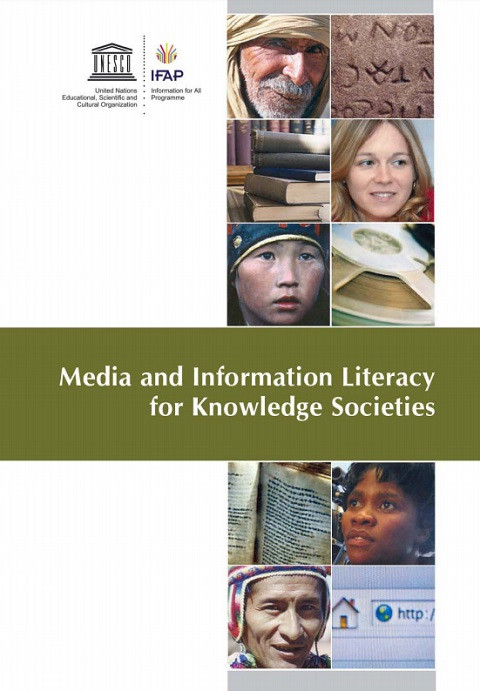 Медиа- и информационная грамотность в обществах знания Year of publication: 2013 Corporate author: Interregional Library Cooperation Centre | Организация Объединенных Наций по вопросам образования, науки и культуры (UNESCO) Издание подготовлено на основе материалов Международной конференции «Медиа- и информационная грамотность в обществах знания», состоявшейся в Москве 24–28 июня 2012 г. в рамках председательства России в Межправительственном совете Программы ЮНЕСКО «Информация для всех».
 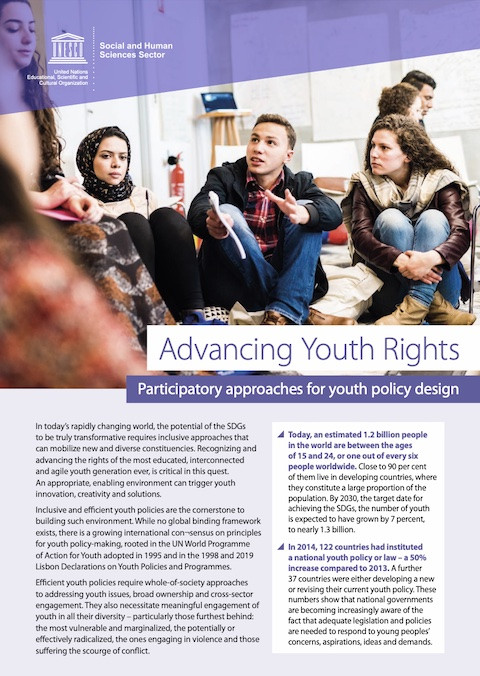 Advancing Youth Rights: Participatory Approaches for Youth Policy Design Year of publication: 2019 Corporate author: UNESCO Inclusive and efficient youth policies are the cornerstone to building such environment. While no global binding framework exists, there is a growing international con¬sensus on principles for youth policy-making, rooted in the UN World Programme of Action for Youth adopted in 1995 and in the 1998 and 2019 Lisbon Declarations on Youth Policies and Programmes. Efficient youth policies require whole-of-society approaches to addressing youth issues, broad ownership and cross-sector engagement. They also necessitate meaningful engagement of youth in all their diversity – particularly those furthest behind: the most vulnerable and marginalized, the potentially or effectively radicalized, the ones engaging in violence and those suffering the scourge of conflict. Promover los derechos de las personas jóvenes: Enfoques participativos para diseñar políticas de juventud Year of publication: 2019 Corporate author: Organización de las Naciones Unidas para la Educación, la Ciencia y la Cultura (UNESCO) Para crear este entorno, es esencial contar con políticas públicas de juventud inclusivas y eficientes. Si bien no existe un marco vinculante a nivel mundial, existe un consenso internacional cada vez mayor en lo que respecta a los principios que deben guiar la formulación de políticas de juventud. Dicho consenso dimana del Programa de Acción Mundial de las Naciones Unidas para los Jóvenes, aprobado en 1995, y de las Declaraciones de Lisboa sobre Políticas y Programas relativos a la Juventud de 1998 y 2019. Para que las políticas públicas de juventud sean eficientes, los enfoques deben englobar a toda la sociedad para abordar los problemas de la juventud y contar con una colaboración intersectorial. También se requiere la verdadera participación e inclusión las juventudes en toda su diversidad incluyendo quienes que han quedado atrás: jóvenes en situación de vulnerabilidad, marginado/as, que podrían radicalizarse o ya lo han hecho, que cometen actos violentos y quienes sufren el flagelo de los conflictos.