
Resources
Explore a wide range of valuable resources on GCED to deepen your understanding and enhance your research, advocacy, teaching, and learning.
2,255 Results found
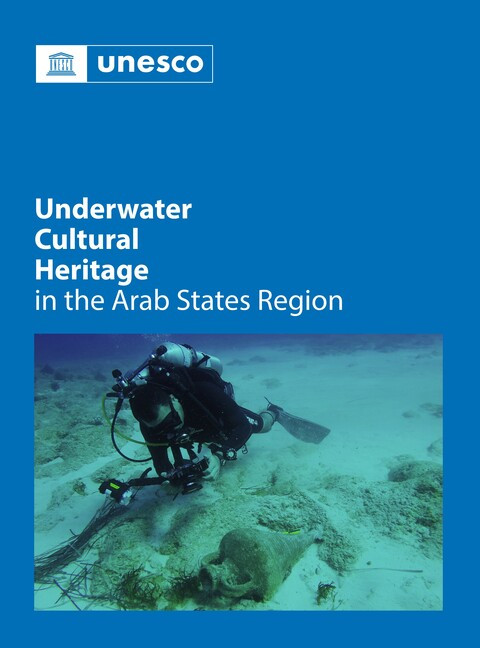 Underwater Cultural Heritage in the Arab States Region Year of publication: 2023 Corporate author: UNESCO Cairo "Underwater Cultural Heritage in the Arab State RegionUnderwater Cultural Heritage (UCH) is defined by UNESCO as “all traces of human existence having a cultural, historical or archaeological character which have been partially or totally under water, periodically or continuously, for at least 100 years such as: i. sites, structures, buildings, artefacts and human remains, together with their archaeological and natural context; ii. vessels, aircraft, other vehicles or any part thereof, their cargo or other contents, together with their archaeological and natural context; and iii. objects of prehistoric character”1.This definition relates primarily to the age and environmental conditions of the deposit, i.e., the remains must have existed fully or partially “underwater” for at least 100 years, regardless of their type, nature, or the culture to which they belong. Once these core elements have been confirmed, the archaeological material can be defined further according to one or more specific criteria: - chronology – the time period the remains date from; - region – the geographical area where the remains were found; - typology – the physical categorisation of the remains, e.g., pottery, animal bone, stone etc.It is important to recognise that while the above criteria will remain constant, the “underwater” nature of the archaeological remains is subject to change, as a result of either human or environmental intervention. For example, many sites where prehistoric activity took place on land, usually close to ancient shorelines, are • 1 - UNESCO. 2001. Convention on the Protection of the Underwater Cultural Heritage. Paris: Records of the General Conference, 31st ses-sion, Article.Underwater Cultural Heritage in the Arab State Regionnow submerged due to rising sea levels. Similarly, items such as swords, deposited in lakes or rivers as part of past rituals, were made and used on land. These sites and artefacts have therefore come to meet the definition of “Underwater Cultural Heritage”. The opposite process is also possible: a shipwreck, for example, or other material remains lifted from the seabed and placed in a museum would lose its status as UCH. This nuance tells us that UCH is not necessarily a constant scientific term. It relates to the underwater environment in which the material culture is located rather than any inherent archaeological or cultural attribute2. That is not to say that the material culture’s underwater location is not important: on the contrary, the underwater context reveals changes in use, condition and meaning over time. The physical changes that the underwater environment can cause, such as corrosion or decay, and the natural, social and ideological changes that underwater locations can reflect, therefore, are vital parts of a site or object’s life history. The underwater location is also a key factor in determining which scientific techniques and methods to use when dealing with this type of material culture for purposes of exploration, research, documentation, excavation, conservation, presentation or public display. Thus, the study of UCH usually requires the use of tools and techniques that differ from those employed on terrestrial archaeological sites3. For this reason, UCH is frequently mentioned in association with underwater archaeology, i.e., archaeological work, such as excavation, recording and analysis, that takes place on partially or fully submerged sites. Underwater archaeology is governed by the same scientific principles and standards as archaeological work on land but is tailored to the specific challenges of underwater conditions4. The term “underwater archaeology” is not, therefore, a sub-discipline of archaeology. Instead, it is a technical term referring to a specific set of tools and techniques used in conducting archaeological work underwater, within the wider framework and principles of archaeological research."
 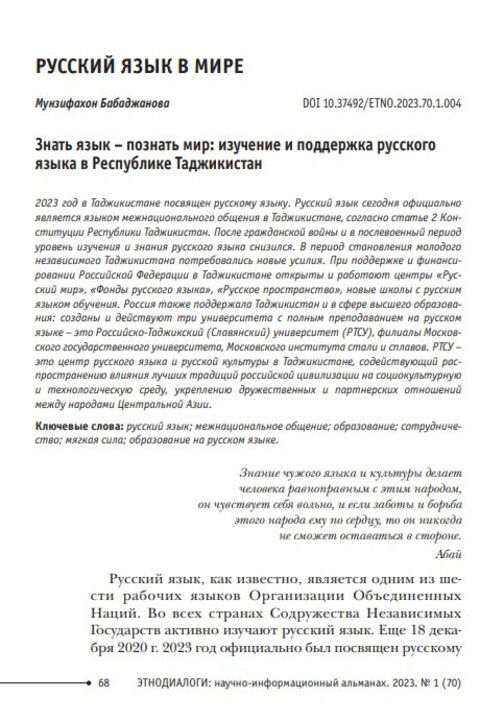 Knowing a Language Is Knowing the World: Learning and Supporting the Russian Language in the Republic of Tajikistan (Ethnodialogues; No.1, 2023) Year of publication: 2023 Author: Мунзифахон Бабаджанова The year 2023 in Tajikistan is dedicated to the Russian language. The Russian language today is officially the language of interethnic communication in Tajikistan. With the support and funding of the Russian Federation, “Russian World”, “Russian Language Foundations”, “Russian Space” centers and new Russian language schools were opened and now operate in Tajikistan. Russia has also supported Tajikistan in higher education: three universities with full Russian-language instruction have been established and are operating. Знать язык - познать мир: изучение и поддержка русского языка в республике Таджикистан (Этнодиалоги; No.1, 2023) Year of publication: 2023 Author: Мунзифахон Бабаджанова 2023 год в Таджикистане посвящен русскому языку. Русский язык сегодня официально является языком межнационального общения в Таджикистане. При поддержке и финансировании Российской Федерации в Таджикистане открыты и работают центры «Русский мир», «Фонды русского языка», «Русское пространство», новые школы с русским языком обучения. Россия также поддержала Таджикистан и в сфере высшего образования: созданы и действуют три университета с полным преподаванием на русском языке.
 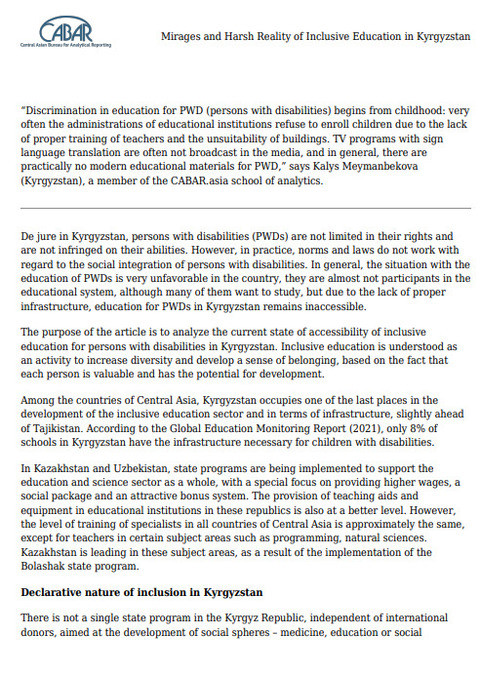 Mirages and Harsh Reality of Inclusive Education in Kyrgyzstan Year of publication: 2022 Author: Kalys Meymanbekova Corporate author: Central Asian Bureau for Analytical Reporting (CABAR) The purpose of the article is to analyze the current state of accessibility of inclusive education for persons with disabilities in Kyrgyzstan. Inclusive education is understood as an activity to increase diversity and develop a sense of belonging, based on the fact that each person is valuable and has the potential for development. Миражи и суровая реальность инклюзивного образования в Кыргызстане Year of publication: 2022 Author: Kalys Meymanbekova Corporate author: Central Asian Bureau for Analytical Reporting (CABAR) Целью статьи является анализ текущего положения доступности инклюзивного образования для ЛОВЗ Кыргызстана. Инклюзивное образование понимается как деятельность по расширению разнообразия и развитию чувства сопричастности, основанная на том, что каждый человек ценен, и у него есть потенциал развития.
 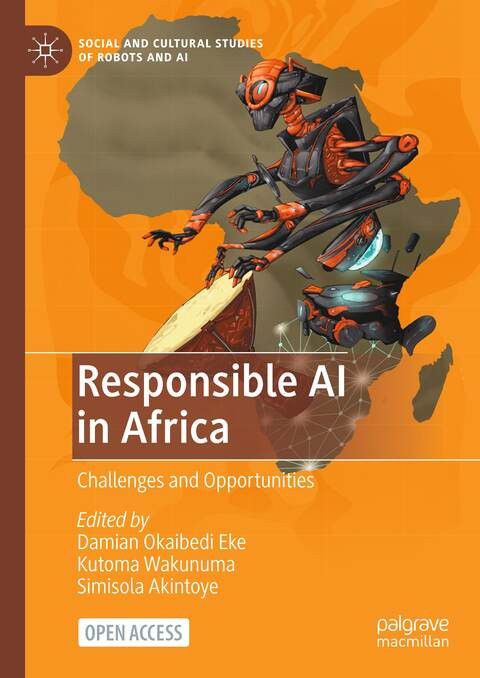 Responsible AI in Africa: Challenges and Opportunities Year of publication: 2023 Corporate author: Palgrave Macmillan This open access book contributes to the discourse of Responsible Artificial Intelligence (AI) from an African perspective. It is a unique collection that brings together prominent AI scholars to discuss AI ethics from theoretical and practical African perspectives and makes a case for African values, interests, expectations and principles to underpin the design, development and deployment (DDD) of AI in Africa. The book is a first in that it pays attention to the socio-cultural contexts of Responsible AI that is sensitive to African cultures and societies. It makes an important contribution to the global AI ethics discourse that often neglects AI narratives from Africa despite growing evidence of DDD in many domains. Nine original contributions provide useful insights to advance the understanding and implementation of Responsible AI in Africa, including discussions on epistemic injustice of global AI ethics, opportunities and challenges, an examination of AI co-bots and chatbots in anAfrican work space, gender and AI, a consideration of African philosophies such as Ubuntu in the application of AI, African AI policy, and a look towards a future of Responsible AI in Africa.
 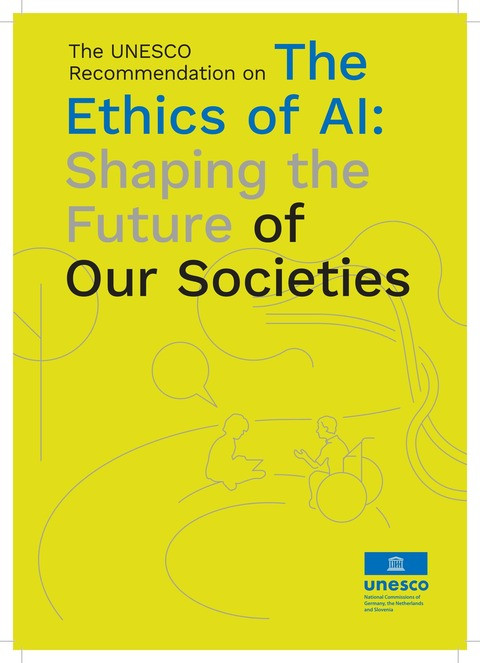 The UNESCO Recommendation on the Ethics of AI: Shaping the Future of Our Societies Year of publication: 2023 Corporate author: German Commission for UNESCO | Netherlands National Commission for UNESCO | Slovenian National Commission for UNESCO The UNESCO commissions of Germany, the Netherlands and Slovenia with the support of IRCAI have jointly published a brochure on the UNESCO recommendation on the ethics of artificial intelligence. It summarizes the most important content in a compact manner and presents the central demands from the areas of health, culture, the environment, gender equality as well as education and research. The recommendation with its diverse topics is not only relevant for political experts, but it offers one for various areas of application of the ethical framework and thus serves as an orientation for dealing with AI in general. The brochure is available for the wider public in a number of formats including the original Adobe InDesign file that allows translations to be inserted and format pages, resulting in new versions of the brochure. Therefore, we strongly encourage all UNESCO Commissions from across all UNESCO regions Africa, Arab States, Asia and the Pacific, Europe and North America, Latin America and the Caribbean to use the text in the basic files and translate the content into their own languages, including using the graphic file to setup their own designs of the brochure.
 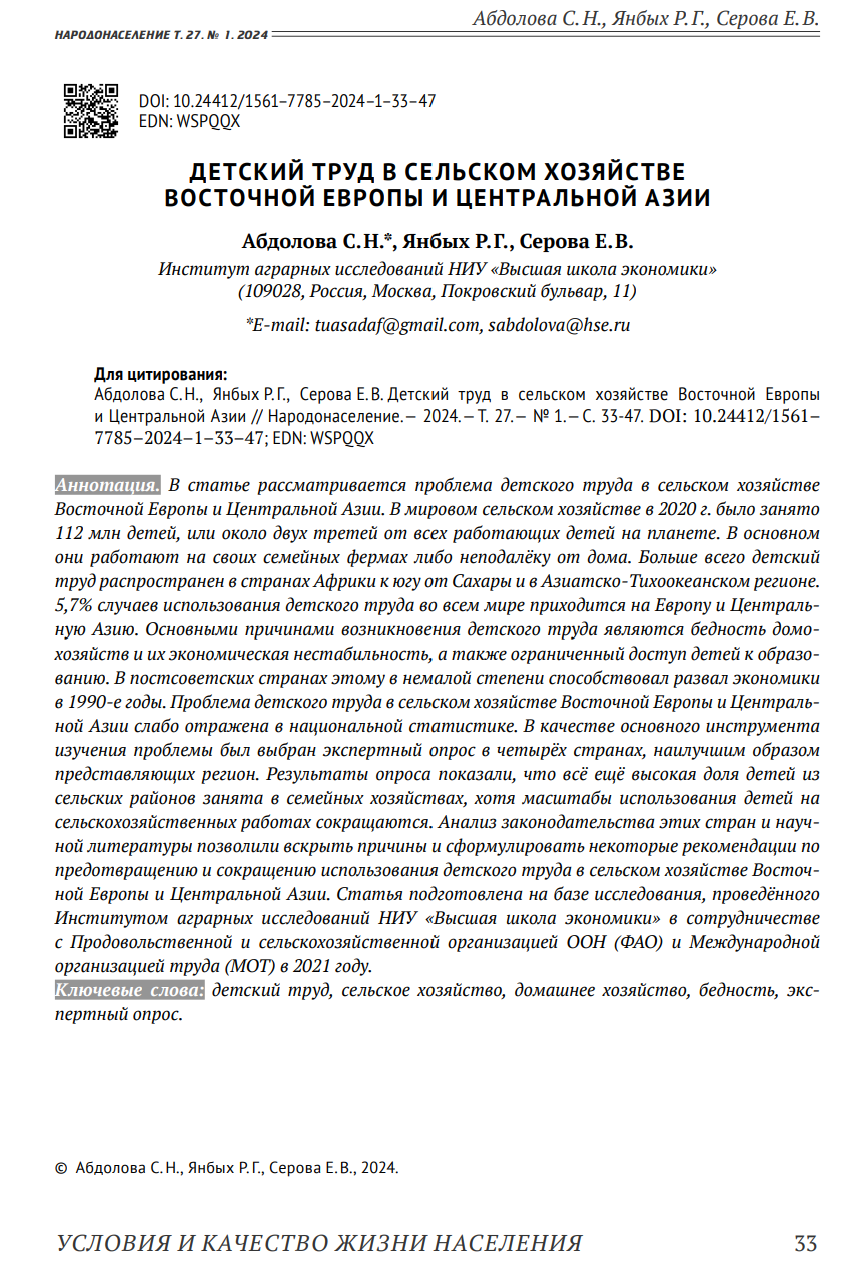 Research on Child Labour in Agriculture in Eastern Europe and Central Asia Year of publication: 2024 Author: Абдолова Садаф | Янбых Рената | Серова Евгения Corporate author: Народонаселение The article deals with the problem of child labor in agriculture in Eastern Europe and Central Asia. An analysis of the legislation of these countries and scientific literature allowed us to uncover the causes and formulate some recommendations for preventing and reducing the use of child labor in agriculture in Eastern Europe and Central Asia. The article was prepared on the basis of a study conducted by The Institute of Agricultural Research of the Higher School of Economics in cooperation with the Food and Agriculture Organization of the United Nations (FAO) and the International by the International Labour Organization (ILO) in 2021. Детский труд в сельском хозяйстве Восточной Европы и Центральной Азии Year of publication: 2024 Author: Абдолова Садаф | Янбых Рената | Серова Евгения Corporate author: Народонаселение В статье рассматривается проблема детского труда в сельском хозяйстве Восточной Европы и Центральной Азии. Анализ законодательства этих стран и научной литературы позволили вскрыть причины и сформулировать некоторые рекомендации по предотвращению и сокращению использования детского труда в сельском хозяйстве Восточной Европы и Центральной Азии. Статья подготовлена на базе исследования, проведённого Институтом аграрных исследований НИУ «Высшая школа экономики» в сотрудничестве с Продовольственной и сельскохозяйственной организацией ООН (ФАО) и Международной организацией труда (МОТ) в 2021 году.
 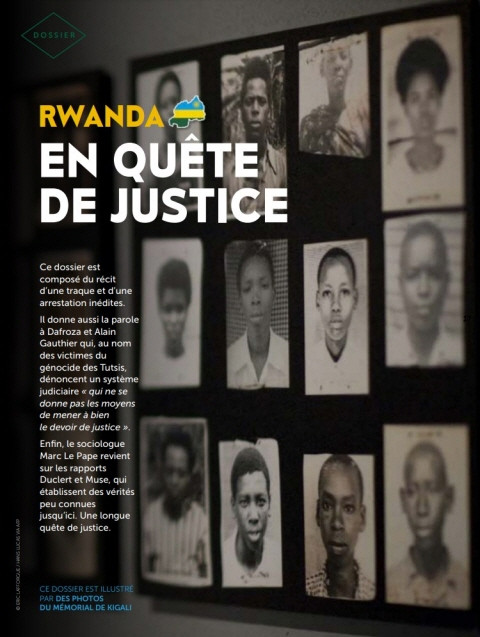 Rwanda: In Search of Justice(Humains; no.30) Year of publication: 2024 Corporate author: Action by Christians for the Abolition of Torture (ACAT France) On the thirtieth anniversary of the genocide of the Tutsis in Rwanda, ACAT-France looks back at this tragic event for human rights. Discover the dossier in the magazine Humains #32 devoted to this subject.