
Resources
Explore a wide range of valuable resources on GCED to deepen your understanding and enhance your research, advocacy, teaching, and learning.
1,828 Results found
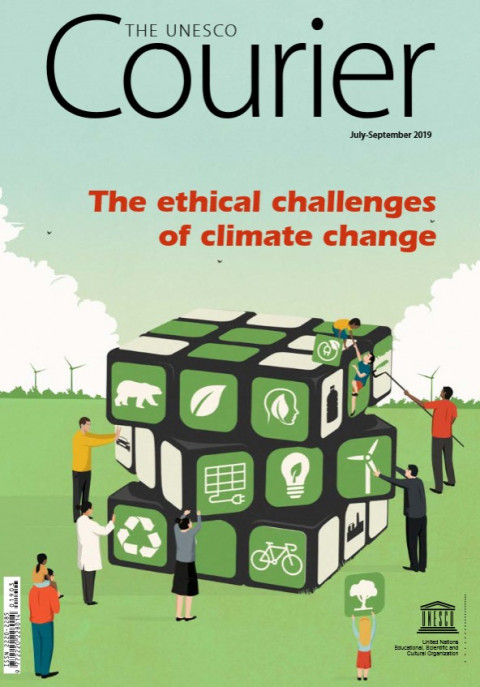 Défis climatiques, défis éthiques (Le Courrier de l'UNESCO 3, July-September 2019) Year of publication: 2019 Corporate author: Organisation des Nations Unies pour l'éducation, la science et la culture (UNESCO) Le changement climatique ne met pas seulement en péril nos écosystèmes : il ébranle le socle de nos droits fondamentaux, il creuse les inégalités et crée de nouvelles injustices. S’adapter au changement climatique et tenter d’en atténuer les effets n’est pas seulement affaire de connaissance scientifique et de volonté politique; cela implique une vue d’ensemble sur une situation complexe. Afin d’aider les États et les autres acteurs concernés à prendre des décisions appropriées et à mener des politiques efficaces en matière de développement durable, d’adaptation au changement climatique et d’atténuation de ses effets néfastes, l’UNESCO a adopté, en novembre 2017, une Déclaration de principes éthiques en relation avec le changement climatique.L’éthique constitue le cœur substantiel de tout engagement. Grâce à sa force mobilisatrice, elle permet d’orienter l’action, de faire des arbitrages, de trancher entre des intérêts contradictoires, de fixer des priorités. L’éthique permet d’articuler la théorie et la pratique, les principes généraux et la volonté politique, la prise de conscience globale et les actions locales.
  Facing the facts: the case for comprehensive sexuality education Year of publication: 2019 Author: Global Education Monitoring Report Team Corporate author: UNESCO Comprehensive sexuality education is an essential part of a good quality education that helps prepare young people for a fulfilling life in a changing world. It improves sexual and reproductive health outcomes, promotes safe and gender equitable learning environments, and improves education access and achievement. This paper, produced jointly with the Section for Health and Education at UNESCO, discusses how governments can overcome social resistance and operational constraints to scale up these programmes as part of their commitment to SDG 4, the global education goal. Regarder la réalité en face: pourquoi faut-il promouvoir l'éducation complète à la sexualité Year of publication: 2019 Author: Global Education Monitoring Report Team Corporate author: Organisation des Nations Unies pour l'éducation, la science et la culture (UNESCO) L'éducation complète à la sexualité est un élément indispensable d'une éducation de qualité qui aide les jeunes à s'épanouir dans un monde en mutation. Elle améliore les résultats en matière de santé sexuelle et reproductive, crée les conditions d'un apprentissage sûr et équitable du point de vue du genre, élargit l'accès à l'éducation et améliore les résultats scolaires. Ce document d'orientation, préparé avec la section de la santé et de l'éducation de l'UNESCO, explique comment les gouvernements peuvent surmonter les résistances sociales et les contraintes opérationnelles pour amplifier ces programmes, conformément à leur engagement envers l'ODD 4, l'objectif mondial d'éducation. Encarar los hechos: el caso de la educación integral en sexualidad Year of publication: 2019 Author: Global Education Monitoring Report Team Corporate author: Organización de las Naciones Unidas para la Educación, la Ciencia y la Cultura (UNESCO) La educación integral en sexualidad forma parte esencial de una educación de buena calidad que ayude a preparar a las y los jóvenes para llevar una vida plena en un mundo en evolución. Dicha educación mejora la salud sexual y reproductiva, promueve entornos de aprendizaje seguros y equitativos en cuanto al género y favorece el acceso a la educación y el rendimiento escolar. En este documento, elaborado conjuntamente con la Sección de la Salud y la Educación de la UNESCO, se analiza cómo los gobiernos pueden superar la resistencia social y las limitaciones operativas para ampliar estos programas en el marco de su compromiso con el ODS 4, el objetivo mundial relativo a la educación.
  4th Meeting of the SDG-Education 2030 Steering Committee, Paris, 28 February-02 March 2018: meeting report Year of publication: 2018 Corporate author: UNESCO This report summarizes the deliberations, the main recommendations adopted, and the decisions made at the 4th meeting of the SDG-Education 2030 Steering Committee (Paris, 28 February - 2 March 2018).The objectives of the meeting were: To define positions and recommendations of the SDG-Education 2030 Steering Committee on key strategic areas. To agree on a strategy for global review, monitoring and reporting process, in view of HLPF 2018 and the 2019 Reviews. To refine the advocacy, communication and outreach strategy of the SDG-Education 2030 Steering Committee To define next steps for the SDG-Education 2030 Steering Committee (next meeting, rotation of members, and the Global Education Meeting 2018). Quatrième Réunion du Comité directeur ODD-Education 2030, Paris, 28 février-02 mars 2018: rapport de la reunion Year of publication: 2018 Corporate author: Organisation des Nations Unies pour l'éducation, la science et la culture (UNESCO) Le présent rapport résume les débats qui ont eu lieu lors de la quatrième réunion du Comité directeur ODD – Éducation 2030 (Paris, 28 février – 2 mars 2018) et reprend les principales recommandations et décisions adoptées.La réunion s’était fixé les objectifs suivants : Définir les positions et les recommandations du Comité directeur ODD – Éducation 2030 dans des domaines stratégiques clés. Convenir d’une stratégie globale portant sur le processus d’examen, de suivi et d’établissement de rapports en vue de l’examen du HLPF 2018 et 2019. Affiner la stratégie du Comité directeur ODD – Éducation 2030 en matière de plaidoyer, de communication et de sensibilisation. Définir les prochaines étapes du Comité directeur ODD – Éducation 2030 (prochaine réunion, renouvellement des membres et Réunion mondiale sur l’éducation 2018).
 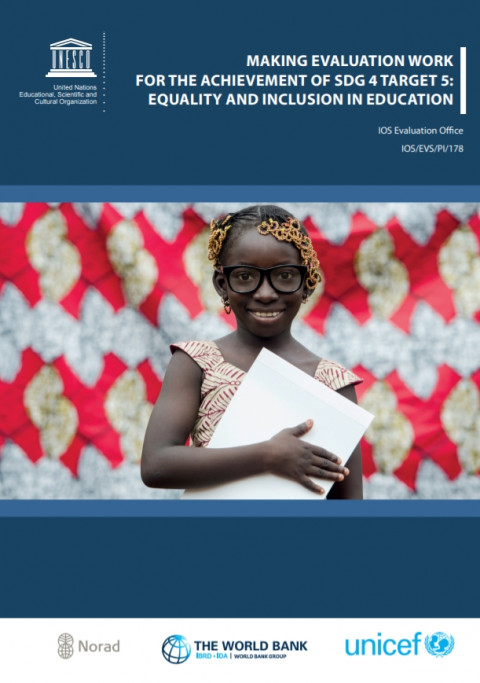 Making evaluation work for the achievement of SDG 4 target 5: equality and inclusion in Education Year of publication: 2019 Corporate author: UNESCO The adoption of the Sustainable Development Goals (SDGs) and the Education 2030 Framework for Action has placed gender parity, equality and inclusion in education at the heart of the international development agenda and is specifically formulated in SDG 4 Target 5. Now, as never before, relevant and contextualised evidence, driven in part by robust evaluation data, is needed to track and strengthen progress on educational equity. To this end, a group of international organisations, led by UNESCO, have combined efforts to explore how their education evaluations can better support Member States to strengthen progress on gender parity, equality and inclusion in education. The following report synthesises evidence from publicly available independent evaluations from 13 organisations, highlighting evidence gaps and summarising ‘what works’ for whom and in what contexts for advancing gender equality and equity for vulnerable groups. The study also reports on responses to the synthesis from national stakeholders in five countries: Ghana, Guatemala, Lebanon, Nepal and Peru. The report culminates in a discussion and recommendations, which outline the need for greater coordination and collaboration in four key areas to further enhance the contribution of evaluations to global and country level progress on SDG 4 Target 5.
 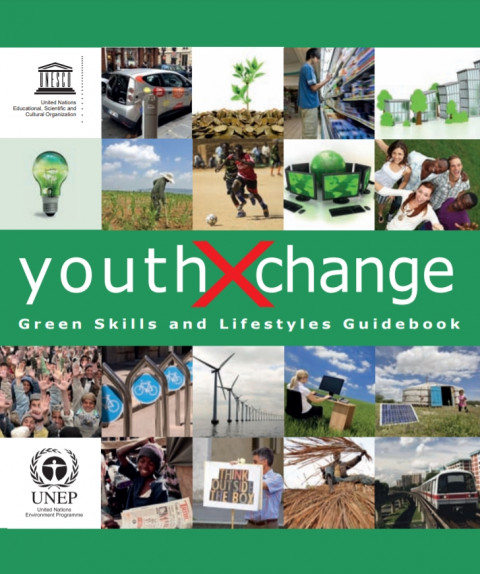 YouthXchange: green skills and lifestyles guidebook Year of publication: 2016 Author: Ryder. Guy, Steiner. Achim Corporate author: UNESCO | United Nations Environment Programme (UNEP) | UNESCO. Director-General, 2009-2017 (Bokova, I.G.) The YouthXchange Green Skills and Lifestyles Guidebook fills this gap. Developed by UNEP and UNESCO, in collaboration with the International Labour Organization (ILO), this Guidebook helps young people connect the talk about the green economy, green societies and green jobs to theirlifestyles. It focuses on the skills required to make these transitions – providing case studies and insight on green jobs and the skills they will require in terms of social innovation and entrepreneurship, the role of different stakeholders (government and private sector) and life skills. Young men and women are already driving change across the world. We must provide them with the skills they need to create new lifestyles and develop green jobs. Building a green future must start with training and education. It must start by listening to young people, by engaging their creativity and acting together.
  Teaching and Learning Transformative Engagement Year of publication: 2019 Corporate author: UNESCO While there is a large body of literature on citizenship and civic education, there is less clarity about the meaning of ‘responsible transformative engagement’ for young learners in relation to GCED and ESD – notably, the types of transformative engagement and the meaning of ‘responsible’. Understanding better the connection between learners’ engagement and education can clarify the knowledge, skills and competencies that schools may provide, as well as how the role of education can vary depending on context. In this light, this paper explores the meaning of ‘responsible transformative engagement’ with a view to clarifying the role of education in ways that may be reflected by UNESCO and other education stakeholders. Enseigner et apprendre l'engagement transformatif Year of publication: 2019 Corporate author: Organisation des Nations Unies pour l'éducation, la science et la culture (UNESCO) Si les ouvrages consacrés à la citoyenneté et à l’éducation civique foisonnent, le sens d’un « engagement transformatif responsable » pour de jeunes apprenants dans le contexte de l’ECM et de l’EDD est moins clairement défini, notamment les types d’engagement transformatif et la notion de « responsabilité ». Mieux comprendre le lien entre l’engagement des apprenants et l’éducation permet de clarifier les connaissances, aptitudes et compétences que l’école peut enseigner, ainsi que le rôle variable que peut jouer l’éducation selon le contexte. Dans cette optique, le présent document s’interroge sur le sens d’un « engagement transformatif responsable » en vue d’apporter des éclaircissements sur le rôle de l’éducation qui peuvent être pris en compte par l’UNESCO et d’autres acteurs de l’éducation.