
Resources
Explore a wide range of valuable resources on GCED to deepen your understanding and enhance your research, advocacy, teaching, and learning.
1,851 Results found
 General Policy Recommendation No. 15 of the European Commission against Racism and Intolerance: On Combating Hate Speech Year of publication: 2016 Corporate author: Council of Europe | European Committee against Racism and Intolerance (ECRI) The file is the recommendations of the European Committee against Racism and Intolerance on combating hate speech for countries. The file contains statistics and criteria established by the Commission. There are 10 recommendations made by the committee. توصية السياسة العامة رقم 15 للجنة الأوروبية لمناهضة العنصرية والتعصب: بشأن مكافحة خطاب الكراهية Year of publication: 2016 Corporate author: Council of Europe | European Committee against Racism and Intolerance (ECRI) الملف هو عبارة عن توصيات اللجنة الأوروبية لمناهضة العنصرية والتعصب بشأن مكافحة خطاب الكراهية للدول. يحتوي الملف على إحصائيات ومعايير وضعتها اللجنة. هناك 10 توصيات وضعتها اللجنة.
  Strategies to Counter Antisemitism: A Handbook for Educators Year of publication: 2025 Corporate author: UNESCO Education is the first line of defence against hate and prejudice. By targeting the root causes of hate ideologies, deconstructing the stereotypes that underlie them from an early age, and promoting inclusive models, education is the keystone of a holistic approach to combating discrimination. Tackling antisemitism through education requires tailored content that addresses its complex, shifting and multilayered forms, both past and present.Acknowledging the topic’s complexity and the paucity of resources available to education stakeholders, this concise guide developed by UNESCO and funded by the European Commission aims to provide a roadmap for policymakers, curriculum developers and educators on current approaches and initiatives. It presents ten educational practices, each grounded in academic literature and illustrated by a promising educational initiative that operationalizes core pedagogical principles. The handbook is built around the three core learning domains which inform UNESCO’s approach to Global Citizenship Education: cognitive, socio-emotional, and behavioural learning.Conceived as an accessible operational guide for practitioners, this resource sets out to start a larger conversation about the needs of educators for tackling contemporary forms of antisemitism. It aims to encourage investments in high-quality empirical research that can pave the way for a better approach to combat antisemitism.
 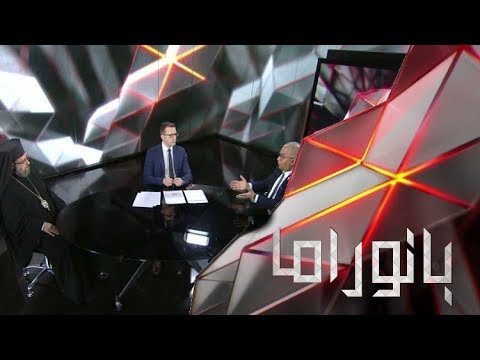 Interfaith Dialogue .. Dialogue of Life and Wise People Year of publication: 2019 Corporate author: RT Arabic Online Through this program, RT channel provides a seminar by hosting speakers to discuss the importance of interfaith dialogue and coexistence between all people from different religions. حوار الأديان .. حوار الحياة وحوار العقلاء Year of publication: 2019 Corporate author: RT Arabic Online تقدم قناة RT من خلال هذا البرنامج ندوة من خلال استضافة المتحدثين لمناقشة أهمية الحوار بين الأديان، والتعايش بين الجميع من مختلف الأديان.
  Quality Adult Education Benchmarks for Indigeneous Education Year of publication: 2011 Author: Sandra L. Morrison | Timote Vaioleti Corporate author: Asia South Pacific Association for Basic and Adult Education (ASPBAE) In November 2010, in Indonesia, Asia South Pacific Association for Basic and Adult Education(ASPBAE) brought together a number of educators from across its region to discuss benchmarking quality adult education for indigenous peoples. Educators came from across the ASPBAE region including the Philippines, India, Nepal, New Zealand, Australia, Thailand, Indonesia and Uzbekistan to share experiences and to build a collective understanding of what constitutes a good quality adult education program for indigenous peoples. Discussions were informed by a broader ASPBAE Quality Adult Education Framework, which had its origins in discussions held in 2009. The Core of the Framework is grounded on ASPBAE’s commitment to education as a right, adult education for transformation, and adult and basic education as integral and inter‐connected components of the vision of lifelong learning (Guevara, 2010). Other frameworks promoted by ASPBAE for education to be empowering, pro‐poor, gender just and sustainable were also important considerations. The 2010 gathering served as a nodal point to discuss the ASPBAE framework more deeply and to reaffirm or create a set of benchmarks for indigenous education which can be validated through a subsequent national and regional consultation process.
  Comprehensive Societal Integration of People with Disabilities in the Arab and Islamic Society (A Historical-original View) Year of publication: 2012 Author: Ibrahim Alnuqythan Corporate author: Gulf Society for Diability The file is a research paper that discusses the comprehensive integration of persons with disabilities in the Arab and Islamic world. The paper seeks to answer the following questions:- Did the disabled in the Arab-Islamic civilization have a comprehensive integration into society?What are the examples of this integration in the Arab-Islamic civilization?The paper discussed and touched on live models that show the reality of inclusion of persons with disabilities in society. الدمج المجتمعي الشامل لذوي الإعاقة في المجتمع العربي الإسلامي (نظرة تاريخية-تأصيلية) Year of publication: 2012 Author: Ibrahim Alnuqythan Corporate author: Gulf Society for Diability الملف عبارة عن ورقة بحثية تناقش الدمج الشامل للمعوقين في الوطن العربي والإسلامي. وتسعى الورقة للإجابة عن الأسئلة التالية:- هل كان للمعوقين في الحضارة العربية الإسلامية دمج شامل في المجتمع؟- ما النماذج على هذا الدمج في الحضارة العربية الإسلامية؟ولقد ناقشت الورقة وتطرقت لنماذج حية تظهر واقع ادماج المعوقين في المجتمع.
  파리협정 함께 보기 Year of publication: 2022 Corporate author: 대한민국 환경부 기후변화국제협력팀 | 한국환경공단 기후정책지원부 이 책자는 ‘파리협정(Paris Agreement)’에 대한 우리 국민의 이해를 높이고, 모든 사회 주체가 함께하는 파리협정 이행 체계를 조성하는데 도움이 되고자 제작되었습니다.이 책자는 환경부와 한국환경공단이 공동으로 발간한 「파리협정 길라잡이(’16.5)」와 「파리협정 이행규칙 안내서(’19.6)」를 통합·개정·증보한 것으로, 기존 발간 자료는 환경부 누리집(me.go.kr)>발행물>환경책자>알기쉬운 소책자에서 받아볼 수 있습니다. 발행처: 환경부 기후변화국제협력팀 (044-201-6601)발행일: 2022.3.31
 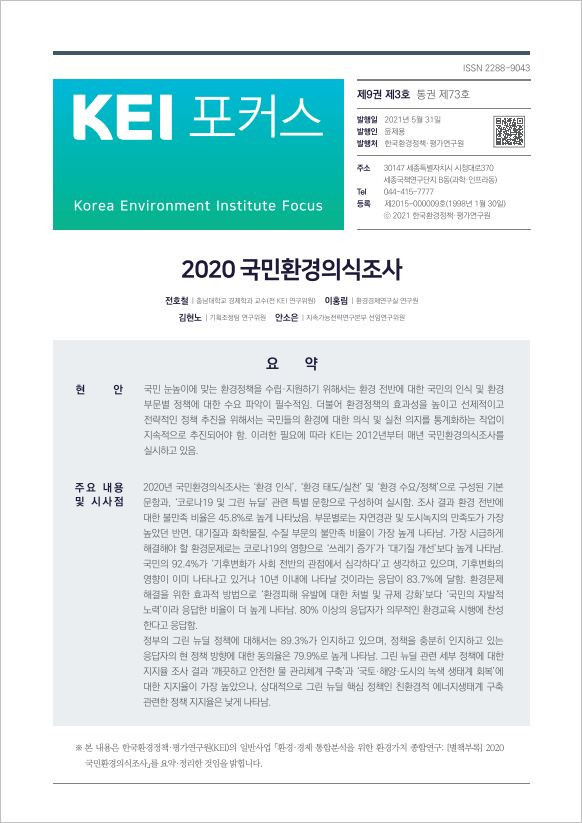 2020 국민환경의식조사 (KEI 포커스 제9권 통권 73호) Year of publication: 2021 Author: 전호철 | 이홍림 | 김현노 | 안소은 Corporate author: 한국환경정책·평가연구원 2020년 국민환경의식 조사는 '환경인식', '환경태도/실천' 및 '환경수요/정책/으로 구성된 기본 문항과 '코로나19 및 그린 뉴딜' 관련 특별 문항으로 구성하여 실시하였다. 조사 결과 환경 전반에 대한 불만족 비율은 45.8%로 높게 나타났으며 부문별로는 자연경관 및 도시녹지의 만족도가 가장 높았던 반면 대기질과 화학물질, 수질 부문의 불만족 비율이 가장 높게 나타났다. 가장 시급하게 해결해야 할 환경문제로는 코로나19의 영향으로 '쓰레기 증가'가 '대기질 개선' 보다 높게 나타났다. 본 저작물은 한국환경정책·평가연구원에서 2021년 작성하여 공공누리 제4유형으로 개방한 '2020 국민환경의식조사(작성자: 전호철)'을 이용하였으며, 해당 저작물은 한국환경연구원 홈페이지(https://www.kei.re.kr/)에서 무료로 내려받으실 수 있습니다.