
Resources
Explore a wide range of valuable resources on GCED to deepen your understanding and enhance your research, advocacy, teaching, and learning.
1,851 Results found
 Addressing Anti-semitism in Schools: Training Curriculum for School Directors Year of publication: 2020 Corporate author: UNESCO | OSCE. Office for Democratic Institutions and Human Rights (ODIHR) This OSCE/ODIHR and UNESCO co-publication aims to help school directors to prevent and respond to anti-Semitism. The curriculum, intended for school director trainers, is designed to be comprehensive, robust, practical and adaptable. It suggests concrete ways to address anti-Semitism and counter prejudice in and through education, while promoting human rights, global citizenship education, and gender equality.The co-publication is part of a series of four training curricula, designed for trainers of (1) primary school teachers, (2) secondary school teachers, (3) vocational school teachers, and (4) school directors.
  Schools and war: urgent agendas for comparative and international education Year of publication: 2005 Author: Lynn Davies Corporate author: Taylor & Francis This paper looks first at the contributions that education makes to conflict, through the reproduction of inequality and exclusion, through perpetuation of ethnic or religious divisions, through its acceptance of dominant aggressive masculinities, through selection, competition and fear, and through distorted curricular emphases on narrow cognitive areas of learning. However, the paper also outlines some ‘possibilities for hope’, such as resilient schools, the impact of peace education initiatives and the rise of global citizenship education. Schools and war: urgent agendas for comparative and international education Year of publication: 2005 Author: Lynn Davies Corporate author: Taylor & Francis Cet article examine en premier lieu les contributions de l'éducation aux conflits, à travers la reproduction de l'inégalité et de l’exclusion, la perpétuation des divisions ethniques ou religieuses, l’acceptation de la dominance de l’agressivité masculine ; à travers la sélection, la compétition et la peur, et à travers une déformation des programmes scolaires mettant l’accent sur des zones cognitives étroites de l'apprentissage. Toutefois, le document décrit également quelques « notes positives », telles que les écoles de la résilience, l'impact des initiatives de l'éducation à la paix et l’importance croissante donnée à l'éducation à la citoyenneté mondiale.
  Lessons Learned from Mental Health and Education: Identifying Best Practices for Addressing Violent Extremism Year of publication: 2015 Author: Stevan Weine | B. Heidi Ellis | Ron Haddad | Alisa B. Miller | Rebecca Lowenhaupt | Chloe Polutnik Corporate author: National Consortium for the Study of Terrorism and Responses to Terrorism (START) The overall purpose of this research was to identify assets from the mental health and education fields that could contribute to best practices for preventing and intervening against violent extremism. Specifically we aimed to address the following questions:1) What prior knowledge, programmes or interventions within the mental health and education fields could contribute to best practices and other strategies that could help stop violent extremism? 2) How can professionals from the mental health and education fields best become involved in stopping violent extremism? Lessons Learned from Mental Health and Education: Identifying Best Practices for Addressing Violent Extremism Year of publication: 2015 Author: Stevan Weine | B. Heidi Ellis | Ron Haddad | Alisa B. Miller | Rebecca Lowenhaupt | Chloe Polutnik Corporate author: National Consortium for the Study of Terrorism and Responses to Terrorism (START) Il s’agit dans cette recherche d'identifier des ressources dans le domaine de l'éducation à la santé mentale qui pourraient contribuer aux meilleures pratiques dans la prévention et l'intervention contre l'extrémisme violent. Plus précisément, les auteurs ont cherché à répondre aux questions suivantes : 1) Quelles sont les connaissances, les programmes ou les interventions requis dans le domaine de l'éducation à la santé mentale pouvant contribuer aux meilleures pratiques et autres stratégies dans la lutte contre l'extrémisme violent ? 2) Comment les professionnels de l'éducation à la santé mentale peuvent s’impliquer davantage dans la lutte contre l'extrémisme violent ?
  2023 Asia-Pacific Regional Global Citizenship Education (GCED): Network Activities Summary Report Year of publication: 2023 Author: Seek Ling Tan Corporate author: UNESCO Bangkok This is a summary report from the Global Citizenship Education (GCED) network activities in Asia-Pacific in 2023. The Asia-Pacific Regional Global Citizenship Education Network, spearheaded by UNESCO Bangkok and the Asia-Pacific Centre of Education for International Understanding (APCEIU), has illuminated the path to empower learners to become global citizens since its inception in 2018. In 2023, their journey was punctuated by significant milestones and a revitalized commitment to propel GCED across the region. This commitment is particularly evident in the key priority areas of advocacy, capacity building, learning/teaching materials, policy and research and the synergizing of regional collaboration towards Education 2030.
 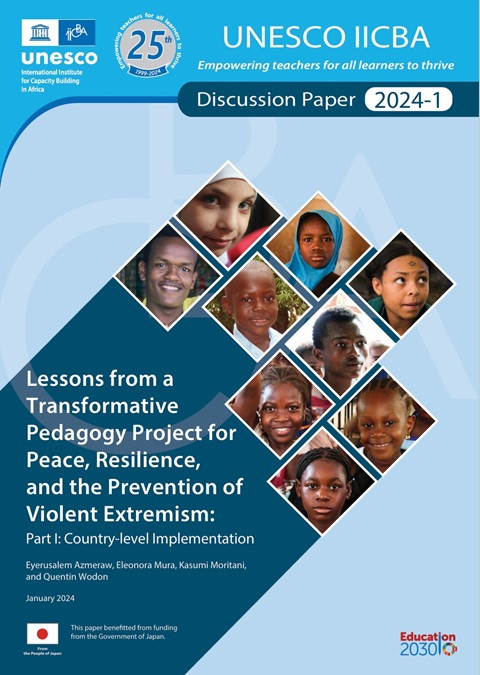 Lessons from a Transformative Pedagogy Project for Peace, Resilience, and the Prevention of Violent Extremism: Part I; Country-Level Implementation Year of publication: 2024 Author: Eyerusalem Azmeraw | Quentin Wodon | Eleonora Mura | Kasumi Moritani Corporate author: UNESCO International Institute for Capacity-Building in Africa (IICBA) From 2017 to 2022, UNESCO’s International Institute for Capacity Building in Africa (IICBA) led a series of projects for peacebuilding and the prevention of violent extremism through education with support from the Government of Japan. This two-part paper draws lessons from the projects. The first part of the paper briefly explains the transformative pedagogy approach that guided project implementation and provides examples of changes that were implemented at the country level under the projects. The analysis is qualitative, with the aim being to outline, through country examples, what can be achieved through such projects. Lessons on factors contributing to impact are also outlined.
 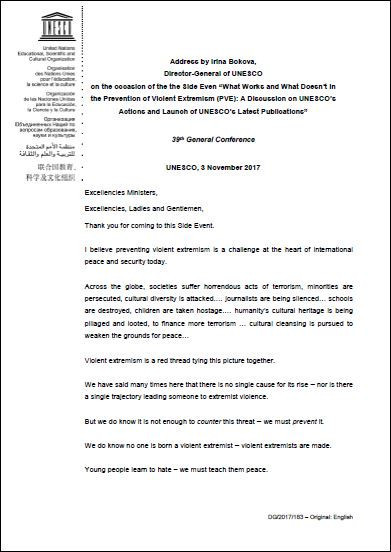 Address by Irina Bokova, Director-General of UNESCO on the occasion of the the Side Even “What Works and What Doesn’t in the Prevention of Violent Extremism (PVE)” Year of publication: 2017 Corporate author: UNESCO. Director-General, 2009-2017 (Bokova, I.G.) This Address was delivered by Irina Bokova, Director-General of UNESCO on the occasion of the the Side Even “What Works and What Doesn’t in the Prevention of Violent Extremism (PVE): A Discussion on UNESCO’s Actions and Launch of UNESCO’s Latest Publications”.
 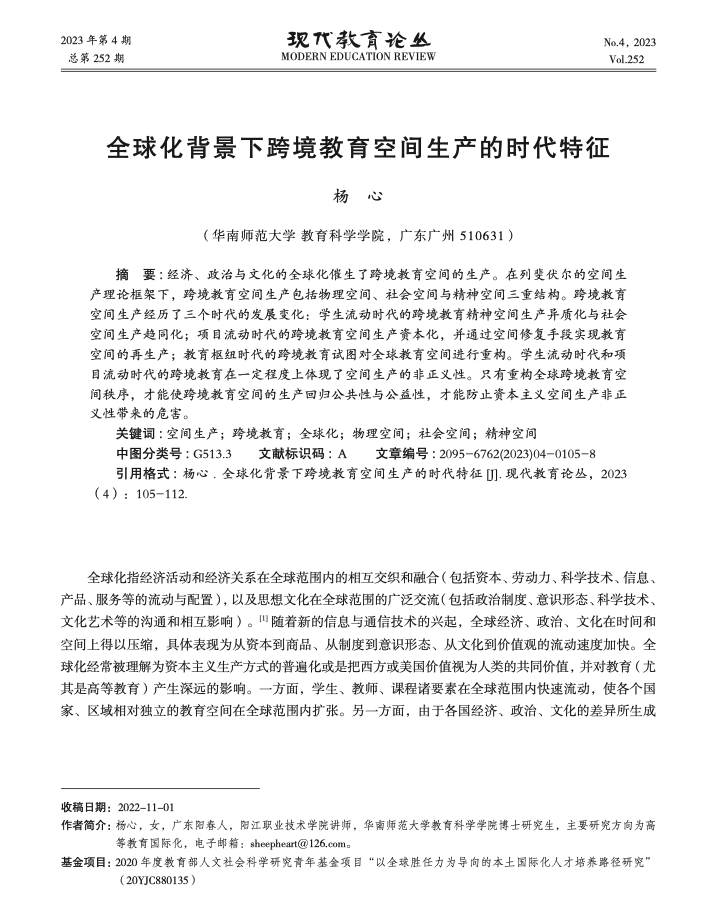 全球化背景下跨境教育空间生产的时代特征 Year of publication: 2023 Author: 杨心 经济、政治与文化的全球化催生了跨境教育空间的生产。在列斐伏尔的空间生产理论框架下,跨境教育空间生产包括物理空间、社会空间与精神空间三重结构。跨境教育空间生产经历了三个时代的发展变化:学生流动时代的跨境教育精神空间生产异质化与社会空间生产趋同化;项目流动时代的跨境教育空间生产资本化,并通过空间修复手段实现教育空间的再生产;教育枢纽时代的跨境教育试图对全球教育空间进行重构。学生流动时代和项目流动时代的跨境教育在一定程度上体现了空间生产的非正义性。只有重构全球跨境教育空间秩序,才能使跨境教育空间的生产回归公共性与公益性,才能防止资本主义空间生产非正义性带来的危害。
 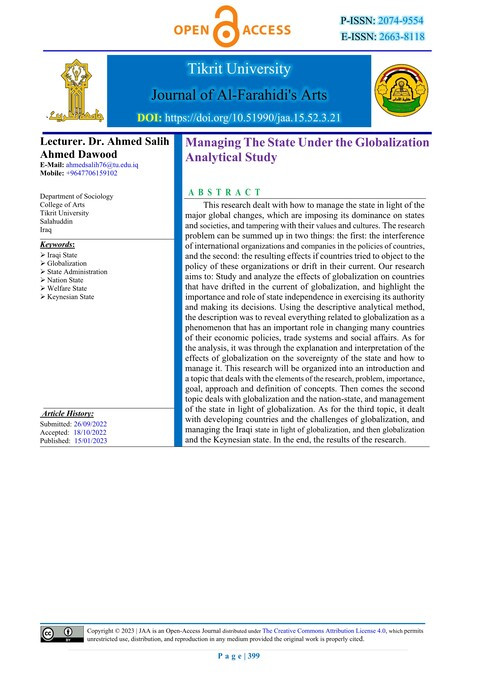 Managing the State Under the Globalization Analytical Study (Journal of Al Farahidi's Arts; Vol.15, Issue 52-3) Year of publication: 2023 Author: Ahmed Saleh Ahmed Dawood Corporate author: Tikrit University This research dealt with how to manage the state in light of the major global changes, which are imposing its dominance on states and societies, and tampering with their values and cultures. The research problem can be summed up in two things: the first: the interference of international organizations and companies in the policies of countries, and the second: the resulting effects if countries tried to object to the policy of these organizations or drift in their current. Our research aims to: Study and analyze the effects of globalization on countries that have drifted in the current of globalization, and highlight the importance and role of state independence in exercising its authority and making its decisions. Using the descriptive analytical method, the description was to reveal everything related to globalization as a phenomenon that has an important role in changing many countries of their economic policies, trade systems and social affairs. As for the analysis, it was through the explanation and interpretation of the effects of globalization on the sovereignty of the state and how to manage it. This research will be organized into an introduction and a topic that deals with the elements of the research, problem, importance, goal, approach and definition of concepts. Then comes the second topic deals with globalization and the nation-state, and management of the state in light of globalization. As for the third topic, it dealt with developing countries and the challenges of globalization, and managing the Iraqi state in light of globalization, and then globalization and the Keynesian state. In the end of the research, resuls will be presented and recommendations will be made.