
Resources
Explore a wide range of valuable resources on GCED to deepen your understanding and enhance your research, advocacy, teaching, and learning.
1,828 Results found
 Mechanisms to overcome Islamic extremism in the context of ensuring the national security of the countries of Central Asia Year of publication: 2018 Author: Gandzina F. Safarova In this article, the author considers the legal aspects of combating extremism in Central Asia, as well as educational and ideological components to combat this phenomenon and cooperation of all three republics with international organizations and other countries of the world in the fight against extremism. Механизмы преодоления исламского экстремизма в контексте обеспечения национальной безопасности стран Центральной Азии Year of publication: 2018 Author: Gandzina F. Safarova В данной статье мы рассмотрим пра-вовые аспекты борьбы с экстремизмом в Центральной Азии, а также образовательные и идеологические составляющие по борьбе с данным явлением и сотруд-ничество всех трех республик с междуна-родными организациями и другими стра-нами мира в борьбе с экстремизмом.
  Terrorism and religious extremism in Central Asia: problems of perception. Case of Kazakhstan and Kyrgyzstan Year of publication: 2016 Author: Anastasiya Reshetnyak Based on the results of a sociological research, the paper presents a comprehensive analysis of public opinion on the problems of securitization of terrorism and religious extremism in modern Kazakhstan and Kyrgyzstan. The publication is addressed to researchers, teachers and students of social and humanitarian faculties, specializing in international relations, political science, sociology, religious studies, as well as employees of government agencies working in relevant areas. Терроризм и религиозный экстремизм в Центральной Азии: проблемы восприятия. Кейс Казахстана и Кыргызстана Year of publication: 2016 Author: Anastasiya Reshetnyak В этой статье рассматриваются актуальные проблемы межкультурного диалога в странах Центральной Азии. Особое место отводится Кыргызстану как полиэтническому и поликультурному государству на постсоветском пространстве, у которого, по мнению автора, большие возможности участия в процессе культурной интеграции с соседними и дружественными странами бывшего советского государства.
  UNESCO IICBA: strategic plan Year of publication: 2019 Corporate author: UNESCO International Institute for Capacity-Building in Africa (IICBA) UNESCO IICBA’s Strategic Plan for 2018-2021 is guided by its mandate and mission to strengthen the capacity of Member States in Africa in teacher policy and development. This work is vital to realizing its vision of an integrated, prosperous and peaceful Africa where everyone has access to qualified, motivated and professionally supported teachers. This plan is supported by a vision for Strategic Partnerships, because UNESCO IICBA recognizes their value in promoting regional and national cooperation in teacher-related issues, and in fostering dialogue on teachers and education. Strategic partnerships have three objectives:Successfully implement UNESCO IICBA’s Strategic Plan 2018-2021 Ensure the efficiency and effectiveness of resource mobilizationStrengthen advocacy, cooperation and coordination mechanisms The Strategic Plan is also supported by a Communication Strategy that covers all of UNESCO IICBA’s programme areas and will support collaboration, coordination and institutional operations. The strategy aims to contribute to effective communication that will:Help to fulfill UNESCO IICBA’s strategic goals and objectivesAmplify the visibility of UNESCO IICBA to its stakeholdersInform partners and donors on implementation progress, and demonstrate UNESCO IICBA’s accountabilityEnsure people understand what UNESCO IICBA represents and doesImprove teachers’ professional image and raise awareness to address teachers’ issues in AfricaKeep UNESCO IICBA team members proud, motivated, innovative and accountable in their tasks
  Dialogue of cultures in integration processes in Central Asia Year of publication: 2017 Author: S. Kalimova The article discusses topical problems of intercultural dialogue in the countries of Central Asia. The overall place is given to Kyrgyzstan as a multientic and multicultural state in the post-Soviet space, which in the process of cultural integration with neighbors and friendly countries of the former Soviet Union. Диалог культур в интеграционных процессах в Центральной Азии Year of publication: 2017 Author: S. Kalimova В этой статье рассматриваются актуальные проблемы межкультурного диалога в странах Центральной Азии. Особое место отводится Кыргызстану как полиэтническому и поликультурному государству на постсоветском пространстве, у которого, по мнению автора, большие возможности участия в процессе культурной интеграции с соседними и дружественными странами бывшего советского государства.
 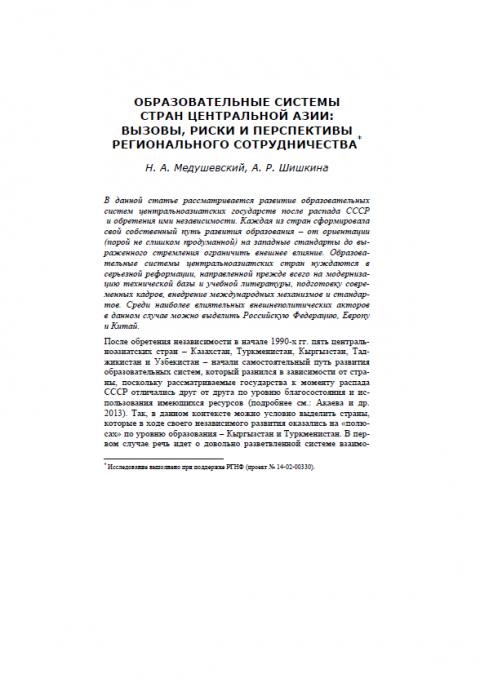 Educational systems of Central Asian countries: challenges, risks and prospects for regional cooperation Year of publication: 2014 Author: Nikolay A. Medushevskiy | Alisa R. Shishkina This article discusses the development of educational systems of Central Asian states after the collapse of the USSR and their independence. Each country has formed their own path of development of education - from orientation (sometimes not too thoughtful) on Western standards to a pronounced desire to limit external influence. The educational systems of the Central Asian countries need a serious reformation, aimed primarily at modernizing the technical base and textbooks, training modern personnel, introducing international mechanisms and standards. Образовательные системы стран Центральной Азии: вызовы, риски и перспективы регионального сотрудничества Year of publication: 2014 Author: Nikolay A. Medushevskiy | Alisa R. Shishkina В данной статье рассматривается развитие образовательных систем центральноазиатских государств после распада СССР и обретения ими независимости. Каждая из стран сформироваласвой собственный путь развития образования – от ориентации(порой не слишком продуманной) на западные стандарты до выраженного стремления ограничить внешнее влияние. Образовательные системы центральноазиатских стран нуждаются в серьезной реформации, направленной прежде всего на модернизацию технической базы и учебной литературы, подготовку современных кадров, внедрение международных механизмов и стандартов
 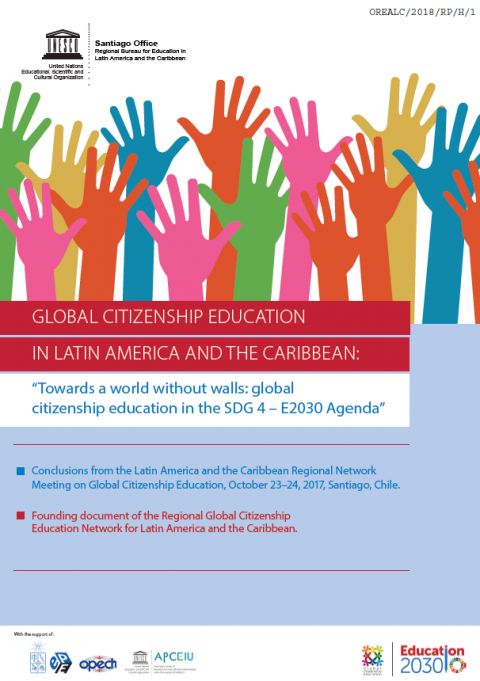 Global Citizenship Education in Latin America and the Caribbean: Towards a World without Walls: Global Citizenship Education in the SDG 4 - E2030 Agenda Year of publication: 2018 Corporate author: UNESCO Santiago The Latin America and the Caribbean Regional Network Meeting on Global Citizenship Education “Towards a World without Walls: Global Citizenship Education in SDG 4 – Agenda E2030”, was organized by the UNESCO Regional Bureau for Education in Latin America and the Caribbean (OREALC / UNESCO Santiago) and the Asia – Pacific Centre of Education for International Understanding (APCEIU), in collaboration with the Chilean Observatory of Educational Policies (OPECH) of the University of Chile. The event, held on October 23 and 24, 2017, in Santiago, Chile, brought together regional researchers, members of civil society organizations and activists, educational communities, social movements, government educational authorities and universities. The objective of the meeting was to promote dialogue on the concept of Global Citizenship Education (GCED), deepen the regional perspective on the topic and create a network that helps strengthen the implementation of GCED in the context of the Latin America and the Caribbean region. This document summarizes the main topics addressed and issues discussed at the meeting. Subsequently, the founding document of the Regional Global Citizenship Education Network for Latin America and the Caribbean, which was elaborated in light of the meeting’s discussions, is presented.