
Resources
Explore a wide range of valuable resources on GCED to deepen your understanding and enhance your research, advocacy, teaching, and learning.
1,828 Results found
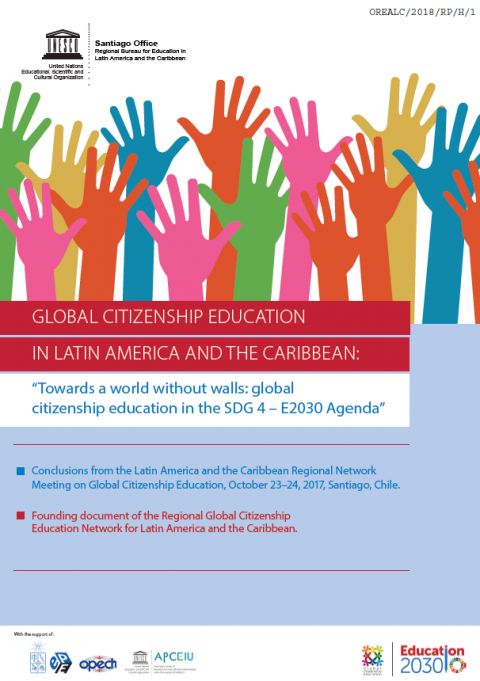 Educación para la Ciudadanía Mundial en América Latina y el Caribe: Hacia un mundo sin muros: educación para la ciudadanía mundial en el ODS4 - Agenda E2030 Year of publication: 2018 Corporate author: UNESCO Santiago La Reunión Regional para América Latina y el Caribe de la Red de Educación para la Ciudadanía Mundial “Hacia un mundo sin muros: educación para la ciudadanía mundial en el ODS 4 – Agenda E2030”, fue organizada por la Oficina Regional de Educación para América Latina y el Caribe (OREALC / UNESCO Santiago) y el Centro de Educación para la Comprensión Internacional de Asia-Pacífico (APCEIU), en colaboración con el Observatorio Chileno de Políticas Educativas de la Universidad de Chile (OPECH). La cita se desarrolló el 23 y 24 de octubre de 2017 en Santiago de Chile, y a ella fueron convocados pensadores y activistas de la región, provenientes de organizaciones de la sociedad civil, comunidades educativas, movimientos sociales, organismos gubernamentales y universidades. El objetivo de la reunión fue promover el diálogo sobre el concepto de Educación para la Ciudadanía Mundial (ECM) y profundizar en una mirada regional para propiciar la conformación de una red que permita fortalecer la implementación de la ECM, situada en el contexto de América Latina y el Caribe. Se presenta este documento como síntesis de las principales temáticas que fueron abordadas y discutidas en el encuentro. A continuación, se presenta el documento fundacional que establece la Red Regional de Educación para la Ciudadanía Mundial para América Latina y el Caribe, que fue elaborada a raíz de las discusiones.
 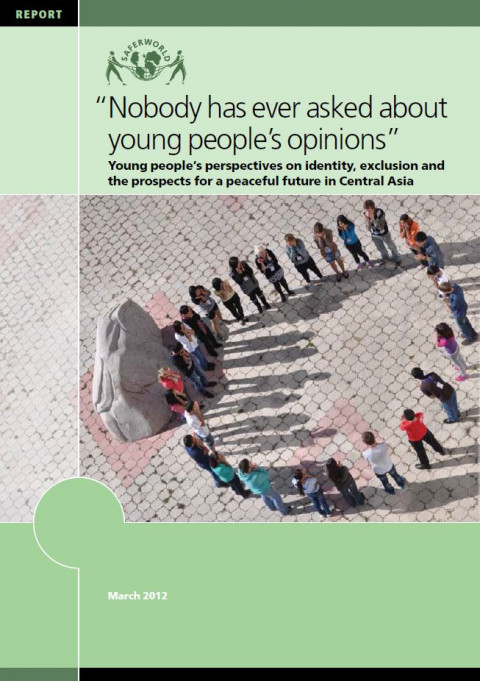 “Nobody Has Ever Asked About Young People’s Opinions”: Young People’s Perspectives on Identity, Exclusion and the Prospects for a Peaceful Future in Central Asia Year of publication: 2012 Corporate author: Saferworld This report offers a number of recommendations for the governments of Central Asian countries, as well as for international donor organizations that provide financial assistance to these states. Recommendations include suggestions priorities and approaches related to institutional and state construction; proposals on creating favorable conditions for enhancing youth participation in political processes; suggestions on how to instill in young people the skills necessary to participate in democratic processes; how to strengthen social unity through building intercommunal dialogue and intergenerational dialogue; as well as how to fight extremism. «Никто и никогда не спрашивал мнения молодежи»: Взгляды молодых людей на вопросы идентичности, изоляции и перспектив мирного будущего в Центральной Азии Year of publication: 2012 Corporate author: Saferworld Данный отчет предлагает ряд рекомендаций для правительств стран Центральной Азии, а также для международных донорских организаций, которые предоставляют финансовую помощь этим государствам. Рекомендации включают предложения приоритетов и подходов, связанных с институциональным и государственным строительством; предложения по вопросам создания благоприятних условий для активизации участия молодежи в политических процессах; предложения как привить молодым людям навыки, необходимые для участия в демократических процессах; как усилить социальное единство через построение межобщинного диалога и диалога между поколениями; а также как бороться с экстремизмом.
  العدالة الاجتماعية وسياسات الإنفاق العام في دول الثورات العربية Year of publication: 2014 Author: Ali Abdul Qadir Ali Corporate author: Arab Center for Research and Policy Studies تهدف هذه الورقة إلى إبراز التحدّي الذي سيواجه دول الثورات العربية في صوْغها سياسات إنفاقٍ عامّ تلبّي ما طالبت به الثورات. في سبيل ذلك، تنظر الورقة إلى الثورات العربية بوصفها سعيًا نحو تأسيس أنظمة حكم ديمقراطية؛ بمعنى إنشاء مؤسسات سياسية تعددية وما يعني ذلك لكفاءة المؤسسات الاقتصادية. وتقترح الورقة أن طبيعة تحدّي صوْغ إنفاق عامّ ملائمة لطموحات الثورات في تحقيق عدالة اجتماعية تتمثّل في خلوّ جعبة المؤسسات الدولية المانحة للعون التنموي، كما يمثّلها صندوق النقد الدولي، من فكرٍ تنموي جديد في مجال صوْغ سياسات الإنفاق العامّ على الرغم من وجود الشواهد التطبيقية التي توضح نجاعة سياسات الإنفاق العامّ التوزيعية في تحقيق العدالة الاجتماعية. وهي شواهد تستعرضها الورقة، التي تعرض أيضًا نتائج تطبيقية ناجمة عن حجم الطبقة الوسطى في عيّنة دول الثورات العربية، وتوضح أن هذه الطبقة تمثّل أغلبية السكّان في هذه الدول، وتقترح أن الانتقال إلى نظام حكم ديمقراطي يستند إلى تفضيلات الناخبين من شأنه أن يفرض اتّباع سياسات إنفاق عامّ توزيعية، حيث يقوم الناخب الوسيط بدور محوري في اختيار مثل هذه السياسات. Social Justice and Public Expenditure Policies in the Arab Revolutions Year of publication: 2014 Author: Ali Abdul Qadir Ali Corporate author: Arab Center for Research and Policy Studies This paper examines the challenges faced by Arab spring states when formulating public expenditure policies that meet the revolutions’ demands. In an attempt to establish democratic regimes, the Arab revolutions dictated the creation of pluralist political institutions with concomitant implications for economic institutions. The paper suggests that the challenge of formulating a public expenditure policy in line with the revolutions’ aspirations for social justice lies in the inability of international development agencies, such as the IMF, to propose new and innovative ideas for formulating development policy. However, there are successful applied examples of distributive public expenditure policies for creating social justice. The paper reviews these examples in addition to the results of a survey identifying the size of the middle class in samples of Arab spring states. The survey demonstrates that the middle class represents a majority of population in these countries, suggesting that the transition to electoral democracy requires adopting distributional public expenditure policies in which the middle class voter occupies a central role.
  Counting on the World to Act: A Roadmap for Governments to Achieve Modern Data Systems for Sustainable Development Year of publication: 2019 Corporate author: Sustainable Development Solutions Network Thematic Research Network on Data and Statistics (SDSN TReNDS) Eradicating poverty and hunger, ensuring quality education, instituting affordable and clean energy, and more – the Sustainable Development Goals (SDGs) lay out a broad, ambitious vision for our world. But there is one common denominator that cuts across this agenda: data. Without timely, relevant, and disaggregated data, policymakers and their development partners will be unprepared to turn their promises into reality for communities worldwide. With only eleven years left to meet the goals, it is imperative that we focus on building robust, inclusive, and relevant national data systems to support the curation and promotion of better data for sustainable development. In Counting on the World to Act, TReNDS details an action plan for governments and their development partners that will enable them to help deliver the SDGs globally by 2030. Our recommendations specifically aim to empower government actors – whether they be national statisticians, chief data scientists, chief data officers, ministers of planning, or others concerned with evidence in support of sustainable development – to advocate for, build, and lead a new data ecosystem.
  Information Flows and Radicalization Leading to Violent Extremism in Central Asia Year of publication: 2019 Corporate author: Search for Common Ground This study was carried out as part of the regional project “Promoting Stability and Peace in Central Asia through Media Literacy, Effective Lighting and Regional Cooperation”, implemented by the Internews office and funded by the European Union. The project aims to support national and regional initiatives that help prevent radicalization in Central Asia by increasing the capacity of journalists, civic activists and media professionals in the production of high-quality media content and the level of critical media consumption of representatives of civil society, decision-makers and active citizens. Информационные потоки и радикализация, ведущая к насильственному экстремизму в Центральной Азии Year of publication: 2019 Corporate author: Search for Common Ground Данное исследование проведено в рамках регионального проекта «Содействие стабильности и миру в Центральной Азии посредством медиаграмотности, эффективного освещения и регионального сотрудничества», реализуемого офисом Интерньюс и финансируемого Европейским союзом. Проект нацелен на поддержку национальных и региональных инициатив, способствующих предотвращению радикализации в Центральной Азии через повышение потенциала журналистов, гражданских активистов и медиаспециалистов в вопросах производства качественного медиаконтента и уровня критического медиапотребления представителей гражданского общества, лиц, принимающих решения, и активных граждан.
  Sustainable Development Report 2019: Transformations to Achieve the Sustainable Development Goals Year of publication: 2019 Corporate author: Bertelsmann Stiftung and Sustainable Development Solutions Network The Sustainable Development Report 2019 presents the SDG Index and Dashboards for all UN member states and frames the implementation of the Sustainable Development Goals (SDGs) in terms of six broad transformations. It was prepared by teams of independent experts at the Sustainable Development Solutions Network (SDSN) and the Bertelsmann Stiftung.
  Achieving gender equality in and through education Year of publication: 2019 Corporate author: GPE The purpose of this paper is to describe the current landscape in gender equality in education and spark discussion and debate around potential areas for Knowledge and Innovation Exchange (KIX) investment. The paper is part of a series of discussion papers, drafted to support the engagement and consultation of developing country partners and technical experts in the initial design of the GPE Knowledge and Innovation Exchange.