
Resources
Explore a wide range of valuable resources on GCED to deepen your understanding and enhance your research, advocacy, teaching, and learning.
1,828 Results found
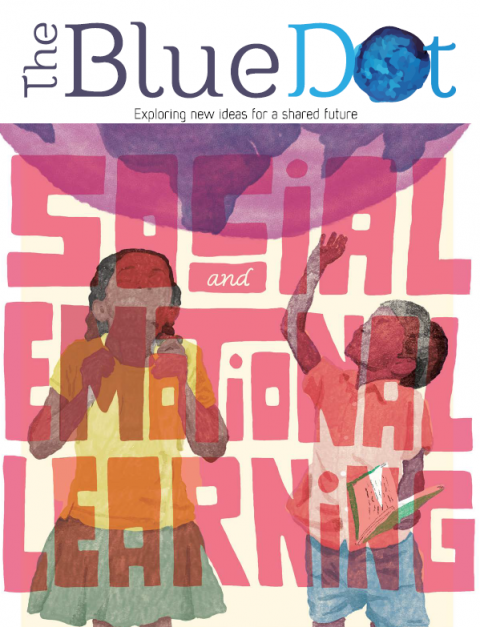 Social and emotional learning (The Blue Dot Issue 10, 2019) Year of publication: 2019 Corporate author: Mahatma Gandhi Institute of Education for Peace and Sustainable Development (MGIEP) The tenth edition of The Blue DOT focuses on different aspects of social and emotional learning, including the neurosciences, teacher training, frameworks such as CASEL and SEE Learning and systemic SEL, amongst others. The issue includes a Foreword by Dr. Richard Davidson, William James and Vilas Professor of Psychology and Psychiatry at the University of Wisconsin–Madison and the Founder and Director of the Center for Healthy Minds, and our Cover Story that focuses on how SEL can help to achieve the United Nations Sustainable Development Goals (SDGs). Additionally, it features interviews and opinions from some of the world’s most prominent SEL experts on the importance of integrating SEL in our education systems. Amongst various experts, we hear from Kimberly Schonert-Reichl on her journey in SEL, Robert W. Roeser on “Educating the Head, the Heart and the Hand in the 21st Century” as well as Roger P. Weissberg and Joseph L. Mahoney on “What is Systemic Social and Emotional Learning and Why Does it Matter”? Further, a featured article with responses to a survey by teachers from 4 countries (Bhutan, India, South Africa and Sri Lanka), following the launch of the Institute’s SEL modules on Global Citizenship in a workshop conducted in New Delhi, India in April 2019 is presented. The modules have been rendered on MGIEP’s in house Artificial Intelligence (AI) driven digital platform now called FramerSpace (formerly CHI) and allow the student to have an interactive, instantaneous feedback and immersive experience while addressing contemporary issues such as migration, nationalism and violence.
 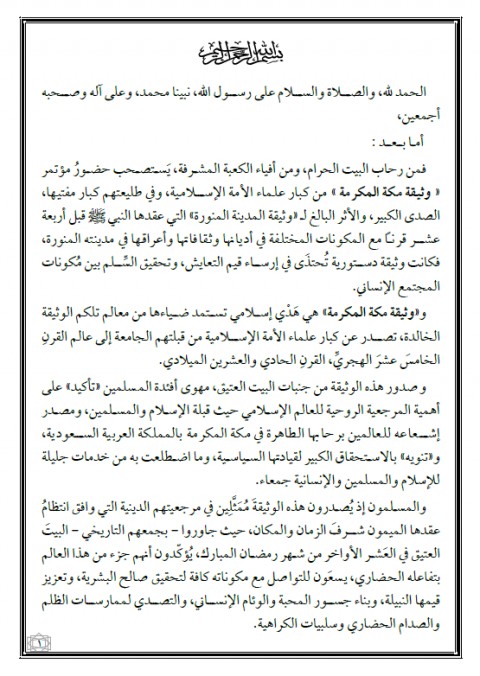 وثيقة مكة Year of publication: 2019 Author: Muslim World League وثيقة مكة هي وثيقة صادرة عن كبار علماء الامة الإسلامية وقد صدرت في مكة والتي تعتبر عاصمة الأمة الإسلامية وقد تم توقيعها في مكان قريب من البيت الحرام بمكة. وتنص الوثيقة على إرساء قيم التعايش وتحقيق السلام بين مكونات المجتمع الانساني، مما ينتج عنه عالم مستدام خالي من المشاكل. وتؤكد الوثيقة أن المسلمون هم جزء من العالم الأكبر بتفاعله الحضاري ويسعون للتواصل مع مكوناته المختلفة من أجل تحقيق صالح البشرية وتعزيز قيمها النبيلة، وبناء جسور المحبة والوئام الإنساني والتصدي لممارسات الظلم والصدام الحضاري ومسببات الكراهية. وتحتوي هذه الوثيقة على 29 مبدأ من مبادئ السلام ونبذ الكراهية والتفاهم الدولي. Mecca Document Year of publication: 2019 Author: Muslim World League The Mecca document is a document issued by the leading Islamic scholars of the Muslim Ummah. It was issued in Mecca, which is considered the capital of the Islamic Ummah. It was signed in the vicinity of the Sacred House in Mecca. The document establishes the values of coexistence and peace between the components of human society, resulting in a sustainable and problem-free world. The document affirms that Muslims are part of the larger world in its cultural interaction and Muslims seek to connect with its various components in order. According to the Document, this connection with others will lead to achieving the benefit of humanity and promote its noble values, build bridges of love and human harmony. It will also help in addressing the practices of injustice, clash of civilizations and causes of hatred. This document contains 29 principles of peace, the rejection of hatred and international understanding.
  Right to Education Handbook Year of publication: 2019 Corporate author: Right to Education Initiative (UK) The ultimate aim of this handbook is to facilitate the realization and universal enjoyment of the right to education. Its objective is not to present the right to education as an abstract, conceptual, or purely legal concept, but rather to be action-oriented. Where possible, practical guidance is given on how to implement and monitor the right to education along with recommendations to overcome persistent barriers. It seeks to do this by: Increasing awareness and knowledge of the right to education. This includes the normative content of the right to education, states’ legal obligations, the various sources of law regarding the right to education, what states must do to domestically implement the right to education, how to monitor the right to education, and how to increase accountability of the right to education. Providing a summary of current debates and issues regarding education and what human rights law says about them, including on forced migration, education in emergencies, the privatization of education, and the challenge of reaching the most marginalized. Providing an overview of the UN landscape and its mechanisms, including a clear understanding of the role of UNESCO and more generally the UN, as well as all relevant stakeholders in education, particularly civil society. UNESCO’s Strategy on standard-setting instruments in the field of education (2016-2021) encourages Member States of the Organization to use normative action in relation with the right to education as a strategic tool to implement and achieve SDG4. In line with this, this handbook – specifically foreseen by the Strategy– will also serve as a reference tool for the design and organization of training modules and workshops in the field of right to education. Finally, the handbook will also be an important reference for those working towards the achievement of SDG4, by offering guidance on how to leverage legal commitment to the right to education as a strategic way to achieve this goal.
 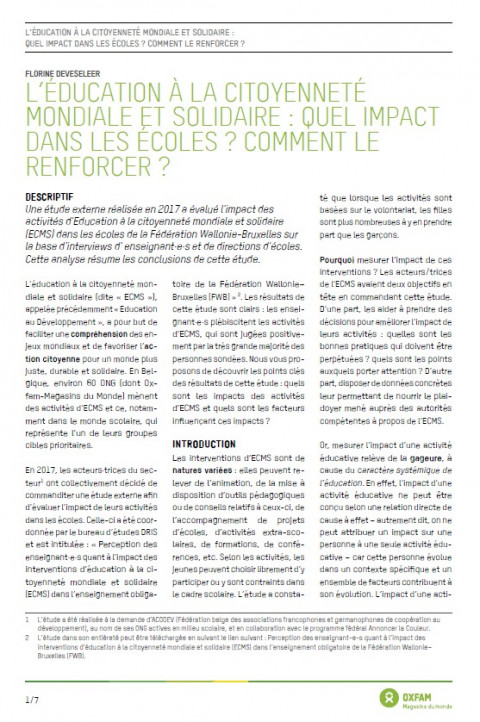 L’éducation à la citoyenneté mondiale et solidaire: quel impact dans les écoles ? comment le renforcer ? Year of publication: 2018 Corporate author: Oxfam Belgique Une étude externe réalisée en 2017 a évalué l’impact des activités d’Education à la citoyenneté mondiale et solidaire (ECMS) dans les écoles de la Fédération Wallonie-Bruxelles sur la base d’interviews d’ enseignant·e·s et de directions d’écoles. Cette analyse résume les conclusions de cette étude.
 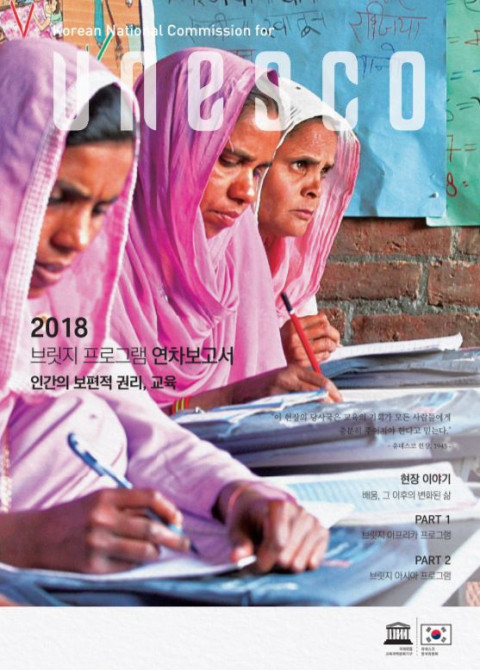 2018-2019 브릿지 프로그램 연차보고서 Year of publication: 2019 Corporate author: 유네스코한국위원회 국제사회는 지속가능발전목표 4번(SDG4)를 통해 2030년까지 모든 이들에게 포용적이고 공평한 양질의 교육을 보장하고, 평생학습의 기회가 증진되도록 노력하자는 교육 기치를 내세웠다.특히 SDG4는 아동의 초등교육 강화에 중심을 둔 '새천년개발목표' 2번(MDG2)과 모든 연령대의 기초교육에 초점을 둔 '모두를위한교육'(EFA)의 미완의 목표를 포괄함은 물론, 기초교육 이후의 교육(중등, 고등) 및 훈련(직업,기술)을 평생학습 차원에서 촉진함으로써 교육의 보편성을 강조하고 있다. 유네스코한국위원회의 브릿지 사업은 이러한 국제사회의 노력에 동참하며, 교육의 보편적 기본권이 확산될 수 있도록 돕기 위해, 전 세계적으로 교육 소외자가 집중되어 있는 사하라 이남 아프리카 지역과 남아시아 지역의 모든 연련대 교육 소외자들을 대상으로 교육권 강화에 이바지하고 있다. 브릿지 사업은 나이, 성별, 종교 그리고 사회적 배경으로 인해 공교육으로부터 배제된 이들이 교육을 받음으로써 자존감을 회복하고 삶의 질을 향상시킬 수 있게 도우며, 이러한 개인의 성장만이 궁극적으로 지역사회의 변화와 발전으로 이어진다는 확신을 갖고 있다.이 보고서에서는 브릿지 아프리카 프로그램, 브릿지 아시아 프로그램과 국별 프로젝트 및 성과를 확인할 수 있다.
  Égalité hommes-femmes vs conscience environnementale: Scène de ménage inéluctable ou convergence des luttes ? Year of publication: 2018 Author: Solène Houzé Réduire son empreinte environnementale est un souci qui gagne chaque jour davantage de citoyens. On essaye de faire de son mieux, pour soi et pour la planète. Cela demande une adaptation pour toute une série de tâches domestiques et de gestes quotidiens (choix de l’alimentation, moyens de transports, zéro déchet, produits d’entretiens naturels, etc.). À l’heure où la répartition des tâches domestiques est encore bien souvent inégalement partagée entre hommes et femmes, il est légitime de s’interroger sur la pression qu’exerce la conscience écologique sur le quotidien des femmes au sein de la sphère privée. Les enjeux des rapports de genre se mêlent alors aux enjeux environnementaux. L’écoféminisme est un courant de pensée qui veut analyser le rapprochement entre ces deux combats. Quels sont donc les fondements de ce mouvement et comment l’action au quotidien pour la nature et le climat s’inscrit-elle dans les analyses écoféministes ? Cette analyse invite donc à discuter des bases genrées nécessaires à une transition verte et durable dans toutes ses dimensions.
 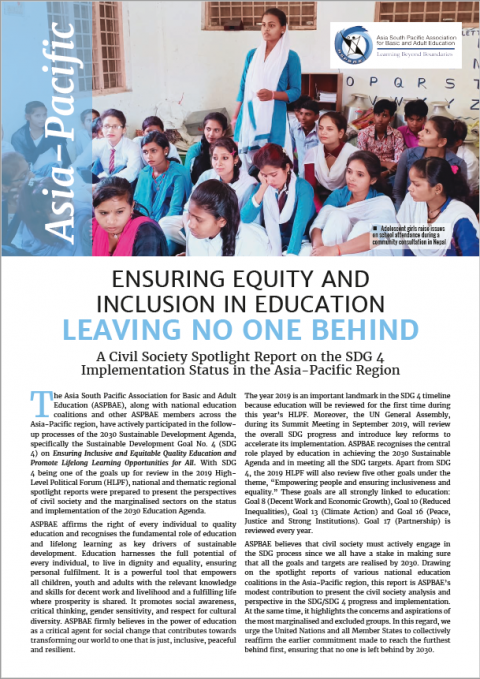 Asia-Pacific Spotlight Report on SDG 4 Year of publication: 2019 Corporate author: Asia South Pacific Association for Basic and Adult Education (ASPBAE) ASPBAE believes that civil society must actively engage in the SDG process since we all have a stake in making sure that all the goals and targets are realised by 2030. Drawing on the spotlight reports of various national education coalitions in the Asia-Pacific region, this report is ASPBAE’s modest contribution to present the civil society analysis and perspective in the SDG/SDG 4 progress and implementation. At the same time, it highlights the concerns and aspirations of the most marginalised and excluded groups. In this regard, we urge the United Nations and all Member States to collectively reaffirm the earlier commitment made to reach the furthest behind first, ensuring that no one is left behind by 2030.
 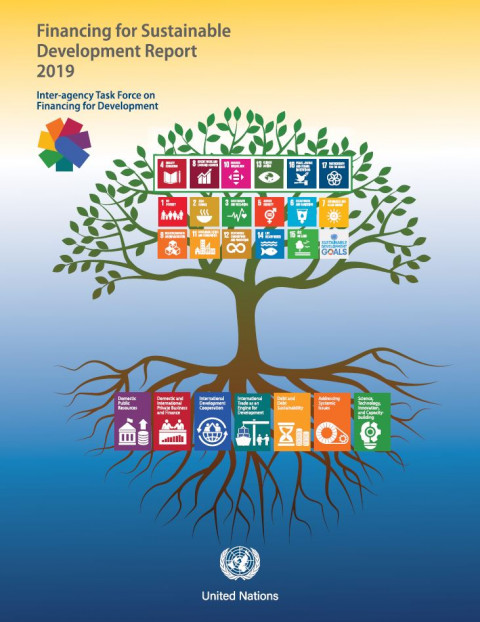 Financing for Sustainable Development Report 2019: Report of the Inter-agency Task Force on Financing for Development Year of publication: 2019 Corporate author: United Nations (UN) This report provides a comprehensive assessment of the state of sustainable finance. Prepared by more than 60 UN agencies, programmes and offices and other relevant international organizations, the report puts forward a set of policy recommendations for achieving tangible progress on financing for sustainable development in 2019 and beyond.The report warns that creating favorable conditions is becoming more challenging. Rapid changes in technology, geopolitics, and climate are remaking our economies and societies, and existing national and multilateral institutions -- which had helped lift billions out of poverty -- are now struggling to adapt. Confidence in the multilateral system has been undermined, in part because it has failed to deliver returns equitably, with most people in the world living in countries with increasing inequality.
 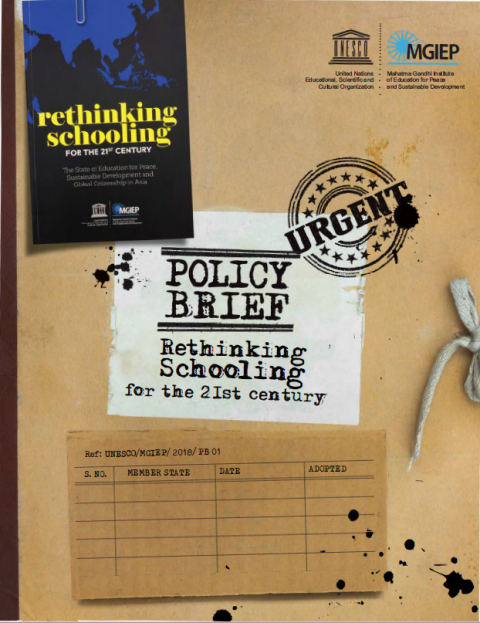 Policy brief: rethinking schooling for the 21st century Year of publication: 2018 Corporate author: Mahatma Gandhi Institute of Education for Peace and Sustainable Development (MGIEP) Analysing how far the ideals of SDG 4.7 are embodied in policies and curricula across 22 Asian countries, this study establishes benchmarks against which future progress can be assessed. It also argues forcefully that we must redefine the purposes of schooling, addressing the fundamental challenges to efforts to promote peace, sustainability and global citizenship through education.