
Resources
Explore a wide range of valuable resources on GCED to deepen your understanding and enhance your research, advocacy, teaching, and learning.
27 Results found
 Aperçu de l’intégration de l'éducation planétaire dans les écoles primaires du Canada: Perspectives à l’échelle des provinces, des districts et des écoles Year of publication: 2007 Author: Karen Mundy | Caroline Manion | Vandra Masemann | Megan Haggerty Corporate author: UNICEF Canada Ce rapport donne une description préliminaire d’une vue d’ensemble de l’éducation planétaire au Canada, documentant de quelle manière l’éducation planétaire est formulée dans les politiques et les programmes scolaires à l’échelle provinciale, comment elle est soutenue par les districts et de quelle façon elle est mise en pratique dans les écoles canadiennes.Comme nous l’avons souligné précédemment, le chapitre 2 présente les faits saillants de plusieurs débats qui animent la mission professorale contemporaine relativement à l’éducation planétaire, et passe en revue les récentes études. Le chapitre 3 examine certaines des caractéristiques structurales de la société, le système politique et les établissements scolaires du Canada, et la manière dont ceux-ci ont contribué à une expérience strictement canadienne en matière d’éducation planétaire. Nous avons également examiné la configuration actuelle des acteurs participant aux activités relatives à l’éducation planétaire et pratique canadienne, selon une perspective comparative.Les six chapitres suivants présentent une brève étude de cas de la pratique en matière d’éducation planétaire de chaque province ou territoire aux trois paliers d’application (des écoles, des districts et de la province). Le chapitre dix présente les données provinciales de la Colombie-Britannique.Dans le chapitre 11, nous résumons les résultats de nos sept études de cas et examinons les différences et similitudes entre elles. Nous situons nos résultats par rapport à la recherche récente sur l’éducation planétaire dans d’autres contextes et y comparons la pratique canadienne. Nous étudions également la façon dont les « définitions perçues » de l’éducation planétaire, telles que nous les avons obtenues dans les écoles canadiennes, peuvent être appliquées aux débats normatifs contemporains sur l’éducation planétaire dans les ouvrages savants et les comptes rendus de recherche. Nous présentons enfin une série de recommandations, parmi lesquelles le besoin, selon nous, d’une nouvelle étude sur l’éducation planétaire au Canada.
  L’éducation dans un contexte mondial pour les élèves de l’Ontario : Stratégies pratiques - Sommaire de recherche Year of publication: 2018 Author: Caroline Manion | Nadya Weber Corporate author: Ontario (Canada). Ministry of Education Le présent sommaire découle de la politique énoncée dans le document Stratégie ontarienne en matière d’éducation internationale de la maternelle à la 12e année (Ministère de l’Éducation de l’Ontario, 2015). Il cible les connaissances actuelles sur les bonnes pratiques prometteuses dans le domaine de l’éducation dans un contexte mondial1 afin de proposer des stratégies pratiques visant à améliorer l’enseignement, l’apprentissage et la réussite. Le présent document s’adresse à tous les intervenants du secteur de l’éducation, c’est-à-dire les membres du milieu, les parents, les élèves, les leaders du système, les leaders scolaires et les éducateurs. Tous sont des agents de changement actifs qui appuient une stratégie d’éducation conçue dans le but d’intégrer les perspectives, les cultures et les expériences mondiales dans le curriculum et le milieu d’apprentissage. L’objectif consiste à permettre aux élèves d’acquérir les compétences dont ils auront besoin pour prospérer en tant que citoyens face à une mondialisation grandissante.L’analyse est présentée par thème. Pour souligner les raisons pour lesquelles l’éducation dans un contexte mondial est d’une importance cruciale pour les élèves de l’Ontario, nous commençons par présenter les contributions importantes que l’éducation dans un contexte mondial peut apporter au bien-être des individus et de la société dans son ensemble. Nous présentons ensuite une vue d’ensemble résumant différentes notions de « l’éducation dans un contexte mondial » et de « l’éducation à la citoyenneté mondiale », ainsi qu’un large éventail de notions secondaires qui se chevauchent.Ensuite, par une revue de la littérature internationale sur le sujet, nous présentons une série de défis et de possibilités concernant la mise en oeuvre de l’éducation dans un contexte mondial et énumérons des exemples pertinents de bonnes pratiques liées à la prestation de l’éducation dans un contexte mondial. Une autre section porte sur les bonnes pratiques en matière de renforcement des capacités et de leadership du système afin d’assurer une éducation dans un contexte mondial efficace. Nous concluons en énumérant les principaux messages et les leçons apprises.
 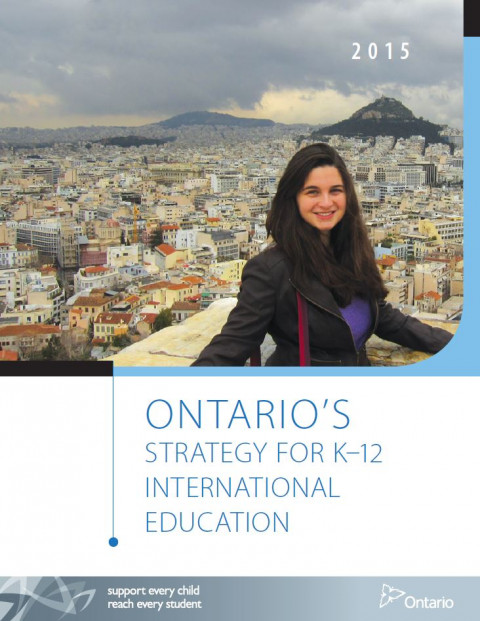 Ontario’s Strategy for K–12 International Education Year of publication: 2015 Corporate author: Ontario (Canada). Ministry of Education Ontario’s strategy for international education will provide an integrated, coordinated approach that will link the continuum of learning from K–12 schooling to postsecondary education and training, to living and working in Ontario.The Ministry of Education will lead with phase one of the provincial strategy, focusing on K–12 learning opportunities. Ontario’s international education strategy will provide: enhanced course offerings and opportunities with an international context, to help Ontario K–12 students and educators build the global competencies, knowledge, and experiences needed to succeed in the worldwide economy;high-quality programs and services and a safe, welcoming environment for international students, to promote achievement and well-being and stimulate intercultural learning;opportunities to develop and share expertise among Ontario and international educators; andpathways for international students studying in Ontario, from elementary/secondary school to postsecondary education and beyond. Stratégie ontarienne en matière d’éducation internationale de la maternelle à la 12e année Year of publication: 2015 Corporate author: Ontario (Canada). Ministry of Education Une stratégie ontarienne en matière d’éducation internationale procurera une approche intégrée et coordonnée qui s’appliquera à l’ensemble du continuum d’apprentissage, allant de la maternelle à la 12e année en passant par les études postsecondaires et la formation, et jusqu’à travailler et résider en Ontario.Le ministère de l’Éducation mènera la première phase de la stratégie provinciale, mettant l’accent sur les possibilités d’apprentissage. La Stratégie ontarienne en matière d’éducation internationale de la maternelle à la 12e année (la « Stratégie ») offrira : un éventail enrichi de cours et d’autres activités d’apprentissage à contexte international en vue d’aider les élèves et le personnel enseignant de la maternelle à la 12e année à développer les connaissances, les compétences et les expériences globales indispensables à la réussite dans le cadre d’une économie mondialisée;des programmes et services de qualité supérieure, et un environnement accueillant et sécuritaire pour les élèves étrangers, destinés à promouvoir le rendement scolaire et le bien-être, de même qu’à stimuler l’apprentissage interculturel;des possibilités accrues d’enrichissement et de partage des connaissances pour les membres du personnel enseignant de l’Ontario et d’ailleurs;un choix de parcours continus pour les élèves étrangers séjournant en Ontario, depuis l’école élémentaire ou secondaire aux études postsecondaires, et jusqu’aux possibilités de vivre et de travailler en Ontario. Global Education for Ontario Learners: Practical Strategies - A Summary of Research Year of publication: 2018 Author: Caroline Manion | Nadya Weber Corporate author: Ontario (Canada). Ministry of Education This summary report flows from the policy outlined in Ontario’s Strategy for K–12 International Education (OME, 2015). The report highlights current knowledge about good and/or promising practices in global education1 in order to suggest practical strategies for improved teaching, learning, and achievement. The intended audience for this piece includes all education stakeholders – community members, parents, learners, system leaders, school leaders, and educators – as active agents of change in support of an education strategy designed to integrate global perspectives, cultures, and experiences in the curriculum and learning environment. The purpose is to enable students to develop the competencies they will need to thrive as citizens in an increasingly globalized world.The discussion is organized by theme. To underline why global education is critically important for Ontario learners, we begin by outlining the significant contributions global education can make to the well-being of individuals and society as a whole. We then provide an overview synthesizing different conceptualizations of “global education” and “global citizenship education”, as well as a broad range of their overlapping sub-concepts. Next, through a review of the international literature on the subject, we present a series of challenges and opportunities for implementing global education, and list pertinent examples of good practices associated with delivering global education. A further section focuses on good practice in building system capacity and leadership for effective global education. We conclude by identifying key messages and lessons learned.
 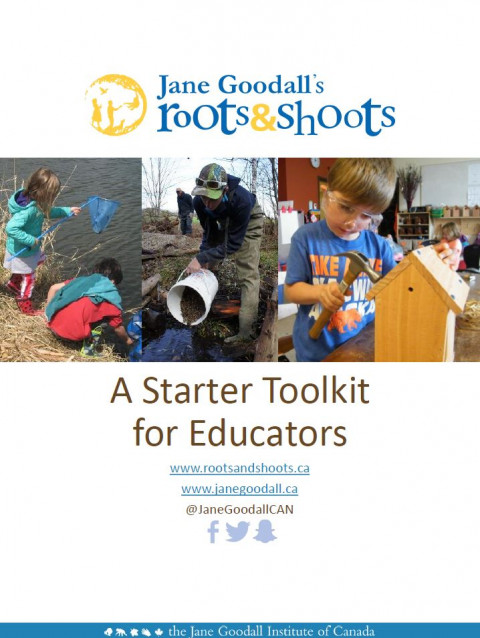 Jane Goodall's Roots & Shoots: A Starter Toolkit for Educators Year of publication: 2016 Corporate author: Jane Goodall Institute of Canada This toolkit (Jane Goodall's Roots and Shoots) is designed to assist you as you guide young people on their Roots & Shoots journey. Whether you’re an educator, parent or trusted adult, you’ll find something useful to inspire the youth around you to make a positive difference for people, animals and the environment we all share.Jane Goodall’s Roots & Shoots is humanitarian and environmental education and youth empowerment program of the Jane Goodall Institute and is active in 87 countries. The program inspires and prepares young people to become compassionate conservation leaders who are globally mindful and locally active by guiding them through youth-led, community projects that help people, other animals and the environment. This toolkit will help educators or parents looking to inspire young people to make a positive difference in the community or young people wanting to lead the change themselves.
  The Ontario Curriculum, Grades 11 and 12 : Canadian and World Studies Year of publication: 2015 Corporate author: Ontario (Canada). Ministry of Education In Canadian and world studies, students develop skills, knowledge and understanding, and attitudes that will serve them both inside and outside the classroom, including in the world of work and as responsible citizens in the various communities to which they belong.The focus of teaching and learning in the Canadian and world studies curriculum is the development of ways of thinking and of transferable skills that students need in order to acquire and apply knowledge and understanding. Students apply these ways of thinking and skills in a variety of contexts to examine information critically; to assess the significance of events, developments, and processes; to develop an understanding of and respect for different points of view; to reach supportable conclusions; and to propose solutions to, and courses of action to address, real problems.Citizenship education is an important facet of students’ overall education. In every grade and course in the Grade 11 and 12 Canadian and world studies curriculum, students are given opportunities to learn about what it means to be a responsible, active citizen in the community of the classroom and the diverse communities to which they belong within and outside the school. It is important for students to understand that they belong to many communities and that, ultimately, they are all citizens of the global community. Le curriculum de l'Ontario, 11e et 12e année : Études canadiennes et mondiales Year of publication: 2015 Corporate author: Ontario (Canada). Ministry of Education Le présent document Le curriculum de l’Ontario, 11e et 12e année – Études canadiennes et mondiales, édition révisée, 2015 est destiné aux écoles de langue française; il remplace Le curriculum de l’Ontario, 11e et 12e année – Études canadiennes et mondiales, 2005 et Le supplément du curriculum de l’Ontario de la 9e à la 12e année – Études canadiennes et mondiales, 2008.À compter de septembre 2015, tous les cours d’études canadiennes et mondiales de 11e et 12e année seront fondés sur les attentes et les contenus d’apprentissage énoncés dans cette édition révisée du programme-cadre.LES ÉCOLES SECONDAIRES AU XXIe SIÈCLE Les écoles secondaires de l’Ontario offrent à chaque élève un programme d’études varié et planifié de grande qualité. Ce programme vise la réussite de tous les élèves dans la destination de leur choix. La mise à jour du curriculum de l’Ontario, de pair avec un élargissement des options d’apprentissage offertes à l’extérieur de la salle de classe traditionnelle, intègre l’apprentissage des compétences essentielles pour réussir au XXIe siècle et respecte les champs d’intérêt, les points forts ainsi que les besoins de chaque élève.Le programme-cadre révisé prend en compte le fait qu’aujourd’hui comme demain, la littératie critique sera fondamentale afin de synthétiser l’information, de prendre des décisions réfléchies, de communiquer de manière efficace et d’évoluer dans une communauté mondiale en continuel mouvement. Il est important que les élèves se sentent concernés par le curriculum établi, qu’ils se reconnaissent dans ce qui est enseigné et dans la méthode d’enseignement, et qu’ils réalisent comment leur apprentissage s’applique au monde qui les entoure. Le programme tient compte des besoins variés des élèves; il les aide à enrichir leurs connaissances et à développer leurs habiletés, et leur offre les perspectives dont elles ou ils ont besoin pour devenir des citoyennes et citoyens informés, productifs, bienveillants, responsables, en bonne santé et actifs au sein de leurs communautés et dans le monde.
 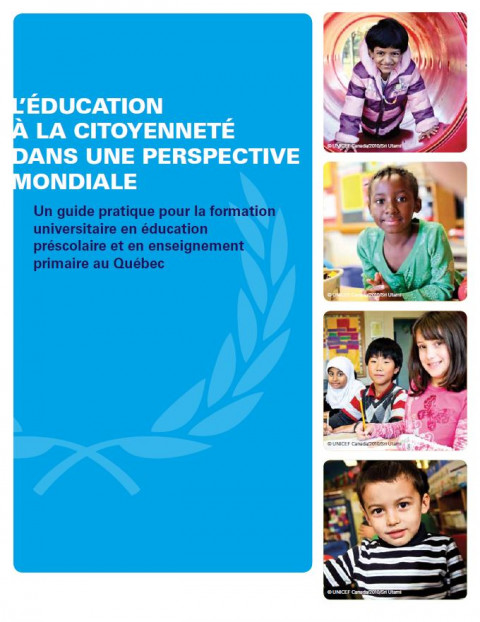 L’éducation à la citoyenneté dans une perspective mondiale : Un guide pratique pour la formation universitaire en éducation préscolaire et en enseignement primaire au Québec Year of publication: 2011 Corporate author: UNICEF Canada Ce guide permet au corps enseignant universitaire, aux étudiantes et étudiants en éducation, ainsi qu’aux enseignantes et enseignants en formation continue, d’acquérir une bonne compréhension des concepts de l’éducation à la citoyenneté dans une perspective mondiale, d’en connaître la pertinence dans tous les aspects de leur enseignement, peu importe le domaine, et ce, afin qu’ils puissent agir en enseignantes et enseignants responsables et informés, et puissent développer des compétences similaires chez leurs élèves.Le guide est divisé en trois parties. La première, intitulée Soutien à la formation initiale, permet de faire un examen des besoins pour la formation initiale et continue au sujet de l’éducation à la citoyenneté dans une perspective mondiale. C’est dans cet esprit que les compétences professionnelles ont été ciblées et que des outils pédagogiques ont été élaborés : l’outil diagnostique et de pratique réflexive. C’est dans cette partie que vous trouverez un tableau indiquant les rubriques du guide et la ou les compétences professionnelles qu’elles permettent de développer.La deuxième partie du guide présente la notion d’éducation à la citoyenneté dans une perspective mondiale. En plus de définir cette notion, elle fait des liens avec le Programme de formation de l’école québécoise. C’est aussi dans cette section que le lecteur se familiarisera avec les six concepts centraux de l’éducation à la citoyenneté dans une perspective mondiale.La troisième partie du guide est divisée en six sections; chacune d’elle présente un des six concepts centraux de l’éducation à la citoyenneté dans une perspective mondiale, soit : droits de l’enfant, interdépendance, images et perceptions, conflits et leur résolution, justice sociale et action viable.
  Assurer à tous une éducation équitable, inclusive et de qualité: Objectif de développement durable 4 au Canada Year of publication: 2020 Corporate author: Council of Ministers of Education, Canada (CMEC) Ce rapport fournit un cadre pour communiquer l’information aux échelons pancanadien et international au sujet du travail en cours au Canada sur la réalisation de l’ODD 4. Il tire parti des données et des indicateurs liés à l’ODD 4 et inclut, dans la mesure du possible, les données provinciales et territoriales.