
Resources
Explore a wide range of valuable resources on GCED to deepen your understanding and enhance your research, advocacy, teaching, and learning.
2,193 Results found
 Education for sustainable development: linking learning and happiness Year of publication: 2007 Author: Joel Bacha Corporate author: UNESCO Bangkok Education for Sustainable Development programmes demonstrating the link between learning and wellbeing and happiness are beginning to emerge throughout the Asia-Pacific region. In small communities throughout the Pacific islands, for example, ESD approaches are helping to engage communities in decision-making about their own lives. L'éducation au développement durable: lier l'apprentissage et le bonheur Year of publication: 2007 Author: Joel Bacha Corporate author: UNESCO Bangkok Des programmes d'éducation pour le développement durable qui démontrent le lien entre l'apprentissage et le bien-être et le bonheur commencent à émerger dans toute la région Asie-Pacifique. Dans les petites localités des îles du Pacifique, par exemple, les approches EDD aident les communautés à prendre des décisions concernant leur propre vie. Tales of hope: grassroots activities of Education for Sustainable Development (ESD) in Asia and the Pacific Year of publication: 2007 Corporate author: Asia-Pacific Cultural Centre for UNESCO (ACCU) This publication is a compilation of the keynote speeches, case presentations, and reports of the field visits conducted during the abovementioned seminar. Chapter Ⅰ presents two highly suggestive keynote speeches, describing the current challenges of “Sustainable Development” and “Education.” The case presentations in Chapter Ⅱ illustrate grassroots activities, well exemplifying ESD, which had been implemented even before the launch of UNDESD, to be followed by commentaries from ESD perspectives. Chapter Ⅲ is dedicated to describing, as an innovative approach to ESD, the “Asaza Project,” a strategy for establishing a sustainable society in the Lake Kasumigaura catchment basin in Japan. Histoires d'espoir: activités de base de l'éducation pour le développement durable (EDD) en Asie et dans le Pacifique Year of publication: 2007 Corporate author: Asia-Pacific Cultural Centre for UNESCO (ACCU) Cette publication est une compilation des discours d'ouverture, des présentations de cas et des rapports des visites sur le terrain menées au cours du séminaire susmentionné. Le chapitre Ⅰ présente deux discours liminaires très suggestifs décrivant les défis actuels du développement durable et de l'éducation. Les présentations de cas présentées au chapitre Ⅱ illustrent les activités de base, qui illustrent bien l'EDD, qui avait été mise en œuvre avant le lancement de l'UNDEDD. Suivis des commentaires des perspectives EDD. Le chapitre Ⅲ est consacré à décrire, en tant qu'approche novatrice de EDD, le «Projet Asaza», une stratégie pour établir une société durable dans le bassin versant du lac Kasumigaura au Japon.
 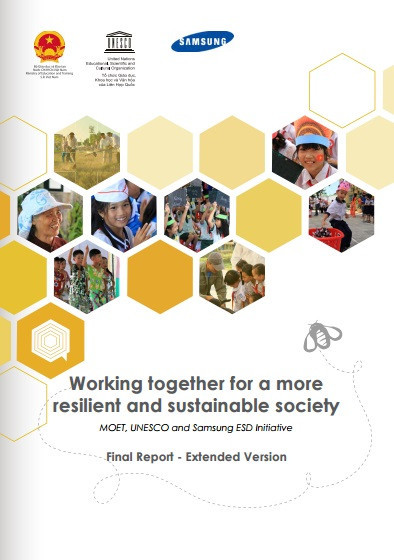 Working Together for a More Resilient and Sustainable Society: MOET, UNESCOand Samsung ESD Initiative; Final Report - Extended Version Year of publication: 2015 Corporate author: UNESCO Hanoi The overarching aim of the ESD Initiative is to support Viet Nam in shaping a more resilient and sustainable learning society. The strategy for the ESD Initiative was developed to establish enabling environments for students to better apply what they learn in school within their homes and communities, and to enhance the education of parents and the community through students. The strategy applies to various themes under ESD. In the case of the current implementation of the Initiative, the key areas are: climate change mitigation and adaptation, disaster risk reduction and biodiversity conservation and restoration, in line with the United Nations Decade of Education for Sustainable Development (UN DESD) and national needs and strategies. Envisioning education beyond 2015: Asia-Pacific regional perspectives; final report Year of publication: 2014 Corporate author: UNESCO Bangkok This report provides a thorough account of the discussions and deliberations that led to the construction of the Asia-Pacific Statement on Education Beyond 2015 (Bangkok Statement), the outcome document of this historic event. Participants reviewed in fine detail EFA progress across the Asia-Pacific region and debated key thematic areas of basic education, skills and competencies, global citizenship education, education for sustainable development, teachers, governance and finance. Participants also looked into implementation strategies, and education ministers from across the region shared their views on remaining challenges, future priorities and strategies for education beyond 2015. Envisager l'éducation au-delà de 2015: Perspectives Régionales Asie-Pacifique; rapport final Year of publication: 2014 Corporate author: UNESCO Bangkok Ce rapport fournit un compte rendu détaillé des discussions et délibérations qui ont conduit à la construction de la Déclaration de l'Asie-Pacifique sur l'éducation Au-delà de 2015 (Déclaration de Bangkok), le document final de cet événement historique. Les participants ont examiné en cours détail EPT bien dans toute la région Asie-Pacifique et ont débattu des domaines thématiques clés de l'éducation de base, les compétences et les compétences, l'éducation à la citoyenneté mondiale, l'éducation pour le développement durable, les enseignants, la gouvernance et les finances. Les participants ont également examiné les stratégies de mise en œuvre, et les ministres de l'éducation de toute la région ont partagé leurs points de vue sur les défis restant à relever, des priorités et des stratégies futures pour l'éducation au-delà de 2015. Promoting sub-regional education for sustainable development in South-East Asia Year of publication: 2011 Corporate author: UNESCO Jakarta UNESCO Office, Jakarta, focuses on five cluster countries, helping their governments to plan and manage the education sector by enhancing national capacities to integrate sustainable development issues and practices into all types and levels of education. Country reports on education for sustainable development: centred on the five cluster countries of UNESCO office, Jakarta Year of publication: 2011 Author: Meeyoung Choi | Robert J. Didham Corporate author: UNESCO Jakarta As the cluster office, UNESCO Office, Jakarta covers the implementation of all major programmes and mandates by UNESCO in these five countries as well as disseminates and shares information and knowledge in the fields of education, science, culture and communication in the Asia and Pacific region. Rapports nationaux sur l'éducation au développement durable: axés sur les cinq pays du bureau de l'UNESCO à Jakarta Year of publication: 2011 Author: Meeyoung Choi | Robert J. Didham Corporate author: UNESCO Jakarta Le bureau de l'UNESCO à Jakarta couvre la mise en œuvre de tous les grands programmes et mandats de l'UNESCO dans ces cinq pays et diffuse et partage des informations et des connaissances dans les domaines de l'éducation, de la science, de la culture et de la communication dans la région de l'Asie et du Pacifique.