
Resources
Explore a wide range of valuable resources on GCED to deepen your understanding and enhance your research, advocacy, teaching, and learning.
1,443 Results found
 Proposed thematic programme on water education within the UN Decade on Education for Sustainable Development (DESD, 2005-2014) Year of publication: 2006 Corporate author: International Hydrological Programme (IHP) Water education is a very important component of UNESCO’s overall effort in water, including within the International Hydrological Programme. The UNESCO Executive Board has called for a UNESCO-wide strategy for water education at all levels. This document reviews the evolution of water education within UNESCO, and draws attention to the Draft Action Plan for the UN Decade on Education for Sustainable Development (DESD), which includes 12 Thematic Programmes one of which would be devoted to “Education for Sustainable Water Management”. The IHP would be expected to play an important role in such a UNESCO-wide effort for water education.
  联合国教科文组织世界可持 续发展教育大会, 会议记录 Year of publication: 2009 Corporate author: German Federal Ministry of Education and Research (BMBF) | German Commission for UNESCO As the United Nations Decade of Education for Sustainable Development (DESD) approached its midpoint, the “UNESCO World Conference on Education for Sustainable Development – Moving into the Second Half of the UN Decade” was held from 31 March to 2 April 2009 in Bonn, Germany. It brought together 900 participants from 147 countries, among them 49 Ministers and Deputy-Ministers. Participants included representatives of UNESCO Member States, UN agencies, civil society organizations, education institutions, youth, and the private sector, as well as individual experts. The Conference was organized by UNESCO and the German Federal Ministry of Education and Research, in cooperation with the German Commission for UNESCO. The programme was developed in consultation with an international advisory group. UNESCO-Weltkonferenz bildung für nachhaltige Entwicklung, 31. März-2.April 2009, Bonn: Tagungsbericht Year of publication: 2009 Corporate author: German Federal Ministry of Education and Research (BMBF) | German Commission for UNESCO As the United Nations Decade of Education for Sustainable Development (DESD) approached its midpoint, the “UNESCO World Conference on Education for Sustainable Development – Moving into the Second Half of the UN Decade” was held from 31 March to 2 April 2009 in Bonn, Germany. It brought together 900 participants from 147 countries, among them 49 Ministers and Deputy-Ministers. Participants included representatives of UNESCO Member States, UN agencies, civil society organizations, education institutions, youth, and the private sector, as well as individual experts. The Conference was organized by UNESCO and the German Federal Ministry of Education and Research, in cooperation with the German Commission for UNESCO. The programme was developed in consultation with an international advisory group.
 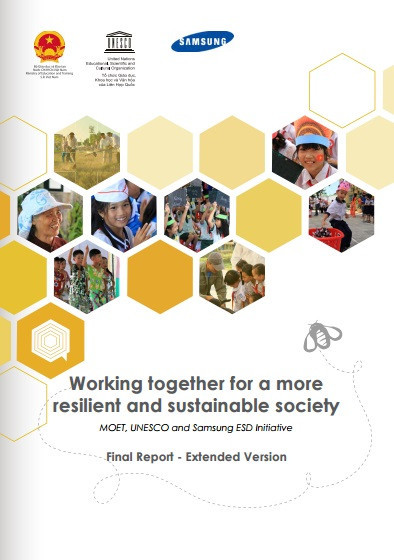 Working Together for a More Resilient and Sustainable Society: MOET, UNESCOand Samsung ESD Initiative; Final Report - Extended Version Year of publication: 2015 Corporate author: UNESCO Hanoi The overarching aim of the ESD Initiative is to support Viet Nam in shaping a more resilient and sustainable learning society. The strategy for the ESD Initiative was developed to establish enabling environments for students to better apply what they learn in school within their homes and communities, and to enhance the education of parents and the community through students. The strategy applies to various themes under ESD. In the case of the current implementation of the Initiative, the key areas are: climate change mitigation and adaptation, disaster risk reduction and biodiversity conservation and restoration, in line with the United Nations Decade of Education for Sustainable Development (UN DESD) and national needs and strategies.
  UNESCO World Conference on Education for Sustainable Development: Conference Report by the General Rapporteur Year of publication: 2015 Author: Heila Lotz-Sisitka Under the banner of ‘Learning Today for a Sustainable Future’, the World Conference on Education for Sustainable Development (WCESD), hosted in Aichi-Nagoya, from 10–12 November 2014, marked and celebrated the end of the United Nations (UN) Decade of Education for Sustainable Development (DESD, 2005–2014). It also saw the launch of the Global Action Programme on Education for Sustainable Development and adoption of the Aichi-Nagoya Declaration. The DESD was established out of an agreement amongst Member States to strengthen the role of education in achieving sustainable development at the World Summit on Sustainable Development in 2002. Through the adoption of Resolution 57/254 in 2002, the UN General Assembly declared the DESD, to take place from 2005 to 2014, and tasked UNESCO as the lead agency. The WCESD, organized at the end of the DESD by UNESCO and the Government of Japan, provided an important opportunity to consolidate the outcomes of the DESD, and to frame the way forward for Education for Sustainable Development (ESD) at global level.
 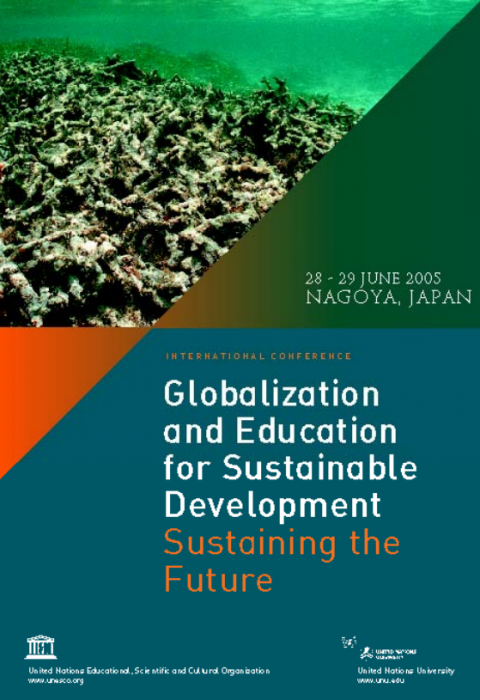 Globalization and education for sustainable development: sustaining the future Year of publication: 2006 Author: Laura Wong Corporate author: United Nations University This publication presents the contributions and outcomes of the stimulating two day gathering in Nagoya, where representatives of governments, academia and civil society gathered to share their experiences and develop their ideas about how to ensure ESD within the context of globalizing societies. La mondialisation et l'éducation pour le développement durable: le maintien de l'avenir Year of publication: 2006 Author: Laura Wong Corporate author: United Nations University Cette publication présente les contributions et les résultats de la stimulation de la collecte de deux jours à Nagoya, où les représentants des gouvernements, des universités et de la société civile se sont réunis pour partager leurs expériences et de développer leurs idées sur la façon d'assurer l'EDD dans le contexte des sociétés de mondialisation. Envisioning education beyond 2015: Asia-Pacific regional perspectives; final report Year of publication: 2014 Corporate author: UNESCO Bangkok This report provides a thorough account of the discussions and deliberations that led to the construction of the Asia-Pacific Statement on Education Beyond 2015 (Bangkok Statement), the outcome document of this historic event. Participants reviewed in fine detail EFA progress across the Asia-Pacific region and debated key thematic areas of basic education, skills and competencies, global citizenship education, education for sustainable development, teachers, governance and finance. Participants also looked into implementation strategies, and education ministers from across the region shared their views on remaining challenges, future priorities and strategies for education beyond 2015. Envisager l'éducation au-delà de 2015: Perspectives Régionales Asie-Pacifique; rapport final Year of publication: 2014 Corporate author: UNESCO Bangkok Ce rapport fournit un compte rendu détaillé des discussions et délibérations qui ont conduit à la construction de la Déclaration de l'Asie-Pacifique sur l'éducation Au-delà de 2015 (Déclaration de Bangkok), le document final de cet événement historique. Les participants ont examiné en cours détail EPT bien dans toute la région Asie-Pacifique et ont débattu des domaines thématiques clés de l'éducation de base, les compétences et les compétences, l'éducation à la citoyenneté mondiale, l'éducation pour le développement durable, les enseignants, la gouvernance et les finances. Les participants ont également examiné les stratégies de mise en œuvre, et les ministres de l'éducation de toute la région ont partagé leurs points de vue sur les défis restant à relever, des priorités et des stratégies futures pour l'éducation au-delà de 2015. Conférence mondiale de l'UNESCO sur l'éducation au développement durable: rapport de la Conférence établi par la Rapporteure Year of publication: 2015 Author: Heila Lotz-Sisitka Placée sous le thème « Apprendre aujourd'hui pour un avenir viable », la Conférence mondiale sur l’éducation au développement durable s’est tenue à Aichi-Nagoya du 10 au 12 novembre 2014 pour marquer, et célébrer, la fin de la Décennie des Nations Unies pour l'éducation au service du développement durable (DEDD, 2005-2014). La Conférence a également été l’occasion de lancer le Programme d'action global pour l'éducation en vue du développement durable et d’adopter la Déclaration d’Aichi-Nagoya sur l’éducation au développement durable. La DEDD a été proclamée suite au Sommet mondial sur le développement durable de 2002 sur la base d’un accord entre les États membres visant à renforcer le rôle de l’éducation afin de parvenir au développement durable. L'Assemblée générale des Nations Unies a adopté la résolution 57/254 proclamant la DEDD de 2005 à 2014 et chargé l'UNESCO de la coordonner. La Conférence mondiale sur l’éducation au développement durable, organisée au terme de la DEDD par l’UNESCO et le Gouvernement du Japon, a été l’occasion de consolider les résultats de la DEDD et de définir la voie à suivre à l’avenir pour l’éducation au développement durable à l’échelle mondiale.