
Resources
Explore a wide range of valuable resources on GCED to deepen your understanding and enhance your research, advocacy, teaching, and learning.
1,402 Results found
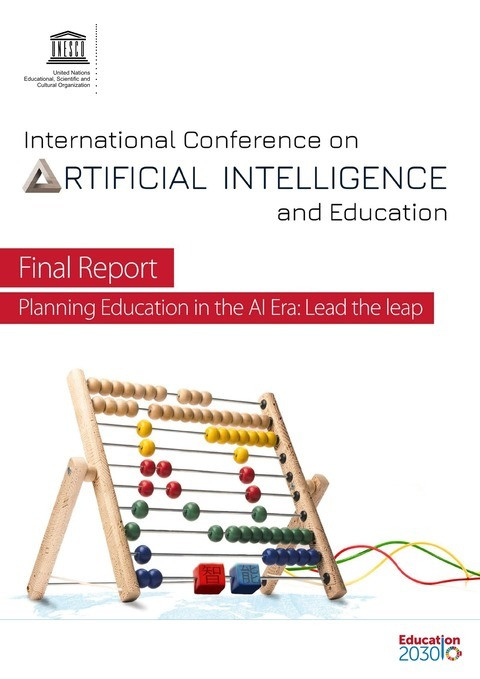 International Conference on Artificial Intelligence and Education, Planning Education in the AI Era: Lead the Leap; Final Report Year of publication: 2019 Corporate author: UNESCO The current report is an exhaustive account of the discussion and debate at the International Conference on Artificial Intelligence and Education (hereafter referred to as ‘the conference’) held in Beijing from 16 to 18 May 2019. Under the overarching theme of ‘Planning Education in the AI Era: Lead the Leap’, the conference was structured into seven plenary sessions and 16 breakout sessions complemented by a live exhibition and study tours to facilitate forwardlooking debates, share cutting-edge knowledge and AI solutions, and deliberate on sector-wide strategies.
  SDG-Education 2030 Steering Committee: Making Higher Education More Inclusive, July 2020 Year of publication: 2020 Corporate author: UNESCO The rapid expansion of higher education in the past two decades, as well as the growing diversity of providers and technological models for delivering education, have made higher education accessible to more students globally. Yet significant barriers remain for many vulnerable groups, and women still lag behind in science, technology, engineering and mathematics. A better understanding of inequality as well as new paradigms, strategies and a renewed political will for ‘leaving no one behind’ are required. Structural equity policies at all levels throughout the education system, as well as extraordinary measures when needed, should ensure that students from any background with the potential to succeed are fully integrated with equal opportunities into higher education. This policy paper reviews the current literature and sets out findings and recommendations to increase and strengthen equity and inclusion in higher education in a lifelong learning perspective. It provides a conceptual framework for equity and inclusion, analyses the urgent need to improve funding and its efficiency, provides insight into the challenges for teaching and teachers, and recommends policy measures for establishing higher education systems that are more equitable and more inclusive.
  Transforming Knowledge and Research for Just and Sustainable Futures: Towards a New Social Imaginary for Higher Education (Education, Research and Foresight: Working Papers; No.33, 2024) Year of publication: 2024 Author: Leon Tikly Corporate author: UNESCO The paper considers why it is important to transform knowledge and research for just and sustainable futures and discusses the role of higher education in these transformation processes. The paper sets out how knowledge, research, and knowledge systems can be understood and critiques knowledge hierarchies that have emerged in the context of colonialism, leading to the marginalization of the knowledge systems and languages of the colonized. It is argued that there is a need to create new ecologies of knowledge that value and develop synergies between ‘all of the archives of the world’ and that can revitalize and expand the knowledge commons and contribute to more just and sustainable futures. Higher education has a pivotal role to play in the creation of new ecologies of knowledge and a revitalized knowledge commons through promoting socially and ethically engaged research, the decolonization and reorientation of university curricula and pedagogy to foster sustainable futures, and the democratization of universities to better represent historically marginalized groups. Underpinning this role must be a shift from a Western modernist social imaginary of higher education to one based on a new planetary consciousness.
 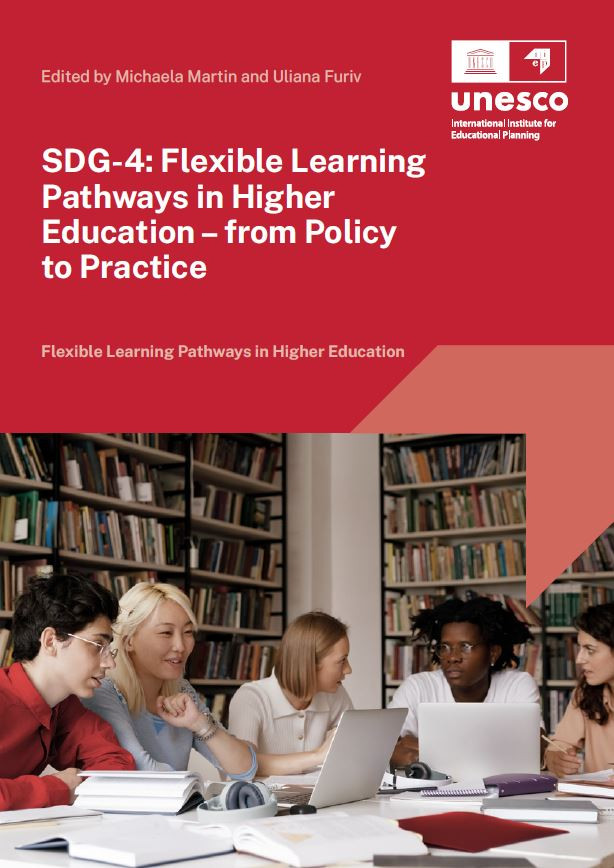 SDG-4: Flexible Learning Pathways in Higher Education – from Policy to Practice: An International Comparative Analysis Year of publication: 2022 Author: Michaela Martin | Uliana Furiv Corporate author: UNESCO International Institute for Educational Planning (IIEP) Higher education systems across the world are currently faced with a massive influx of learners with more diverse needs. They are expected to respond to this growing diversity through a more flexible learning offer and pathways that allow all learners, including those from disadvantaged groups, to access, progress through, and complete, higher education.To enhance knowledge on how to provide increased flexibility in higher education, IIEP–UNESCO undertook an international research project on SDG-4: Planning for Flexible Learning Pathways (FLPs) in Higher Education. The project included a stocktaking of policies, instruments, and practices, an international survey among UNESCO Member States, and eight in-depth country studies on Chile, Finland, India, Jamaica, Malaysia, Morocco, South Africa, and the UK.This book presents the findings from the research, including a cross-country analysis of available FLP policies and practices, and how they enhance equitable higher education systems. It also presents a series of country experiences with innovative approaches to alternative entry, flexible progression, and governance systems in support of FLPs.
 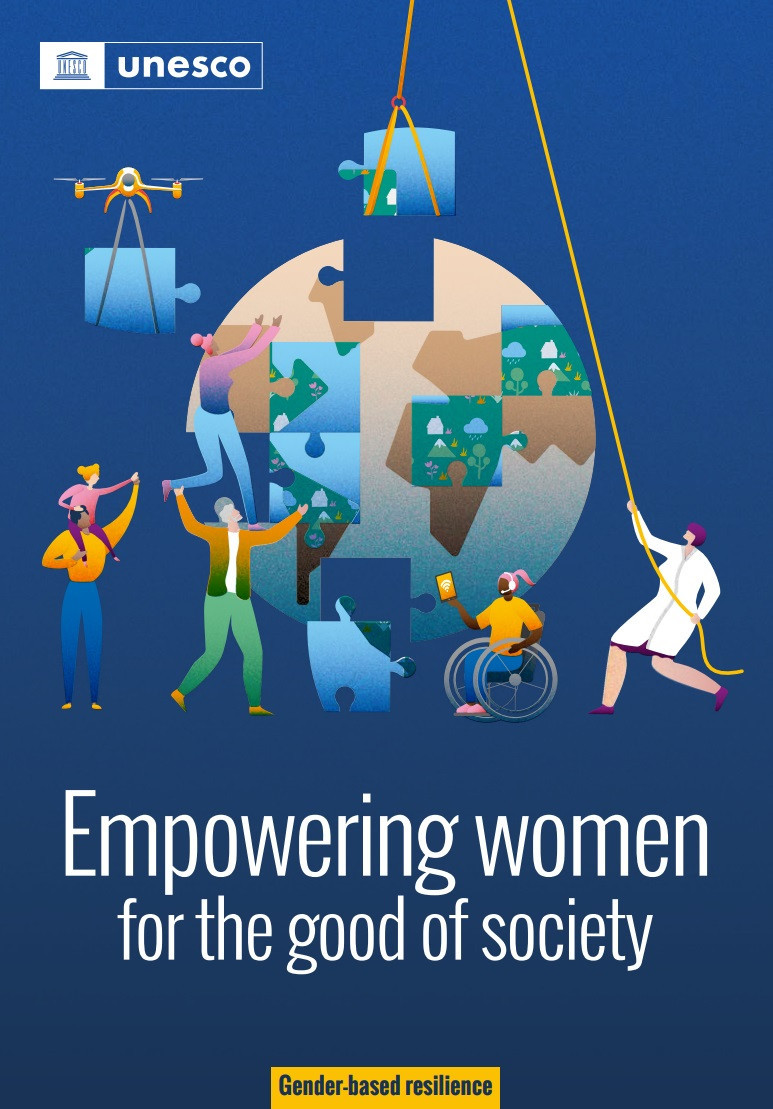 Empowering women for the good of society: gender-based resilience Year of publication: 2023 Author: Squicciarini, Mariagrazia | Sarlat, Garance | Manca, Anna Rita Corporate author: UNESCO <Short Summary> Let’s change the resilience paradigmWhat are the root causes and drivers of resilience? Societal resilience is shaped by the unique roles that individuals play and their ability to respond to shocks, gender-based expectations and discriminations hinder women’s and girls’ ability to participate in, and contribute to, society. In times of crises, their vulnerability intensifies resulting in a weakened response that ripples throughout society.In response, UNESCO designed the first Gender-Based Resilience Framework. As a compass for inclusive policymaking, this report analyzes how differences in opportunities, needs and constraints impact resilience and proposes a measurement Framework based on: (1) fundamental human rights; (2) socioeconomic characteristics, such as health, education, work, political engagement, and climate justice; (3) contextual factors, such as values and perceptions.Moving beyond the standard approach of coping with and recovering from shocks; UNESCO calls for a gender-transformative resilience, which leverages the interrelations between individuals and institutions. Decision- and policy-makers, researchers, and gender equality advocates are invited to use and add to this Framework to effectively navigate through current and future crises.It is only by empowering all women and girls, and people of all genders, that we will be able to face the challenges ahead.
  Résumé du rapport mondial de suivi sur l'éducation 2024/5: leadership dans l'éducation: diriger pour apprendre Year of publication: 2024 Corporate author: Global Education Monitoring Report Team Le Rapport mondial de suivi sur l'éducation 2024/5 évalue les progrès accomplis dans la réalisation des objectifs du Programme 2030 et montre que, si le nombre d'enfants scolarisés et achevant l'enseignement secondaire n'a jamais été aussi élevé, de nombreux domaines connaissent une stagnation. Le leadership joue un rôle central pour y remédier. Aucune école n’améliore les résultats des élèves sans un bon leader pour montrer la voie. Sur la base d’un examen des lois et politiques concernant la sélection, la préparation et les conditions de travail des chefs d'établissement de 211 systèmes éducatifs, le rapport analyse les leviers stratégiques permettant d'attirer et de retenir des leaders de talent.Les possibilités d’exercer un leadership ne se limitent pas aux dirigeants des écoles, elles s’étendent à des personnes qui occupent d’autres postes dans le système éducatif et en dehors de celui-ci, telles que les directeurs adjoints, les enseignants et les élèves lorsque le leadership est partagé, les responsables politiques, la société civile, les organisations internationales, les syndicats et les médias, qui contribuent à définir les objectifs en matière d’éducation.Le rapport préconise que des efforts soient faits pour former des leaders dans quatre dimensions essentielles : fixer des objectifs, donner la priorité à l’apprentissage, encourager la collaboration et faire évoluer les personnes. Pour que ces dimensions se concrétisent, il faut faire confiance aux personnes occupant des postes de direction et leur donner les moyens d’agir ; il faut les recruter grâce à des pratiques d’embauche équitables ; les soutenir dans leur évolution ; et les encourager à mettre en place une culture de collaboration. Le rapport appelle également à investir dans la capacité des responsables de l'éducation à jouer un rôle de leader au sein du système, en mettant particulièrement l'accent sur la direction pédagogique et l'assurance qualité
  Resumen del informe de seguimiento de la educación en el mundo, 2024/5: Liderazgo en la educación: liderar por el aprendizaje Year of publication: 2024 Corporate author: Global Education Monitoring Report Team El Informe de seguimiento de la educación en el mundo 2024-2025 evalúa los avances hacia el logro de las metas de 2030 y muestra que, aunque hay más niños escolarizados y que finalizan la educación secundaria que nunca, en muchos ámbitos hay estancamientos. El liderazgo es fundamental para abordar esta cuestión. Ninguna escuela puede mejorar los resultados de los alumnos sin un buen líder que muestre el camino a seguir. Partiendo de un examen de la legislación y las políticas relativas a la selección, preparación y condiciones laborales de los directores de escuela de 211 sistemas educativos, el informe analiza instrumentos de política para atraer y retener a líderes talentosos.El potencial de liderazgo no se limita a los líderes escolares, sino que abarca también a las personas que ocupan otros puestos en el sistema educativo, así como fuera de él, desde subdirectores, docentes y alumnos, cuando el liderazgo es compartido, hasta líderes políticos, la sociedad civil, organizaciones internacionales, sindicatos y medios de comunicación, que contribuyen a definir los objetivos de la educación.El informe insta a adoptar medidas para que los líderes desarrollen sus capacidades en las cuatro dimensiones fundamentales del liderazgo: establecer expectativas, centrarse en el aprendizaje, fomentar la colaboración y favorecer el perfeccionamiento personal. Para llevar a la práctica estas dimensiones, es esencial confiar en quienes ocupan puestos de liderazgo y empoderarlos; reclutarlos mediante prácticas de contratación justas; brindarles apoyo para que se perfeccionen; y motivarlos a fomentar culturas de colaboración. Asimismo, el informe pide que se invierta en fortalecer las capacidades de los funcionarios de educación para que actúen como líderes del sistema, especialmente en el liderazgo pedagógico y la garantía de la calidad.
  [Summary] Gender and EFA 2000-2015: Achievements and Challenges; EFA Global Monitoring Report 2015; Gender Summary Year of publication: 2015 Corporate author: Global Education Monitoring Report Team This report describes an array of country efforts, some quite effective, to achieve and go beyond gender parity in education. Many of these policies and programmes focus on the immediate school environment in which girls learn. Others focus on the informal and formal laws, social norms and practices that deny girls their right of access to, and completion of, a full cycle of quality basic education. The analyses and key messages in Gender and EFA 2000–2015: Achievements and Challenges deserve careful scrutiny as the world embarks on a universal, integrated and even more ambitious sustainable development agenda in the years to come.
  International Higher Education: Shifting Mobilities, Policy Challenges, and New Initiatives Year of publication: 2018 Author: Rajika Bhandari | Chelsea Robles | Christine Farrugia Corporate author: Global Education Monitoring Report Team | Institute of International Education (USA). Center for Academic Mobility Research and Impact Cross-border mobility in higher education, while still referring to a minority of people, is a large phenomenon that is increasingly taking new forms, extending from students and faculty member mobility to the movement of educational programs and institutions, including the spread of online courses facilitated by improvements in technology. It is also a phenomenon with major implications in facilitating the flow and exchange of ideas and knowledge, improving practices, generating resources for receiving countries, and attracting talent. For that reason, the internationalization of higher education puts pressure on countries to develop a strategy that would maximize the education, political and economic benefits while minimizing the costs.Based on an in-depth review of research and existing data, this paper examines key issues in the internationalization of higher education, assesses broad consequences, and discusses a selection of the latest trends. The paper also provides an overview of the key policy challenges and options facing governments in low, middle and high income countries as they seek to internationalize their higher education sectors while also sending their top talent overseas to acquire a global education.
  Beyond commitments 2019: how countries implement SDG 4 Year of publication: 2019 Corporate author: Global Education Monitoring Report Team Almost one-third of the time set to achieve the Sustainable Development Goals (SDGs) has elapsed. The 2019 High-level Political Forum (HLPF), the global SDG follow-up and review mechanism, represents a major stock-taking moment for countries, especially as regards SDG 4, the education goal, which is being reviewed for the first time. The international community relies primarily on quantitative measures to assess progress towards the SDGs. Acompanion publication by the UNESCO Institute for Statistics and the Global Education Monitoring Report for the 2019 HLPF, titled ‘Meeting commitments: Are countries on track to achieve SDG 4?’, shows that there are major challenges ahead. But increasingly, member states demand more than quantitative information. They ask for guidance on how to respond when their education systems do not reach their targets. To respond to this demand, this publication has the following purposes: Understand countries’ perceptions of SDG 4 based on responses to a questionnaire prepared for this publication, which asked countries to report on their flagship SDG 4 policies Distil those perceptions into a framework of the types of national policies that are best aligned with SDG 4 and whose implementation should be monitored Communicate the framework succinctly and provide a complementary input for the review of SDG 4 at the 2019 HLPF Provide an opportunity for countries to engage in dialogue on how they approach SDG 4. An analysis of the questionnaires submitted by 72 governments shows that most countries refer to SDG 4 as a framework in which they place their education planning. A core recommendation is that countries should align their education plans and policies with their international commitments.