
Resources
Explore a wide range of valuable resources on GCED to deepen your understanding and enhance your research, advocacy, teaching, and learning.
328 Results found
 Education pour la compréhension internationale: une rivière qui coule des montagnes (SangSaeng vol 5. automne 2002) Year of publication: 2002 Author: Swee-Hin Toh Corporate author: Centre Asie-Pacifique d'éducation pour la compréhension internationale (APCEIU) ECI (éducation pour la compréhension internationale) est un concept qui a diverses sources et affluents, un peu comme une rivière qui commence dans les montagnes et se jette à la mer ou de l'océan, enrichi par des idées innombrables, les perspectives et les pratiques le long de son voyage. Cependant, contrairement à une rivière dans une communauté ou d'une nation, cela est une rivière qui coule à travers le monde englobant la largeur et la profondeur des civilisations, les peuples et la Terre mère. Bien que par la désignation ECI semble avoir une «généalogie moderne», il est essentiel de reconnaître et de rechercher ses racines dans les anciennes sagesses de toutes les civilisations, en particulier à travers les valeurs et les principes du bien-être, la dignité et de bons ou vertueux relations entre et parmi tous les peuples, les communautés et les sociétés. ECI a été catalysée et développé par des individus multiples, les organisations, les organismes et les mouvements, y compris les éducateurs, les chercheurs, les organisations nationales / multilatérales (par exemple les agences de l'ONU), les ONG, les Organisations Populaires (OPs) et les autres mouvements de la société civile et les défenseurs. ECI est simultanément pratiqué dans tous les modes de l'éducation (formelle, non formelle et informelle), mais un défi est d'atteindre une synergie entre tous les modes pour des résultats optimaux et la durabilité.
 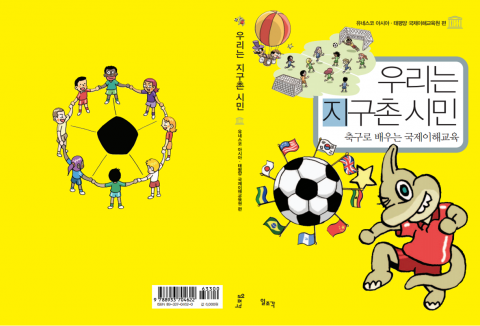 우리는 지구촌 시민: 축구로 배우는 국제이해교육 Year of publication: 2004 Corporate author: 유네스코 아시아태평양 국제이해교육원 『우리는 지구촌 시민—축구로 배우는 국제이해교육』은 세계화 시대에 우리 학생들이 세계 이웃의 다른 모습을 이해하고, 함께 살아가는 가치관을 깨우칠 수 있도록 도움을 주기 위하여 만들어진 교재입니다.세계적인 석학들과 교육 전문가들로 구성된 유네스코 21세기 세계교육위원회는 「들로르 보고서」에서 ‘함께 살기 위한 교육’을 21세기 교육의 핵심 과제로 제시하였습니다. 점차 증가하고 있는 여러가지 갈등 문제를 교육을 통하여 해결해 나가기 위한 시도인 것입니다. 이러한 세계적인 흐름 속에서 우리나라도 이에 발맞추어 제 7차 교육과정에서 '국제이해교육'을 창의적 재량학습 과목의 하나로 채택하였습니다. 이제는 국제이해교육의 하나의 독립된 학습 과목으로 자리잡을 수 있게 되었고, 이에 걸맞은 전문 교재와 교육 자료들이 필요하게 되었습니다. 하지만 안타깝게도 이러한 시대적인 요구를 만족시켜 줄만한 교재나 교육 자료는 그다지 많지 않습니다. 또한 '국제이해교육'이라는 제목을 통해서도 알 수 있듯이, 그 범위가 아주 넓어 어디서부터 어떻게 시작해야 할 지 막막한 기분이 드는 것도 사실입니다.유네스코 아시아태평양 국제이해교육원은 이러한 교육 현장의 요구에 부응하기 위해 『우리는 지구촌 시민—축구로 배우는 국제이해교육』을 발간하게 되었습니다. 유네스코 아시아태평양 국제이해교육원은 아시아·태평양 지역의 45개 나라들과 함께 '국제이해교육'을 강화하고 발전시킬 책임을 완수하기 위해 학교와 시민사회에서 다양한 활동을 이어오고 있습니다. 이러한 활동의 일환으로 우리 교육원은 다양한 분야의 전문가들과 함께 국제이해교육의 교육과정을 연구하는 동시에, 교원들에 대한 연수와 교육자료 개발에 온 힘을 쏟고 있습니다. 이번에 발간된 『우리는 지구촌 시민—축구로 배우는 국제이해교육』은 일곱 개의 장으로 구성되어 있으며, 각 장은 학생들이 세계 여러 나라의 저마다 다른 문화에 대한 이해를 통해서 문화간 이해, 인권, 평화, 세계화, 지속가능한 발전 등의 범세계적인 가치관을 배울 수 있도록 짜여졌습니다. 학생들이 일상 생활에서 쉽게 접할 수 있는 '축구'라는 작고 친근한 소재를 통해 '나와 다른 모습에 대한 이해'와 '함께 만들어가는 세상'을 체험하고 배울 수 있도록 꾸몄으며, 각 단원마다 다양한 <함께해보기>를 수록하여 학생들이 직접 참여함으로써 자신들이 가지고 있던 편견과 선입견을 발견하고 스스로 깨우쳐 나갈 수 있도록 구성하였습니다. 이 교재를 통하여 학생들이 편견에서 벗어나 세계의 친구들과 함께 살아갈 수 있는 올바른 가치관과 태도를 배울 수 있게 되기를 바랍니다.
 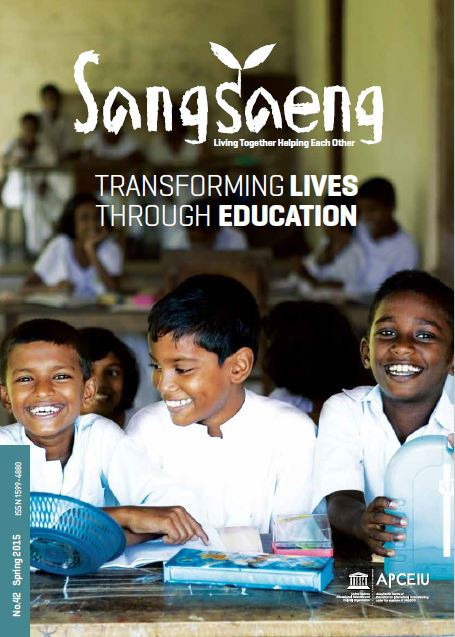 Transforming lives through education (SangSaeng no. 42 spring 2015) Year of publication: 2015 Corporate author: APCEIU The 42nd issue of SangSaeng, ‘Transforming Lives Through Education’, has been published. This spring edition has been released prior to the World Education Forum 2015 to provide the context for the post-2015 education agenda. It contains compelling articles that underline the importance of Global Citizenship Education in building a more sustainable and peaceful society. 3 Director’s Message4 Special Column Every Child Deserves a Child-Friendly World8 Focus: Transforming Lives Through Education 8 Emergence of Global Citizenship Education in the Post-2015 Education Agenda13 Re-Visioning Education Beyond 201518 Global Citizenship Education for the 21st Century23 Young People Are Ready to Lead: The Education We Want26 Interview Education Beyond 201531 Special ReportGlobal UNESCO Clearinghouse on Global Citizenship Education Hosted by APCEIU34 Best Practices34 Citizenship Education in a Community Setting38 Pangaea42 Letter Unity in Diversity44 Peace in My MemoryPresenting a Message of Peace Through Music47 Understanding the Asia-Pacific Region Timeless Festivity of the Ancient World: Hidirellez50 APCEIU in Action Transformer des vies par l'éducation (SangSaeng no. 42 printemps 2015) Year of publication: 2015 Corporate author: APCEIU Message du Directeur 3 4 Colonne spécialeChaque enfant mérite un enfant-Friendly Monde 8 Mise au point: Transformer des vies par l'éducation8 Emergence de L'éducation à la citoyenneté Mondiale (ECM) dans le L'après 2015 Agenda Education13 Re-Visioning Education Beyond 201518 L'éducation à la citoyenneté Mondiale (ECM) pour le 21e siècle23 jeunes gens sont prêts à plomb: L'éducation que nous voulons 26 InterviewEducation Beyond 2015 Rapport spécial 31Centre UNESCO mondial sur L'éducation à la citoyenneté Mondiale (ECM) Hébergé par APCECI 34 Meilleures pratiques34 éducation à la citoyenneté dans un cadre communautaire38 Pangaea 42 LettreUnité dans la diversité 44 Paix dans ma mémoirePrésenter un message de paix par la musique 47 Présentation de la région Asie-PacifiqueTimeless Festivity du monde antique: Hidirellez 50 APCECI en action
  Video sketch: Global Youth Advocacy Workshop on GCED Year of publication: 2015 Corporate author: APCEIU APCEIU produced a video on the Global Youth Advocacy Workshop on GCED held in Busan, Republic of Korea, from 30 March to 4 April 2015. The workshop invited 45 youth participants from 34 countries around the world, who are actively engaged with and committed to advocating and educating youth for GCED in their local contexts.This short video sketch of the workshop provides an overview of the activities carried out during the workshop and also includes the interviews of the participants, who shared their expectations, impressions, and reflections on the workshop.The workshop was co-organized by APCEIU, UN Secretary General’s Global Education First Initiative (GEFI), and the UNESCO Mahatma Gandhi Institute of Education for Peace and Sustainable Development (MGIEP); and sponsored by Educate A Child and the Geum-jeong District of Busan Metropolitan City.
 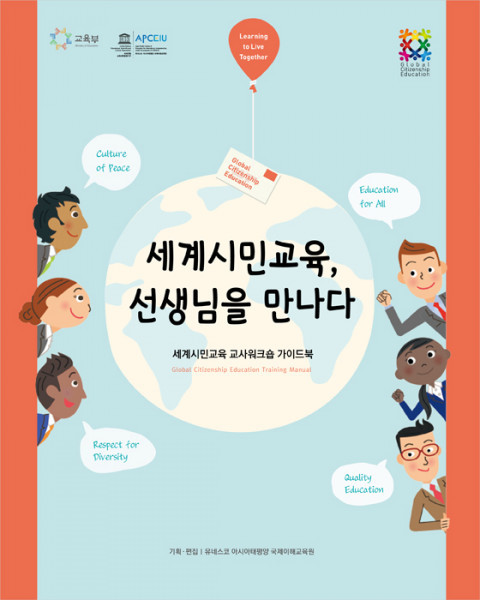 GCED Meets Teachers: GCED Teacher Workshop Guidebook Year of publication: 2015 Corporate author: APCEIU APCEIU published the GCED teacher workshop guidebook “GCED meets teachers.” This guidebook will be used at GCED workshops for teachers of 17 metropolitan and provincial offices of education carried out by GCED Lead teachers. The contents include the concept and the background of GCED, main contents, implementing methods at school. This GCED workshop manual provides teachers with opportunities to search for the ways to implement GCED at the schools, experience learning methods, and understand the main issues and themes of GCED through workshops. This guidebook is composed of 7 workshop sessions(refer to list below). Teachers and teacher educators planning GCED workshop can use this guidebook which includes the contents of the sessions, consultation to help plan and implement workshops based on participation and communication of the participants. “Global Citizenship Education meets teachers” GuidebookSession 1. Importance of World Education Forum and Global Citizenship EducationSession 2. Concept of GCED and its backgroundSession 3. Learning the contents and the theme of GCEDSession 4. Understanding the complexity and interrelationship of the issuesSession 5. Discussion class for cooperative communicationSession 6. Implementing GCED through Project Based LearningSession 7. Setting GCED action plans Éducation à la citoyenneté mondiale, rencontrer l'enseignant Year of publication: 2015 Corporate author: APCEIU APCECI publié le manuel de formation de l'ECM pour les enseignants intitulé «L’éducation à la citoyenneté mondiale: Guide de l'enseignant ».Ce guide est conçu comme un manuel pour les formateurs d'enseignants à planifier et à mettre en œuvre l'atelier d'ECM. Il comprend des informations de base sur ECM, thèmes clés, les concepts et les questions d'ECM et pédagogies transformatrices, les méthodes d'apprentissage, et la planification de l'action pour les classes d'ECM.Ce guide est composé de 7 séances de l'atelier comme ci-dessous. Les enseignants et les formateurs d'enseignants planifient des ateliers d'ECM peut concevoir et mettre en œuvre un atelier de 15 heures au niveau de base.«L'éducation à la citoyenneté mondiale: Guide des enseignants»Session 1. Forum mondial sur l'éducation (WEF) et L'éducation à la citoyenneté Mondiale (ECM) (ECM)Session 2. ECM: Concepts et Arrière-plansSession 3. thèmes et contenu ECM clésSession 4. Comprendre la complexité et de l'interdépendance des questionsSession 5. pédagogies: classe de discussion pour les communications coopérativesSession 6. pédagogies: ECM à travers (apprentissage axé sur les projets) PBLSession de planification 7. Action 세계시민교육, 선생님을 만나다 Year of publication: 2015 Corporate author: 유네스코 아시아태평양 국제이해교육원 유네스코 아시아태평양 국제이해교육원(www.unescoapceiu.org) 은 세계시민교육 교사워크숍 가이드북 “세계시민교육, 선생님을 만나다”를 출간하였다. 이 가이드북은 세계시민교육 중앙선도교사들이 17개 시·도교육청에서 소속 교사들을 대상으로 실시할 세계시민교육 연수를 위한 자료로 개발되었으며, 세계시민교육의 개념과 배경, 주요 내용, 교실에서 실천할 수 있는 세계시민교육 방법론 등에 관한 내용을 담고 있다.이 가이드북은 총 15시간의 세계시민교육 워크숍 매뉴얼로서 세계시민교육을 처음 접하는 교사들이 워크숍을 통해 세계시민교육의 배경과 기본 개념을 이해하고, 주요 내용 및 주제, 교수학습방법을 경험하며, 세계시민교육을 학교 현장에서 실천할 수 있는 방법과 기회를 모색하는 것을 목적으로 한다.총 7개의 워크숍 세션(아래 참조)으로 구성되어 있는 이 가이드북은 워크숍 진행자들이 참여와 소통에 기반한 워크숍을 기획 및 실행할 수 있도록 돕는 도움말 등이 함께 실려 있어 세계시민교육 워크숍을 기획하는 교사 및 교사교육가들에게 도움이 될 것으로 기대된다. “세계시민교육, 선생님을 만나다” 가이드북 구성 세션 1. 세계교육포럼의 의의와 세계시민교육 세션 2. 세계시민교육의 개념과 배경 세션 3. 세계시민교육의 내용과 주제 알기 세션 4: 이슈의 복합성과 상호연계성 이해하기 세션 5: 협력적 소통을 위한 토론 수업 세션 6: 프로젝트기반 학습(PBL)을 통한 세계시민교육 실천 세션 7: 세계시민교육 실천계획 수립
  Global youth advocacy workshop on GCED: final report Year of publication: 2015 Corporate author: APCEIU The United Nations Secretary-General's Global Education First Initiative (GEFI) recognizes Global Citizenship Education (GCED) as one of its three priorities. UNSG GEFI has generated momentum for GCED which has since been in the target of the education goal in the Muscat Agreement 2014 and in the proposed Sustainable Development Goals (SDGs) of the Open Working Group. The proposed SDGs will provide the basis for further intergovernmental negotiations on the post 2014 development agenda.In support of UNSG GEFI, UNESCO held its Second Global Forum on Global Citizenship Education on Building Peaceful and Sustainable Societies: Preparing for Post-2015 from 28 to 30 January 2015 in Paris, France. The forum aimed to identify GCED related inputs to the emerging Framework for Action on Education for the post 2015 development agenda, as well as key dimensions of GCED in relation to peace. Furthermore, it had a concurrent session dedicated to youth on Driving the GCED Agenda Forward: Acting with and for Young People to assemble the perspectives, ideas, and priorities of youth on GCED. Against this background, the Global Youth Advocacy Workshop on GCED, co-organized by GEFI, the Asia-Pacific Centre of Education for International Understanding (APCEIU) and UNESCO's Mahatma Gandhi Institute of Education for Peace and Sustainable Development (MGIEP) aimed to build the capacity of dynamic youth leaders from countries around the world to advocate for GCED. The participants of the workshop were selected on the basis of their previous experiences, present engagement, and future commitment in educating youth at the local and national levels. The objectives of the workshop were: 1. To build a common understanding of GCED and its key priority areas by building on the dialogue initiated at the Paris GCED Forum.2. To allow the participating youth leaders to elaborate an advocacy strategy suitable for implementation at the local and national levels to advance the GCED agenda beyond 2015.3. To establish a wider network of youth advocates on GCED to advance the agenda globally. La jeunesse mondiale atelier de plaidoyer sur ECM: rapport final Year of publication: 2015 Corporate author: Centre Asie-Pacifique d'éducation pour la compréhension internationale (APCEIU) À l'appui de SGNU GEFI, l'UNESCO a tenu son Forum mondial Deuxième sur L'éducation à la citoyenneté Mondiale (ECM) sur la construction de sociétés pacifiques et durables: Préparation de L'après 2015 du 28 au 30 Janvier 2015 à Paris, France. Le forum visait à identifier les entrées liées à l'ECM au Cadre émergent d'action sur l'éducation pour le programme de développement post 2015, ainsi que les dimensions clés de l'ECM par rapport à la paix. En outre, il a eu une séance simultanée dédiée aux jeunes sur la conduite du ECM Agenda Forward: Agir avec et pour les jeunes à assembler les perspectives, les idées et les priorités de la jeunesse sur ECM. Dans ce contexte, l'atelier de plaidoyer mondial de la jeunesse sur ECM, co-organisé par GEFI, le Centre Asie-Pacifique d'éducation pour la compréhension internationale (APCECI) et de l'Institut Mahatma Gandhi de l'UNESCO de l'éducation pour la paix et le développement durable (MGIEP) visant à construire le la capacité des jeunes leaders dynamiques des pays du monde entier à plaider pour ECM. Les participants de l'atelier ont été sélectionnés sur la base de leurs expériences précédentes, l'engagement présent et futur engagement dans l'éducation des jeunes aux niveaux local et national. Les objectifs de l'atelier étaient les suivants: 1. Pour construire une compréhension commune de l'ECM et de ses domaines prioritaires en misant sur le dialogue initié lors du Forum ECM Paris. 2. Pour permettre aux jeunes leaders participants d'élaborer une stratégie de plaidoyer approprié pour la mise en œuvre aux niveaux local et national pour faire avancer l'ordre du jour de l'ECM au-delà de 2015. 3. Pour établir un réseau plus large de défenseurs des jeunes sur ECM pour faire avancer l'ordre du jour à l'échelle mondiale.