
Resources
Explore a wide range of valuable resources on GCED to deepen your understanding and enhance your research, advocacy, teaching, and learning.
1,443 Results found
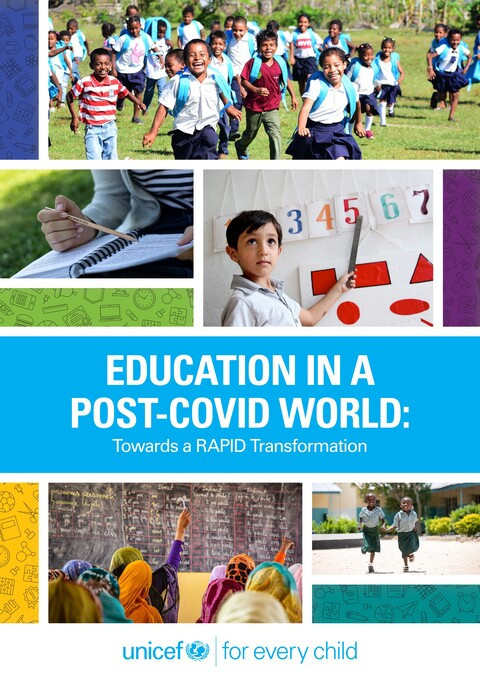 Education in a Post-COVID World: Towards a Rapid Transformation; Main Report Year of publication: 2023 Corporate author: United Nations Children's Fund (UNICEF) On March 11, 2020, the World Health Organization declared COVID-19 a global pandemic, resulting in disruptions to education at an unprecedented scale. In response to the urgent need to recover learning losses, countries worldwide have taken RAPID actions to: Reach every child and keep them in school; Assess learning levels regularly; Prioritize teaching the fundamentals; Increase the efficiency of instruction; and Develop psychosocial health and wellbeing. Marking three years since the onset of the pandemic, this report looks back at policy measures taken during school closures and reopening based on country survey data, initiatives implemented by countries and regions to recover and accelerate learning, and their emerging lessons within each RAPID action. With schools now reopened worldwide, this report also looks ahead to longer-term education transformation, offering policy recommendations to build more resilient, effective and equitable education systems.
 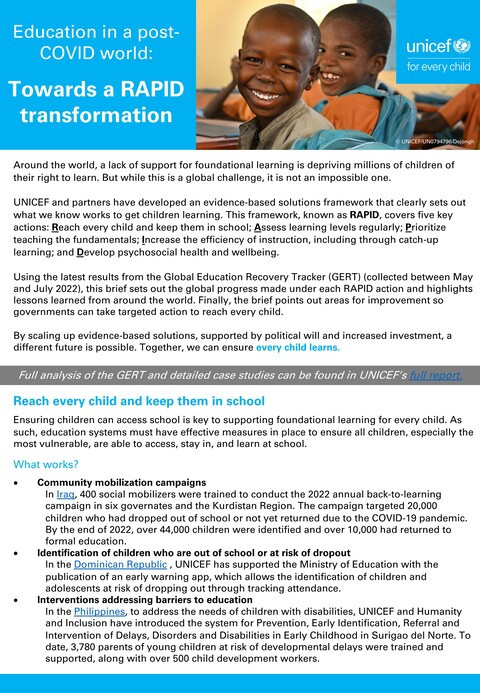 Education in a Post-COVID World: Towards a Rapid Transformation; Advocacy Brief Year of publication: 2023 Corporate author: United Nations Children's Fund (UNICEF) Around the world, a lack of support for foundational learning is depriving millions of children of their right to learn. But while this is a global challenge, it is not an impossible one. UNICEF and partners have developed an evidence-based solutions framework that clearly sets out what we know works to get children learning. This framework, known as RAPID, covers five key actions: Reach every child and keep them in school; Assess learning levels regularly; Prioritize teaching the fundamentals; Increase the efficiency of instruction, including through catch-up learning; and Develop psychosocial health and wellbeing. Using the latest results from the Global Education Recovery Tracker (GERT) (collected between May and July 2022), this brief sets out the global progress made under each RAPID action and highlights lessons learned from around the world. Finally, the brief points out areas for improvement so governments can take targeted action to reach every child.
 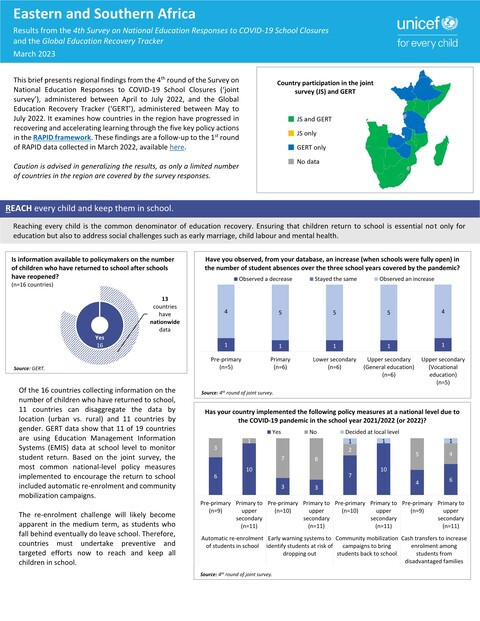 Education in a Post-COVID World: Towards a Rapid Transformation; Eastern and Southern Africa Regional Brief Year of publication: 2023 Corporate author: United Nations Children's Fund (UNICEF) On March 11, 2020, the World Health Organization declared COVID-19 a global pandemic, resulting in disruptions to education at an unprecedented scale. In response to the urgent need to recover learning losses, countries worldwide have taken RAPID actions to: Reach every child and keep them in school; Assess learning levels regularly; Prioritize teaching the fundamentals; Increase the efficiency of instruction; and Develop psychosocial health and wellbeing. This brief presents regional findings from the 4th round of the Survey on National Education Responses to COVID-19 School Closures (‘joint survey’), administered between April to July 2022, and the Global Education Recovery Tracker (‘GERT’), administered between May to July 2022. It examines how countries in the region have progressed in recovering and accelerating learning through the five key policy actions in the RAPID framework. These findings are a follow-up to the 1st roundof RAPID data collected in March 2022.
 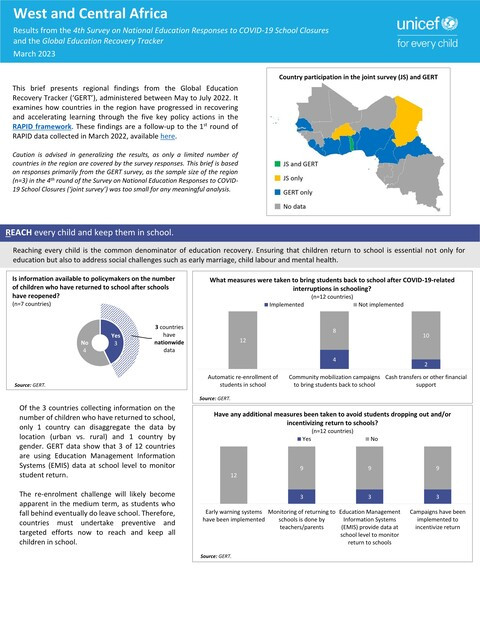 Education in a Post-COVID World: Towards a Rapid Transformation West and Central Africa Regional Brief Year of publication: 2023 Corporate author: United Nations Children's Fund (UNICEF) On March 11, 2020, the World Health Organization declared COVID-19 a global pandemic, resulting in disruptions to education at an unprecedented scale. In response to the urgent need to recover learning losses, countries worldwide have taken RAPID actions to: Reach every child and keep them in school; Assess learning levels regularly; Prioritize teaching the fundamentals; Increase the efficiency of instruction; and Develop psychosocial health and wellbeing. This brief presents regional findings from the Global Education Recovery Tracker (‘GERT’), administered between May to July 2022. It examines how countries in the region have progressed in recovering and accelerating learning through the five key policy actions in the RAPID framework. These findings are a follow-up to the 1st round of RAPID data collected in March 2022.
 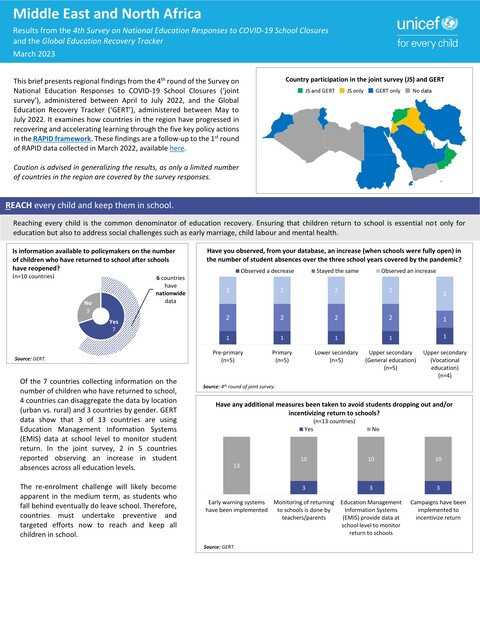 Education in a Post-COVID World: Towards a Rapid Transformation; Middle East and North Africa; Regional Brief Year of publication: 2023 Corporate author: United Nations Children's Fund (UNICEF) On March 11, 2020, the World Health Organization declared COVID-19 a global pandemic, resulting in disruptions to education at an unprecedented scale. In response to the urgent need to recover learning losses, countries worldwide have taken RAPID actions to: Reach every child and keep them in school; Assess learning levels regularly; Prioritize teaching the fundamentals; Increase the efficiency of instruction; and Develop psychosocial health and wellbeing. This brief presents regional findings from the 4th round of the Survey on National Education Responses to COVID-19 School Closures (‘joint survey’), administered between April to July 2022, and the Global Education Recovery Tracker (‘GERT’), administered between May to July 2022. It examines how countries in the region have progressed in recovering and accelerating learning through the five key policy actions in the RAPID framework. These findings are a follow-up to the 1st round of RAPID data collected in March 2022.
 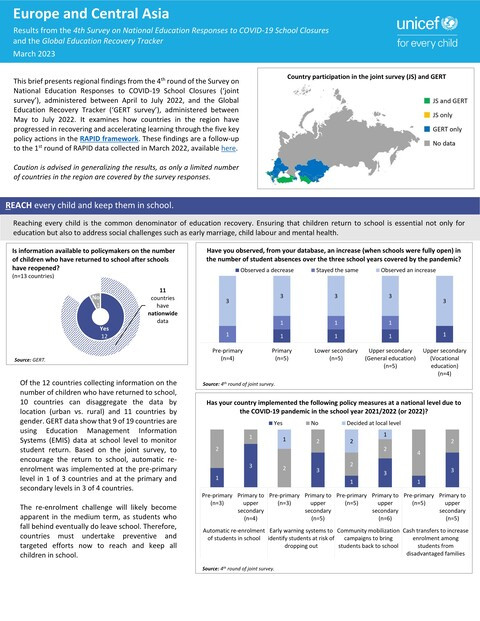 Education in a Post-COVID World: Towards a Rapid Transformation; Europe and Central Asia Regional Brief Year of publication: 2023 Corporate author: United Nations Children's Fund (UNICEF) On March 11, 2020, the World Health Organization declared COVID-19 a global pandemic, resulting in disruptions to education at an unprecedented scale. In response to the urgent need to recover learning losses, countries worldwide have taken RAPID actions to: Reach every child and keep them in school; Assess learning levels regularly; Prioritize teaching the fundamentals; Increase the efficiency of instruction; and Develop psychosocial health and wellbeing. This brief presents regional findings from the 4th round of the Survey on National Education Responses to COVID-19 School Closures (‘joint survey’), administered between April to July 2022, and the Global Education Recovery Tracker (‘GERT survey’), administered between May to July 2022. It examines how countries in the region have progressed in recovering and accelerating learning through the five key policy actions in the RAPID framework. These findings are a follow-up to the 1st round of RAPID data collected in March 2022.
 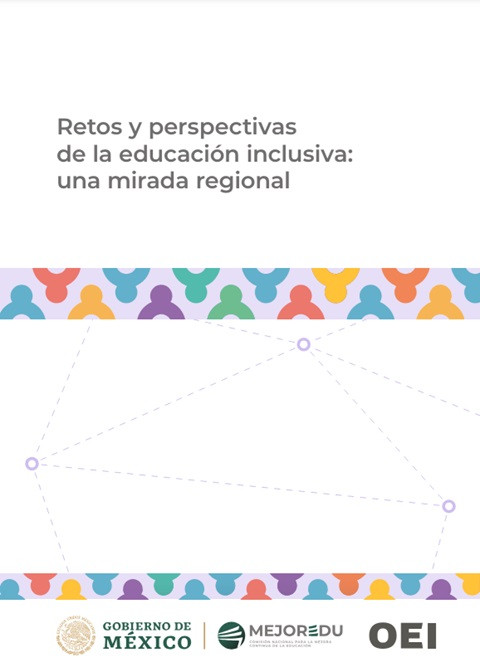 Challenges and Perspectives of Inclusive Education: A Regional Perspective Year of publication: 2024 Corporate author: National Commission for the Continuous Improvement of Education (Mejoredu) | Organization of Ibero-American States for Education, Science and Culture (OEI) This work compiles the four analysis tables Challenges and perspectives of inclusive education, which, to contribute to this purpose, were constituted as spaces for reflection and plural and democratic dialogue. During the analysis tables held in June 2023, the prominent speakers gave life to a space for reflection and plural and democratic dialogue, seeking to contribute through conversations to a topic of debate that cannot be postponed in the life of schools, speaking about the current situation of populations historically violated in their fundamental rights, the challenges of inclusive education in the region, experiences in educational care for historically disadvantaged populations and proposals for actions that contribute to educational systems moving towards inclusive education. Retos y perspectivas de la educación inclusiva: Una mirada regional Year of publication: 2024 Corporate author: National Commission for the Continuous Improvement of Education (Mejoredu) | Organización de Estados Iberoamericanos para la Educación, la Ciencia y la Cultura (OEI) Esta obra compila las cuatro mesas de análisis Retos y perspectivas de la educación inclusiva, las cuales, para contribuir a este propósito, se constituyeron en espacios de reflexión y diálogo plural y democrático. Durante las mesas de análisis realizadas en junio de 2023, los destacados ponentes dieron vida a un espacio de reflexión y diálogo plural y democrático, buscando aportar mediante conversatorios a un tema de debate inaplazable en la vida de las escuelas, hablando sobre la situación actual de las poblaciones históricamente vulneradas en sus derechos fundamentales, los desafíos de la educación inclusiva en la región, experiencias en atención educativa de poblaciones históricamente desfavorecidas y propuestas de acciones que contribuyan a que los sistemas educativos avancen hacia una educación inclusiva.
 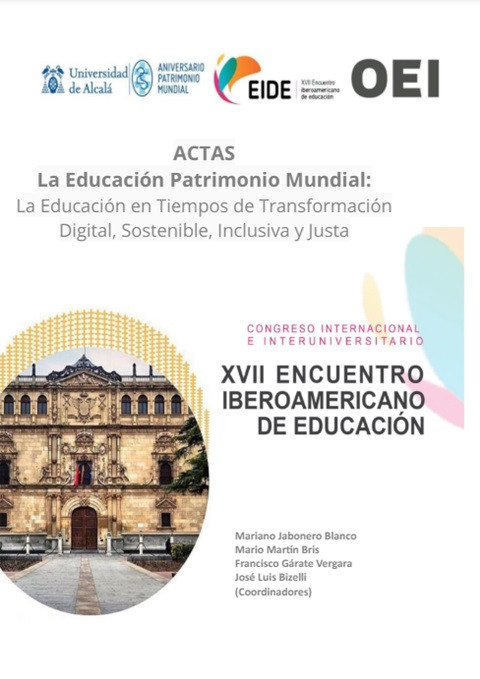 Minutes World Heritage Education: Education in Times of Digital, Sustainable, Inclusive and Fair Transformation Year of publication: 2024 Corporate author: University of Alcala | Organization of Ibero-American States for Education, Science and Culture (OEI) Document obtained from the XVII International and Interuniversity Congress of the Ibero-American Education Meeting. The University of Alcalá (UAH) in Madrid (Spain) and the Organization of Ibero-American States (OEI) organize the XVII Ibero-American Education Meeting (EIDE 2023) with the purpose of continuing to offer a scientific, rigorous and committed space for discussion and interdisciplinary exchange , interuniversity and international, with the focus on the Ibero-American geographical and cultural context, responding to the need to continue analyzing the educational reality from a global and collaborative perspective, as demanded by all professional and academic fields of education, at a time of great transformation challenges in the digital field, sustainability, inclusion, social justice and interculturality. Actas la educación patrimonio mundial: La educación en tiempos de transformación digital, sostenible, inclusiva y Justa Year of publication: 2024 Corporate author: University of Alcala | Organización de Estados Iberoamericanos para la Educación, la Ciencia y la Cultura (OEI) Documento obtenido del Congreso Internacional e Interuniversitario XVII Encuentro Iberoamericano de Educación. La Universidad de Alcalá (UAH) en Madrid (España) y la Organización de Estados Iberoamericanos (OEI) organizan el XVII Encuentro Iberoamericano de Educación (EIDE 2023) con el propósito de seguir ofreciendo un espacio científico, riguroso y comprometido de discusión e intercambio interdisciplinar, interuniversitario e internacional, con el foco puesto en el contexto geográfico y cultural iberoamericano, dando respuesta a la necesidad de seguir analizando la realidad educativa desde una perspectiva mundial y colaborativa, como demandan todos los ámbitos profesionales y académicos de la educación , en un momento de grandes retos de transformación en el ámbito digital, la sostenibilidad, la inclusión, la justicia social y la interculturalidad.