
Resources
Explore a wide range of valuable resources on GCED to deepen your understanding and enhance your research, advocacy, teaching, and learning.
2,781 Results found
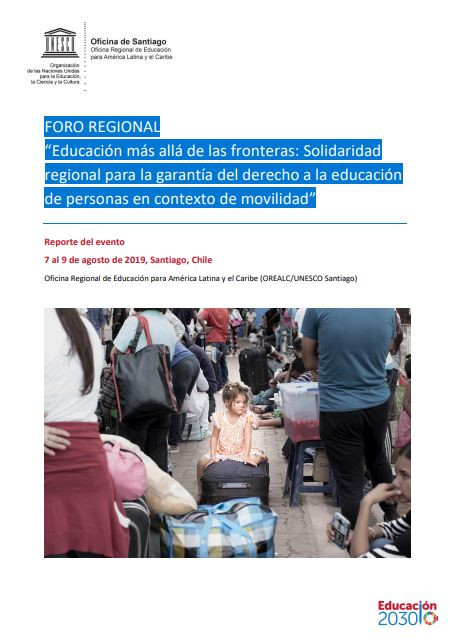 Foro regional: Educación más allá de las Fronteras: Solidaridad Regional para la Garantía del Derecho a la Educación de Personas en Contexto de Movilidad; reporte del evento Year of publication: 2019 Corporate author: UNESCO Santiago El aumento sustantivo de la movilidad intrarregional, la progresiva transformación de la procedencia de la población en contexto de movilidad y la presencia de flujos masivos de desplazamiento en los últimos años han supuesto importantes desafíos para los Estados. Particularmente, en establecer las maneras en que las personas migrantes, refugiadas, solicitantes de asilo y retornadas puedan ejercer sus derechos fundamentales. Entre estos derechos, el derecho a la educación emerge como una herramienta para proteger la dignidad humana, especialmente considerando su capacidad de promover la garantía de otros derechos y de constituirse, por tanto, en un derecho multiplicador. Un compromiso central de la Agenda 2030 adoptada por los Estados Miembros es “no dejar a nadie atrás”, por lo que considerar las necesidades de protección de las personas en situación de movilidad resulta urgente. El logro de los Objetivos de Desarrollo Sostenible depende de nuestra respuesta a este desafío mundial y regional.
  Education and Migration Policy Paper: Language, Education and Migration in the Context of Forced Displacement (Policy Brief Series, no 1) Year of publication: 2018 Author: Francine Sara Menashy | Zeena Zhakaria A surge in global migration, spurred in part by conflict, emergency, and fragility, has elicited increased attention to the specific needs of migrant and refugee learners. The international community faces an urgent global challenge: more people are now displaced than since the end of the Second World War. Half of those displaced are under the age of 18. Further, while two-thirds of international migrants are in high-income countries, 85% of those displaced by conflict and natural disaster now live in low-income countries. Forced displacement creates particular vulnerabilities, including access to education free from discrimination. Meeting Sustainable Development Goal 4 by 2030 demands that all children, youth, and adults receive an inclusive and equitable quality education. Education is a right that plays a critical role in advancing both sustainable development and peace. Yet refugees, migrants, and asylum seekers encounter numerous barriers to an inclusive andequitable quality education in host countries worldwide.
  Online Programme and Meeting Document Situation Analysis of SDG 4 with a Gender Lens, Target 4.C Year of publication: 2018 Corporate author: UNESCO Bangkok Teachers play a critical role in delivering high-quality education and learning outcomes. Indeed, the quality of an education system cannot exceed that of its teachers (OECD, 2010). Target 4.c recognizes this fact by calling on countries to increase the supply of qualified teachers. East Asia and the Pacific does not have enough trained and qualified teachers, particularly in remote and impoverished areas where children are most in need of highquality education. Moreover, the gender distribution of teachers is uneven across the education system, in teaching and administration. While integrating Target 4.c into national education policies and sector plans, governments should develop specific strategies to ensure that teachers are trained, qualified and deployed in an equitable manner.
  Situation Analysis of SDG 4 with a Gender Lens, Target 4.5 Year of publication: 2018 Corporate author: UNESCO Bangkok Equity and inclusion are at the heart of the SDG 4-Education 2030 Agenda. Target 4.5 calls for monitoring equity using disaggregated parity indices for all education indicators “by income, sex, age, race, ethnicity, migratory status, disability and geographic location, or other characteristics” (UN, 2016). In East Asia and the Pacific, access to basic education has expanded in recent decades, especially for girls (UNESCO & UNICEF, 2012). Despite these gains, many girls are still denied the right to education in the sub-region, but this should not mask the fact that boys also face barriers to education. As policymakers seek to implement Target 4.5, they must address the multiple, intersecting disadvantages that all children and youth face.
  Tajik cultural identity and multiculturalism Year of publication: 2014 Author: Khamrokhon Zarifi The article is devoted to issues of history, cultural identity and the heritage of the Tajik people. The issues of preservation and continuity of cultural diversity, as well as the phenomenon of multiculturalism are discussed.
  Language and education in post-Soviet Central Asia Year of publication: 2008 Author: Monica Perotto In the article, the author tries to assess the dynamics of the changing role of Russian and the titular languages in the post-Soviet republics of Central Asia with reference to demographic and geopolitical data, as well as to determine the consequences of the language policy pursued in these countries. Язык и образование в постсоветской Центральной Азии Year of publication: 2008 Author: Monica Perotto В статье автор пытается дать оценку динамике изменения роли русского и титульных языков в постсоветских республиках Центральной Азии со ссылкой на демографические, геополитические данные, а также определить последствия проводимой в этих странах языковой политики.
  Language Reforms in Central Asia: trends - goals - results Year of publication: 2008 Author: Pavel I. Dyatlenko The article considers the evolution of language reforms in Central Asia from the beginning of the twentieth century to the end of the 2000s and their significance as a reflection of changing trends. The author analyzes the goals and interests of the political elites who initiated the language reforms, as well as the consequences of the reforms in different areas of public life. Языковые реформы в Центральной Азии: тренды — цели — итоги Year of publication: 2008 Author: Pavel I. Dyatlenko Статья рассматривает эволюцию языковых реформ в Центральной Азии в период с начала ХХ века до конца 2000-х годов и их значение, как отражение менявшихся трендов. Автор анализирует цели и интересы политических элит, инициировавших языковые реформы, а также последствия проведенных преобразований в разных сферах общественной жизни.
 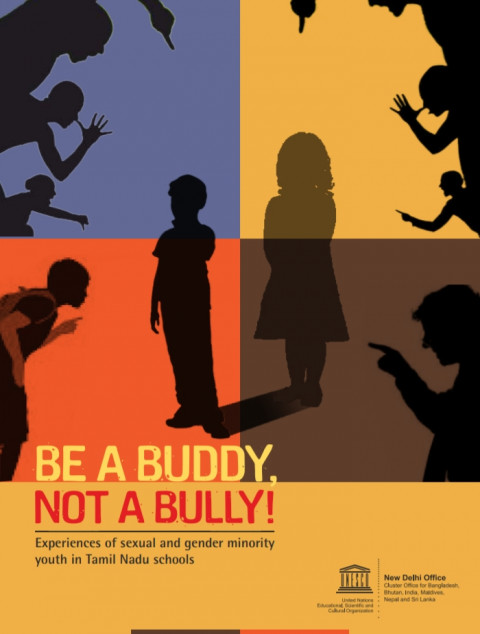 Be a buddy, not a bully: experiences of sexual and gender minority youth in Tamil Nadu schools Year of publication: 2019 Author: Menon C. Sunil, Chakrapani. Venkatesan, Jadav. Sarita Corporate author: UNESCO New Delhi We at UNESCO recognize that no country can achieve Sustainable Development Goal 4 - to ensure inclusive and equitable quality education and promote lifelong learning opportunities for all - if students are discriminated against or experience violence because of their actual or perceived sexual orientation and gender identity. This study conducted under the overall guidance of the School Education Department, Government of Tamil Nadu highlights our shared commitment to prevent and address bullying in educational institutions. We are confident that this report will be an effective tool for evidence based advocacy with school education departments and go a long way in promoting a comprehensive education sector response to SOGIE-based bullying, which includes enabling policy environments; inclusive curriculum and learning materials; professional development programmes for teachers and other school staff; support for learners including awarenessraising activities; and an overall school environment that is safe, nonviolent and that understands and appreciates diversity.