
Resources
Explore a wide range of valuable resources on GCED to deepen your understanding and enhance your research, advocacy, teaching, and learning.
1,180 Results found
 Envisioning the Future of Assessment in Transformative Education: A Synthesis Report of the Expert Meeting on Evaluation and Assessment for Transformative Education: Towards and Beyond 2030 Year of publication: 2025 Author: Esther Care Corporate author: APCEIU Transformative education calls for learning that nurtures not only knowledge, but also the values, attitudes, and behaviours essential for inclusive, just, and sustainable societies. Recent global discussions, including UNESCO’s Reimagining Our Futures Together: A New Social Contract for Education and the Recommendation on Education for Peace and Human Rights, International Understanding, Cooperation, Fundamental Freedoms, Global Citizenship and Sustainable Development, emphasise learning that fosters critical thinking, empathy, cooperation, and action-oriented engagement. Within this vision, assessment needs to evolve from primarily measuring achievement to supporting a process of learning that actively enables and evidences learners’ reflection, growth, and empowerment. Traditional approaches, which prioritise standardisation and summative outcomes, are insufficient for capturing the complex competencies at the heart of transformative education, such as socio-emotional development, critical reflection, ethical reasoning, and responsible action. These limitations raise fundamental questions about not only how transformative learning outcomes can be assessed across diverse systems and contexts, but also what purposes assessment should serve.To examine these issues, APCEIU convened the Expert Meeting on Evaluation and Assessment for Transformative Education: Towards and Beyond 2030, held in Seoul, Republic of Korea, on 2–3 July 2025. The meeting brought together global experts, researchers, and policymakers to discuss current challenges, share emerging practices, and consider strategic directions for reimagining assessment in support of transformative education.Building on these rich discussions, this report synthesises the key reflections and forward-looking perspectives shared during the meeting. Part I presents analytical insights and strategic considerations for advancing assessment in transformative education, while Part II documents the meeting proceedings, including presentations and collaborative discussions.
  UNESCO, Climate Change Education and COP22 Year of publication: 2016 Corporate author: UNESCO Education is a key vector to prepare societies for global changes. It plays a critical role in achieving sustainable development goals and putting into practice a global agreement on climate change. Education plays a paramount role in raising awareness and promoting behavioural change for climate change mitigation and adaption. It helps increase the climate change mitigation and adaptation capacity of communities by enabling individuals to make informed decisions. L'UNESCO, l'éducation au changement climatique et la COP22 Year of publication: 2016 Corporate author: UNESCO L’éducation est un vecteur clé pour préparer les sociétés à faire face aux changements globaux. Elle joue un rôle essentiel dans la réalisation des objectifs de développement durable et de mettre en pratique un accord mondial sur le changement climatique.L’éducation joue un rôle primordial dans la promotion de la sensibilisation et le changement de comportement concernant l’atténuation et l’adaptation en matière de changement climatique.Elle aide à accroitre l’atténuation du changement climatique et la capacité d’adaptation des collectivités en permettant aux individus de prendre des décisions informées.
  Futures of Education: learning to become Year of publication: 2019 Corporate author: UNESCO UNESCO’s Futures of Education initiative aims to rethink education and shape the future. The initiative is catalyzing a global debate on how knowledge, education and learning need to be reimagined in a world of increasing complexity, uncertainty, and precarity. Looking to 2050 and beyond, the Futures of Education initiative seeks to reimagine how education and knowledge can contribute to the global common good. The initiative will catalyze a global debate on how knowledge and learning can shape the future of humanity and the planet. L'avenir de l'éducation: apprendre à devenir Year of publication: 2019 Corporate author: UNESCO L’initiative de l’UNESCO intitulée L’avenir de l’éducation vise à repenser l’éducation et à façonner l’avenir, en lançant un débat mondial sur la manière de réinventer le savoir, l’éducation et l’apprentissage dans un monde de plus en plus complexe, incertain et précaire. Le savoir et l’apprentissage sont les plus riches ressources renouvelables dont dispose l’humanité, pour relever les défis et frayer des voies nouvelles. Or, l’éducation fait bien plus que s’adapter à un monde changeant. L’éducation transforme le monde.
  Руководство и рекомендации по переориентации педагогического образования на решение задач устойчивого развития Year of publication: 2005 Corporate author: Организация Объединенных Наций по вопросам образования, науки и культуры (UNESCO) Члены международной сети разработали рекомендации, касающиеся переориентации педагогического образования на решение задач устойчивого развития. Эти рекомендации основаны на результатах проведенных экспериментов и большой работы, проделанной специалистами в области педагогического образования. Рекомендации предназначены для учреждений министерского и национального уровня, а также для местных учреждений. Они касаются учебных планов, педагогики, политики, практической деятельности, программ, вознаграждений, научных исследований, информации и компьютерной технологии, партнерских отношений, создания сетей, коммуникации и тд.
 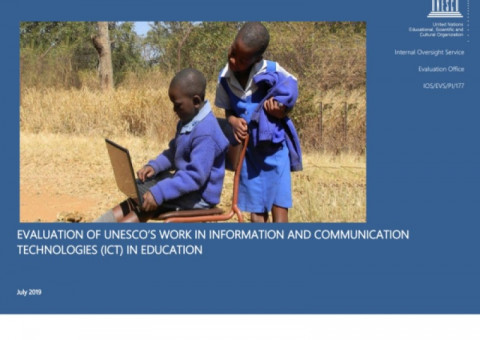 Evaluation of UNESCO's work in information and communication technologies (ICT) in education Year of publication: 2019 Author: Seán Ó Siochru and Graham Attwell Corporate author: UNESCO ICT in Education is a fast-growing area globally that offers many strategic opportunities. As the leader and coordinator of the SDG 4 – Education 2030 with the aim to “Ensure inclusive and equitable quality education and promote lifelong learning opportunities for all”, UNESCO has the mandate and expertise needed to strategically position itself as a world leader in this field. UNESCO’s work in ICT in Education aims at enhancing the quality and relevance of learning and at strengthening inclusion. While technology can facilitate wider access to education and bridge learning divides, can advance gender equality and inclusion as well as digital skills development, the rapidly changing technologies and work processes require the development of new pedagogies, both for the use of ICT for teaching and learning in the classroom and through open access and distance learning. Compared to other players, UNESCO leverages its comparative strengths in its ICT in Education interventions - especially its impartiality, convening power, and policy expertise - through an inclusive and humanistic approach to achieving quality education in coherence with Sustainable Development Agenda 2030. Its expertise across all levels of Education and its multidisciplinary potential of working across its Programme Sectors are also considered among UNESCO’s specific strengths. The evaluation revealed that UNESCO achieved important results, at the level of the learning environment, at the policy level and in institutional capacity building, but it also showed that UNESCO still needs to strengthen its positioning and visibility within the wider landscape of ICT in Education. For example, UNESCO has to continue positioning itself for producing forward-looking knowledge on ICT in Education and as a laboratory of ideas for future-oriented thinking. While the evaluation came across various specific interventions successfully addressing the needs of disadvantaged groups, the evaluation found that considerations of inclusion and gender equality were not consistently mainstreamed into policy-related and capacity building interventions. Other challenges are mainly linked to the current dispersion of resources and fragmentation of expertise across different entities within the Organization, which also leads to reduced visibility. While the key entities active in this area recognize that they are working within a common theme, collaboration and coordination still needs to be improved. The strategic measures proposed by the evaluation towards an overall organizational framework for ICT in Education aim at establishing an enabling environment for inter- and multidisciplinary approaches and greater coherence and collaboration.
 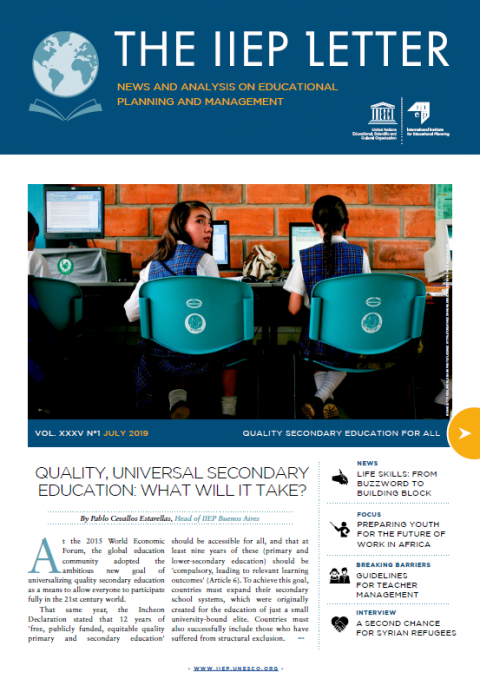 The IIEP letter: news and analysis on educational planning and management, vol. 35, no. 1 Year of publication: 2019 Corporate author: UNESCO This issue is dedicated to addressing the challenges and opportunities for quality secondary education for all. It addresses the necessary structural and curricular changes secondary education must undergo in order to address long histories of segregation and inequality. Experiences from Latin America illustrate some key takeaways on how to match commitment with meaningful change.
 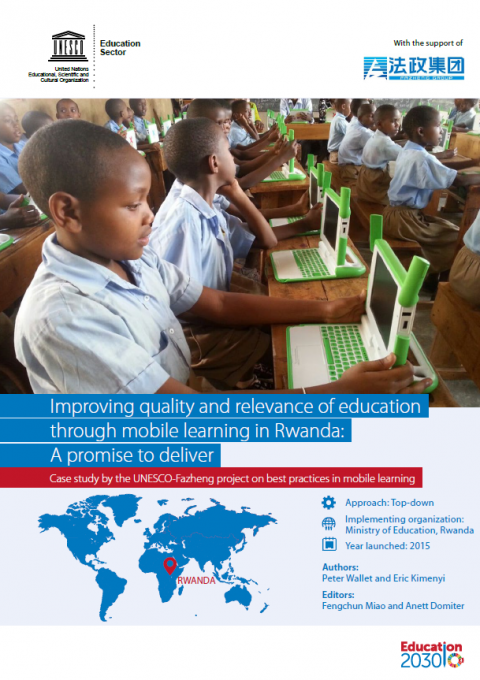 Improving quality and relevance of education through mobile learning in Rwanda: a promise to deliver: case study by the UNESCO-Fazheng project on best practices in mobile learning Year of publication: 2019 Author: Wallet, Peter | Kimenyi, Eric | Miao, Fengchun | Domiter, Anett Corporate author: UNESCO Rwanda’s education sector is evolving through the adoption of information and communication technology (ICT ). Whereas the focus was previously on the extensive deployment of laptop devices, it is shifting towards advancing adaptive child-centred learning and the use of ICT augmented environments to enrich teaching and learning. In developing countries, however, an orientation frequently remains to select strategies which have previously shown to be successful in developed contexts without taking into account the full range of elements required for effective implementation including a comprehensive assessment of the financial implications required to ensure longer term sustainability. This case study aims to showcase Rwanda’s customised approach to the integration of ICT in classrooms adapted to meet the particular needs of the Rwandan education system. The SMARTRwanda Master Plan lays out a vision to transform Rwanda’s economy by leveraging the use of ICT. Aligned to SMART Rwanda, the Ministry of Education (MINEDUC) is implementing the SMARTClassroominitiative under its ICT in Education Master Plan to reach all schools by 2020. Although there have been several challenges encountered during the various phases of implementation, more than half of all schools across the country are now equipped with ICT devices and many teachers have undergone various capacity-building initiatives to make better use of ICT in teaching and learning. More work is required in order to develop a fully functioning ICT in education ecosystem in Rwanda; nevertheless, this case study demonstrates progress made thus far and describes the various system stakeholders, their roles, responsibilities and contributions to date to improve access, quality and relevance of education through ICT adoption.
  Education transforms lives: empowering people and ensuring inclusiveness and equality Year of publication: 2019 Corporate author: UNESCO This brochure compiles the main elements of progress on Sustainable Development Goal 4 (SDG 4) highlighted in the submission by UNESCO, on behalf of the SDG-Education 2030 Steering Committee, to the Office of the Under-Secretary-General, Department of Economic and Social Affairs (DESA) on the occasion of the High-level Political Forum (HLPF) 2019 - Empowering people and ensuring inclusiveness and equality.