
Resources
Explore a wide range of valuable resources on GCED to deepen your understanding and enhance your research, advocacy, teaching, and learning.
2,781 Results found
 Bilingual education as the basis of humanitarian space and integration processes in the EAEU Year of publication: 2017 Author: M. Tagaev, B. Borchieva This article focuses on conducting a situational analysis and the prospects for introducing bilingual education in Kyrgyzstan as the basis for integration processes in the post-Soviet space. Билингвальное образование как основа гуманитарного пространства и интеграционных процессов в ЕАЭС Year of publication: 2017 Author: M. Tagaev, B. Borchieva В данной статье ставится задача провести ситуационный анализ и перспективы внедрения билингвального образования в Кыргызстане как основы интеграционных процессов на постсоветском пространстве.
  Creating Global Citizens: The AFS Effect Year of publication: 2019 Corporate author: AFS Intercultural Programs The AFS global community has countless testimonials of how our alumni, students, volunteers, families, and others are making a positive change in their communities. These stories are a true inspiration and a testament to the important impact our organization is creating worldwide. Our hope is that our exchange students become changemakers through their study abroad experience with significant contributions to the global corporate and non-profit sectors, while benefiting from the intercultural learnings and meaningful connections long after they return home. All AFS participants are active global citizens in the making, representing their countries as cultural ambassadors, each helping drive the AFS mission forward - the mission of building a more just and peaceful world.While the impact of AFS and studying abroad in general have been examined in the past through various research projects, this report is the first large-scale, global survey of the AFS alumni community based on responses from over 10,500 former AFS participants. It aims to explore the effect an AFS experience can have on the lives and careers of our alumni while investigating the impact of secondary school mobility globally. The study also includes real-life examples from our former participants of changes alumni can bring to their local communities thereby furthering the AFS mission worldwide. The results of this global survey demonstrate that AFS alumni are making an impact across industries, working on social causes, and contributing to their home and host countries alike. That is what we call the #AFSEffect.
  How to Hit a Moving Target: 35 Years of Gender and Sexual Diversity in Teacher Education Year of publication: 2019 Author: Lee Airton | Austen Koecher This essay shares findings from an exhaustive review of the English-language published scholarship on integrating gender and sexual diversity in teacher education (GSDTE) since 1982. The 158 sources substantiate a largely USA-based field with an array of studied pedagogies and a citational reliance on statistics that reveal the school-sited suffering of gender and sexual minority youth. Implications for the field are shared, including: critical questions about the field's construction, objects and beneficiaries; the importance of citing GSDTE and teacher education research and not only youth outcome research; and preparing teachers for gender and sexual diversities that are presently unimaginable. Highlights • A review of the literature on integrating gender and sexual diversity in teacher education.• There is a citational reliance on the school-sited suffering of gender and sexual minority youth.• It is important to cite GSDTE and teacher education research and not only youth outcome research.• This will help prepare teachers for gender and sexual diversities that are presently unimaginable.
  INEE Guidance Note on Gender: Equality in and Through Education Year of publication: 2019 Corporate author: Inter-agency Network for Education in Emergencies (INEE) With the launch of the Global Goals for Sustainable Development (SDGs) in 2015, the international community committed to providing inclusive and equitable quality education for all (SDG4) as well as achieving gender equality and the empowerment of all women and girls (SDG5). The Global Goals also emphasize the need to “leave no one behind” by focusing on those furthest behind first, such as those affected by crisis. In line with this, the Education 2030 Framework for Action stresses the importance of providing education in “safe, supportive and secure learning environments free from violence” and recommends a stronger, better coordinated response to ensure the protective space of education is maintained during crises and subsequent recovery efforts.In response to these global commitments, the INEE Guidance Note on Gender provides strategies to ensure that girls, boys, women, and men in contexts of conflict and crisis equally enjoy the protection and learning outcomes that quality education can provide. It also outlines principles for gender-responsive programming, in alignment with the INEE Minimum Standards for Education in Emergencies. The Guidance Note on Gender shows how attention to gender dynamics and social constraints will result in better education for all crisis-affected populations and help build inclusive, equitable education systems for the future. This guidance note also responds to recent developments in the humanitarian context, including the historic commitment made by G7 partners to quality education for girls in crisis situations. The ensuing Charlevoix Declaration on Quality Education for Girls, Adolescent Girls, and Women in Developing Countries recognizes that quality education can contribute to peace and stability as well as positive health and life outcomes for all. It is critical that the development community now harnesses this global momentum by working together to break the particular barriers that prevent too many girls and boys in situations of crisis and conflict from accessing the education they need. It is our hope that this Guidance Note on Gender will help better equip those at the frontlines of this work to do just that.
 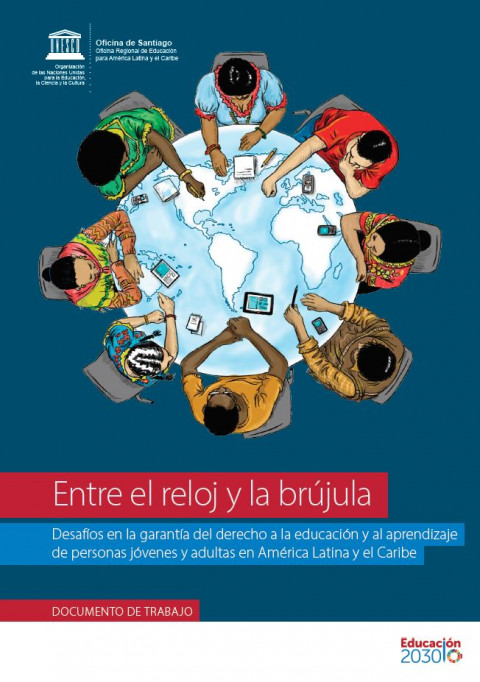 Entre el reloj y la brújula: desafíos en la garantía del derecho a la educación y al aprendizajede personas jóvenes y adultas en América Latina y el Caribe; documento de trabajo Year of publication: 2019 Author: Henry Renna Corporate author: UNESCO Santiago Este documento tiene por objetivo proporcionar una visión general de la educación y del aprendizaje de personas jóvenes y adultas como derecho humano y social. Los instrumentos de derecho vinculante y no vinculante que la sustentan son históricos y de larga data, como también contingentes, amplios y extensos en su alcance, con presencia regional e internacional. El documento muestra —sobre la base de los Indicadores del Objetivo de Desarrollo Sostenible 4 (ODS 4 Agenda 2030)— que los principales desafíos para los países de América Latina y el Caribe tienen relación con la lentitud de los progresos (el desafío del reloj) dejando a muchas y muchos jóvenes y adultos al margen de oportunidades educativas, de conocimientos, habilidades y aptitudes, y privados de alcanzar el bienestar integral. Este informe también sostiene —basado en los informes nacionales del Tercer Reporte Global de Educación y Aprendizaje de Adultos— que muchos desafíos están vinculados con la dirección de las políticas (el desafío de la brújula), con sentidos reduccionistas y homogeneizadores detrás de las instituciones y de la acción pública, lo que precariza y fragiliza la garantía del derecho a la educación y al aprendizaje de las personas jóvenes y adultas. Este documento es consistente con el llamado de la UNESCO a «repensar la educación» e invita a reconstruir en el siglo XXI un mundo y una educación sin muros, donde se difuminen las fronteras mentales e institucionales que reducen, dividen y aislan los sistemas educativos, con el fin de liberar su poder transformador para todos y todas.
 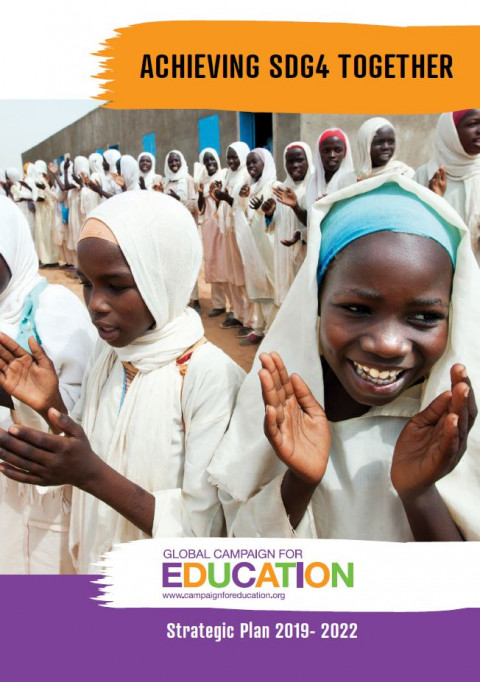 Achieving SDG 4 Together: Strategic Plan 2019 - 2022 Year of publication: 2018 Corporate author: Global Campaign for Education (GCE) The 2019-2022 strategic plan of the Global Campaign for Education was adopted during the 6th World Assembly of the movement in November 2018, Kathmandu. The plan identifies 4 priority strategic areas: Inclusivity and non-discrimination, Transformative education, Education in emergencies and Financing education. The plan also focus on strengthening the global movement and integrating youth voices.On the eve of celebrating its 20th anniversary, the Global Campaign for Education (GCE) is the largest civil society organisation movement working to promote the human right to education and to put pressure on governments and the international community to fulfil their commitments to provide free, inclusive, quality public education and lifelong learning for all, particularly for children. Our regional and national coalitions encompass many thousands of civil society organisations and represent millions of individuals across the world. Each is independent, and all are united by the commitment to the human right to education, and to achieving change through the mobilisation of citizens and civil society.
 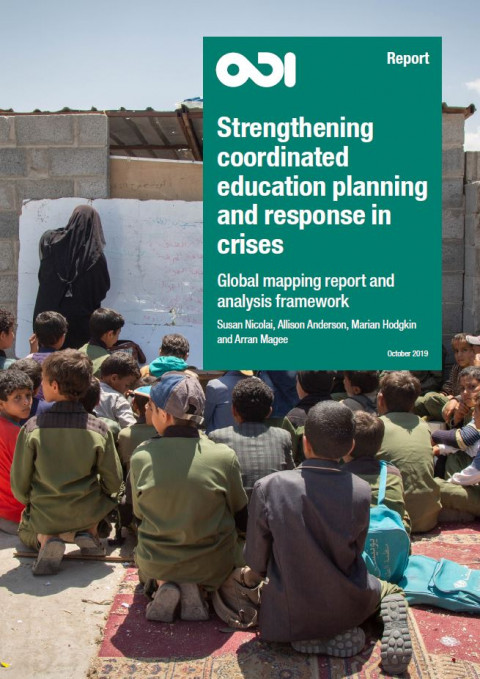 Strengthening Coordinated Education Planning and Response in Crises: Global Mapping Report and Analysis Framework Year of publication: 2019 Author: Susan Nicolai | Allison Anderson | Marian Hodgkin | Arran Magee Corporate author: Overseas Development Institute (ODI) This report presents a framework for analysis of formal coordination approaches for education planning and response in emergencies and protracted crises. It reviews concepts and definitions of coordination, approaches and structures for coordinated planning and response, and expected outcomes of these processes, with a focus on humanitarian structures across the humanitarian–development nexus.It is part of a set of publications produced in partnership with the Global Education Cluster, the Inter-Agency Network for Education in Emergencies and UNHCR – the UN Refugee Agency – with funding from the Education Cannot Wait Fund. The conceptual framework and set of research questions that emerge from this report is applied to six country case studies, which will be published in December 2019.
 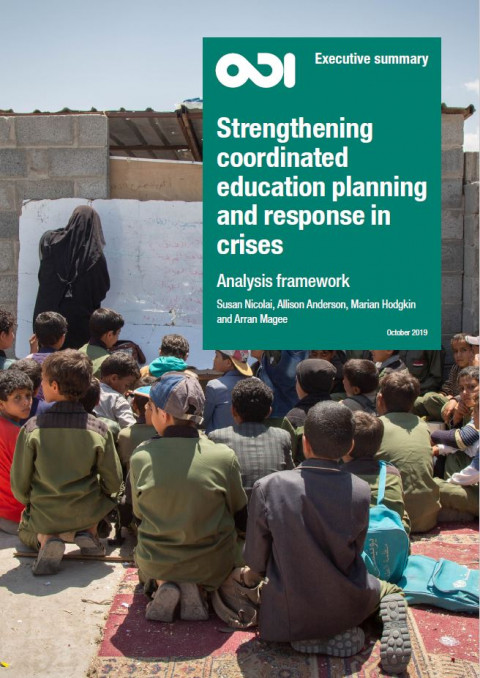 [Summary] Strengthening Coordinated Education Planning and Response in Crises: Analysis Framework; Executive Summary Year of publication: 2019 Author: Susan Nicolai | Allison Anderson | Marian Hodgkin | Arran Magee Corporate author: Overseas Development Institute (ODI) This report presents a framework for analysis of formal coordination approaches for education planning and response in emergencies and protracted crises. It reviews concepts and definitions of coordination, approaches and structures for coordinated planning and response, and expected outcomes of these processes, with a focus on humanitarian structures across the humanitarian–development nexus. The main types of formal education coordination groups include Education Clusters, Refugee Education Working Groups and Local Education Groups (LEGs). These often have different purposes and organisations associated with them, sometimes resulting in overlaps and gaps in coordination efforts.
  Transforming Systems in Times of Adversity: Education and Resilience; White Paper Year of publication: 2019 Author: Ritesh Shah Corporate author: United States Agency for International Development (USAID) This white paper was commissioned to provide USAID, including Missions, Regional Bureaus, Pillar Bureaus, and the Office of U.S. Foreign Disaster Assistance (OFDA), with an overview of global and Agency thinking and practice on education and resilience and a foundation and justification for positioning USAID education efforts more concretely within a resilience frame.The white paper is organized into three key sections. The first section outlines the business case for resilience, explaining how and why resilience is an important consideration for education programs to consider in contexts of crisis and conflict and how education is well poised as a sector to contribute to strengthening resilience. The second section presents a conceptual framework for understanding how resilience operates through and within the education sector and program interventions. The third section provides a series of key considerations for developing and supporting USAID education programs with a resilience lens or focus.