
Resources
Explore a wide range of valuable resources on GCED to deepen your understanding and enhance your research, advocacy, teaching, and learning.
2,668 Results found
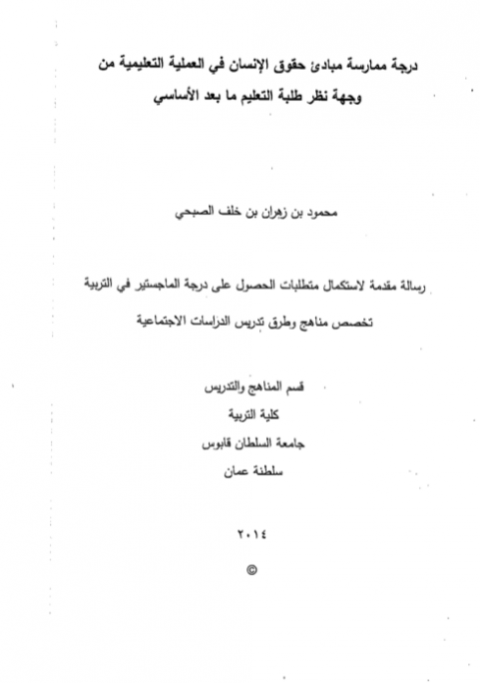 درجة ممارسة حقوق الانسان في العملية التعليمية من وجهة نظر التعليم ما بعد الاساسي Year of publication: 2014 Author: Mahmoud AlSubhi هدفت هذه الدراسة للكشف عن درجة ممارسة حقوق الانسان في العملية التعليمية من وجهة نظر الطلبة في مدارس التعليم ما بعد الاساسي. ولتحقيق أهداف الدراسة استخدم الباحث المنهج الوصفي، اذ قام بإعداد إستبانة مكونة من 37 عبارة موزعة على محورين وهما حرية التعبير عن الرأي، والعدل والمساواة. وقد أظهرت النتايج أن درجة الممارسة كانت متوسطة، وأن درجة الممارسة كانت أكبر في محور العدل والمساواة عن محور حرية التعبير عن الرأي. وأوصت الدراسة بضرورة تعزيز ممارسة حقوق الانسان في العملية التعليمية.
  Right to Education Handbook Year of publication: 2019 Corporate author: Right to Education Initiative (UK) The ultimate aim of this handbook is to facilitate the realization and universal enjoyment of the right to education. Its objective is not to present the right to education as an abstract, conceptual, or purely legal concept, but rather to be action-oriented. Where possible, practical guidance is given on how to implement and monitor the right to education along with recommendations to overcome persistent barriers. It seeks to do this by: Increasing awareness and knowledge of the right to education. This includes the normative content of the right to education, states’ legal obligations, the various sources of law regarding the right to education, what states must do to domestically implement the right to education, how to monitor the right to education, and how to increase accountability of the right to education. Providing a summary of current debates and issues regarding education and what human rights law says about them, including on forced migration, education in emergencies, the privatization of education, and the challenge of reaching the most marginalized. Providing an overview of the UN landscape and its mechanisms, including a clear understanding of the role of UNESCO and more generally the UN, as well as all relevant stakeholders in education, particularly civil society. UNESCO’s Strategy on standard-setting instruments in the field of education (2016-2021) encourages Member States of the Organization to use normative action in relation with the right to education as a strategic tool to implement and achieve SDG4. In line with this, this handbook – specifically foreseen by the Strategy– will also serve as a reference tool for the design and organization of training modules and workshops in the field of right to education. Finally, the handbook will also be an important reference for those working towards the achievement of SDG4, by offering guidance on how to leverage legal commitment to the right to education as a strategic way to achieve this goal.
 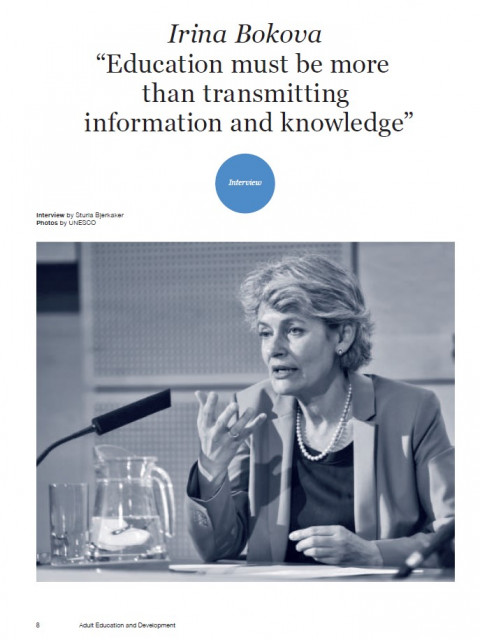 Education must be more than transmitting information and knowledge Year of publication: 2015 Author: Sturla Bjerkaker Corporate author: UNESCO. Director-General, 2009-2017 (Bokova, I.G.) Irina Bokova has been the Director-General of UNESCO since November 2009. She is the first woman to lead the organisation. Ms Bokova has served as Bulgaria’s Secretary of State for European Integration, Minister of Foreign Affairs, Ambassador to France and Monaco and Permanent Delegate to UNESCO, among other positions. She has been actively engaged in international efforts to advance quality education for all, gender equality, human rights, cultural dialogue and scientific cooperation. She also serves as Executive Secretary of the Steering Committee of the UN Secretary-General’s Global Education First Initiative.
  Grève scolaire pour le climat: L’engagement des jeunes à l’épreuve de la démocratie Year of publication: 2019 Author: Axel Winkel Qui a dit que les jeunes ne s’engageaient plus ? Que la politique ne les intéressait plus ? Les manifestations pour le climat organisées par les jeunes du secondaire depuis le début de l’année 2019 semblent nous indiquer le contraire. Elles chamboulent nos perceptions habituelles du jeune apathique et désintéressé par la vie de la cité. Elles posent aussi de nombreuses questions. Comment comprendre cet élan soudain de milliers d’étudiants à travers la Belgique ? Quelle forme particulière l’engagement de la nouvelle génération prend-il ?
 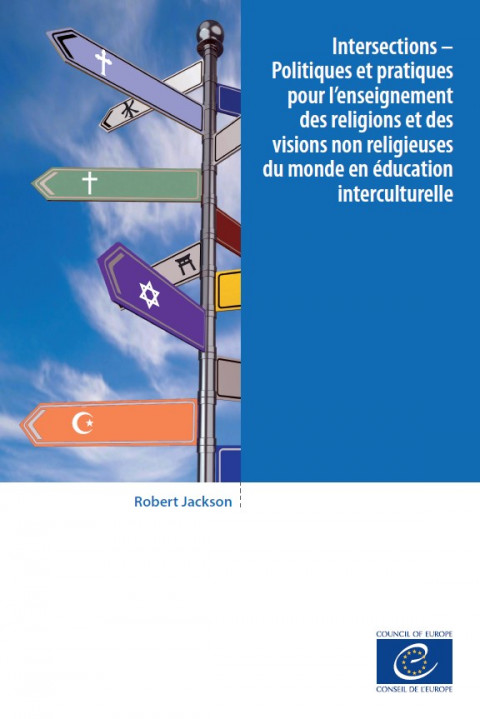 Intersections – Politiques et pratiques pour l’enseignement des religions et des visions non religieuses du monde en éducation interculturelle Year of publication: 2015 Author: Robert Jackson Que peut apporter l’étude des religions et des visions non religieuses du monde à l’éducation interculturelle des élèves européens ? Dans une importante recommandation, la Recommandation CM/Rec(2008)12 relative à la dimension des religions et des convictions non religieuses dans l’éducation interculturelle, le Comité des Ministres du Conseil de l’Europe explique la nature et les objectifs de cet enseignement.Intersections va beaucoup plus loin, car il s’agit ici d’aider les décideurs, les établissements scolaires (enseignants et équipe de direction) et les formateurs d’enseignants à relever au mieux les défis que soulève la recommandation. En tenant dûment compte de l’avis de responsables pédagogiques, d’enseignants et de formateurs d’enseignants des États membres du Conseil de l’Europe, Intersections fournit des conseils pour, par exemple, comprendre la terminologie employée dans cette forme d’enseignement; développer des compétences d’enseignement et d’apprentissage, et adopter différentes approches pédagogiques; créer en classe un « espace sécurisant » propice au dialogue entre élèves; aider les élèves à analyser les représentations des religions dans les médias; parler à la fois des visions non religieuses du monde et des points de vue religieux ; aborder les questions de religions et de convictions sous l’angle des droits de l’homme ; et tisser des liens entre établissements scolaires (de différents types) et entre l’école et son environnement.Intersections n’est ni un programme à suivre ni un manifeste politique. L’ouvrage vise à donner aux décideurs, aux établissements scolaires et aux formateurs d’enseignants des États membres du Conseil de l’Europe, ainsi qu’à toutes les personnes intéressées, les outils nécessaires pour résoudre les problèmes d’interprétation de la recommandation et adapter son message aux besoins propres à chaque pays. Intersections est le fruit du travail d’un groupe international d’experts réunis sous les auspices du Conseil de l’Europe et du Centre européen Wergeland. Il a été rédigé au nom du groupe par le professeur Robert Jackson.
  Apprentissage de la citoyenneté à l'école Year of publication: 2018 Corporate author: Geotimoun Geotimoun est le site d’éducation au développement de l’ONG Geomoun. Il s’adresse à vous: enseignants, parents et animateurs auprès d’enfants de primaires.L’objectif central de Geotimoun est de: promouvoir la paix par la rencontre de l’Autre encourager les enfants à garder leur esprit critique s’engager pour être acteur de changement et faire respecter les droits de l’enfant dans le monde.
 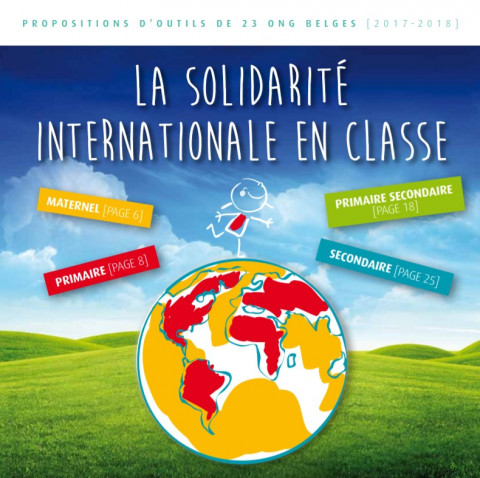 La solidarité internationale en classe: Proposition d'outils pédagogiques de 23 ONG belges Year of publication: 2017 Corporate author: Plan Belgique La solidarité internationale en classe Proposition d'outils pédagogiques de 23 ONG belges Très pratique, ce catalogue recense les outils pédagogiques de 23 ONG destinés à l’enseignement maternel, primaire et secondaire. Un classement thématique permet d’identifier les sujets abordés par chacun de ces outils. En plus des sujets, le catalogue reprend les ONG qui proposent des trajets pour l'ensemble des écoles, comme le font les Partenaires des Ecoles des droits de l'enfant.Très utile pour organiser votre année scolaire, vous retrouverez toutes les informations utiles pour sensibiliser vos élèves à une problématique qui vous tient à coeur.
 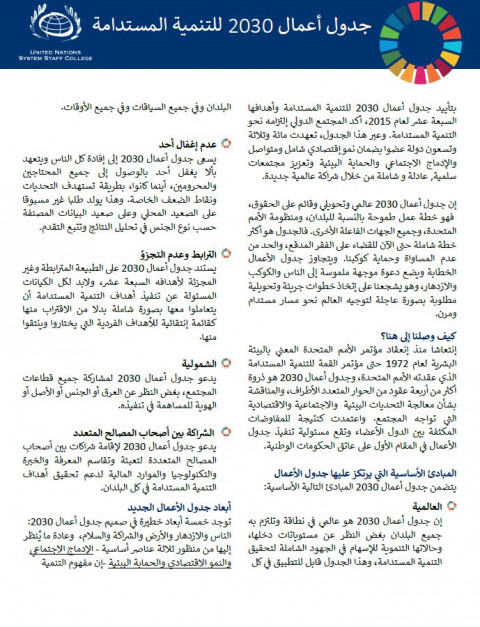 جدول أعمال 2030 للتنمية المستدامة Year of publication: 2018 Corporate author: United Nations System Staff College (UNSSC) من خلال تأييد خطة التنمية المستدامة لعام 2030 وأهدافها السبعة لعام 2015 ، أكد المجتمع الدولي على التنمية المستدامة. في هذا الجدول ، تعهدت مائة وتسع وثلاثون دولة من الدول الأعضاء بضمان نمو اقتصادي شامل ومستدام ، والاندماج الاجتماعي ، وحماية البيئة وتعزيز المجتمعات السلمية والعادلة والشاملة للجميع من خلال شراكة عالمية جديدة. إن جدول أعمال 2030 قائم على الحقوق وطموح. إنه خطة عمل طموحة للبلدان ، ومنظومة الأمم المتحدة ، وجميع الجهات الفاعلة الأخرى. تتجاوز الأجندة الخطابة وتوجه دعوة ملموسة للناس والكوكب والازدهار ، وتشجعنا على اتخاذ خطوات جريئة وتحويلية مطلوبة بشكل عاجل لتوجيه العالم نحو طريق مستدام ومرن. 2030 Agenda for Sustainable Development Year of publication: 2018 Corporate author: United Nations System Staff College (UNSSC) By endorsing the 2030 Agenda for Sustainable Development and its seven goals for 2015, the international community emphasized sustainable development. In this table, one hundred and ninety three Member States pledged to ensure inclusive and sustained economic growth, social inclusion, environmental protection and the promotion of peaceful, just and inclusive societies through a new global partnership. The Agenda 2030 is rights-based and ambitious.It is an ambitious plan of action for countries, the United Nations system, and all other actors. The agenda goes beyond rhetoric and makes a concrete call to people, the planet and prosperity, and it encourages us to take bold and transformative steps urgently needed to guide the world towards a sustainable and resilient path.
  Results Report 2019 Year of publication: 2019 Corporate author: GPE The Global Partnership for Education (GPE) is a multi-stakeholder partnership and fund dedicated to improving education in the world’s poorest countries, and those with the most children out of school. Founded in 2002, the partnership is designed to harness the power of collaboration among developing countries, donor countries, civil society, foundations, the private sector and youth (represented through civil society organizations) to support inclusive and quality education for all.The partnership is now implementing GPE 2020, its strategic plan for the 2016-2020 period that outlines an ambitious course of action to achieve three strategic goals:Strategic Goal 1: Improved and more equitable student learning outcomes through quality teaching and learningStrategic Goal 2: Increased equity, gender equality and inclusion for all in a full cycle of quality education, targeting the poorest and most marginalized, including by gender, disability, ethnicity and conflict or fragilityStrategic Goal 3: Effective and efficient education systems delivering equitable, quality educational services for allThese efforts are aligned with and support Sustainable Development Goal 4, the world’s commitment to inclusive and equitable quality education for all.