
Resources
Explore a wide range of valuable resources on GCED to deepen your understanding and enhance your research, advocacy, teaching, and learning.
2,203 Results found
 From Academic Organization to National Think Tank: A Historical Study on Center for Civic Education (Tsinghua Journal of Education; Vol.38, No. 5) Year of publication: 2017 Author: Su Yongrui | Fu Anzhou | Hu Qiumei Corporate author: Tsinghua University Center for Civic Education is the most influential Think Tank in the field of civic education in America. Since 1960s, while American civic education experienced dilemma and reform, Center for Civic Education, at the same time, has transformed from the Civic Education Committee of University of California at Los Angeles to a national Think Tank. This plays an important role in promoting policy-making of American civic education, curriculum standardization of school citizenship education, sustained development of nationwide education programs, implementation of international development strategies, and spreading of American democratic values. With the historical background of American civic education and American modern Think Tank, this paper summarizes the stages of development of the Center. This paper holds that the decisive factors of the Center’s transformation include the following points: building a bridge between “knowledge” and “power” through continuing and effective responses to the theme of civic education at ideological and strategic level, affecting decision makers by forming a Policy Advocacy Coalition with those who have common political beliefs, realizing such functions of Think Tank as setting and guiding policy agenda of civic education, providing effective products of civic education, promoting the international development of American civic education. This research contribute to promoting understanding of operating process and strategies of the Center, giving effective advice to Chinese Think Tank in cooperation with American Think Tank,enhancing Chinese Think Tank’s the sense and ability of dialogue,so as to strengthen their voices. 从学术团体到国家智库: 美国公民教育中心的历史考察 (清华大学教育研究; Vol. 38, No. 5) Year of publication: 2017 Author: Su Yongrui | Fu Anzhou | Hu Qiumei Corporate author: Tsinghua University 美国公民教育中心,是美国公民教育领域最具影响力的智库。在 20 世纪 60 年代以来美国公民教育从困境到变革的历史背景下,该中心完成了从学术团体到国家智库的转型,在促进美国公民教育政策制定、实施公民教育国际拓展策略、传播美国民主价值理念等方面发挥了重要作用。本文以美国公民教育变迁和美国现代智库发展为历史背景,系统梳理了该中心的发展转型历程。本文认为,该中心转型发展的决定因素有 三: 其一,对美国公民教育的时代主题在思想和策略层面作出持续有效响应,并搭建“知识”与“权力”的桥梁; 其二,结成有共同政治信念的“政策倡导联盟”影响决策者; 其三,实现“设置并引导公民教育政策议程、提供公民教育产品、推动美国公民教育向世界拓展”等智库功能。研究该中心的影响力产生机制、传播策略、智库功能,有助于加深对其运作过程和策略的认识,在中美智库合作及教育领域交流方面提高主动性和策略性,提升 对话意识和对话能力,增强话语权。
  The Education of Core Values Among Contemporary Youth Students: Based on the Enlightenment From American Citizen Core Values Education (Journal of Liaoning University, Philosophy and Social Sciences Edition; Vol. 45, No. 4) Year of publication: 2017 Author: Ji Huibin | Wang Ping Corporate author: Liaoning University Civic Education is a key task for modern nation states around the world, among which the education of core values among youth students is the most important issue. The US has its own experience and practice in civic education and core values education. An analysis of the US experience can provide reference and enlightenment for the promotion and practice of core socialist values among youth students. 当代青年学生的核心价值观教育: 基于美国公民核心价值观教育的启示 (辽宁大学学报, 哲学社会科学版; Vol. 45, No. 5) Year of publication: 2017 Author: Ji Huibin | Wang Ping Corporate author: Liaoning University 公民教育是当今世界现代民族国家都面临的重要任务。其中,青年的核心价值观教育是公民教育中最为核心的问题。美国在其公民教育和核心价值观教育方面有着独到的历史经验和实践逻辑,通过整理和分析这些经验,为我国青年学生弘扬和践行社会主义核心价值观提供借鉴和启示。
  감염병 재난 극복을 위한 영유아 심리방역 매뉴얼 Year of publication: 2020 Author: 조숙인 | 송하나 | 김연수 | 김주련 | 김문정 Corporate author: 육아정책연구소 2020년도 수시과제 '재난 극복을 위한 영유아 정신건강 지원 매뉴얼 개발(조숙인, 송하나, 김연수, 김주련, 김문정)'의 일환으로 개발한 자료집이다. [목차]01. 감염병 재난이란?02. 감염병 재난은 왜 스트레스일까요?03. 감염병 재난 스트레스 반응 알아보기04. 영유아 부모와 교사를 위한 감염병 재난 기본 대응 방법05. 영유아 발달 특성에 따른 감염병 재난 스트레스 반응 이해하기06. 영유아에게 감염병 재난 설명하기07. 재난 후 영유아가족 적응 돕기08. 사례를 통해 배우는 영유아 감염병 재난 스트레스 대응 방법09. 기타 재난 스트레스 대응 방법10. 영유아와 함께 하는 마음 도닥이기 활동
  Examining the Citizenship Education in the UK from Perspective of Solidarity (Studies in Foreign Education; Vol. 46, No. 7) Year of publication: 2019 Author: Tang Kejun Corporate author: Northeast Normal University It is claimed to build a cohesive community in plural society because of diversity undermining social cohesion. According to communitarianism, the grounds of solidarity include shared values, loyalty and civic trust. Britain is seen as a plural society which made up of a diverse range of ethnicities, cultures nations and religions. So citizenship education are expected to place emphasis on promoting the fundamental British values national loyalty or patriotism and social trust in schools of the UK, which has caused a number of criticism. It is concluded from examining the approaches of citizenship education and its criticism that a cohesive society depends on an inclusive citizenship. 团结视域下的英国公民教育 (外国教育研究; Vol. 46, No. 7) Year of publication: 2019 Author: Tang Kejun Corporate author: Northeast Normal University 多元的社会因为差异性挑战了团结,因而寻求建立团结的社会就成为多元社会的基本追求。按社群主义理解,社会团结源自共享的价值观、忠诚和公民之间的信任。英国自认为是多元的社会,不仅民族多样,而且种族、宗教和文化多样。为了增进英国社会的团结,英国学校公民教育强化英国的基本价值观、国家忠诚或爱 国主义、社会信任等因素。这些做法引起诸多批评。从英国公民教育的做法及其受 到的批评可以看出,要增进社会团结,需要培养包容性的公民。
  Western Debates on Global Citizenship Education: Definition, Value and Practice (International and Comparative Education; No. 7) Year of publication: 2019 Author: Lijian | Liu Baocun Corporate author: Beijing Normal University In the late twentieth century, in order to deal with the opportunities and challenges came from the globalization to all the countries worldwide, the developed countries in Europe and the United States began to focus on cultivating students’ global citizenship consciousness and global citizenship practice. Since 1990s, the western debate on global civic education has been widely spread among scholars and practitioners worldwide. The global citizenship education debate focuses on global citizenship education value and practice in three aspects: the connotation of global citizenship education debate on the ability-oriented, value-oriented definition, and the comprehensive-based definition. The value debate on the global citizenship education mainly includes: patriotism and the world socialist argument, national interests and global interests, the global education debate and the civic education debate and unified culture and cultural diversity debate. The global citizenship education practice debate involves the research and development of world education and cognitive education and behavior education. 西方关于全球公民教育内涵、价值和途径的争论 (比较教育研究; No. 7) Year of publication: 2019 Author: Lijian | Liu Baocun Corporate author: Beijing Normal University 20世纪末期,为了应对全球化带来的挑战,欧美发达国家开始关注培养学生的全球公民意识,全球公民教育逐渐成为世界教育改革的一个热点话题。但是,关于全球公民教育的内涵、价值和途径等全球公民教育的核心问题却存在着广泛的争论。在全球公民教育的内涵上,存在能力导向和价值导向的争论 ;在全球公民教育的价值上,存在爱国主义和世界主义的争论、国家利益和全球利益的争论、全球教育和公民教育的争论、文化统一和文化多样的争论 ;在全球公民教育的途径上,存在世界研究和发展教育研究的争论、认知教学和实践教学的争论。
 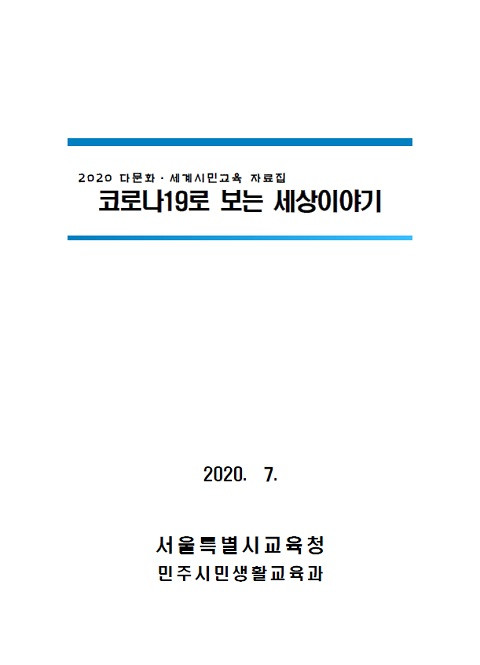 코로나19로 보는 세상이야기: 2020 다문화·세계시민교육 자료집 Year of publication: 2020 Corporate author: 서울특별시교육청 다문화교육지원센터 본 자료는 서울시교육청 다문화교육지원센터에서 단위학교의 다문화 세계시민 교육을 지원하고자 제작된 것으로, 코로나19 시대에 필요한 평화교육, 세계시민교육, 다문화교육, 인권교육 등의 교수학습 자료이다.