
Resources
Explore a wide range of valuable resources on GCED to deepen your understanding and enhance your research, advocacy, teaching, and learning.
3,451 Results found
 Message de Mme Irina Bokova, Directrice générale de l’UNESCO, à l’occasion du 50e anniversaire de la Journée internationale de l'alphabétisation Year of publication: 2016 Corporate author: UNESCO. Director-General, 2009-2017 (Bokova, I.G.) Literacy is essential to success across the board. A foundation for human rights and dignity, literacy is vital for poverty eradication, for gender equality, for more inclusive and sustainable societies. This is why we launch today the Global Alliance for Literacy, to mobilize investment and promote innovative initiatives, with a focus on gender and new information and communication technologies. We must seize every opportunity-- we must work across all sectoral boundaries.
  New Methodology Shows that 258 Million Children, Adolescents and Youth Are Out of School Year of publication: 2019 Corporate author: UNESCO Institute for Statistics (UIS) This fact sheet presents the latest UIS data on education available as of September 2019.Three years after the adoption of Sustainable Development Goal 4 (SDG 4) and the promise to provide universal primary and secondary education, there has been no progress in reducing the global number of out-of-school children, adolescents and youth. This fact sheet by the UNESCO Institute for Statistics (UIS) highlights the most recent statistics on trends at the global and regional levels, based on a revised calculation method that provides more precise estimates of the out-of-school population.
  [Vidéo] Citoyenneté mondiale pour les écoles jésuites Year of publication: 2019 Corporate author: Educate Magis Pourquoi la Citoyenneté Mondiale est-elle importante dans le monde d’aujourd’hui et dans le contexte jésuite? Le Globale a toujours fait partie du fonctionnement de la Compagnie de Jésus. Dès le début, dans les années 1500, Ignace et ses compagnons missionnaires ont parcouru le monde, se sont écrit des lettres pour parler des expériences qu’ils vivaient ainsi les écoles en ont appris davantage sur le monde qui les entourait. Bien que notre monde ait changé, cet aspect de notre mission n’a pas changé. C’est sans doute plus important que jamais, car nous vivons dans un monde de plus en plus interconnecté.(José Alberto Mesa, SJ, Secrétaire pour l’Enseignement Secondaire et Présecondaire, Compagnie de Jésus)
  Background Information on Education Statistics in the UIS Database Year of publication: 2019 Corporate author: UNESCO Institute for Statistics (UIS) Background Information on Education Statistics in the UIS Database Data releases Data sources Population estimates Economic statistics Technical notes Country notes Message from Ms Irina Bokova, Director-General of UNESCO, on the occasion of the International Literacy Day, 50th Anniversary, 8 September 2016 Year of publication: 2016 Author: Anna Robinson-Pant Corporate author: UNESCO. Director-General, 2009-2017 (Bokova, I.G.) Literacy is essential to success across the board. A foundation for human rights and dignity, literacy is vital for poverty eradication, for gender equality, for more inclusive and sustainable societies. This is why we launch today the Global Alliance for Literacy, to mobilize investment and promote innovative initiatives, with a focus on gender and new information and communication technologies. We must seize every opportunity-- we must work across all sectoral boundaries.
  Reading the past, writing the future Year of publication: 2016 Address by Nicholas Burnett, Assistant Director-General for Education on the occasion of the Inauguration of the UNESCO Chair in Children, Youth and Civic Engagement, National University of Ireland, Galway (NUI Galway), Republic of Ireland, 4 March 2009 Year of publication: 2009 Author: Nicholas Burnett This speech is presented on the occasion of the inauguration of the UNESCO Chair in Children, Youth and Civic Engagement, addressing its goal of building bridges between institutions, serving as an intermediary between the academic community and policy-makers, and seeking to provide both groups with a greater voice in the context of the UN system.
 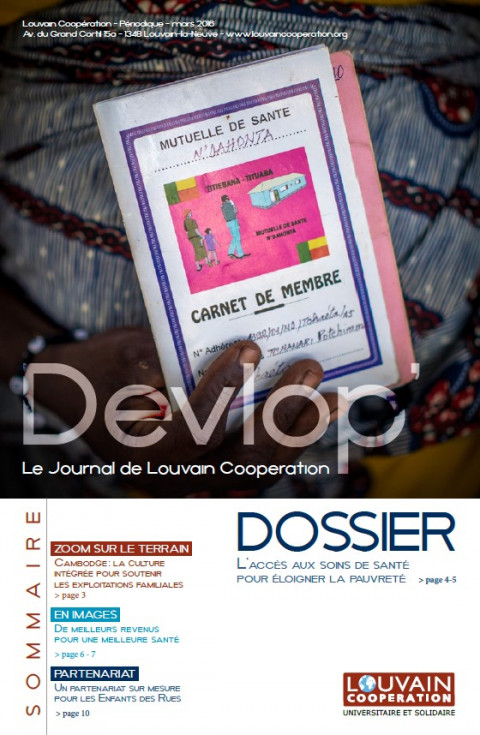 Devlop’ Le journal de Louvain Coopération 2 - Mars 2016 Year of publication: 2016 Corporate author: Louvain Coopération "2016 sera une annee charniere pour Louvain Cooperation" 2016 sera une annee charniere a beaucoup d’egards. Nous fetons les 10 ans d’un partenariat solide avec l’Union Nationale des Mutualites Libres, autour des mutuelles de sante au Benin et au Togo. Chaque annee la collaboration se renforce. Les echanges d’expertise se multiplient. Tout cela dans un contexte ou la protection sociale et la couverture maladie universelle sont en bonne place dans les agendas politiques africains. Au-dela des communes et districts, l’enjeu est national. Le programme MASMUT, alliant les differentes Unions mutualistes belges et leurs ONG partenaires , soutient ce plaidoyer. Differents modeles s’opposent. La mutuelle de sante est le seul qui repartit les responsabilites entre l’Etat, les prestataires de soins et les patients d’une maniere fonctionnelle et democratique. Mais 2016, c’est aussi l’annee de reflexions et decisions en vue de notre prochain plan strategique et notre programme 2017-2021. Une evaluation pointue de nos actions passees nous pousse a encore elargir notre comprehension des mecanismes sociaux ou culturels qui operent partout. Quels codes regissent les choix des micro-entrepreneurs, les reticences a adherer a une cooperative ou a une mutuelle, le type d’alimentation, la conception du bien-etre ? Nos equipes et partenaires, avec l’appui transdisciplinaire de l’UCL vont consacrer leur energie a ces analyses qui nourriront nos projets et actions. Enfin, 2016, ce sont aussi des nouveaux projets, de nouvelles zones d’intervention.
  Devlop’ Le journal de Louvain Coopération 3 - Octobre 2016 Year of publication: 2016 Corporate author: Louvain Coopération “Renforcer la collaboration entre ONG“ Quatre ONG universitaires belges, actives dans les pays du Sud et en Belgique, qui se rejoignent dans leurs domaines et lieux d’intervention, mais aussi dans leur specificite universitaire… Les points qui unissent Louvain Cooperation (ONG de l’UCL), ULB Cooperation (ONG de l’ULB), ADG (ONG de l’ULg-Gembloux) et la FUCID (ONG de l’UNamur) sont nombreux. Ces ONG ont en commun la realisation d’etudes ou de recherches-actions, la capitalisation des acquis, l’appel a des experts academiques universitaires, la diffusion la plus judicieuse possible des savoirs, la sensibilisation des etudiants a travers l’organisation de Campus Plein Sud… Ces collaborations existantes et points communs forment la base de l’idee d’une cooperation plus large, qui correspond a la dynamique du secteur de l’aide au developpement : rechercher des synergies, des apprentissages communs, des reseaux actifs. Les ONG, il faut bien l’admettre, ont souvent eu tendance a travailler de maniere trop isolee. A l’ere de la mondialisation, des nouvelles technologies de l’information et de la communication et des reseaux sociaux, il n’est plus possible, ni souhaitable de travailler dans son coin… Profitons au mieux de chacune des experiences, positive ou negative, des autres ! Juin 2016 fut donc une grande premiere dans l’histoire de ces quatre ONG : celles-ci ont decide de s’associer et de definir ensemble un programme quinquennal (2017-2021) qui vient d’etre soumis a la DGD pour une demande de financement commune. Ce programme comprend des actions au Sud dans les domaines de la Securite alimentaire et economique et de la Sante, et des actions en Belgique, d’Education a la Citoyennete Mondiale et Solidaire.
  Accountability from a Human Rights Perspective: The Incorporation and Enforcement of the Right to Education in the Domestic Legal Order Year of publication: 2017 Corporate author: ActionAid International | Right to Education Initiative (UK) The aim of this paper is to reframe States’ political commitment to education under Education 2030 as a legal commitment the vast majority of States have already made under international human rights law. By recasting the content of SDG Four as part of the right to education, the legal obligations owed to that content can be invoked. This renders various elements of SDG Four, ifthe State in question has legally committed to the right to education and incorporated the right to education in their domestic legal orders, amenable to adjudication by competent mechanisms, offering the possibility of legal accountability through legal enforcement.