
Resources
Explore a wide range of valuable resources on GCED to deepen your understanding and enhance your research, advocacy, teaching, and learning.
2,162 Results found
 Content, Comprehensiveness and Coherence in Policies for Early Childhood: How the Curriculum Can Contribute Year of publication: 2016 Author: María Isabel Díaz Corporate author: UNESCO International Bureau of Education (IBE) In the context of international agreements and commitments concerning early childhood, the purpose of this document is to review and renew the challenges that are involved in forging educational and curriculum policies for the first level of education. In the light of early childhood being increasingly included in the public agenda, countries are making sustained efforts to increase equity and quality in the design and implementation of policies for the early years.These are policies that are in the process of changing by including quality and participation criteria; fine-tuning monitoring and assessment mechanisms; going beyond the lack of sectoral and territorial coordination, among other limitations; moving from a needs-based approach to a rights-based approach; and adopting a comprehensive view. The document analyses, from a long-term public policy perspective, some of the challenges that second-generation policies face, positioning the curriculum as the articulating factor for the development of comprehensive policies for early childhood.
  The Seen Unseen: Improving Education for the Invisible Billion Difference Learners (The Blue Dot Issue 5, 2017) Year of publication: 2017 Corporate author: Mahatma Gandhi Institute of Education for Peace and Sustainable Development (MGIEP) MGIEP believes that addressing the needs of children with difference learning offers a unique opportunity to build the competency of understanding, respect and appreciation between the children and the rest of their peers in school.It provides the Institute favorable conditions to put in practice how inclusive education is a necessary condition for building peaceful and sustainable societies. Many of the Information Technology pedagogical tools developed by the Institute lend themselves to children with difference learning.Transforming the education system in such a manner will allow mainstream schools to provide a learning platform that breaks down barriers across learning types and provide the equitable access to education that is a fundamental Sustainable Development Goal.We are, in this issue of The Blue Dot, privileged to read from some of the world’s best experts on the subject describing the challenges at hand and suggesting ways and means of addressing the lacuna present in curricula and policy. As always, we dedicate a special section to reflecting the voices of young people in our discussion. I am especially honoured and delighted to present a foreword from a young entrepreneur who has not allowed his neurobiological dyslexic condition to prevent him from pursuing his dreams to help others.
  All Together Now!: A Whole School Approach to Anti-bullying Practice Year of publication: 2010 Corporate author: Save the Children All Together Now! provides learning and examples of good practice for teachers and school management teams, in order to encourage a culture in which bullying is less likely to occur. In particular, this report recognises the benefits of two strategies to instil an anti-bullying culture within any school. First, it describes a whole school approach to tackling bullying and promoting positive behaviour, with children and young people participating in their school’s decision-making processes. Positive changes in school anti-bullying policy, together with the ongoing development of better professional practice and peer support, are more likely if everyone connected to the school is informed and offered the opportunity to play a part. Second, All Together Now! demonstrates how creating an effective anti-bullying ethos is dependent upon creating a ‘telling environment’. To achieve this, pupils, staff, and parents and carers need to be consulted and involved.
  Addressing Anti-semitism through Education: Guidelines for Policymakers Year of publication: 2018 Corporate author: OSCE. Office for Democratic Institutions and Human Rights (ODIHR) A new UNESCO and OSCE co-publication takes up the challenge of educating learners to resist contemporary anti-Semitism at a time when the issue is becoming ever more crucial around the world. It suggests concrete ways to address anti-Semitism, counter prejudice and promote tolerance through education, by designing programmes based on a human rights framework, global citizenship education, inclusiveness and gender equality.It also provides policymakers with tools and guidance to ensure that education systems build the resilience of young people to anti-Semitic ideas and ideologies, violent extremism and all forms of intolerance and discrimination, through critical thinking and respect for others. Prévenir l’antisémitisme par l’éducation: Lignes directrices à l’intention des décideurs politiques Year of publication: 2018 Corporate author: OSCE. Office for Democratic Institutions and Human Rights (ODIHR) Cette nouvelle publication UNESCO/OSCE relève le défi de l’antisémitisme contemporain à un moment où la question devient de plus en plus cruciale dans le monde entier. Elle propose des moyens concrets pour combattre l’antisémitisme, lutter contre les préjugés et promouvoir la tolérance par l’éducation, sur la base de programmes fondés sur les droits humains, l’éducation à la citoyenneté mondiale, l’inclusion et l’égalité des sexes. Elle fournit également aux décideurs politiques des outils et des recommandations pour garantir que les systèmes éducatifs renforcent la résilience des jeunes aux idées et idéologies antisémites, à l’extrémisme violent et à toutes les formes d’intolérance et de discrimination, par l’acquisition d’une pensée critique et le respect des autres. Addressing Anti-semitism through Education: Guidelines for Policymakers Year of publication: 2018 Corporate author: OSCE. Office for Democratic Institutions and Human Rights (ODIHR) A new UNESCO and OSCE co-publication takes up the challenge of educating learners to resist contemporary anti-Semitism at a time when the issue is becoming ever more crucial around the world. It suggests concrete ways to address anti-Semitism, counter prejudice and promote tolerance through education, by designing programmes based on a human rights framework, global citizenship education, inclusiveness and gender equality.It also provides policymakers with tools and guidance to ensure that education systems build the resilience of young people to anti-Semitic ideas and ideologies, violent extremism and all forms of intolerance and discrimination, through critical thinking and respect for others.
 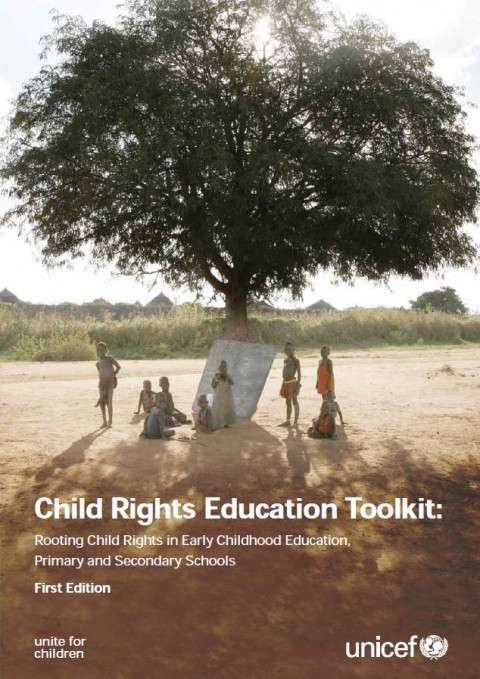 Child Rights Education Toolkit: Rooting Child Rights in Early Childhood Education, Primary and Secondary Schools Year of publication: 2014 Corporate author: United Nations Children's Fund (UNICEF) This toolkit, developed by UNICEF, defines what is meant by child rights education and the child rights approach. It explains the relevance of child rights education to UNICEF’s mission and the ways in which education can take place in a range of contexts--including with professionals, caregivers, the corporate sector, the media, and children’s groups. The audience of this toolkit is therefore intended to be UNICEF National Committees, UNICEF country offices, UN agencies working on child rights education (CRE), governments, and other civil society organisations, NGOs, and academic institutions.Although this Toolkit focuses on child rights education in the formal learning environment (early childhood education settings, primary and secondary schools), it is hoped that it will also be useful for those working to promote child rights education through other channels, such as in the media, with children’s organizations and through children’s involvement in advocacy.For more information check the UNICEF webpage.
  Mémoire et Histoire de la Shoah à l'école Cette publication est organisé selon trois thèmes: «L'histoire de l'Holocauste», la «citoyenneté» et «arts et de la transmission". Il est un guide précieux pour les enseignants de l'enseignement primaire, où ils peuvent trouver des suggestions et des matériaux atelier pour une première approche du sujet de l'Holocauste.
 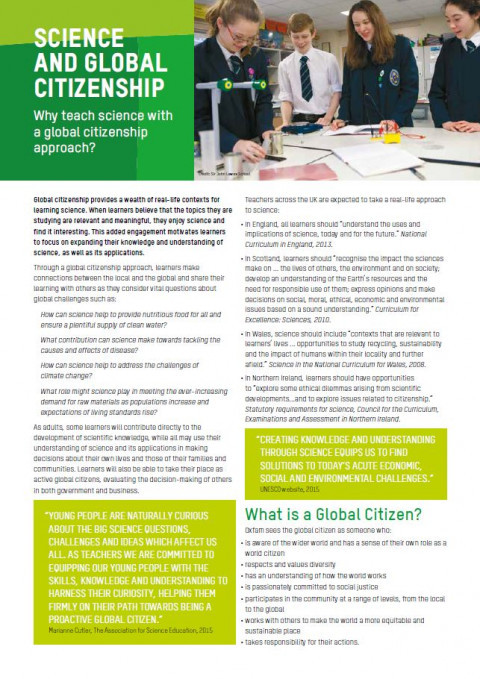 Science and Global Citizenship Corporate author: Oxfam GB Nurturing global scientists is key to the creation of a clean and fairer world for the future. A global citizenship approach enables learners to appreciate the relevance of science and investigate how it can be used to answer vital questions to global challenges.This guide includes practical advice for embedding global citizenship in topic areas like health and disease, water and climate change. It also has handy links to teaching resources which can be used in your lessons.
  التعليم كوسيلة للتعافي: معالجة صدمة النزوح من خلال التعلم الاجتماعي والعاطفي Year of publication: 2019 وتتناول هذه الوثيقة أنشطة التعليم النظامي وغير النظامي، ولا سيما الأنشطة التي تركز على التعلم الاجتماعي والعاطفي، كنهج واعد لتوفير الدعم النفسي والاجتماعي للمهاجرين واللاجئين في مواجهة الآثار السلبية للصدمات التي تعرضوا لها. وتغطي الوثيقة سياقات الطوارئ والأوضاع المجتمعية التي تقود فينهاية المطاف إلى استقرار أطفال المهاجرين واللاجئين. كما تغطي الدراسة مسألة توفير التعليم وبيئة التعلم؛ ومحتوى التعليم والتعلم لكل من الأطفال وأولياء أمورهم؛ والدور الذي يمكن أن يقوم به المعلمون وغيرهم من المهنيين .