
Resources
Explore a wide range of valuable resources on GCED to deepen your understanding and enhance your research, advocacy, teaching, and learning.
3,451 Results found
 Handbook on measuring equity in education Year of publication: 2018 Corporate author: UNESCO Institute for Statistics (UIS) This handbook provides a conceptual framework for measuring equality in learning; offers methodological guidance on how to calculate and interpret indicators; and investigates the extent to which measuring equity in learning has been integrated into country policies, national planning and data collection and analysis.
  A Whole School Approach to Prevent School-Related Gender-Based Violence Year of publication: 2016 Corporate author: United Nations Girls' Education Initiative (UNGEI) The limitations of data collection and monitoring mechanisms around school-related gender-based violence (SRGBV) are widely acknowledged. This guide provides a framework to guide policy makers and practitioners in designing school violence prevention programmes and strengthening response actions. The prevention model is based on eight evidence-based standards and is accompanied by a monitoring approach with a set of proposed indicators at school, district and national levels. The goal is to enable implementation strategies to be adapted and monitored in order to improve data collection and accountability around incidents of SRGBV at the school, district and national levels.
  Play & Resilience: A toolkit for teachers, caregivers, and other stakeholders Year of publication: 2019 Corporate author: UNESCO International Institute for Capacity-Building in Africa (IICBA) This publication is a toolkit for teachers, caregivers, community members and other stakeholders in the Early Childhood Care and Education Landscape.This toolkit is aimed at fostering Resilience in children through playbased strategies.
 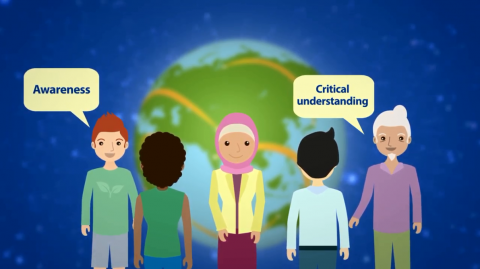 What is Global Education Year of publication: 2019 Corporate author: North-South Centre of the Council of Europe Pedagogical video about the concept of global education and the approach of the North-South Centre of the Council of Europe.
 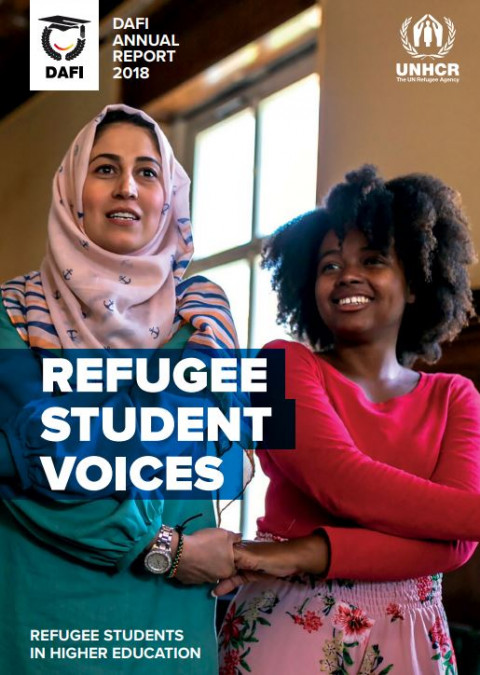 DAFI ANNUAL REPORT 2018- Refugee Student Voices: Refugee Student In Higher Education Year of publication: 2019 Corporate author: UN. Office of the United Nations High Commissioner for Refugees (UNHCR) The DAFI refugee scholarship programme was launched in 1992 by UNHCR and the German government. The programme has supported over 15,500 young refugees to date and is currently implemented in 51 countries, the vast majority of which are in the Global South.The DAFI programme aims to secure refugee students’ inclusion in national education systems, prioritising enrolment in public higher education institutions. Participation in public institutions enables refugee students to study alongside their host country peers and pursue nationally accredited degree programmes, as well as bringing resources into public higher education institutions.
  Measuring SDG 4: how PIRLS can help; how the Progress in International Reading Literacy Study (PIRLS) helps monitor Sustainable Development Goal 4 targets Year of publication: 2017 Corporate author: International Association for the Evaluation of Educational Achievement (IEA) This booklet has been prepared for the international release of the 2016 Progress in International Reading Literacy Study (PIRLS) and ePIRLS at UNESCO. PIRLS is one of the International Association for the Evaluation of Educational Achievement’s (IEA) core largescale international assessment projects, successfully administered every five years since 2001. It provides internationally comparative data on how well children read by assessing grade 4 students’ reading achievement and offers policyrelevant information for improving teaching and learning. Initiated in 2016, ePIRLS is an extension of PIRLS that monitors how well grade 4 students read, interpret, and critique online information in an environment that looks and feels like the Internet.
 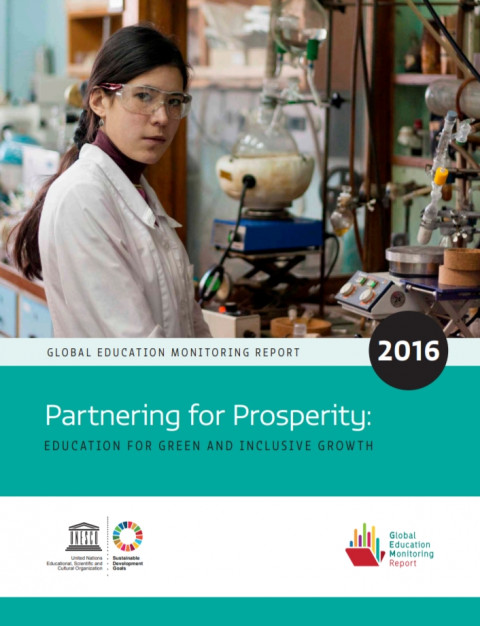 Partnering for prosperity: education for green and inclusive growth; Global education monitoring report, 2016; summary Year of publication: 2017 Author: Sachs, Jeffrey D Corporate author: UNESCO. Director-General, 2009-2017 (Bokova, I.G.) This Report makes three messages starkly clear. Firstly, the urgent need for new approaches. On current trends only 70% of children in low income countries will complete primary school in 2030, a goal that should have been achieved in 2015. We need the political will, the policies, the innovation and the resources to buck this trend. Secondly, if we are serious about SDG 4, we must act with a sense of heightened urgency, and with long-term commitment. Failure to do so will not only adversely affect education but will hamper progress towards each and every development goal: poverty reduction, hunger eradication, improved health, gender equality and women’s empowerment, sustainable production and consumption, resilient cities, and more equal and inclusive societies. Lastly, we must fundamentally change the way we think about education and its role in human well-being and global development. Now, more than ever, education has a responsibility to foster the right type of skills, attitudes and behavior that will lead to sustainable and inclusive growth. Mesurer l'ODD 4: la contribution du PIRLS, comment le Programme international de recherche en lecture scolaire (PIRLS) peut aider au suivi des cibles de l'Objectif de développement durable 4 Year of publication: 2017 Corporate author: International Association for the Evaluation of Educational Achievement (IEA) Cette brochure a été préparée en vue de la présentation internationale du Programme international de recherche en lecture scolaire (PIRLS) et d’ePIRLS 2016 à l’UNESCO. Le PIRLS est l’un des principaux projets d’étude internationale à grande échelle de l’Association internationale pour l’évaluation des acquis scolaires (International Association for the Evaluation of Educational Achievement, IEA), mené avec succès tous les cinq ans depuis 2001. Cette étude fournit des données comparatives internationales sur le niveau d’alphabétisation des enfants en évaluant les performances en lecture des élèves en 4ème année de scolarité, et livre des informations d’intérêt politique destinées à améliorer l’enseignement et l’apprentissage. De plus, inaugurée en 2016, ePIRLS est une extension du PIRLS visant à déterminer la façon dont les élèves en 4ème année de scolarité lisent, interprètent, et critiquent les informations en ligne dans un environnement semblable à celui d’Internet.
 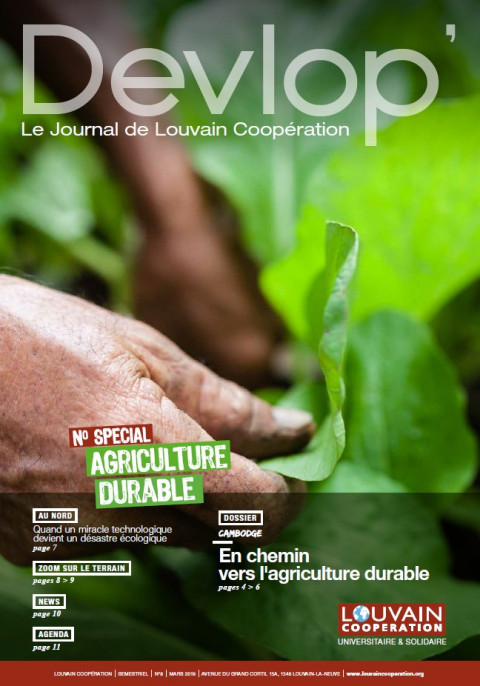 Devlop’ Le journal de Louvain Coopération 8 - MARS 2019 Year of publication: 2019 Corporate author: Louvain Coopération Dans ce numéro, nous partirons de Louvain-la-Neuve avec le plaidoyer agro-écologique de Philippe Baret, doyen de la faculté d’agronomie de l’UCLouvain ; nous nous envolerons ensuite vers le Cambodge où académiques et acteurs de terrains soutiennent des paysans cambodgiens dans la réappropriation de leurs activités ; nous transiterons chez nos partenaires boliviens, dans les quartiers marginalisés d’El Alto, qui eux aussi lancent des initiatives d’agriculture urbaine pour mieux atterrir en République démocratique du Congo où place est faite à l’agro-écologie. Finalement, nous reviendrons à Louvain-la-Neuve où les Ingénieux-Sud réfléchissent avec leurs contreparties locales à mettre en place des solutions intelligentes et adaptées aux problèmes agricoles rencontrés. Nous espérons qu’à la lecture de notre journal vous serez convaincus, comme nous, que tous ensemble, producteurs, consommateurs, gouvernements, entreprises privées, associations, face aux défis agricoles, nous sommes capables de transformer des risques en opportunités.
 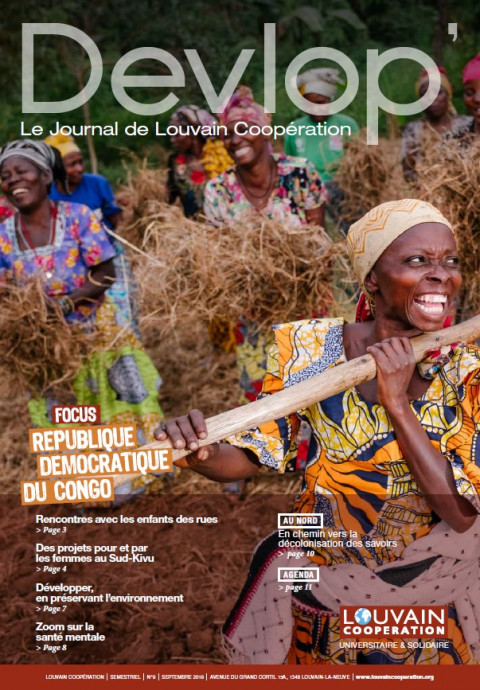 Devlop’ Le journal de Louvain Coopération 9 - SEPTEMBRE 2019 Year of publication: 2019 Corporate author: Louvain Coopération Le renforcement des capacites de nos partenaires locaux est pour nous un objectif crucial et un theme transversal a tous les projets de Louvain Cooperation, ceci dans le but d’augmenter l’autonomie et la resilience des populations. Alors, oui, il n’est pas evident de travailler dans le contexte socio-politico-economique de la RDC et, oui, nous devons parfois faire face a des echecs lorsque des evenements que nous ne pouvons controler surviennent. Mais nous pouvons aussi constater chaque jour l’utilite de nos actions et la difference concrete qu’elles peuvent faire pour les personnes qui en beneficient. Voila pourquoi nous croyons en notre travail et nous voulons continuer d’agir en RDC, malgre les difficultes rencontrees. Ce Devlop’ vous invite aujourd’hui a decouvrir ces beaux projets et a rencontrer celles et ceux qui les vivent et qui les font vivre au quotidien.