
Resources
Explore a wide range of valuable resources on GCED to deepen your understanding and enhance your research, advocacy, teaching, and learning.
2,199 Results found
 The Remapping and Analysis of Human Rights and Peace Education in ASEAN/Southeast Asia Year of publication: 2019 Corporate author: Strengthening Human Rights and Peace Research/Education in ASEAN/Southeast Asia (SHAPE-SEA) | AUN Human Rights Education Network (AUN-HRE) This book is the result of SHAPE-SEA’s Research Project on “The Remapping and Analysis of Human Rights and Peace Education in ASEAN/Southeast Asia.” It is a follow-up to the 2013 report on “The Mapping and Analysis of Human Rights and Peace Education in Southeast Asia.” It aimed at establishing a systematic updating of developments in human rights and peace education/studies in ASEAN/Southeast Asia. The study investigated courses and programmes on human rights and peace & conflict being undertaken by higher education institutions in all ASEAN member countries and Timor Leste. It had also identified new developments and/or setbacks in human rights and peace education. Researchers located existing academic institutions that have been running programmes and courses on human rights and/or peace. The analysis of existing course syllabi and curriculum in the region was also conducted. To a certain extent, materials being used by instructors were also examined.
  Getting Started With the SDGs in Universities: A Guide for Universities, Higher Education Institutions, and the Academic Sector (Australia, New Zealand and Pacific Edition) Year of publication: 2017 Author: Tahl Kestin | Marjan van den Belt | Leanne Denby | Katie Ross | John Thwaites | Martine Hawkes Corporate author: Sustainable Development Solutions Network (SDSN) Australia/Pacific | Australasian Campuses Towards Sustainability (ACTS) | Sustainable Development Solutions Network (SDSN) Getting started with the SDGs in universities outlines the key roles universities – and the higher education and academic sectors more generally – have in contributing to the United Nations (UN) Sustainable Development Goals (SDGs) and the benefits of becoming engaged. It provides practical guidance on how to get started with deepening contributions. Cómo empezar con los ODS en las universidades: Una guía para las universidades, los centros de educación superior y el sector académico Year of publication: 2017 Author: Tahl Kestin | Marjan van den Belt | Leanne Denby | Katie Ross | John Thwaites | Martine Hawkes Corporate author: Sustainable Development Solutions Network (SDSN) Australia/Pacific | Australasian Campuses Towards Sustainability (ACTS) | Sustainable Development Solutions Network (SDSN) Empezar con los ODS en las universidades subraya tanto el papel clave que las universidades – y, en general, la educación superior y el sector académico - tienen en contribuir a alcanzar los Objetivos de Desarrollo Sostenible (ODS) de Naciones Unidas, así como los beneficios que este compromiso pueda conllevar. La guía proporciona información práctica sobre cómo empezar a trabajar través de ejemplos concretos. Как начать внедрение ЦУР в университетах: Руководство для университетов и иных учреждений высшего образования, а также для научных организаций Year of publication: 2017 Author: Tahl Kestin | Marjan van den Belt | Leanne Denby | Katie Ross | John Thwaites | Martine Hawkes Corporate author: Sustainable Development Solutions Network (SDSN) Australia/Pacific | Australasian Campuses Towards Sustainability (ACTS) | Sustainable Development Solutions Network (SDSN) В документе "Как начать внедрение ЦУР в университетах" раскрывается ключевая роль университетов и прочих учреждений высшего образования, а также научных организаций академического сектора в реализации Целей Устойчивого Развития, а также рассматриваются преимущества вовлечения университетов в соответствующую деятельность. Данный документ представляет собой практическое руководство для университетов, которые хотят в дальнейшем вносить вклад в глобальные усилия по внедрению ЦУР.
  Call Me When He Tries to Kill You: State Response to Domestic Violence in Kyrgyzstan Year of publication: 2015 Corporate author: Human Rights Watch This report documents the government of Kyrgyzstan’s failure to provide survivors of domestic violence with adequate services, protection, and legal remedies. It is based on Human Rights Watch research conducted in November and December 2014 in three cities in Kyrgyzstan: Bishkek and Naryn in the north and Osh in the south. Additional meetings and interviews were conducted in Bishkek in May 2015. The report also contains a number of recommendations to the government of Kyrgyzstan. Вызывайте, когда будет убивать: Реагирование государства на семейное насилие в Кыргызстане Year of publication: 2015 Corporate author: Human Rights Watch В этом докладе документировано необеспечение правительством Кыргызстана надлежащих услуг, защиты и средств правовой защиты пережившим семейное насилие. Доклад основан на материалах исследований, проводившихся Хьюман Райтс Вотч в ноябре – декабре 2014 г. в трех городах: Бишкеке и Нарыне на севере и Оше на юге страны. Дополнительные встречи и интервью проводились в Бишкеке в мае 2015 г. Отчет также содержит ряд рекомендаций правительству Кыргызстана.
  자유학기제와 미디어리터러시: 학교교사와 미디어교육 강사를 위한 가이드북 Year of publication: 2018 Author: 김양은 | 박한철 | 배은주 | 박정원 Corporate author: 시청자미디어재단 | 방송통신위원회 자유학기제에서 이루어지는 미디어교육을 담당하는 학교교사와 강사를 위한 미디어리터러시 교육 가이드북이다. 교육방법, 수업설계, 수업모형 및 미디어교육 참고자료 등 미디어교육과 관련한 교수학습자료를 다양하게 수록하였으며, 호주 및 캐나다의 미디어교육 사례도 참고할 수 있다.
 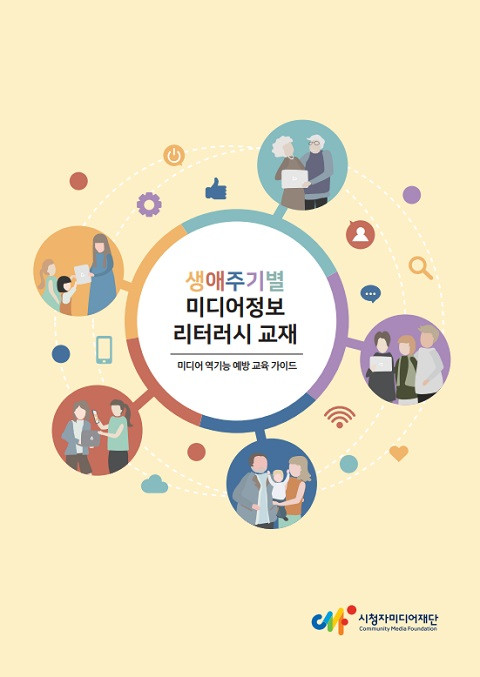 생애주기별 미디어정보 리터러시 교재: 미디어 역기능 예방 교육 가이드 Year of publication: 2018 Author: 김은규 | 정수진 | 김수정 Corporate author: 시청자미디어재단 본 교재의 목적은 과잉 정보 시대에 온라인, 소셜 미디어 등을 통해 전달되는 허위정보에 대응 하는 시민의 ‘미디어정보 리터러시’ 함양에 있다. 교재는 기본적으로 미디어정보의 의미와 활용, 미디어정보의 영향력, 좋은 정보와 거짓 정보의 구별, 허위정보의 유해성 등의 내용이 차시별로 제시되도록 구성했으며, 학교 중심의 미디어교육에서 벗어나 어린이, 청소년, 학부모, 성인, 실버세대의 다섯영역으로 유형화한 것이 특징이다. 또한, 이론식 수업이 아니라 실습 활동이 되도록 체험활동, 토론 등 다양한 수업 방식을 제시함으로써 각 개인이 수업 내용을 쉽게 체득할 수 있도록 했다.
 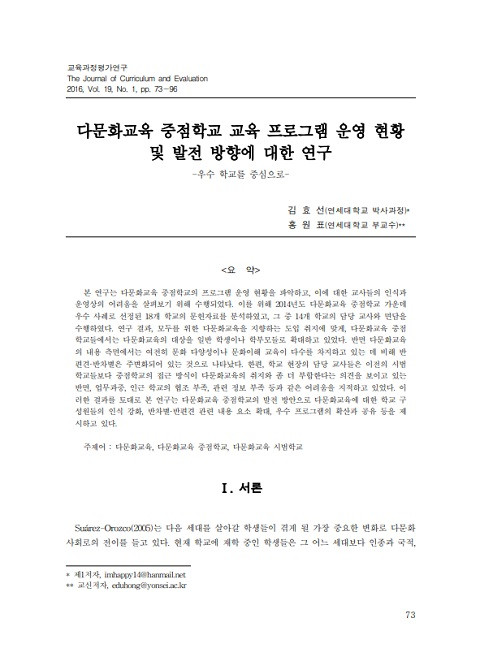 Effects and Limits of Core Schools for Multicultural Education (The Journal of Curriculum and Evaluation; Vol. 19, No. 1) Year of publication: 2016 Author: Hyosun Kim | Wonpyo Hong Corporate author: Korea Institute for Curriculum and Evaluation (KICE) This study investigates curriculum programs of core schools for multicultural education and teachers’ responses to their effects and limits. To address these topics, this study analyzes curricular documents collected from 18 elementary and secondary schools selected as exemplary cases in 2014. It also conducted in-depth interviews with 14 teachers who are in charge of planing and implementing multicultural programs in core schools. Major results support that multicultural core schools expand the targets of multicultural education to mainstream students, their parents and local residents beyond minority students and their parents. It turned out, however, that multicultural core schools still tend to untouch structural biases and discriminations, while focusing on extending students’ awareness of cultural and racial diversities. This study also reveals that participating teachers face such difficulties as heavy workloads, lack of collaboration from local schools, and lack of relevant experiences and instructional materials. Based on these results, this study suggests the sharing of successful programs, enhancing teachers awareness of the significance of multicultural education, and further supports for teachers in charge of multicultural education to achieve the targeted goals of multicultural core schools. 다문화교육 중점학교 교육 프로그램 운영 현황 및 발전 방향에 대한 연구 (교육과정평가연구; Vol. 19, No. 1) Year of publication: 2016 Author: 김혜선 | 홍원표 Corporate author: 한국교육과정평가원 본 연구는 다문화교육 중점학교의 프로그램 운영 현황을 파악하고, 이에 대한 교사들의 인식과 운영상의 어려움을 살펴보기 위해 수행되었다. 이를 위해 2014년도 다문화교육 중점학교 가운데 우수 사례로 선정된 18개 학교의 문헌자료를 분석하였고, 그 중 14개 학교의 담당 교사와 면담을 수행하였다. 연구 결과, 모두를 위한 다문화교육을 지향하는 도입 취지에 맞게, 다문화교육 중점학교들에서는 다문화교육의 대상을 일반 학생이나 학부모들로 확대하고 있었다. 반면 다문화교육의 내용 측면에서는 여전히 문화 다양성이나 문화이해 교육이 다수를 차지하고 있는 데 비해 반편견·반차별은 주변화되어 있는 것으로 나타났다. 한편, 학교 현장의 담당 교사들은 이전의 시범학교들보다 중점학교의 접근 방식이 다문화교육의 취지와 좀 더 부합한다는 의견을 보이고 있는 반면, 업무과중, 인근 학교의 협조 부족, 관련 정보 부족 등과 같은 어려움을 지적하고 있었다. 이러한 결과를 토대로 본 연구는 다문화교육 중점학교의 발전 방안으로 다문화교육에 대한 학교 구성원들의 인식 강화, 반차별·반편견 관련 내용 요소 확대, 우수 프로그램의 확산과 공유 등을 제시하고 있다.