
Resources
Explore a wide range of valuable resources on GCED to deepen your understanding and enhance your research, advocacy, teaching, and learning.
1,451 Results found
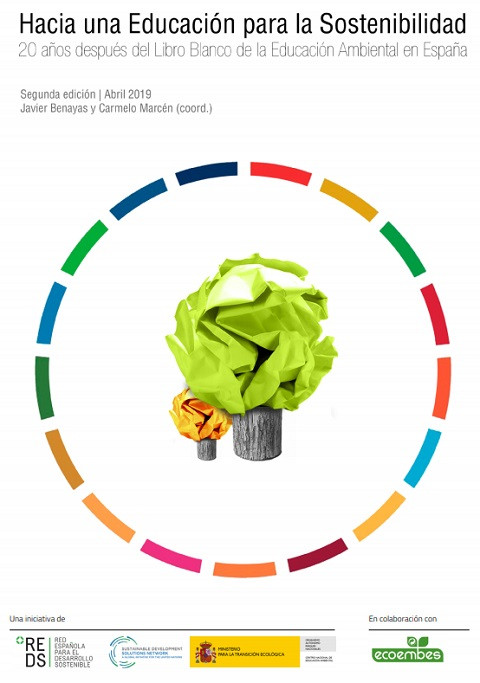 Hacia una Educación para la Sostenibilidad: 20 años después del Libro Blanco de la Educación Ambiental en España Year of publication: 2019 Author: Javier Benayas | Carmelo Marcén Corporate author: Red Española para el Desarrollo Sostenible (REDS) | Centro Nacional de Educación Ambiental (CENEAM) | Ecoembes El document presenta las luces y sombras de la multiforme intervención de la Educación Ambiental en los últimos 30 años; a la vez identifica pautas para recorrer el camino hacia la sostenibilidad de una forma más eficaz y segura pero sobre todo con la implicación de toda la sociedad.
  What Makes a Good Global Citizenship Resource? Corporate author: Reading International Solidarity Centre (RISC) This guidance document provides tips, ideas and a criteria of do's and don'ts for selecting a good Global Citizenship resource, from story books, to holiday photos and maps. With advice on how to evaluate resources, improve and add to existing ones, and suggestions for creating new ones, this is an invaluable starting point for any educator and any age group.
 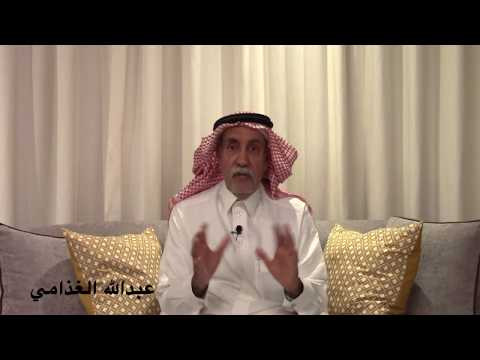 مفهوم التعددية الثقافية- 2 Year of publication: 2017 Author: Abdullah Al-Ghathami يقدم عبدالله الغذامي في هذا المقطع طرحا متوازنا لمفهوم التعددية الثقافية، ويستشهد في ذلك بالولايات المتحدة الامريكية. مقطع الفيديو يطرح بعض التطورات في مفهوم التعددية ويناقش الانصهار والاندماج من أجل نجاح المجتمع المتعدد. The Concept of Multiculturalism - 2 Year of publication: 2017 Author: Abdullah Al-Ghathami In this short video, Abdullah Al-Ghazhami presents a balanced presentation of the concept of multiculturalism. The author use the United States of America as a nation of multiculturalism. The video presents some developments in the concept of pluralism and discusses fusion and integration for the success of a multi-society.
 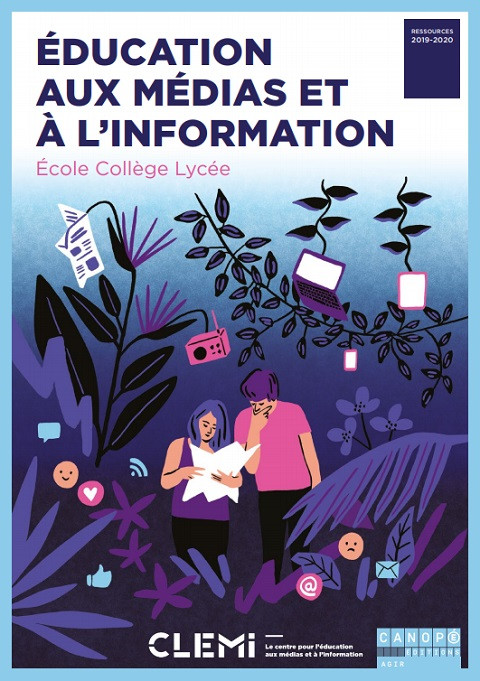 Éducation aux médias et à l’information: École collège lycée Year of publication: 2019 Corporate author: Centre pour l’éducation aux médias et à l’information (CLEMI) | Réseau Canopé Cette édition 2019-2020 a été entièrement revue et augmentée afin d'approcher au mieux les besoin des nouveaux enseignants. Elle s'adresse aussi bien au 1er qu'au 2nd degré.Vous y trouverez notamment : Les informations pratiques (socle commun, textes réglementaires...) et les dispositifs du CLEMI (Semaine de la presse et des médias dans l'école, Concours Médiatiks, #ZéroCliché...), afin de présenter les enjeux de l'Éducation aux médias et à l'information et les moyens proposés par le CLEMI pour la mettre en œuvre .Le focus Déclic' Critique, qui présente des exemples d'ateliers proposés en classe par le CLEMI et explique comment utiliser ces séquences pour développer l'esprit critique des élèves.Une partie est consacrée aux médias scolaires, à la fois pour encourager cette pratique mais aussi mieux la valoriser.Dans la partie 1er degré, vous trouverez les ressources nécessaires pour découvrir la presse, vérifier les images sur internet ou encore analyser un journal télévisé.La partie 2nd degré va s'intéresser à la publicité cachée, au journalisme de vérification, mais aussi aux nouveaux formats de l'info, comme la «story».
 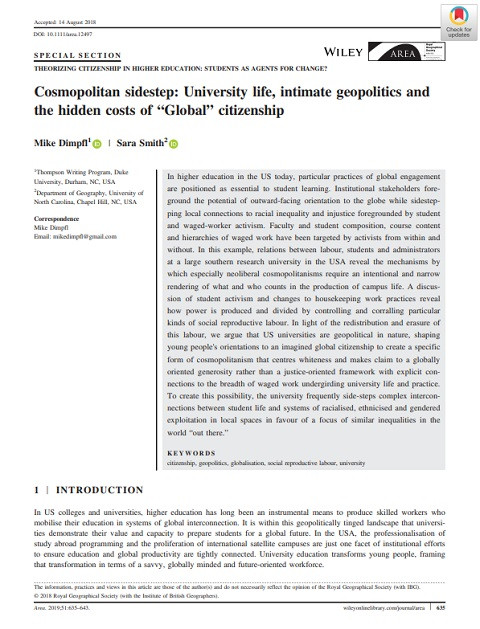 Cosmopolitan Sidestep: University Life, Intimate Geopolitics and the Hidden Costs of “Global” Citizenship (Area; Vol. 51, No. 4) Year of publication: 2018 Author: Mike Dimpfl | Sara Smith Corporate author: Royal Geographical Society | Wiley In higher education in the US today, particular practices of global engagement are positioned as essential to student learning. Institutional stakeholders foreground the potential of outward‐facing orientation to the globe while sidestepping local connections to racial inequality and injustice foregrounded by student and waged‐worker activism. Faculty and student composition, course content and hierarchies of waged work have been targeted by activists from within and without. In this example, relations between labour, students and administrators at a large southern research university in the USA reveal the mechanisms by which especially neoliberal cosmopolitanisms require an intentional and narrow rendering of what and who counts in the production of campus life. A discussion of student activism and changes to housekeeping work practices reveal how power is produced and divided by controlling and corralling particular kinds of social reproductive labour. In light of the redistribution and erasure of this labour, we argue that US universities are geopolitical in nature, shaping young people's orientations to an imagined global citizenship to create a specific form of cosmopolitanism that centres whiteness and makes claim to a globally oriented generosity rather than a justice‐oriented framework with explicit connections to the breadth of waged work undergirding university life and practice. To create this possibility, the university frequently side‐steps complex interconnections between student life and systems of racialised, ethnicised and gendered exploitation in local spaces in favour of a focus of similar inequalities in the world “out there.”
  Global Education for Ontario Learners: Practical Strategies; A Summary of Research Year of publication: 2018 Author: Caroline Manion | Nadya Weber Corporate author: Ontario (Canada). Ministry of Education This summary report flows from the policy outlined in Ontario’s Strategy for K–12 International Education (OME, 2015). The report highlights current knowledge about good and/or promising practices in global education in order to suggest practical strategies for improved teaching, learning, and achievement. The intended audience for this piece includes all education stakeholders – community members, parents, learners, system leaders, school leaders, and educators – as active agents of change in support of an education strategy designed to integrate global perspectives, cultures, and experiences in the curriculum and learning environment. The purpose is to enable students to develop the competencies they will need to thrive as citizens in an increasingly globalized world.
  Manual for Teachers and Educators: To Empower Young People on Sdgs and Migration Year of publication: 2018 Corporate author: Start the Change | European Union (EU) The Start the Change project aims to improve education provision linked to the Sustainable Development Goals (SDGs) in 12 European countries, with a special emphasis on the relationship between migration and global inequality, and contributing to the fulfilment of the 2030 Agenda for Sustainable Development.The first part of the guide (THINK) describes the educational model proposed by Start the Change. Service Learning gives an overview of a pedagogical approach that promotes a new perspective to acquiring global citizenship knowledge, skills and attitudes - not just in the classroom but also through direct experience of working on real issues in the community. MANUAL TO INSPIRE: START THE CHANGE 11 Participative methodologies are the basis of all good global citizenship education, and youth empowerment can be enhanced through peer to peer approaches. The second part of the guide (LEARN) is dedicated to enhancing teachers’ and educators’ knowledge of the contents of the project: the Sustainable Development Goals, inequality and migration issues. Storytelling can be used to develop short film storylines on Start the Change issues. Educational activities can be enriched by using ICT to promote global learning and include voices and experiences from the Global South. The third part of the guide (DO) is dedicated to activities and methodologies to help young people explore these issues and inspire them to take action in their communities.
  Development Education: What Is It and Why Get Involved? Year of publication: 2017 Corporate author: WorldWise Global Schools (WWGS) Global Citizenship Education (GCE) is an educational process aimed at increasing awareness and understanding of the rapidly changing, interdependent and unequal world in which we live. This video explores what we mean by Development Education (DE), as also known as Global Citizenship Education, what value it has for students and what supports are available to help schools doing it.
  Global Rights, Nobel Goals: Refugees, Migration, the Sustainable Development Goals and Youth; Resource Pack Year of publication: 2016 Author: Valerie Duffy | Leo Gilmartin | Grace McManus | Dermot O’Brien Corporate author: National Youth Council of Ireland (NYCI) This resource pack explores the terms around migration (asylum seeker, refugee, internally displace peoples etc), the reasons that people choose or are forced to migrate and makes connections with the SDGs. It also includes a great selection of activities for young people at different ages and stages.