
Resources
Explore a wide range of valuable resources on GCED to deepen your understanding and enhance your research, advocacy, teaching, and learning.
3,451 Results found
 Devlop’ Le journal de Louvain Coopération 4 - Février 2017 Year of publication: 2017 Corporate author: Louvain Coopération “Soutenir un tissu economique solide“ Louvain Cooperation est constamment a la recherche de diversification et d’innovation dans ses moyens d’action. Les subsides publics belges et europeens avec lesquels nous travaillons, s’ils sont necessaires et efficaces, ne sont pas l’unique moyen d’action que nous devons mobiliser pour remplir notre mission. Nos partenaires du monde agricole et rural, cooperative ou organisations paysannes, nous interpellent sur notre capacite a les soutenir dans leur developpement entrepreneurial, au-dela des techniques de production agroecologiques. Des unites de transformation et de commercialisation de leurs produits leur permettraient d’ajouter de la valeur a leur production tout en conservant la maitrise. Or ce type de projet entrepreneurial rencontre des difficultes de financement : exclus des subsides, trop risques pour les banques ou microfinances locales, trop petits pour les investisseurs sociaux des pays occidentaux. Le fonds d’investissement Kampani, dont Louvain Cooperation est membre fondateur, propose des outils financiers adaptes au developpement de telles initiatives. Le soutien technique et strategique apporte par nos programmes, couple, via Kampani, aux capacites et exigences d’investissement pour la creation de PME agricoles, nous donne la possibilite de soutenir un tissu economique solide, au service des petits agriculteurs et de la lutte contre le rechauffement climatique.
 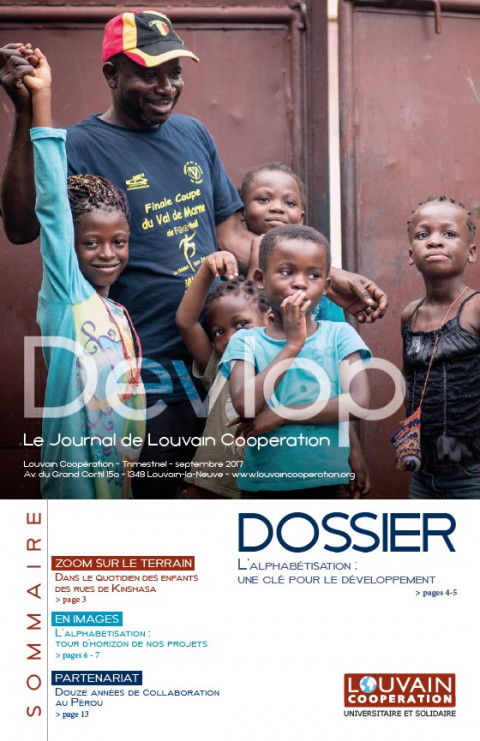 Devlop’ Le journal de Louvain Coopération 5 - Septembre 2017 Year of publication: 2017 Corporate author: Louvain Coopération Notre assemblee generale a approuve les comptes de 2016. Ils se soldent par une perte de 846.171€ qui resulte principalement d’un engagement trop important de fonds aupres de nos partenaires empechant l’ONG de materialiser une serie de cofinancements et de valorisations. Si ceci a ete ≪ benefique ≫ a nos partenaires, cela a neanmoins reduit considerablement nos fonds propres. Heureusement, la continuite des operations n’est pas menacee grace aux mesures urgentes qui ont ete prises. A tres court terme, elles visent a garantir que l’exercice 2017 ne sera pas en perte. Ceci passe notamment par une baisse des charges d’exploitation et par des efforts en matiere de ressources humaines. Le conseil d’administration a par ailleurs confie a deux de ses membres la realisation d’un audit institutionnel et financier dont les resultats ont permis au CA de prendre une premiere serie de decisions importantes relatives a l’organisation de l’ONG. Ils constituent la base d’un plan d’actions en vue d’une reorganisation progressive des equipes du siege et du terrain. C’est ainsi que l’ONG se centrera dorenavant sur un nouveau departement ≪ Programmes ≫ soutenu dans ses actions par un departement ≪ Supports ≫. L’objectif de ce recentrage autour des programmes, couple aux efforts des differentes equipes, est de pouvoir rebondir et accroitre l’efficience de notre organisation. Cela nous permettra de renforcer la qualite du travail mene avec nos quelques 140 partenaires en vue d’ameliorer les conditions de vie des populations de nos zones d’intervention. Saluons la mobilisation tres forte des equipes de Louvain Cooperation en vue de relever ce defi.
 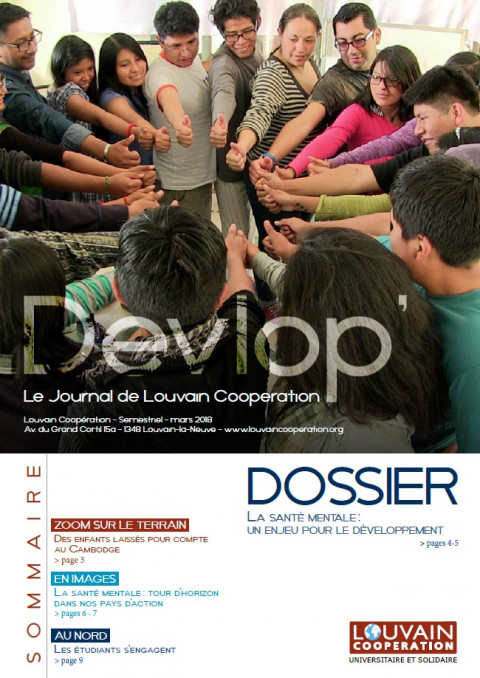 Devlop’ Le journal de Louvain Coopération 6 - Mars 2018 Year of publication: 2018 Corporate author: Louvain Coopération Comme nous vous en parlions dans notre edition precedente, Louvain Cooperation a pris les mesures necessaires – parfois difficiles – pour perenniser ses activites dans le cadre de sa mission, ceci en concertation avec toutes les parties prenantes. L’elaboration de ces mesures a ete notamment l’occasion de jeter les bases d’une nouvelle organisation de l’ONG qui permettra de parvenir plus efficacement a la realisation de ses objectifs. Un nouveau directeur general a ete engage ainsi qu’un nouveau responsable financier. L’equipe ≪ Programmes ≫ a ete adaptee en fonction de la mission de l’ONG et aussi des exigences augmentees des bailleurs de fonds ; rendre les populations locales plus autonomes en leur transferant plus de competences est dans la lignee de cette mission. Des efforts considerables ont ete consentis en matiere de ressources humaines au siege a Louvainla-Neuve ; que toute l’equipe soit remerciee de sa collaboration. La reorganisation a aussi ete rendue possible grace a l’Universite catholique de Louvain qui, ayant confiance en l’ONG et en ses capacites a reagir, a mobilise les ressources indispensables pour la mise en oeuvre des reformes. Ce processus a pu aboutir car il a reuni les forces vives entourant notre association. C’est ensemble que nous continuons a ecrire l’histoire de Louvain Cooperation en mettant en place une dynamique nouvelle et porteuse de changement. Sur ces nouvelles bases, l’ONG rebondit, pleine de motivation et d’energie en se focalisant sur sa mission premiere, donner aux beneficiaires de ses projets les moyens de prendre leur destin en main. Un volet de cette mission est concretise par son programme de ≪ sante mentale ≫, theme qui fait l’objet de cette edition de Devlop’. Bonne lecture !
 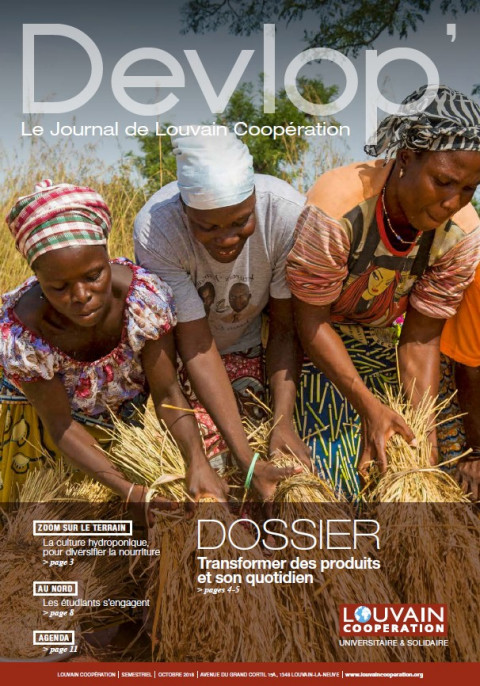 Devlop’ Le journal de Louvain Coopération 7 - OCTOBRE 2018 Year of publication: 2018 Corporate author: Louvain Coopération Universitaire pour l’avenir En tant que premier cadre partant à la retraite, on m’offre le privilège d’écrire cet édito, que je consacre à l’opportunité que représente l’ancrage universitaire de notre ONG. Pendant mes quelques années au sein de cette organisation, j’ai pu observer et contribuer à quelques initiatives qui m’ont convaincu de la valeur ajoutée d’être une ONG universitaire. Les interactions avec l‘UCLouvain les plus intéressantes et pertinentes sont selon moi celles qui impliquent et renforcent des organisations et universités du Sud. Le développement durable étant avant tout l’affaire des citoyens locaux concernés, notre binôme avec l’UCLouvain doit relever le défi de renforcer les capacités locales du Sud à formuler et mettre en oeuvre ses propres politiques de développement : évoluer d’une dépendance aux idées du Nord vers une interdépendance avec les idées du Sud. J’encourage donc l’équipe à soutenir les capacités de recherche et d’innovation des partenaires du Sud. C’est le meilleur gage d’une appropriation de leur développement et d’une adaptation à leur contexte de stratégies adéquates. Au Nord, de nombreux chercheurs universitaires participent aux processus multi-acteurs qui orientent nos propres transitions sociétales. Pourquoi ne pas contribuer à cette capacitation-là au Sud ? Le défi pour Louvain Coopération consisterait alors à développer de plus en plus de collaborations incluant des ONG, étudiants et chercheurs universitaires du Sud. Ainsi nous pourrons évoluer vers des alliances entre partenaires de plus en plus égaux, et améliorerons notre ancrage social au sein du milieu universitaire. Les processus de transformations des productions agricoles présentés dans ce numéro de Devlop’ sont au coeur de cette problématique d’appropriation. Bonne lecture !
 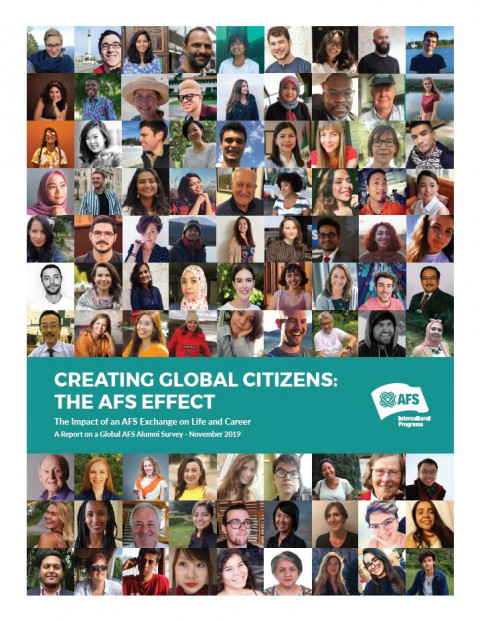 Creating Global Citizens: The AFS Effect Year of publication: 2019 Corporate author: AFS Intercultural Programs The AFS global community has countless testimonials of how our alumni, students, volunteers, families, and others are making a positive change in their communities. These stories are a true inspiration and a testament to the important impact our organization is creating worldwide. Our hope is that our exchange students become changemakers through their study abroad experience with significant contributions to the global corporate and non-profit sectors, while benefiting from the intercultural learnings and meaningful connections long after they return home. All AFS participants are active global citizens in the making, representing their countries as cultural ambassadors, each helping drive the AFS mission forward - the mission of building a more just and peaceful world.While the impact of AFS and studying abroad in general have been examined in the past through various research projects, this report is the first large-scale, global survey of the AFS alumni community based on responses from over 10,500 former AFS participants. It aims to explore the effect an AFS experience can have on the lives and careers of our alumni while investigating the impact of secondary school mobility globally. The study also includes real-life examples from our former participants of changes alumni can bring to their local communities thereby furthering the AFS mission worldwide. The results of this global survey demonstrate that AFS alumni are making an impact across industries, working on social causes, and contributing to their home and host countries alike. That is what we call the #AFSEffect.
 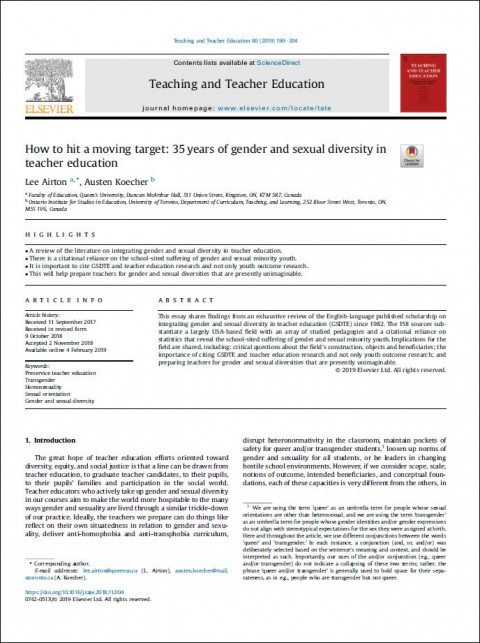 How to Hit a Moving Target: 35 Years of Gender and Sexual Diversity in Teacher Education Year of publication: 2019 Author: Lee Airton | Austen Koecher This essay shares findings from an exhaustive review of the English-language published scholarship on integrating gender and sexual diversity in teacher education (GSDTE) since 1982. The 158 sources substantiate a largely USA-based field with an array of studied pedagogies and a citational reliance on statistics that reveal the school-sited suffering of gender and sexual minority youth. Implications for the field are shared, including: critical questions about the field's construction, objects and beneficiaries; the importance of citing GSDTE and teacher education research and not only youth outcome research; and preparing teachers for gender and sexual diversities that are presently unimaginable. Highlights • A review of the literature on integrating gender and sexual diversity in teacher education.• There is a citational reliance on the school-sited suffering of gender and sexual minority youth.• It is important to cite GSDTE and teacher education research and not only youth outcome research.• This will help prepare teachers for gender and sexual diversities that are presently unimaginable.
 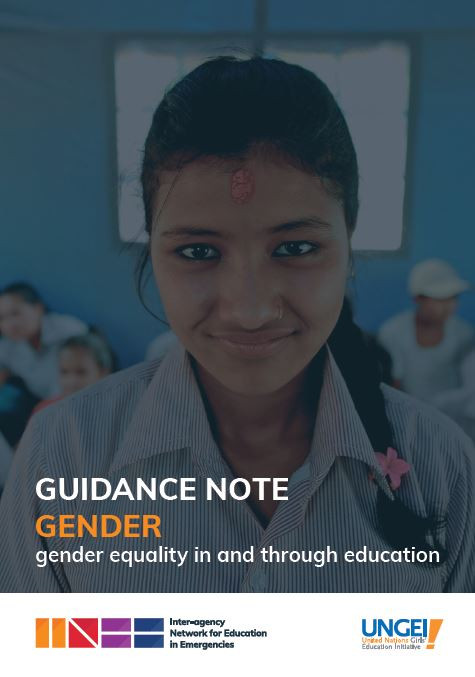 INEE Guidance Note on Gender: Equality in and Through Education Year of publication: 2019 Corporate author: Inter-agency Network for Education in Emergencies (INEE) With the launch of the Global Goals for Sustainable Development (SDGs) in 2015, the international community committed to providing inclusive and equitable quality education for all (SDG4) as well as achieving gender equality and the empowerment of all women and girls (SDG5). The Global Goals also emphasize the need to “leave no one behind” by focusing on those furthest behind first, such as those affected by crisis. In line with this, the Education 2030 Framework for Action stresses the importance of providing education in “safe, supportive and secure learning environments free from violence” and recommends a stronger, better coordinated response to ensure the protective space of education is maintained during crises and subsequent recovery efforts.In response to these global commitments, the INEE Guidance Note on Gender provides strategies to ensure that girls, boys, women, and men in contexts of conflict and crisis equally enjoy the protection and learning outcomes that quality education can provide. It also outlines principles for gender-responsive programming, in alignment with the INEE Minimum Standards for Education in Emergencies. The Guidance Note on Gender shows how attention to gender dynamics and social constraints will result in better education for all crisis-affected populations and help build inclusive, equitable education systems for the future. This guidance note also responds to recent developments in the humanitarian context, including the historic commitment made by G7 partners to quality education for girls in crisis situations. The ensuing Charlevoix Declaration on Quality Education for Girls, Adolescent Girls, and Women in Developing Countries recognizes that quality education can contribute to peace and stability as well as positive health and life outcomes for all. It is critical that the development community now harnesses this global momentum by working together to break the particular barriers that prevent too many girls and boys in situations of crisis and conflict from accessing the education they need. It is our hope that this Guidance Note on Gender will help better equip those at the frontlines of this work to do just that.
 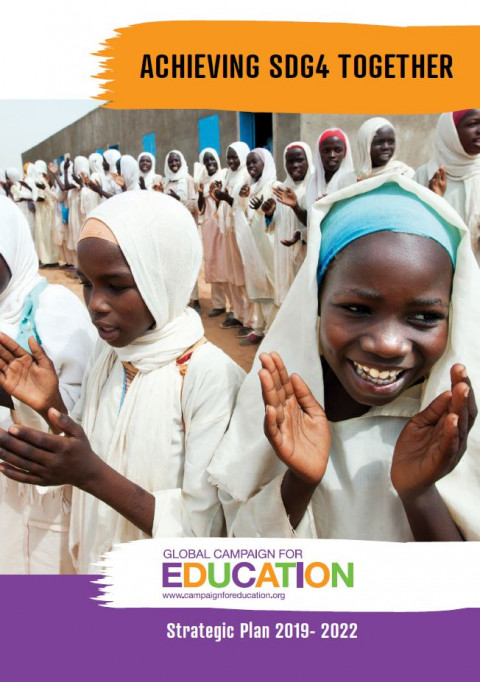 Achieving SDG 4 Together: Strategic Plan 2019 - 2022 Year of publication: 2018 Corporate author: Global Campaign for Education (GCE) The 2019-2022 strategic plan of the Global Campaign for Education was adopted during the 6th World Assembly of the movement in November 2018, Kathmandu. The plan identifies 4 priority strategic areas: Inclusivity and non-discrimination, Transformative education, Education in emergencies and Financing education. The plan also focus on strengthening the global movement and integrating youth voices.On the eve of celebrating its 20th anniversary, the Global Campaign for Education (GCE) is the largest civil society organisation movement working to promote the human right to education and to put pressure on governments and the international community to fulfil their commitments to provide free, inclusive, quality public education and lifelong learning for all, particularly for children. Our regional and national coalitions encompass many thousands of civil society organisations and represent millions of individuals across the world. Each is independent, and all are united by the commitment to the human right to education, and to achieving change through the mobilisation of citizens and civil society.
 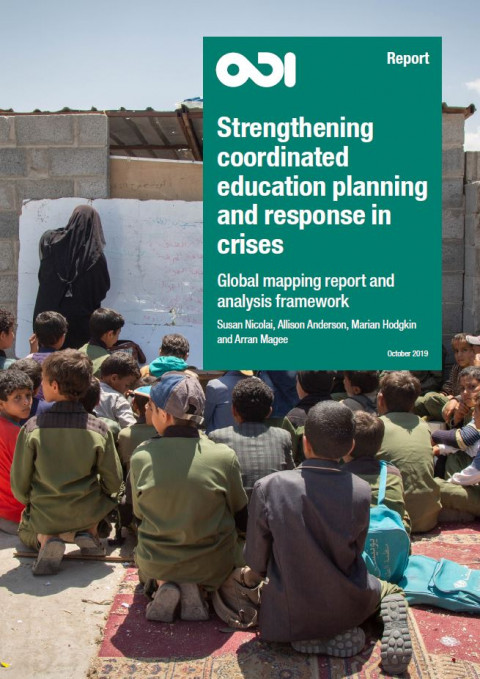 Strengthening Coordinated Education Planning and Response in Crises: Global Mapping Report and Analysis Framework Year of publication: 2019 Author: Susan Nicolai | Allison Anderson | Marian Hodgkin | Arran Magee Corporate author: Overseas Development Institute (ODI) This report presents a framework for analysis of formal coordination approaches for education planning and response in emergencies and protracted crises. It reviews concepts and definitions of coordination, approaches and structures for coordinated planning and response, and expected outcomes of these processes, with a focus on humanitarian structures across the humanitarian–development nexus.It is part of a set of publications produced in partnership with the Global Education Cluster, the Inter-Agency Network for Education in Emergencies and UNHCR – the UN Refugee Agency – with funding from the Education Cannot Wait Fund. The conceptual framework and set of research questions that emerge from this report is applied to six country case studies, which will be published in December 2019.
 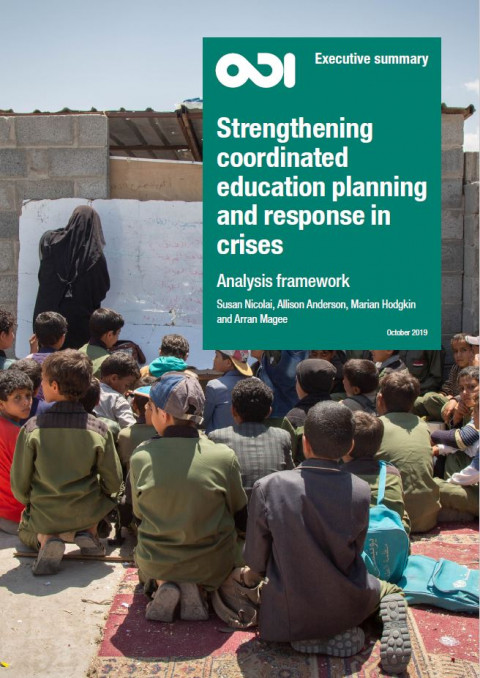 [Summary] Strengthening Coordinated Education Planning and Response in Crises: Analysis Framework; Executive Summary Year of publication: 2019 Author: Susan Nicolai | Allison Anderson | Marian Hodgkin | Arran Magee Corporate author: Overseas Development Institute (ODI) This report presents a framework for analysis of formal coordination approaches for education planning and response in emergencies and protracted crises. It reviews concepts and definitions of coordination, approaches and structures for coordinated planning and response, and expected outcomes of these processes, with a focus on humanitarian structures across the humanitarian–development nexus. The main types of formal education coordination groups include Education Clusters, Refugee Education Working Groups and Local Education Groups (LEGs). These often have different purposes and organisations associated with them, sometimes resulting in overlaps and gaps in coordination efforts.