
Resources
Explore a wide range of valuable resources on GCED to deepen your understanding and enhance your research, advocacy, teaching, and learning.
3,229 Results found
 Libyan Experience in Literacy and Adult Education Year of publication: 2017 Corporate author: Masouda Ali Al Aswad Libya, like other Third World countries, has suffered from the illiteracy problem as one of the most important challenges it has faced and continues to face the progress it is seeking. The country has gone through stages of underdevelopment, colonialism and mandate that have had a bad impact on the individual and societal level, which has delayed human development and weakened the pace of development and construction. Given the importance of education in nation-building, Libya has long sought to spread science and learning among different segments of society, young and old, and has had great ambitions for the literacy program from the 1950s to the present day.The methods and methods of illiteracy have been varied, from the alphabetical illiteracy targeted to segments of society that have lost their opportunity to read and write in a timely manner, to try to eradicate vocational illiteracy, vocational training, craft preparation, home training and health education, by acquiring these categories. Adequate skills to achieve autonomy, to combat civilizational, functional, technical and training illiteracy aimed at training cadres capable of meeting the needs in the labor market. The Libyan state has adopted all possible means and methods to eliminate illiteracy, from adult education schools to evening schools to extraordinary classes in leisure time, to mosques, lighthouses and corners that contributed to spreading the culture of memorizing and studying the Holy Qur'an, which reflected positively on the level of learning among large groups of people who were unable to From entering schools.This is in addition to the Open University program, which is an achievement that provided golden opportunities for those who missed the opportunity of university education. The State also achieved a balance between the workforce and the high levels of education for these forces. Libya has achieved high levels in terms of its ability to cope with illiteracy, spread awareness and alphabet culture, as well as achieve tangible stages in terms of technical illiteracy. Reports have proved to be high on the list of countries that have succeeded in fighting illiteracy. At the same time, however, they continue to face significant challenges and problems that require thorough studies and efforts to eliminate them.
  المواءمة من أجل التعلم: استراتيجيات لتحقيق فعالية التعليم Year of publication: 2008 Author: Donald H. Wulff | Wayne H. Jacobson على أعضاء الهيئة التدريسية وخبراء التنمية التعليمية والإدارية في بيئة التعليم العالي المتغيرة أن يسعوا إلى إيجاد طرق مبتكرة لمقاربة تعقيدات التعليم والتعلم. يقترح نموذج المواءمة ضرورة قيام المعلمين، ليكونوا فعالين في تحقيق أهداف التعلم، بالانخراط في عملية مواءمة مستمرة بينهم وبين المضمون والطلبة في بيئة معينة. يجمع هذا الكتاب نموذج المواءمة مع سنوات خبرة المؤلفين بوصفهم معلمين وخبراء تنمية تعليمية وإداريين لإنتاج مجلد عملي في التعليم والتعلم يتضمن أفكاراً قابلة للتطبيق في مؤسسات وبيئات تعليمية متنوعة. Aligning for Learning: Strategies for Teaching Effectiveness Year of publication: 2008 Author: Donald H. Wulff | Wayne H. Jacobson Faculty and educational and administrative development experts in the changing environment of higher education should seek innovative ways to approach the complexities of teaching and learning. The Harmonization Model suggests that teachers, in order to be effective in achieving learning objectives, should engage in an ongoing process of alignment between them and the content and students in a given environment. This book combines a model of alignment with the authors' years of experience as teachers and development experts.
  INTRAC in Central Asia 1994-2018: A Story of the Past, the Present and the Future; Special Series Paper Year of publication: 2019 Author: Charles Buxton | Anne Garbutt | Janice Giffen | Chynara Irisova | Konstantin Kovtunets | Anara Moldosheva | Brian Pratt | Medet Tiulegenov | Chris Wardle | Nazgul Zakiriaeva Corporate author: International Non-Governmental Organisation Training and Research Centre (INTRAC) This publication is a special newsletter which marks the next phase of support provided by INTRAC to civil society in Central Asia. The articles in this special bulletin describe the history of INTRAC in Central Asia from the very first days to the present, and also provide a glimpse into the future. ИНТРАК в Центральной Азии с 1994 по 2018 годы: прошлое, настоящее и будущее; Специальный выпуск Year of publication: 2019 Author: Charles Buxton | Anne Garbutt | Janice Giffen | Chynara Irisova | Konstantin Kovtunets | Anara Moldosheva | Brian Pratt | Medet Tiulegenov | Chris Wardle | Nazgul Zakiriaeva Corporate author: International Non-Governmental Organisation Training and Research Centre (INTRAC) Это издание является специальным бюллетенем, который ознаменует следующий этап поддержки, оказываемой ИНТРАК гражданскому обществу в Центральной Азии. Статьи в этом специальном бюллетене описывают историю ИНТРАК в Центральной Азии с самых первых дней и до настоящего времени, а также позволяют заглянуть в будущее.
 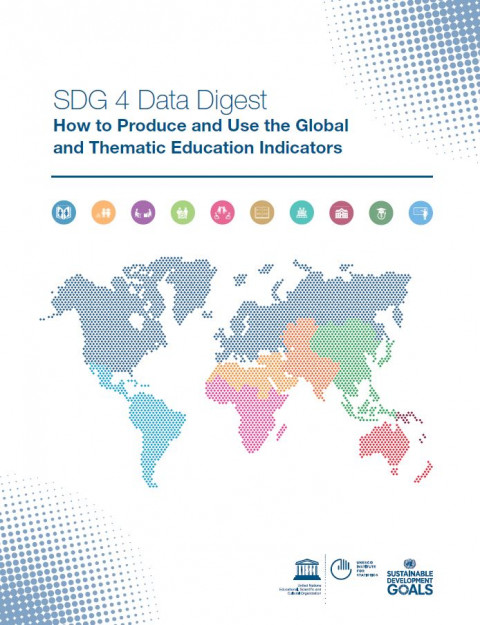 SDG 4 Data Digest: How to Produce and Use the Global and Thematic Education Indicators Year of publication: 2019 Corporate author: UNESCO Institute for Statistics (UIS) This edition of the SDG 4 Data Digest from the UNESCO Institute for Statistics (UIS) aims to help countries develop and report the indicators needed to deliver on the promise of Sustainable Development Goal 4 – a quality education for all by 2030.It stresses the urgency: every child in the generation that should finish secondary education by the deadline should be in a primary classroom right now. Yet if current trends continue, and without a rapid shift from “business as usual”, one in six children aged 6 to 17 will still be out of school in 2030 while just six in ten youth will be completing secondary education. Moreover, there is an urgent need to improve the quality of education on offer. According to UIS estimates, 55% of children and adolescents of primary and lower secondary school age are not achieving minimum proficiency levels in reading and 60% are not acquiring critical skills in mathematics The investment case for education is clear and has been repeated time and time again: education reduces poverty, improves health and nutrition, advances equity and drives national prosperity. But education systems cannot function effectively without a clear picture of progress – or the lack of it – and without knowing who is missing out on education and why.To help ll such gaps, the Digest focuses on new methodologies to help countries build a full and accurate understanding of their own education successes and challenges while generating the internationally comparable data needed for global monitoring. Through these methodological tools, countries can track and accelerate progress on their own education priorities and contribute to the global achievement of SDG4. Compendio de Datos sobre el ODS 4: Cómo producir y utilizar los indicadores globales y temáticos sobre educación Year of publication: 2019 Corporate author: UNESCO Institute for Statistics (UIS) La presente edición del Compendio de Datos ODS 4 publicada por el Instituto de Estadística de la UNESCO (UIS) pretende a ayudar a los países a desarrollar y reportar los indicadores que se requerirán para cumplir la promesa del Objetivo de Desarrollo Sostenible 4 – una educación de calidad para todos de aquí al 2030. Se pone énfasis en la urgencia: todo niño que forma parte de la generación que debería concluir la educación secundaria dentro del plazo, debería estar en un aula de primaria hoy. Sin embargo, si la actual tendencia continúa, y de no mediar un drástico cambio, uno de cada seis niños entre 6 y 17 años aún estará fuera de la escuela en 2030 y solo seis de cada diez jóvenes habrán completado su educación secundaria. Adicionalmente, existe la urgente necesidad de mejorar la calidad de la educación que hoy se ofrece. De acuerdo con estimaciones del UIS, el 55% de los niños y adolescentes en edad de cursar educación primaria y educación secundaria baja no están adquiriendo niveles mínimos de competencia en lectura y 60% no está adquiriendo competencias fundamentales en matemáticas. El caso de inversión para la educación es claro y se ha repetido una y otra vez: la educación reduce la pobreza, mejora la salud y la nutrición, promueve la equidad y fomenta la prosperidad nacional. Sin embargo, los sistemas educativos no pueden funcionar en forma eficiente si no cuentan con un escenario claro - o con ningún escenario - del avance y sin saber quién no está recibiendo educación y por qué. Para ayudar a cerrar estas brechas, el Compendio se centra en nuevas metodologías que ayudan a los países a desarrollar una clara y completa visión de sus propios éxitos y desafíos en materia de educación, al tiempo que genera los datos internacionalmente comparables necesarios para el monitoreo global. A través de estas herramientas metodológicas, los países podrán rastrear y acelerar el avance de sus propias prioridades de educación y contribuir al logro global del ODS 4. Rapport sur les données de l’ODD 4: Comment produire et utiliser les indicateurs mondiaux et thématiques de l’éducation Year of publication: 2019 Corporate author: UNESCO Institute for Statistics (UIS) La présente édition du Rapport sur les données de l’ODD 4 de l’Institut de statistique de l’UNESCO (ISU) vise à aider les pays à élaborer et à fournir les indicateurs nécessaires pour respecter la promesse de l’Objectif de développement durable 4 (ODD 4) : assurer l’accès de tous à une éducation de qualité d’ici 2030. Il insiste sur l’urgence que chaque enfant de la génération qui doit achever le cycle secondaire à l’échéance 2030 soit inscrit dans le primaire dès aujourd’hui. Cependant, si la tendance actuelle et le statu quo se poursuivent, un enfant de 6 à 17 ans sur six ne sera toujours pas scolarisé en 2030, et seuls six jeunes sur dix achèveront le cycle secondaire. Par ailleurs, il est urgent d’améliorer la qualité de l’éducation offerte. Selon les estimations de l’ISU, 55 % des enfants et des adolescents en âge de fréquenter le primaire et le premier cycle du secondaire n’atteignent pas les seuils minimaux de compétence en lecture, et 60 % n’acquièrent pas ces seuils en mathématiques. Les arguments en faveur de l’investissement dans l’éducation sont clairs et ont été répétés à maintes reprises : l’éducation réduit la pauvreté, améliore la santé et la nutrition, fait avancer l’équité et stimule la prospérité nationale. Mais les systèmes éducatifs ne peuvent pas fonctionner efficacement s’ils ne disposent pas du tableau des progrès accomplis – ou de leur absence – et sans savoir ce dont manque l’éducation et pourquoi. Pour contribuer à combler ces lacunes, le Rapport se concentre sur les nouvelles méthodologies pour aider les pays à développer une compréhension précise de leurs progrès, de leurs succès et de leurs défis dans le domaine de l’éducation, tout en produisant des données comparables sur le plan international pour le suivi mondial. Ces outils méthodologiques leur donneront les moyens de suivre et d’accélérer les progrès accomplis pour atteindre leurs propres priorités éducatives et contribuer à la réalisation de l’ODD 4.
 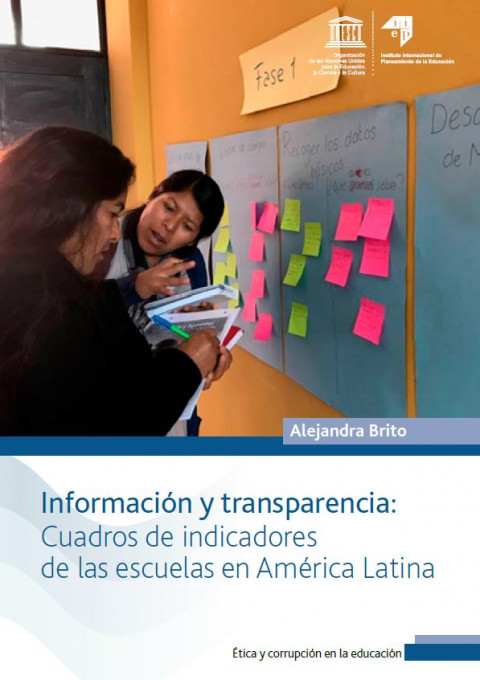 Información y transparencia: cuadros de indicadores de las escuelas en América Latina Year of publication: 2019 Author: Alejandra Brito Corporate author: UNESCO International Institute for Educational Planning (IIEP) ¿La publicación de indicadores sobre cada escuela y compartirlos con los actores escolares mejoran la transparencia y la rendición de cuentas y ayudan a combatir la corrupción de manera eficaz? Mientras que los cuadros de indicadores de las escuelas se están desarrollando en un número creciente de países de América Latina, esta pregunta aparece particularmente aguda; la información y las evaluaciones disponibles sobre el tema siguen siendo parcelarias.Este estudio muestra un panorama de la situación a nivel regional, revisando los sistemas de información e indicadores escolares de acceso público de 15 países de América Latina. Además, examina en profundidad siete cuadros de indicadores de información escolar en cuanto a su contenido, periodicidad, mecanismos de relevamiento y difusión de la información, diseño, uso e impacto en temas de transparencia, rendición de cuentas y lucha contra la corrupción.En conclusión, formula recomendaciones detalladas para los encargados de la toma de decisiones, entre las que se incluyen: considerar la utilidad, claridad y accesibilidad de los cuadros; mejorar la validez y vigencia de los datos; fomentar la comprensión y uso de la información; vincular los cuadros con los sistemas de rendición de cuentas actuales; incluirlos en los canales de comunicación en uso; proporcionar consecuencias o sanciones en caso de corrupción; asegurar la comprensión y difusión de los resultados por los padres de familias, así como su participación en los planes de mejora.
  Sustainable Development Report 2019: Transformations to Achieve the Sustainable Development Goals Year of publication: 2019 Corporate author: Bertelsmann Stiftung and Sustainable Development Solutions Network The Sustainable Development Report 2019 presents the SDG Index and Dashboards for all UN member states and frames the implementation of the Sustainable Development Goals (SDGs) in terms of six broad transformations. It was prepared by teams of independent experts at the Sustainable Development Solutions Network (SDSN) and the Bertelsmann Stiftung.