
Resources
Explore a wide range of valuable resources on GCED to deepen your understanding and enhance your research, advocacy, teaching, and learning.
3,451 Results found
 Accountability for Gender Equality Year of publication: 2018 Author: Elaine Unterhulter | Amy North | Orlanda Ward The aim of this paper is to consider approaches to understanding and evaluating accountability in education from the perspective of concerns with gender equality in education. This task has a number of facets and complexities, because ‘gender’ is not one simple set of relationships, and the notion of gender equality in education can be read in a number of different ways. Thus developing adequate conceptualizations for the key terms (accountability, and gender equality and education) needs to take account of gender as a particularly fluid, contextually located and contested idea signaling processes, which link with different formulations of policy and practice to enhance gender equality and accountability in education.In this paper we look at a range of different meanings of accountability, distilled in the main GEM Report (UNESCO, 2017) and consider their implications in relation to debates about gender and gender equality in education. The aim of the paper is to develop a ‘bespoke’ interpretation of accountability and different forms of gender equality in education through which we can assess a number of research studies and country examples of forms of accountability.This paper is also background paper prepared for the 2018 Global education monitoring report gender review: Meeting our commitments to gender equality in education.
  Security, Extremism and Education: Safeguarding or Surveillance? Year of publication: 2015 Author: Lynn Davies This article analyses how education is positioned in the current concerns about security and extremism. Initially, a central dilemma is acknowledged: that schooling appears to be simultaneously irrelevant to the huge global questions of security and yet central to the learning of alternative ways to conduct human relations. With regard to extremism, two aspects of importance in ideological compliance or challenge are firstly the attempted securitization of education, and secondly the role of education in young people joining or supporting extremist movements. Educational approaches within transitional justice underline the importance of tackling violence in schools and promoting a human rights culture that promotes both human security and ultimately national security. Security, Extremism and Education: Safeguarding or Surveillance? Year of publication: 2015 Author: Lynn Davies Cet article analyse le rôle de l'éducation dans les préoccupations actuelles concernant la sécurité et l'extrémisme. Dans un premier temps, on reconnait le problème fondamental suivant : à priori, il n’y a aucun rapport entre l'école et la question pressante de la sécurité dans le monde, et pourtant l’école est clé dans l'apprentissage des différents moyens de gestion des relations interpersonnelles. En ce qui concerne l'extrémisme, deux aspects de l’adhésion à une idéologie ou de la défiance sont importants : d'une part les efforts pour sécuriser l'éducation, et d'autre part le rôle de l'éducation vis-à-vis des jeunes rejoignent ou soutiennent des mouvements extrémistes. Les approches éducatives au sein de la justice transitionnelle soulignent l'importance de lutter contre la violence dans les écoles et de promouvoir une culture des droits de l'homme favorisant à la fois la sécurité humaine et la sécurité nationale.
  中国少数民族基础教育政策研究报告 Year of publication: 2010 Corporate author: UNESCO Beijing 本报告是在“提高少数民族群体的受教育程度及文化上敏感的教育”的框架下是实地调查少数民族基础教育政策研究实施情况。2010年,根据对中国政府制定、实施的少数民族基础教育政策文本分析报告,确定实地调研的目标和任务,对三个项目省十二个个案点调研报告。通过田野调查和问卷调查,六个调研组完成十二个个案点调研报告。基于十二个个案调研报告内容形成本报告,并在此基础上提出改进建议和下一步的行动计划。
 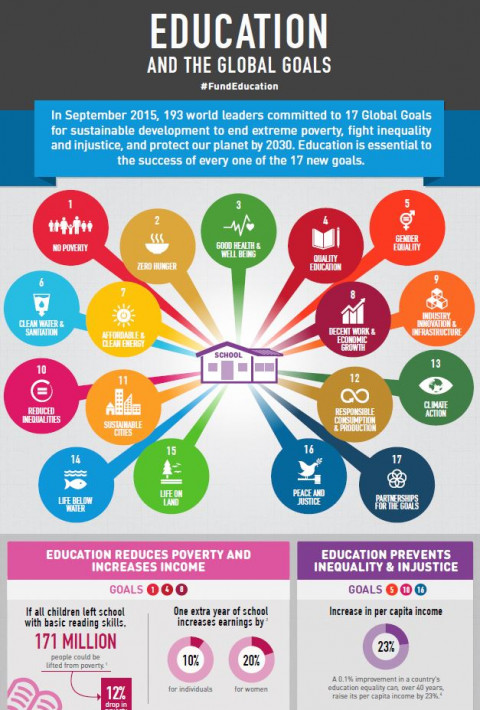 Education and the Global Goals Year of publication: 2015 Corporate author: Global Partnership for Education (GPE) In September 2015, 193 world leaders committed to 17 Global Goals for sustainable development to end extreme poverty, fight inequality and injustice, and protect our planet by 2030. Education is essential to the success of every one of the 17 new goals.To learn more: https://www.globalpartnership.org/blog/17-ways-education-influences-new-17-global-goals
  UNITED NATIONS HUMAN RIGHTS MECHANISMS and the Right to Education in Insecurity and Armed Conflict Author: Takhmina Karimova | Gilles Giacca | Stuart Casey-Maslen Corporate author: Geneva Academy of International Humanitarian Law and Human Rights This publication, United Nations Human Rights Mechanisms and the Right to Education in Insecurity and Armed Conflict, seeks to respond to the acute need to identify trends in the practice, and contribution, of United Nations human rights mechanisms to the protection of education in times of insecurity and conflict. It is the result of a one-year research project carried out by researchers at the Geneva Academy of International Humanitarian Law and Human Rights (Geneva Academy). The research was overseen by a Legal Advisory Committee and subject to multi-disciplinary peer review. Accompanying the publication is a summary policy document intended to guide future work in this area. An electronic version of each publication is available at http://www.geneva-academy.ch and at http://www.educationandconflict.org.United Nations Human Rights Mechanisms and the Right to Education in Insecurity and Armed Conflict is the second in a series of legal research documents commissioned by Protect Education in Insecurity and Conflict (PEIC) on the protection of education during insecurity and armed conflict. PEIC is a programme of the Education Above All Foundation, an independent organization chaired by Her Highness Sheikha Moza Bint Nasser of Qatar, UNESCO Special Envoy for Basic and Higher Education. A policy, research, and advocacy organization, PEIC is concerned with the protection of education during insecurity and armed conflict. PEIC’s Legal Programme contributes to such protection through the strategic use of international and national law. Its legal research papers are authored by academics and/or practicing lawyers. They are aimed at a varied audience, including international and national lawyers; non-legally trained education experts and policy-makers within governments; political, social, and cultural bodies; and civil society. The Geneva Academy aims to provide instruction of a high academic standard, conduct and promote scientific research, organize training courses and expert meetings, and provide legal expertise in the branches of international law relating to situations of armed conflict. Founded in 2007, the Academy replaces the University Centre for International Humanitarian Law created in 2002 by the Faculty of Law of the University of Geneva and the Graduate Institute of International Studies, now the Graduate Institute of International and Development Studies(IHEID).
 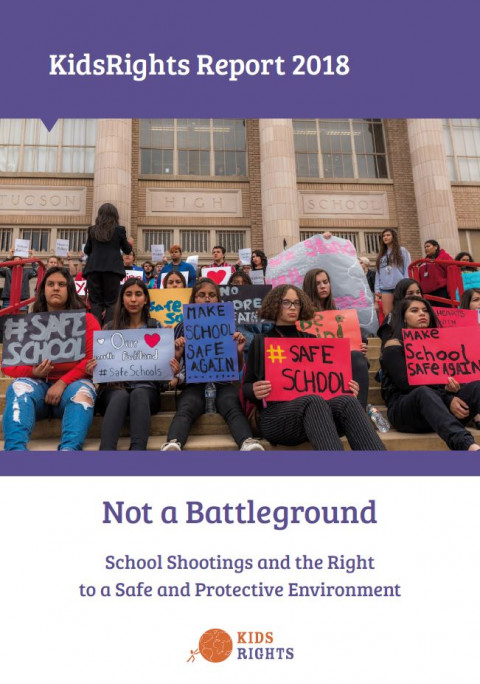 Not a Battleground: School Shootings and the Right to a Safe and Protective Environment Year of publication: 2018 Author: Kim Brouwers | Chrissie van Heijningen Corporate author: KidsRights Foundation Violence is a daily reality for many children, at home, at play and at school. More than 100,000 children die from violence every year, and others suffer the effects well into adulthood. This is a violation of Article 19 of the UNCRC, which stipulates that every child has the right to a safe environment to grow up in, protected from all kinds of violence.School should be a safe place where young people can grow and develop without fear. School shootings are a very real threat to many children, devastating families, creating a lifetime of trauma for survivors, and affecting millions more children by putting them in a permanent state of alert in their learning environment.To prevent school shootings, we need a better understanding of the causes, and therefore more academic research, and better data, therefore detailed registration of incidents by national governments.
  Éducation à la citoyenneté mondiale : Un guide pédagogique Year of publication: 2010 Corporate author: Fondation Éducation et Déveleoppement L’«éducation à la citoyenneté» a pour but d’enseigner les interdépendances mondiales en faisant des liens globaux. Les élèves étudient les différents aspects du même thème à travers les interdé-pendances, les intérêts divergents, les différentes perceptions et valeurs. Ils doivent être capables de se situer dans un monde globalisé et de développer leurs propres valeurs et attitudes. Le Guide d’éducation à la citoyenneté mondiale propose aux enseignant-e-s une méthode d’enseignement qui permettra à leurs élèves de comprendre les interdépendances mondiales.Les bases théoriques vous présentent le concept de l’éducation à la citoyenneté mondiale. Un guide didactique vous aide à préparer votre enseignement.Des exemples vous proposent des idées de mise en œuvre et du matériel pédagogique.
 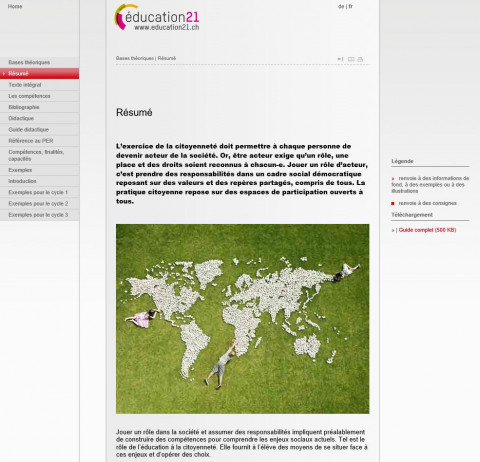 [Résumé] Éducation à la citoyenneté mondiale : Un guide pédagogique Corporate author: Éducation 21 L’exercice de la citoyenneté doit permettre à chaque personne de devenir acteur de la société. Or, être acteur exige qu’un rôle, une place et des droits soient reconnus à chacun-e. Jouer un rôle d’acteur, c’est prendre des responsabilités dans un cadre social démocratique reposant sur des valeurs et des repères partagés, compris de tous. La pratique citoyenne repose sur des espaces de participation ouverts à tous.
  Expo et outils pédagogiques Year of publication: 2015 Corporate author: La maison des solidarités locales et internationales Éduquer à la citoyenneté c’est changer les mentalités et les comportements de chacun dans le but de contribuer individuellement et collectivement à la construction, dès le plus jeune âge, d’un monde juste, solidaire et durable.Dans ce sens, le centre de ressources de la Maison propose à la location ou à la vente des outils pour donner les moyens, par l’information et la sensibilisation, de faire des choix plus responsables.