
Resources
Explore a wide range of valuable resources on GCED to deepen your understanding and enhance your research, advocacy, teaching, and learning.
306 Results found
 From IT Elite to Refugee in an Instant - a Young Ukrainian Man Describes His Experience of War Year of publication: 2022 Corporate author: United Nations (UN) This audio presents a young Ukrainian woman's own personal account of her experience of the conflict in Ukraine. 从IT精英瞬间变为难民 — 一位乌克兰年轻人述说战争经历 Year of publication: 2022 Corporate author: United Nations (UN) 本音频介绍了一位乌克兰年轻人本人讲述乌克兰冲突中的亲身经历。
 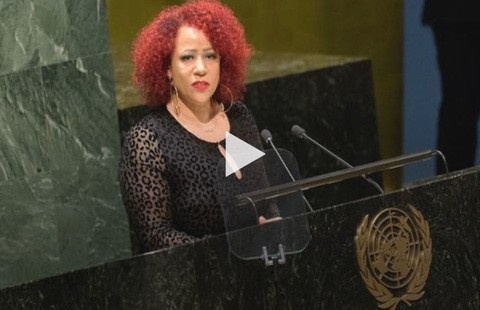 Remembering the Tragic History of Slavery in America is About Real Reconciliation - Interview with Hannah Jones, New York Times Year of publication: 2022 Corporate author: United Nations (UN) This audio is a UN News interview with New York Times reporter Hannah Jones, looking back at the history of slavery in the United States and highlighting the need to reflect on this history in order to address social problems such as the issue of racism today. 铭记美国奴隶制惨痛历史是为了实现真正和解——专访《纽约时报》记者汉娜-琼斯 Year of publication: 2022 Corporate author: United Nations (UN) 本音频是联合国新闻对《纽约时报》记者汉娜 · 琼斯的专访,回顾了美国奴隶制的历史,强调反思这段历史对解决当下种族主义等社会问题的必要性。
  Countering and addressing online hate speech: a guide for policy makers and practitioners Year of publication: 2023 Corporate author: UN. Office on Genocide Prevention and the Responsibility to Protect Online hate speech remains a critical challenge to advancing the objectives set out in the UN Strategy and Plan of Action on Hate Speech and the pillars of the United Nations work, namely Peace and Security, Human Rights and Sustainable Development. The recommendations outlined in this policy paper, provide a framework for countering hate speech, in line with international human rights norms and standards. The recommendations are based on three years of consultations and dialogue, including with the technology and social media companies, experts, the UN Working Group on Hate Speech and civil society. Their implementation should be part of broader efforts to address hate speech globally, including its root causes and impact offline, in line with the UN Strategy and Plan of Action. The pursuit of these recommendations should also prioritize participation and engagement directly with the victims of hate speech, underpinned by the principles of non-discrimination and leaving no one behind.
  United Nations Global Principles for Information Integrity : Recommendations for Multi-stakeholder Action Year of publication: 2024 Corporate author: United Nations (UN) Technological advances have revolutionized communications, connecting people on a previously unthinkable scale. They have supported communities in times of crisis, elevated marginalized voices and helped mobilize global movements for racial justice and gender equality. Yet these same advances have enabled the spread of misinformation, disinformation and hate speech at an unprecedented volume, velocity and virality, risking the integrity of the information ecosystem. New and escalating risks stemming from leaps in AI technologies have made strengthening information integrity one of the urgent tasks of our time. This clear and present global threat demands coordinated international action. The United Nations Global Principles for Information Integrity show us another future is possible. Principes mondiaux des Nations Unies pour l’intégrité de l’information: Recommandations pour une action multipartite Year of publication: 2024 Corporate author: United Nations (UN) Les avancées technologiques ont révolutionné les communications, connectant les personnes à une échelle autrefois inimaginable. Elles ont soutenu les communautés en temps de crise, amplifié les voix marginalisées et contribué à la mobilisation mondiale pour la justice raciale et l’égalité des genres. Pourtant, ces mêmes avancées ont également favorisé la propagation de la désinformation, des informations fallacieuses (ou « fake news ») et des discours de haine à une vitesse, une ampleur et une viralité sans précédent, menaçant ainsi l’intégrité de l’écosystème informationnel. Les risques émergents et croissants liés aux progrès rapides de l’intelligence artificielle font du renforcement de l’intégrité de l’information l’un des défis les plus urgents de notre époque. Cette menace mondiale, claire et actuelle, exige une action internationale coordonnée. La publication Principes mondiaux des Nations Unies pour l’intégrité de l’information nous montrent qu’un autre avenir est possible.
  Connections that Matter: How the Quality of Governance Boosts Climate Action; A Systematic Scoping Review of the Literature Year of publication: 2024 Corporate author: United Nations Development Programme (UNDP) | German Institute of Development and Sustainability (IDOS) This report reflects the findings of a systematic literature review jointly undertaken by the UNDP Global Policy Centre for Governance and the German Institute of Development and Sustainability. The report offers aggregated empirical insight from across the globe about how inclusive, effective and accountable governance systems produces positive effects on climate action. The report aims to galvanize development actors and stakeholders to invest in SDG 16 and the strengthening of governance systems, and to better identify pathways that raise the ambition and effectiveness of climate action.
  [Executive Summary] Connections that Matter: How the Quality of Governance Boosts Climate Action Year of publication: 2024 Corporate author: United Nations Development Programme (UNDP) | German Institute of Development and Sustainability (IDOS) This is the executive summary of the Connections that Matter: How the Quality of Governance Boosts Climate Action prepared by the UNDP Global Policy Centre for Governance and the German Institute of Development and Sustainability.
  Minimum Standards for Education: Preparedness, Response, Recovery Year of publication: 2024 Corporate author: Inter-agency Network for Education in Emergencies (INEE) Since 2004, the INEE Minimum Standards for Education: Preparedness, Response, Recovery (INEE MS) have provided a framework for inclusive and equitable quality education. The purpose of the handbook is:-To improve the quality of education preparedness, response, and recovery;-To increase access to safe and relevant learning opportunities;-To ensure that the actors who provide these services are held accountable The INEE MS are designed to be applicable to crisis response in many different situations, including emergencies caused by conflict, by natural hazards such as those induced by climate change, and slow- and rapid-onset crises in both rural and urban environments.