
Resources
Explore a wide range of valuable resources on GCED to deepen your understanding and enhance your research, advocacy, teaching, and learning.
328 Results found
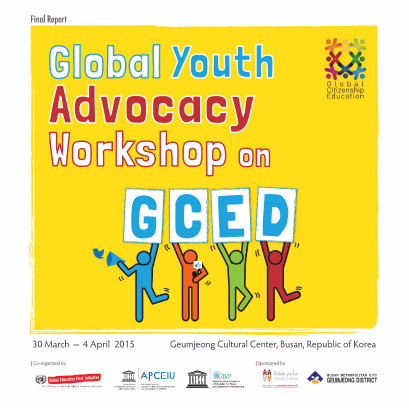 글로벌시민교육 청소년 리더십 워크숍 최종보고서 Year of publication: 2015 Corporate author: 유네스코 아시아태평양 국제이해교육원 본 보고서는 2015년 3월 30일부터 4월 4일까지 부산에서 열린 ‘글로벌시민교육 청소년 리더십 워크숍(Global Youth Advocacy Workshop on GCED)’의 최종보고서이다. 이번 워크숍은 글로벌시민교육 청소년 옹호활동에 초점을 둔 첫 번째 워크숍으로서, 전세계 34개국에서 45명의 청소년 활동가들이 참가하여 글로벌시민교육에 대한 아이디어를 교환하며, 글로벌시민교육을 전 세계적으로 확산하고 지역·국가적 차원의 청소년 글로벌시민교육 활동을 증진하기 위한 핵심 전략을 논의하는 장이었다. 본 보고서는 6일 간의 워크숍 활동들에 대한 기록과 더불어 글로벌시민교육의 주체로서 글로벌시민교육의 의미와 우선 과제들에 대한 젊은이들의 목소리를 담고자 했다. 본 워크숍은 유네스코 아태교육원과 유엔 사무총장의 글로벌교육우선구상(GEFI), 유네스코 마하트마간디 평화지속가능발전교육원(MGIEP)가 공동주최하고 부산시 금정구와 에듀케이트어차일드(Educate A Child)가 후원했다.문의: 유네스코 아태교육원 교육연수팀(ent@unescoapceiu.org)
  Global citizenship education: goals and challenges in the new millennium Year of publication: 2013 Author: Soonyong Pak Corporate author: APCEIU The research report examines what issues are at stake in delivering global citizenship education, a new emerging education initiative. Revisiting the conceptual and operational framework of global citizenship education, readers can have a broad picture on the current status of global citizenship education and a way forward towards effective implementation of it. Éducation à la citoyenneté mondiale: objectifs et défis dans le nouveau millénaire Year of publication: 2013 Author: Soonyong Pak Corporate author: APCEIU Le rapport de recherche examine les questions qui sont en jeu dans la prestation de l'éducation à la citoyenneté mondiale, une nouvelle initiative émergente de l'éducation. Revisiter le cadre conceptuel et opérationnel de l'éducation à la citoyenneté mondiale, les lecteurs peuvent avoir une vue d'ensemble sur l'état actuel de l'éducation à la citoyenneté mondiale et une voie à suivre pour la mise en œuvre effective de celui-ci. 글로벌 시민 교육: 새 천년의 목표와 도전 Year of publication: 2013 Author: 박순용 Corporate author: 유네스코 아시아태평양 국제이해교육원 이 연구 보고서는 새로운 신흥 교육 이니셔티브인 글로벌 시민 교육을 제공하는 데에 어떤 문제가 있는지를 조사하고 있다. 글로벌 시민 교육의 운영 체제와 개념을 다시 살펴보면, 독자는 글로벌 시민 교육의 현 상태와 이를 효과적으로 이를 구현할 수 있는 방법에 관한 폭넓은 그림을 그릴 수 있다.
 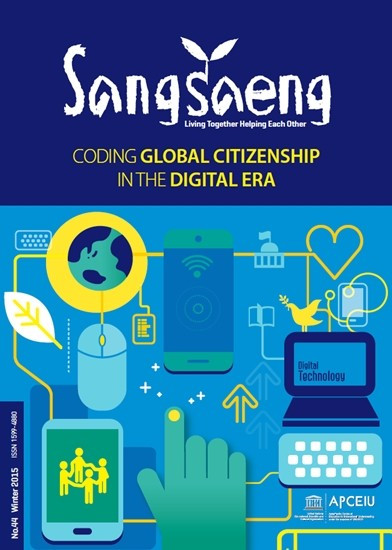 Coding global citizenship in the digital era (SangSaeng no. 44 winter 2015) Year of publication: 2015 Corporate author: APCEIU Summary:The 44th issue of SangSaeng, “Coding Global Citizenship in the Digital Era,” has been released. The advancement of digital technology has connected the world, accelerating globalization. In this global digital age, Global Citizenship Education (GCED) is drawing enormous attention. Recognizing its significance, this Winter edition brings out the topic of GCED for digital citizens through the lens of education policymakers, children and youth, and corporations. In particular, the articles suggest actively participating in and contributing to the information society through ethical, safe, and responsible use of digital technology as the core competency for global citizens in the digital era.8 Striking a Balance Between Digital Opportunities & Related Risks12 Young People as Active Citizens in the Digital Age16 Empowering Children to Become Creative Digital Leaders20 Fostering Inclusive Innovation for a Better World38 Interview38 Understanding Culture through Media and Language40 Embracing Diversity to Live Together42 Peace in My MemoryTo achieve Peace, Must Understand Peace46 Understanding the Asia-Pacific RegionGlimpse into Ancient Healing Ritual of Ulik Mayang50 APCEIU in Action Codage de la citoyenneté mondiale à l'ère du numérique (SangSaeng no 44 hiver 2015) Year of publication: 2015 Corporate author: Centre Asie-Pacifique d'éducation pour la compréhension internationale (APCEIU) Le 44e numéro de SangSaeng, intitulé «Codage de la citoyenneté mondiale à l'ère numérique», a été publié. L'avancement de la technologie numérique a connecté le monde, l'accélération de la mondialisation. À l'ère numérique mondiale, l'éducation à la citoyenneté mondiale (ECM) attire l'attention. Reconnaissant son importance, cette édition d'hiver met en évidence le thème du ECM pour les citoyens numériques à travers l'optique des responsables de l'éducation, des enfants et des jeunes et des entreprises. En particulier, les articles proposent de participer activement à la société de l'information et de contribuer à celle-ci par une utilisation éthique, sûre et responsable des technologies numériques comme compétence fondamentale pour les citoyens du monde à l'ère du numérique.8 Trouver un équilibre entre les Débouchés Numériques et les Risques Connexes12 Les Jeunes en tant que Citoyens Actifs à l'ère du Numérique16 Permettre aux enfants de devenir des leaders numériques créatifs20 Favoriser l'innovation inclusive pour un monde meilleur38 Entretien38 Comprendre la Culture par le biais des Médias et de la Langue40 Adopter la Diversité pour Vivre Ensemble42 La Paix dans ma MémoirePour atteindre la paix, il faut comprendre la paix46 Comprendre la région Asie-PacifiqueDécouvrez le rituel de guérison antique d'Ulik Mayang50 APCEIU en action
 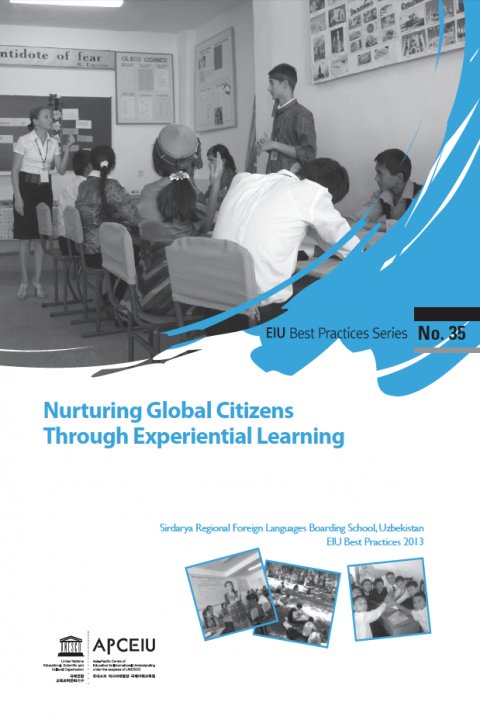 EIU Best Practice Series No. 35: Nurturing global citizens through experiential learning Year of publication: 2013 Author: Ildar Yusupov | Feruza Ahmedova Corporate author: APCEIU The following case is set in Uzbekistan where evidently diverse social groups live in harmony despite their differences. Among the schools in the country, the Sirdarya Regional Foreign Languages Boarding School in Gulistan City is arguably an exceptionally unique school due to the close engagement of parents with the boarding school’s EIU-themed activities. Activities range from extra-curricular activities including artwork and sports, to classroom-based activities such as role plays and international awareness events. Each activity is carefully designed to arouse the interest of the students in EIU-related themes such as tolerance, understanding and sustainable development. In the process, the students become highly motivated to take leading roles as responsible global citizens in creating a more peaceful world. Nourrir les citoyens du monde par l'apprentissage expérientiel (ECI Série des Meilleures Pratiques no.35) Year of publication: 2013 Author: Ildar Yusupov | Feruza Ahmedova Corporate author: Centre Asie-Pacifique d'éducation pour la compréhension internationale (APCEIU) Le cas suivant est réglé en Ouzbékistan où les groupes sociaux évidemment diverses vivent en harmonie malgré leurs différences. Parmi les écoles du pays, les langues régionales Sirdarya étrangères pensionnat de Gulistan ville est sans doute une école exceptionnellement unique en raison de la collaboration étroite des parents avec les activités ECI-thème de l'école d'embarquement. Les activités vont des activités extra-scolaires, y compris art et du sport, aux activités en salle de classe tels que des jeux de rôle et des activités de sensibilisation internationales. Chaque activité est soigneusement conçu pour susciter l'intérêt des étudiants dans les thèmes ECI-connexes tels que la tolérance, la compréhension et le développement durable. Dans le processus, les étudiants deviennent très motivés à prendre des rôles de premier plan en tant que citoyens du monde responsables dans la création d'un monde plus pacifique.
 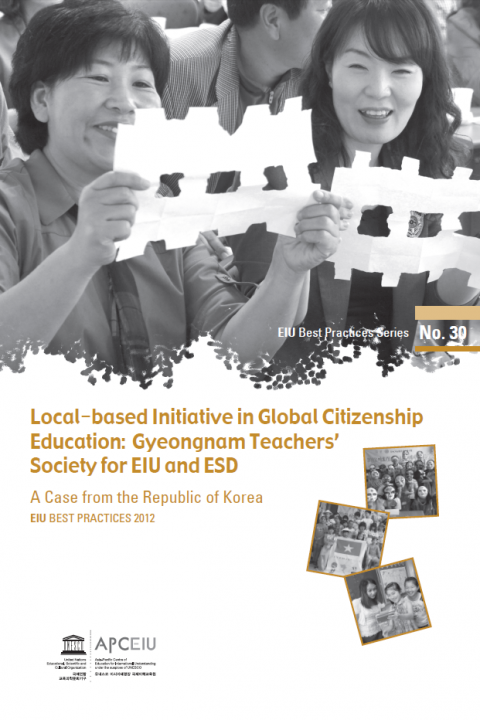 EIU Best Practice Series No.30: Local-based initiative in global citizenship education: Gyeongnam teachers’ society for EIU and ESD Year of publication: 2012 Author: Byeongseob Choi Corporate author: APCEIU Issue No. 30 introduces a case in the Republic of Korea on the local-based initiatives of school teachers to promote EIU and ESD in their local community. The case illustrates the taken steps and efforts made by the respective teachers when elaborating innovative approaches to promote EIU and ESD, led by the intention to create a more open and locally relevant educational setting for students as well as teachers in response to the growing globalization. Especially the Gyeongnam Province, where the teachers are based, is experiencing a rapid demographic change due to the high influx of foreigners, which calls upon the educators to prepare their students to effectively cope with these changes and become global citizens. Local à base initiative en matière d'éducation à la citoyenneté mondiale: la société des enseignants Gyeongnam pour ECI et EDD (ECI Série des Meilleures Pratiques no.30) Year of publication: 2012 Author: Byeongseob Choi Corporate author: Centre Asie-Pacifique d'éducation pour la compréhension internationale (APCEIU) Question n ° 30 introduit un cas en République de Corée sur les initiatives locales à base des enseignants des écoles pour promouvoir ECI et EDD dans leur communauté locale. Ce cas illustre les étapes et les efforts déployés par les enseignants respectifs lors de l'élaboration d'approches novatrices pour promouvoir ECI et EDD, menés par l'intention de créer un cadre éducatif plus ouvert et pertinent au niveau local pour les étudiants ainsi que les enseignants en réponse à la mondialisation croissante prises. En particulier, la province de Gyeongnam, où les enseignants sont basés, connaît une évolution démographique rapide en raison de l'afflux massif d'étrangers, qui invite les éducateurs à préparer leurs élèves à faire face efficacement à ces changements et à devenir des citoyens du monde.