
Resources
Explore a wide range of valuable resources on GCED to deepen your understanding and enhance your research, advocacy, teaching, and learning.
2,193 Results found
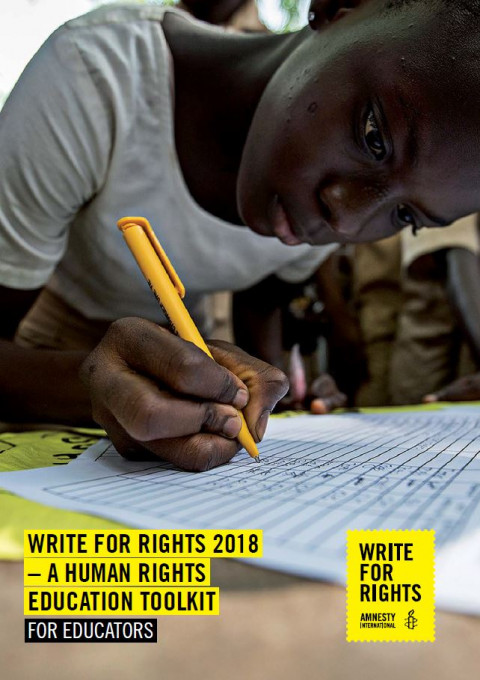 Escribe por los derechos 2018: Carpeta de materiales de educación en derechos humanos para educadores/as Year of publication: 2018 Corporate author: Amnesty International La campaña anual Escribe por los Derechos es uno de los mayores eventos de derechos humanos de Amnistía Internacional. En 2018, la campaña se centra en defensoras de los derechos humanos que han sufrido violaciones de derechos humanos o corren grave riesgo a causa de la postura que han adoptado respecto a ciertas cuestiones de derechos humanos.Esta carpeta de materiales de Educación en Derechos Humanos se creó para ayudar a profesores y profesoras a participar con sus estudiantes en la campaña Escribe por los Derechos. Ofrece una amplia perspectiva de cuestiones de derechos humanos y brinda la oportunidad de abrir la mente de los y las jóvenes a cuestiones de preocupación mundiales. Al aprender sobre estas cuestiones y escribir cartas convincentes para ayudar a poner fin a las violaciones de derechos humanos y lograr justicia, los profesores y profesoras y sus estudiantes contribuyen al movimiento internacional de derechos humanos y ven con sus propios ojos cómo las palabras pueden hacer cambiar las cosas en el mundo.Esta carpeta se creó para estudiantes de a partir de 13 años y está concebida principalmente para utilizarla en un entorno escolar: tanto dentro del aula como en clubes o eventos de toda la escuela. Las actividades también se pueden adaptar para utilizarlas en otros contextos de educación no formal, como grupos de jóvenes y entornos comunitarios. La carpeta contiene actividades generales sobre derechos humanos y destaca el caso de seis defensoras de los derechos humanos de la campaña Escribe por los Derechos que han hecho contribuciones extraordinarias al progreso de los derechos humanos en todo el mundo.
  Asia-Pacific Education 2030: SDG 4 Midterm Review Year of publication: 2024 Corporate author: UNESCO Institute for Statistics (UIS) | UNESCO Bangkok This publication marks the conclusion of the collaborative national midterm reviews of SDG 4 achievement in the Asia-Pacific. More importantly, it represents the beginning of the final sprint to the 2030 finish line. It also serves as a comprehensive analytical and policymaking tool for all stakeholders in the region to reflect and be better prepared for the second half of the journey. At the midway point of implementing the Education 2030 Agenda, we are observing both challenges and progress in achieving Sustainable Development Goal 4 (SDG 4) in the Asia-Pacific. The region, overall, has made advances in reaching the globally and regionally most important targets under SDG 4, yet it is still far from delivering the common commitment of the Education 2030 Agenda, to ‘ensure inclusive and equitable quality education and promote lifelong learning opportunities for all’. Eight years into implementation, the Asia-Pacific has shown progress, especially in improving access to lower levels of basic education, as well as expanding early childhood education (ECE). Across most subregions of Asia and the Pacific, over 95% of primary school students complete primary education within the expected timeframe, while more than 80% of children one year before the official primary entry age are enrolled in organized early childhood education. However, participation in education is only one part of the puzzle, and the quality of learning, evidenced by limited data for the Asia-Pacific region on learning outcomes, remains concerning. More than half of students in Eastern and South-Eastern Asia do not reach the minimum proficiency level in mathematics at the end of lower secondary education. Overall and from a regional perspective, with priorities having accelerated in ECE, primary education reaching universal participation, and higher education being consistently regarded as prestigious to accomplish, secondary education is currently the weakest link apart from the chronically undervalued technical vocational education and training path. Fulfilling our commitment to the Education 2030 Agenda and leaving no one behind is not an easy endeavour and we need everyone on board in this unprecedented, yet necessary feat. This publication is meant to facilitate taking stock of the current situation and accelerate focused advances on the most relevant education topics for the Asia-Pacific region.
  To live together: shaping new attitudes to peace through education Year of publication: 1997 Author: Daniel S. Halpérin Corporate author: UNESCO International Bureau of Education (IBE) The ‘To live together’ initiative was born at a meeting in February 1996 with Professor Emeritus Antoine Cuendet, a pediatric surgeon, former Dean of the Faculty of Medicine at Geneva University, and chairman of the Geneva Foundation to Protect Health in War (hereafter the Geneva Foundation). His foundation was in a process of trying to better define its scope of action within the large theme of ‘health and war’, and to identify areas of research that would deserve priority support. We agreed that, at a time when politicians had entered an era of peacemaking in the Middle-East, the situation might be suitable for Palestinians and Israelis to venture into joint research projects. In particular, a potentially fruitful project could be to examine the effects of long term, protracted conflicts-such as the Israeli-Palestinian one-on the mental and social health of children. Little was known about how much of their anxiety, psychosomatic complaints, agressivity, behavioural disorders or school failures may be linked with direct or indirect consequences of the conflict. What were the interventions or instruments that may counterbalance, or even correct such problems? Was there any kind of an educational programme, for instance, that might be demonstrated to be efficacious in counteracting those putative effects of the conflict; and that might prove of value in actually accelerating the healing of the traumatisms, while simultaneously strengthening the construction of peace? Pour vivre ensemble: l'élaboration de nouvelles attitudes à la paix par l'éducation Year of publication: 1997 Author: Daniel S. Halpérin Corporate author: UNESCO International Bureau of Education (IBE) L'initiative «Pour vivre ensemble» est né lors d'une réunion en Février 1996 avec le professeur Emeritus Antoine Cuendet, un chirurgien pédiatrique, ancien doyen de la Faculté de médecine de l'Université de Genève et président de la Fondation de Genève pour la protection de la santé dans la guerre (ci-après Fondation de Genève). Sa fondation était en train d'essayer de mieux définir son champ d'action au sein du grand thème de «la santé et de la guerre», et d'identifier les domaines de recherche qui mériterait un soutien prioritaire. Nous avons convenu que, à un moment où les politiciens étaient entrés dans une ère de rétablissement de la paix au Moyen-Orient, la situation pourrait être appropriée pour les Palestiniens et les Israéliens à se lancer dans des projets de recherche conjoints. En particulier, un projet potentiellement fructueux pourrait consister à examiner les effets de long terme, les conflits prolongés, tels que celui sur la santé israélo-palestinien mental et social des enfants. On ne savait pas combien de leur anxiété, troubles psychosomatiques, agressivité, troubles du comportement ou des échecs scolaires peuvent être liés avec des conséquences directes ou indirectes du conflit. Quelles ont été les interventions ou les instruments qui peuvent contrebalancer, voire corriger ces problèmes? Y avait-il tout type d'un programme d'éducation, par exemple, qui pourrait être démontré pour être efficace dans la lutte contre les effets putatifs du conflit; et qui pourrait se révéler utile pour accélérer effectivement la guérison des traumatismes, tout en renforçant simultanément la construction de la paix? Asia-Pacific guidelines for the development of national ESD indicators Year of publication: 2007 Author: Daniella Tilbury | Sonja Janousek | Derek Elias | Joel Bacha Corporate author: UNESCO Bangkok UNESCO Bangkok, with assistance from the Commission on Education and Communication (CEC) of the World Conservation Union (IUCN) in conjunction with Macquarie University in Australia, implemented a project to assist with the important task of monitoring and assessing progress during the UN Decade of Education for Sustainable Development (DESD). This process has been funded by the generous contribution of the Ministry of Education, Culture, Sports, Science and Technology under the Japanese Funds-In-Trust for Education for Sustainable Development (ESD). The DESD provides an important opportunity to enhance the profile of ESD in both formal and informal learning spaces which in turn assists UNESCO Member States with the transformation into sustainable societies. Efforts to promote and integrate ESD at all levels will be key to advancing the reach of the Decade.Responding to the DESD International Implementation Scheme’s (IIS) recommendation to develop indicators (see Appendix 1), the Asia-Pacific DESD Indicators Project commenced in March 2006. The first stage of the project has resulted in the publication of this Guidelines document which assists UNESCO Member States in the Asia-Pacific region with the development of ESD indicators and monitoring systems at the national level.The document is intended to provide an important practical resource for UNESCO National Commissions, in addition to other stakeholders, in the area of ESD indicator development. By outlining how to develop national ESD indicators, the Guidelines offers an effective way of building knowledge and increasing ownership of the Decade among stakeholders. Rather than deliver a pre-packaged set of ESD indicators, this document provides countries with a foundation for developing indicators that are relevant to their national contexts.The objectives of the Guidelines are:• To assist with understanding the nature of ESD indicators and the different approaches for their use;• To identify the different types of ESD indicators and what they may reveal about progress;• To identify important sources, methods and planning tools for both data collection and reporting;• To encourage UNESCO Member States in the Asia-Pacific region to work collaboratively, share experiences and learn about meaningful monitoring and assessment during and beyond the DESD; and• To build national capacity to develop ESD indicators and ESD data collection mechanisms at the national level Orientations Asie-Pacifique pour l'élaboration d'indicateurs nationaux Year of publication: 2007 Author: Daniella Tilbury | Sonja Janousek | Derek Elias | Joel Bacha Corporate author: UNESCO Bangkok L'UNESCO Bangkok, avec l'aide de la Commission de l'Éducation et de la Communication (CEC) de l'Union mondiale pour la nature (UICN) en collaboration avec l'Université Macquarie en Australie, a mis en œuvre un projet pour aider à la tâche importante de suivi et d'évaluation des progrès de la Décennie des Nations Unies. Éducation pour le développement durable (DEDD). Ce processus a été financé par la contribution généreuse du ministère de l'Éducation, de la Culture, des Sports, des Sciences et de la Technologie au Fonds fiduciaire japonais pour l'éducation pour le développement durable. Le DEDD offre une occasion importante de rehausser le profil de l'EDD dans les espaces d'apprentissage formels et informels, ce qui aide les États membres de l'UNESCO à se transformer en sociétés durables. Les efforts déployés pour promouvoir et intégrer l'EDD à tous les niveaux seront essentiels pour faire progresser la portée de la Décennie.Répondant à la recommandation du DEDD International Implementation Scheme (IIS) pour l'élaboration d'indicateurs (voir Annexe 1), le Projet d'Indicateurs DEDD de l'Asie-Pacifique a débuté en mars 2006. La première étape du projet a abouti à la publication du présent document qui aide l'UNESCO Les États membres de la région Asie-Pacifique, avec l'élaboration d'indicateurs et de systèmes de suivi au niveau national.Le document est destiné à fournir une ressource pratique importante aux Commissions nationales de l'UNESCO, en plus des autres parties prenantes, dans le domaine de l'élaboration d'indicateurs de développement durable. En définissant la manière d'élaborer des indicateurs nationaux de développement économique durable, les Lignes directrices offrent un moyen efficace de renforcer les connaissances et d'accroître l'appropriation de la Décennie par les parties prenantes. Plutôt que de fournir un ensemble pré-emballé d'indicateurs EDD, ce document fournit aux pays une base pour développer des indicateurs qui sont pertinents à leur contexte national.Les objectifs des lignes directrices sont les suivants:• Aider à comprendre la nature des indicateurs EDD et les différentes approches pour leur utilisation;• Identifier les différents types d'indicateurs EDD et ce qu'ils peuvent révéler sur les progrès;• Identifier les sources, les méthodes et les outils de planification importants pour la collecte et le compte rendu des données;• Encourager les États membres de l'UNESCO de la région Asie-Pacifique à travailler en collaboration, à échanger leurs expériences et à en apprendre davantage sur le suivi et l'évaluation significatifs pendant et après le DEDD; et• Renforcer la capacité nationale d'élaborer des indicateurs EDD et des mécanismes de collecte de données EDD au niveau national
  Education Reform in Pakistan Year of publication: 2014 Corporate author: International Crisis Group In April 2010, the eighteenth constitutional amendment committed Pakistan to free and compulsory education for all children between the ages of five and sixteen. Yet millions are still out of school, and the education system remains alarmingly impoverished. The madrasa (religious school) sector flourishes, with no meaningful efforts made to regulate the seminaries, many of which propagate religious and sectarian hatred. Militant violence and natural disasters have exacerbated the dismal state of education. The public education system needs to foster a tolerant citizenry, capable of competing in the labour market and supportive of democratic norms within the country and peace with the outside world. Education Reform in Pakistan Year of publication: 2014 Corporate author: International Crisis Group En Avril 2010, le Pakistan s’est engagé, l'amendement constitutionnel XVIII, à mettre en place une éducation gratuite et obligatoire pour tous les enfants âgés de cinq à seize ans. Pourtant, des millions d’enfants ne sont encore à l'école et le système éducatif s’appauvrit d’une façon alarmante. Le secteur de la madrasa (école religieuse) fleurit, sans que des efforts significatifs soient déployés pour réglementer les séminaires, qui propagent souvent la haine religieuse et le sectarisme. La violence militante et les catastrophes naturelles ont aggravé l'état lamentable de l'éducation. Le système public de l'éducation doit favoriser une citoyenneté tolérante, compétitive sur le marché du travail et apportant son soutien aux normes démocratiques dans le pays et à la paix avec le monde extérieur.
  2023 Asia-Pacific Regional Global Citizenship Education (GCED): Network Activities Summary Report Year of publication: 2023 Author: Seek Ling Tan Corporate author: UNESCO Bangkok This is a summary report from the Global Citizenship Education (GCED) network activities in Asia-Pacific in 2023. The Asia-Pacific Regional Global Citizenship Education Network, spearheaded by UNESCO Bangkok and the Asia-Pacific Centre of Education for International Understanding (APCEIU), has illuminated the path to empower learners to become global citizens since its inception in 2018. In 2023, their journey was punctuated by significant milestones and a revitalized commitment to propel GCED across the region. This commitment is particularly evident in the key priority areas of advocacy, capacity building, learning/teaching materials, policy and research and the synergizing of regional collaboration towards Education 2030.
 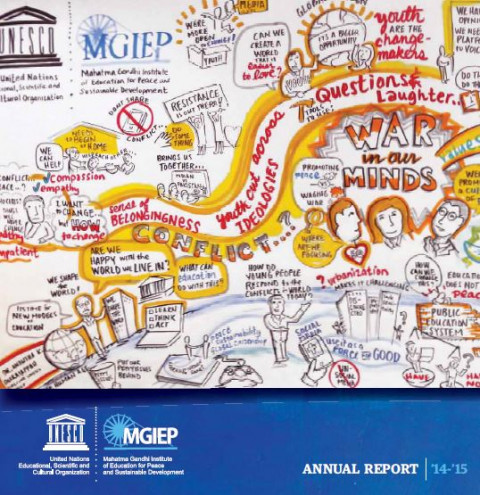 MGIEP Annual Report '14-'15 Year of publication: 2016 Corporate author: Mahatma Gandhi Institute of Education for Peace and Sustainable Development (MGIEP) The Mahatma Gandhi Institute of Education for Peace and Sustainable Development (MGIEP) is UNESCO’s first Category I institute in the Asia-Pacific region, established with the generous support of the Government of India. UNESCO MGIEP focuses on transforming current education policies and practices by developing innovative teaching and learning methods.Their objective is to build generations of young people equipped to create peaceful and sustainable societies. This annual report describes MGIEP’s main works and various educational programmes for peace and sustainable development.