
Resources
Explore a wide range of valuable resources on GCED to deepen your understanding and enhance your research, advocacy, teaching, and learning.
875 Results found
 Learning to live together: education for conflict resolution, responsible citizenship, human rights and humanitarian norms Year of publication: 2013 Author: Margaret Sinclair Corporate author: Education Above All (Qatar) L'éducation ne peut offrir des remèdes immédiats aux problèmes locaux et mondiaux que nous voyons sur les écrans d'information tous les jours, mais elle peut contribuer à les résoudre sur le long terme. Ce livre examine spécifiquement la contribution que l'éducation peut apporter pour vivre ensemble même dans les pays où la formation des enseignants et les ressources en classe sont limitées.De nombreux pays ont des populations diverses (ethniques, linguistiques, religieuses, etc.) cherchent à maintenir l'harmonie entre les différents groupes. Dans certains pays, cependant, en particulier lorsque le stress économique ou les changements climatiques ont intensifié les arguments sur les ressources, les tensions ont conduit à des conflits armés. Cela apporte avec elle toute la misère de la mort, les blessures, le déplacement et la pauvreté, ainsi que la perturbation des systèmes éducatifs. Dans certains cas, l'éducation elle-même a été un facteur contributif à l'éclatement du conflit, notamment grâce à des possibilités d'éducation inégales pour les différents groupes, et à travers les programmes scolaires biaisés.La guerre civile a causé des souffrances indicibles au cours des dernières années, et dans un monde globalisé, il a des effets négatifs de débordement vers les pays voisins et d'autres pays. Il est essentiel d'élaborer des politiques de l'éducation et la réforme des programmes qui peuvent aider à transmettre les valeurs et les compétences pour apprendre à vivre ensemble pour les jeunes, pour aider à réduire les tensions, à l'intérieur et entre les pays.Education décideurs politiques peuvent aider à jeter les bases d'un avenir meilleur en ajustant le contenu et le processus de l'éducation afin de refléter les compétences et les valeurs des droits de l'homme, des normes humanitaires, la résolution pacifique des conflits, le développement durable et d'autres questions comme éléments de local, national et citoyenneté mondiale.Réforme de l'éducation ne suffit pas, bien sûr, de résoudre les nombreux problèmes de notre temps. L'objectif de ce volume est sur la contribution qui peut être faite par le biais d'aligner le contenu de l'éducation à l'objectif d'apprendre à vivre ensemble. Ce travail aura un plus grand impact quand il a lieu au sein des systèmes et politiques d'éducation qui sont conformes aux valeurs des droits de l'homme et bien sûr, quand d'autres secteurs en dehors de l'éducation font leurs contributions respectives.Ce livre montre que l'éducation transformatrice pour la résolution des conflits et la paix, à la citoyenneté locale, nationale et mondiale, des droits de l'homme et des valeurs humanitaires peut être appliqué même dans des conditions difficiles, s'il y a un engagement politique de le faire. Les auteurs ont fourni des exemples et les enseignements tirés de leurs propres expériences en tant que praticiens éminents dans le domaine.
  Participatory Planning to Achieve Structural Change with Equality: Citizen Participation Strategies in Multi-scale Planning Processes Year of publication: 2015 Author: Alicia Williner | Andrea Sanhueza | Carlos Sandoval Corporate author: United Nations (UN) This manual that ILPES places at the disposal of public officials and non-governmental agents working in the community, has the purpose of sharing a brief theoretical reflection on the current socio-political context through which this manual becomes important; and a set of methodological instruments that will bring the user closer to the social practice of a citizen participation process in the construction of a public management instrument. The manual is divided into two chapters: The first conceptualizes participatory multiscale planning, while also briefly introducing three topics of great importance to be incorporated into any participatory planning process and construction of public management instruments: the perspective of gender, the use of Convention 169 and Principle 10. The second chapter systematizes a set of methodological instruments that describe the stages of a citizen participation strategy to incorporate the multiscale public management instruments. The manual closes with two annexes, the last of which incorporates a set of tools that can be used in the stages of the construction of a citizen participation strategy. La Planificación Participativa para Lograr un Cambio Estructural Con igualdad: Las Estrategias de Participación Ciudadana en los Procesos de Planificación Multiescalar Year of publication: 2015 Author: Alicia Williner | Andrea Sanhueza | Carlos Sandoval Corporate author: United Nations (UN) Este manual que ILPES coloca a disposición de funcionarios públicos y agentes no gubernamentales que trabajan en la comunidad, tiene el propósito de compartir una breve reflexión teórica sobre el contexto socio-político actual por el cual este manual cobra importancia; y un conjunto de instrumentos metodológicos que acercarán al usuario a la práctica social de un proceso de participación ciudadana en la construcción de un instrumento de gestión pública. El manual se estructura en dos capítulos: El primero de ellos conceptualiza la planificación multiescalar participativa, a la vez que realiza una breve introducción a tres temas de suma relevancia a incorporar en todo proceso de planificación participativa y construcción de instrumentos de gestión pública: la perspectiva de género, el uso del Convenio 169 y del Principio 10. El segundo capítulo sistematiza un conjunto de instrumentos metodológicos que describen las etapas de una estrategia de participación ciudadana para incorporar a los instrumentos de gestión pública multiescalar. El manual cierra con dos anexos, el último de los cuales incorpora un conjunto de herramientas que podrán ser utilizadas en las etapas de la construcción de una estrategia de participación ciudadana.
  Education, Development and Citizenship in Latin America: Proposals for the Debate Year of publication: 2011 Author: Alicia Barcena | Narcis Serra Corporate author: Naciones Unidas. Comisión Económica para América Latina y el Caribe (CEPAL) | Centro de Estudios y Documentación Internacionales de Barcelona (CIDOB) Through ADI, an initiative promoted by CIDOB, the Ibero-American General Secretariat (SEGIB) and the Economic Commission for Latin America and the Caribbean (ECLAC), with the support of various sponsoring companies, it is intended to encourage academic debate along with the political debate on diverse issues crucial for the region. Through a rigorous analysis of the social, economic and political reality carried out by academics, public policymakers and other key actors in the development process in Latin America, the aim is to offer recommendations that make economic growth compatible with well-being of the majorities. This publication constitutes the fifth volume of the series and is the result of the willingness of the participating institutions to disseminate, as much as possible, the ideas and discussions that emerged in the seminar. Its reading is a fundamental element to understand the current state of education in the region, as well as the possibilities that exist in this area to continue advancing in inclusion and development. Educación, Desarrollo y Ciudadanía en América Latina: Propuestas para el Debate Year of publication: 2011 Author: Alicia Barcena | Narcis Serra Corporate author: Naciones Unidas. Comisión Económica para América Latina y el Caribe (CEPAL) | Centro de Estudios y Documentación Internacionales de Barcelona (CIDOB) Mediante la ADI, iniciativa impulsada por CIDOB, la Secretaría General Iberoamericana (SEGIB) y la Comisión Económica para América Latina y el Caribe (CEPAL), con el apoyo de diversas empresas patrocinadoras, se pretende alentar el debate académico junto con el debate político en diversos temas cruciales para la región. A través del análisis riguroso de la realidad social, económica y política realizado por los académicos, los encargados de formular políticas públicas y otros actores clave en el proceso de desarrollo de América Latina, se pretende ofrecer recomendaciones que hagan compatible el crecimiento económico y el bienestar de las mayorías. Esta publicación constituye el quinto volumen de la serie y es fruto de la voluntad de las instituciones participantes de difundir, en la mayor medida posible, las ideas y discusiones surgidas en el seminario. Su lectura supone un elemento fundamental para comprender el estado actual de la educación en la región, así como las posibilidades que existen en este ámbito para seguir avanzando en la inclusión y el desarrollo.
  Buenos Aires Recommendations Year of publication: 2007 Corporate author: PRELAC II Recognizing that education is a public good and is the key to building a more just and better world for all, the Second Intergovernmental Meeting of the Regional Education Project, PRELAC II, held in the city of Buenos Aires, on the 29th and March 30, 2007, agrees the following recommendations as criteria and lines of action for national policies and international cooperation. Recomendaciones de Buenos Aires Year of publication: 2007 Corporate author: PRELAC II Reconociendo que la educación es un bien público y es la llave para la construcción de un mundo más justo y mejor para todos, la Segunda Reunión Intergubernamental del Proyecto Regional de Educación, PRELAC II, reunida en la ciudad de Buenos Aires, los días 29 y 30 de marzo de 2007, acuerda las siguientes recomendaciones como criterios y líneas de acción para las políticas nacionales y la cooperación internacional.
  Childhood and Citizenship Year of publication: 2011 Author: Osvaldo Torre G. This publication, Niñez y Ciudadanía, is an effort of the Postgraduate Diploma, "Childhood and Public Policies", taught by the Department of Anthropology of the Faculty of Social Sciences of the University of Chile. This course has been held for 5 years, in partnership with the Chilean Association for the United Nations, ACHNU. This first publication presents a selection of those works developed by students graduated from the Diploma in 2010, in which a subject of interest for the researcher is tested and on which a rights approach is applied, which tends to evaluate the situation of the boys and girls in a different way than traditional childhood views; these works are the product of their dissertations to approve this post-title. Also included are some brief essays on the relationship between childhood and violence, elaborated by some of the students of the 2011 generation, in the idea of making available to the interested public a sample of the different forms that acquire the uses of violence on children. It also incorporates a collaboration requested to the anthropologist Dimas Santibáñez, member of the Academic Committee of the Diploma. Niñez y Ciudadanía Year of publication: 2011 Author: Osvaldo Torre G. Esta publicación, Niñez y Ciudadanía, es un esfuerzo del Diplomado de postítulo, “Niñez y Políticas Públicas”, que imparte el Departamento de Antropología de la Facultad de Ciencias Sociales de la Universidad de Chile. Este curso se realiza desde hace 5 años, en alianza con la Asociación Chilena pro Naciones Unidas, ACHNU. Esta primera publicación presenta una selección de aquellos trabajos desarrollados por estudiantes egresados del Diplomado en el año 2010, en los cuales se ensaya un tema de interés para el investigador y sobre el cual aplica un enfoque de derechos, que tiende a evaluar la situación de los niños y niñas de una forma distinta a como lo hacen las miradas tradicionales sobre la infancia; estos trabajos son el producto de sus tesinas para aprobar este postítulo. También se incluyen algunos breves ensayos sobre la relación entre la niñez y la violencia, elaborados por algunos de los y las estudiantes de la generación 2011, en la idea de poner a disposición del público interesado una muestra de las diversas formas que adquieren los usos de la violencia sobre los niños. También se incorpora una colaboración solicitada al antropólogo Dimas Santibáñez, miembro del Comité Académico del Diplomado.
 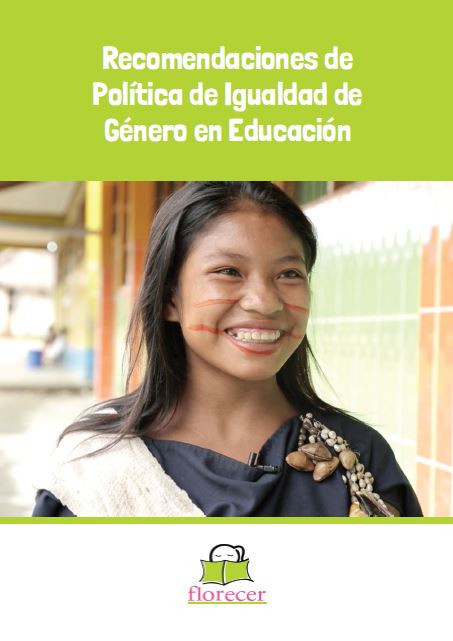 Policy Recommendations of Gender Equality in Education Year of publication: 2015 Author: Teresa Tovar Samanez Corporate author: United Nations Children's Fund (UNICEF) This document synthesizes the proposals of the Florecer Network to advance in gender equality, because we are convinced that the commitment to a more just and more human world necessarily implies the assumption of equality between men and women.