
Resources
Explore a wide range of valuable resources on GCED to deepen your understanding and enhance your research, advocacy, teaching, and learning.
2,781 Results found
 Between Transmission and Conflict Mediation: On the Handling of “Problematic” Forms of Appropriation of Nazi History in Multicultural School Classes Year of publication: 2000 Author: Bernd Fechler The original title: Zwischen Tradierung und Konfliktvermittlung: Über den Umgang mit “Problematischen” Aneignungsformen der NS-Geschichte in Multikulturellen Schulklassen(Erziehung nach Auschwitz” in der multikulturellen Gesellschaft: Pädagogische und soziologische Annäherungen, pp.1-18) Discussion of the challenges of Holocaust education a multicultural setting, based on a case when a German 10th grade class visited an exhibition about the Nazi period, something which led to an intense conflict between “German” and “immigrant” students.The above abstract is taken from the International Holocaust Remembrance Alliance Education Research Project. Please also consult the full list of abstracts in 15 languages and the accompanying publication Research in Teaching and Learning about the Holocaust: A Dialogue Beyond Borders. Ed: IHRA, Monique Eckmann, Doyle Stevick, Jolanta Ambrosewicz-Jacobs, 2017, Metropol Verlag at www.holocaustremembrance.com/resources/publications
  Gender Justice, Citizenship and Difference in Latin America Year of publication: 2010 Author: Maxine Molyneux This article surveys feminist citizenship practices and scholarship on gender, justice, citizenship and rights in Latin America. Feminism’s critique of patriarchal privilege expressed a modern desire for greater individual freedom and collective recognition, a combination that produced tensions and some inconsistencies in regard to the «difference» question, notably in its encounter with indigenous populations. However, central to feminism’s project was the pursuit of both recognition and redistribution, which achieved greater success in the realm of law and politics than in the distribution of public and private goods. A review of Latin American feminism’s achievements reveals a history of substantial advances but a striking persistence of gender inequality, which provides a rich agenda for further investigation. Justicia de Género, Ciudadanía y Diferencia en América Latina Year of publication: 2010 Author: Maxine Molyneux Este artículo hace un recorrido por las prácticas feministas ciudadanas y los estudios sobre género, justicia, ciudadanía y derechos en América Latina. La crítica al privilegio patriarcal realizada desde el feminismo expresa un deseo moderno de mayor libertad individual y reconocimiento colectivo. Unas peticiones que han producido tensiones y algunas contradicciones en relación a la cuestión de la «diferencia», especialmente en el encuentro con los pueblos indígenas. No obstante, el feminismo siempre se ha dedicado a lograr tanto el reconocimiento como la redistribución; si bien, ha alcanzado más éxito en los terrenos legales y políticos que en la redistribución de recursos públicos y privados. El análisis de los logros del feminismo en América Latina revela una historia de éxitos significativos, pero parciales; y una serie de desafíos para futuras investigaciones al respecto.
  The Time Period of the Holocaust in the Beliefs of Primary School Children – Children’s Perspectives and the Thematization of the Holocaust and National Socialism in Primary-School Instruction (in General Subjects) Year of publication: 2012 Author: Andrea Becher The original title: Die Zeit des Holocaust in Vorstellungen von Grundschulkindern – Perspektiven von Kindern und die Thematisierung von Holocaust und Nationalsozialismus im (Sach-)Unterricht der Grundschule(In I. Enzenbach, C. Klätte, & D. Pech, (Eds.). Kinder und Zeitgeschichte: Jüdische Geschichte und Gegenwart, Nationalsozialismus und Antisemitismus, Supplement, 8, pp. 101–120) This is a summary of a study of German primary school children’s beliefs about the Holocaust, based on interviews conducted in two classes in 2005. The author finds that the children almost exclusively focus on Hitler; that one can find “latent anti-Semitic fragments” in their statements; that, even without formal education, the pupils still possess knowledge about the Holocaust; and their main source of information about Nazi Germany seems to be family members. However, the family narratives mainly touch upon everyday-life and avoid the topic of the Holocaust. From these findings, the author argues that one could and should teach the Holocaust already in the German primary school. The above abstract is taken from the International Holocaust Remembrance Alliance Education Research Project. Please also consult the full list of abstracts in 15 languages and the accompanying publication Research in Teaching and Learning about the Holocaust: A Dialogue Beyond Borders. Ed: IHRA, Monique Eckmann, Doyle Stevick, Jolanta Ambrosewicz-Jacobs, 2017, Metropol Verlag.
  “Just Don’t Moralize!” Emotional Processes in the Pedagogical Engagement with National Socialism Year of publication: 2008 Author: Gudrun Brockhaus The original title: “Bloß nicht moralisieren!” Emotionale Prozesse in der pädagogischen Auseinandersetzung mit dem Nationalsozialismus(Einsichten und Perspektiven, Bayerische Zeitschrift für Politik und Geschichte, 1(8), pp. 28–33.) The article is a critical reflection on the outcomes of an empirical study (Kühner 2008; Kühner et al. 2008), based on a psychological/psychoanalytical perspective: how should we deal with emotions when dealing with the Holocaust? The author highlights the teachers’ very high expectations regarding the emotional Betroffenheit, the pressure on consensus, and the tabooisation of “political incorrectness” in the classroom, tendencies that can lead to a problematic teacher-student relationship. Thus, teachers encounter specific didactical difficulties and show a certain lack of self-assertion. Brockhaus assumes that this is based on how the teacher relates, as a person and as a pedagogue, to the heritage of National Socialism. Brockhaus concludes by insisting on the necessity to reflect openly, as students and as teachers, on the emotional processes and the reluctance caused by the topic of the Holocaust in this society. The above abstract is taken from the International Holocaust Remembrance Alliance Education Research Project. Please also consult the full list of abstracts in 15 languages and the accompanying publication Research in Teaching and Learning about the Holocaust: A Dialogue Beyond Borders. Ed: IHRA, Monique Eckmann, Doyle Stevick, Jolanta Ambrosewicz-Jacobs, 2017, Metropol Verlag at www.holocaustremembrance.com/resources/publications
  Education and Disability: Analysis of Data from 49 Countries (UIS Information Paper No. 49) Year of publication: 2018 Corporate author: UNESCO Institute for Statistics (UIS) Sustainable Development Goal (SDG) 4 calls for “inclusive and quality education for all”. Persons with a disability are among the population groups most likely to suffer from exclusion from education but data that permit an analysis of the links between disability and education remain scarce.This paper examines educational disparities linked to disability based on data from 49 countries and territories for five education indicators: Proportion of 15- to 29-year-olds who ever attended school Out-of-school rate (primary school age, lower secondary school age) Completion rate (primary education, lower secondary education) Mean years of schooling of the population 25 years and older Adult literacy rate (population 15 years and older)
 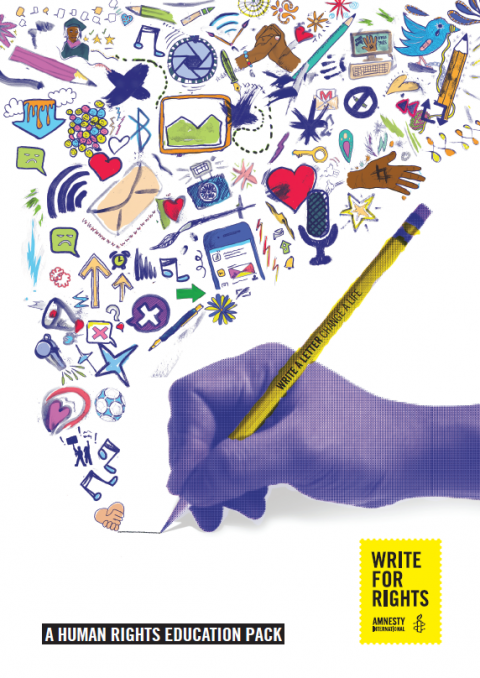 The Write for Rights: A Human Rights Education Pack Year of publication: 2015 Corporate author: Amnesty International This education pack contains five activities on human rights for young people. It can be used as an introduction to human rights, to global solidarity, to campaigning and activism, and to the wider work of Amnesty International. The activities provide a broad perspective on these issues and others.They are useful in opening young people’s minds to global concerns and involving them in actions which can have a real impact on people’s lives.The activities can be run at any time, but will be most effective either before or during the time of Amnesty International’s ‘Write for Rights’ campaign, which this year runs from 4 to 17 December. By working on these cases and taking part in the campaign, young people will know that they are part of a massive global movement of people. They – and you – can bring about a real improvement in the lives of the people featured in the following pages. Escribe por los derechos: Conjunto de materiales para la educacion ed derechos humanos Year of publication: 2015 Corporate author: Amnesty International This education pack contains five activities on human rights for young people. It can be used as an introduction to human rights, to global solidarity, to campaigning and activism, and to the wider work of Amnesty International. The activities provide a broad perspective on these issues and others.They are useful in opening young people’s minds to global concerns and involving them in actions which can have a real impact on people’s lives.The activities can be run at any time, but will be most effective either before or during the time of Amnesty International’s ‘Write for Rights’ campaign, which this year runs from 4 to 17 December. By working on these cases and taking part in the campaign, young people will know that they are part of a massive global movement of people. They – and you – can bring about a real improvement in the lives of the people featured in the following pages. Écrire pour les droits: Dossier pour l’éducation aux droits humains Year of publication: 2015 Corporate author: Amnesty International This education pack contains five activities on human rights for young people. It can be used as an introduction to human rights, to global solidarity, to campaigning and activism, and to the wider work of Amnesty International. The activities provide a broad perspective on these issues and others.They are useful in opening young people’s minds to global concerns and involving them in actions which can have a real impact on people’s lives.The activities can be run at any time, but will be most effective either before or during the time of Amnesty International’s ‘Write for Rights’ campaign, which this year runs from 4 to 17 December. By working on these cases and taking part in the campaign, young people will know that they are part of a massive global movement of people. They – and you – can bring about a real improvement in the lives of the people featured in the following pages.
 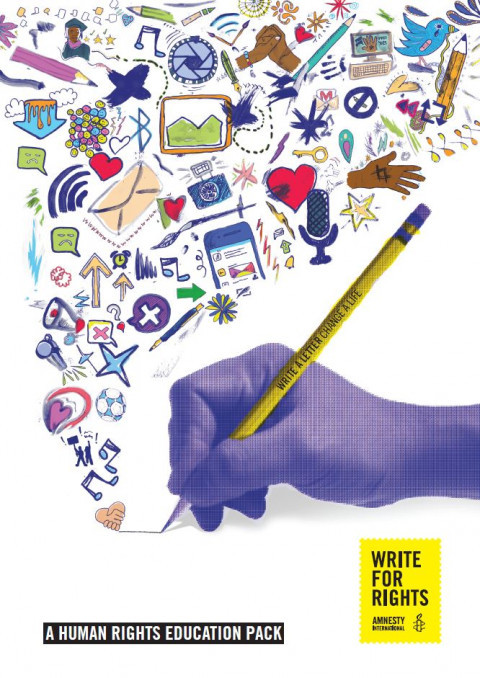 The Write for Rights: A Human Rights Education Pack Year of publication: 2015 Corporate author: Amnesty International This education pack contains five activities on human rights for young people. It can be used as an introduction to human rights, to global solidarity, to campaigning and activism, and to the wider work of Amnesty International. The activities provide a broad perspective on these issues and others.They are useful in opening young people’s minds to global concerns and involving them in actions which can have a real impact on people’s lives.The activities can be run at any time, but will be most effective either before or during the time of Amnesty International’s ‘Write for Rights’ campaign, which this year runs from 4 to 17 December. By working on these cases and taking part in the campaign, young people will know that they are part of a massive global movement of people. They – and you – can bring about a real improvement in the lives of the people featured in the following pages.