
Resources
Explore a wide range of valuable resources on GCED to deepen your understanding and enhance your research, advocacy, teaching, and learning.
1,322 Results found
 From Emergency to Resilience: Building Healthy and Resilient Cities Through Learning; Fifth International Conference on Learning Cities, Yeonsu, Republic of Korea, 27 to 30 October 2021 Year of publication: 2022 Corporate author: UNESCO Institute for Lifelong Learning (UIL) Responding to and recovering from the COVID-19 pandemic remains an enormous challenge for cities worldwide. Lifelong learning lays the foundation for healthy and resilient cities. Hence, these municipalities are working hard to promote learning for health, and to build long-term resilience among their local populations so that they can deal both with the pandemic and with future emergencies, including those caused by climate change.The fifth International Conference on Learning Cities (ICLC 5) was hosted by UIL in collaboration with Yeonsu City, Republic of Korea, and took place from 27 to 30 October 2021. Entitled ‘From emergency to resilience: Building healthy and resilient cities through learning’, the conference attracted over 2,000 participants, who attended either online or in-person. This was an opportunity for cities to come together and share their responses to the COvID-19 pandemic.
  Counting the Cost: Achieving Literacy in Countries of the Global Alliance for Literacy Year of publication: 2021 Corporate author: UNESCO Institute for Lifelong Learning (UIL) This paper seeks to determine the cost of achieving Sustainable Development Goal 4 (SDG 4) Target 4.6: 'By 2030, ensure that all youth and a substantial proportion of adults, both men and women, achieve literacy and numeracy'. In an effort to answer this question, UNESCO ran simulations and identified the cost and funding gap for the 29 member countries of the Global Alliance for Literacy within the Framework of Lifelong Learning (GAL). This paper argues that 739 million youth and adults require additional literacy programmes of which 580 million are located in 9 of the 29 member countries (the E-9 countries). Based on the results of the simulation, an estimated US$ 190 billion is needed to achieve Target 4.6 by 2030 in the 29 GAL countries. The E-9 countries account for 80% of this cost as the large majority of the global population of youth and adults who lack basic literacy skills live in these territories. The estimation considers the impact of the COVID-19 crisis on GDP growth and presents several scenarios for consideration. If the 29 member countries allocate the recommended 3 per cent of their national education budget to youth and adult literacy, a funding gap of US$ 17 billion will still remain. However, this gap is greater in the 20 non-E9 countries, which account for US$ 12 billion of the funding gap. These 20 non-E9 countries already experience massive challenges for investing in their public education system due to low economic growth and low education development outcomes. A detailed description of the UNESCO GAL simulation model used to estimate the total cost and identify the financing gap for the 29 countries is presented to help interpret the results. The paper ends with a set of recommendations for governments and the international community to work together and ensure the availability of lifelong learning opportunities for all, especially those often left behind.
  Making Lifelong Learning a Reality: A Handbook Year of publication: 2023 Corporate author: UNESCO Institute for Lifelong Learning (UIL) This handbook provides education stakeholders with practical guidance on lifelong learning. With an overview of key concepts, policy issues, technical knowledge and practical approaches, it demonstrates how lifelong learning can be strengthened in policy-making and implemented at national, regional, local and institutional levels. The handbook supports those experts and professionals in the field of education who wish to develop their understanding of lifelong learning, and offers tips, information and examples targeted at learners, facilitators, institutional leaders, policy-makers and legislators. More broadly, it illustrates how lifelong learning can address complex political, social, economic and environmental issues affecting people around the world. 让终身学习成为现实:手册 Year of publication: 2023 Corporate author: UNESCO Institute for Lifelong Learning (UIL) 这本关于终身学习的手册试图描绘一个全面立体、包罗万象的终身学习愿景, 并将其塑造成教育利益攸关者的实用指南。本手册并未详尽无遗地介绍所有的终 身学习形式,而是阐明了终身学习的本质,通过制定国家政策和实施战略,使之 得到广泛的了解、认可、推广和具体应用。本手册第一章明确了终身学习的概念,介绍了联合国教科文组织对终身学习及 其关键维度的理解。之后解释了提倡终身学习的原因,为读者提供了一系列循证观 点,说明终身学习将如何应对世界面临的大规模严峻挑战。因此,第一章为政策制 定者、政府官员、机构负责人、相关从业者或研究人员提供了一个起点,以推进终 身学习,将其作为一种政策措施,来应对学习系统当前的挑战和长期的问题。要使终身学习从一个抽象的概念转变成为可以实际增加学习机会和改善学习 体验的行动,政策层面需要有所作为。因此,第二章明确了终身学习政策的定义 和政策制定过程, 并提出了制定有效终身学习政策的多个因素。 这些因素表明, 终身学习政策在根本上应符合国情和地方实际情况、打造全面终身学习愿景、制 定治理方案、具有财政可行性、以实证作为监测和评估的基础,并通过磋商实现 多方参与的终身学习政策制定。第三章侧重于终身学习的实施,并通过国家终身学习实施战略的视角讨论了 不同的实施方式。此外,这一章还展示了实施战略如何在正规、非正规和非正式 学习方面融入终身学习理念并增加终身学习机会。在学习形式之间建立联系,第 三章还提供了有关灵活学习途径的建议,并指导如何使用国家资历框架和学习成 果认证机制等相关政策来创建灵活学习途径。随后,第三章论述了信息通信技术 对于终身学习的重要价值,以及多层级治理在终身学习实施过程中的关键作用。第四章则关注地方层面,首先概述了城市地区的终身学习情况,并重点介绍 了联合国教科文组织全球学习型城市网络的学习型城市模式。之后,通过贝塔市 的研究案例具体展示了终身学习的政策制定过程,并揭示了那些与设计终身学习 实施战略有关的考虑因素如何应用于具体的终身学习政策。立足全球视角,基于实践经验,本手册的最终目标是为读者提供全面、可行 的指导意见,让全民终身学习成为现实。
  Lifelong learning for health in cities: a guide, enacting the Yeonsu Declaration for Learning Cities Year of publication: 2023 Author: Jourdan, Didier | Gray, Nicola | Howells, Alex | Valdés-Cotera, Raúl Corporate author: UNESCO Institute for Lifelong Learning (UIL) <Executive summary> The COVID-19 health crisis has led all cities in the world to put public health issues at the top of their agendas. The pandemic has highlighted that one cannot implement public health measures without, or indeed against, the goodwill of the population. The population is not the ‘problem’. Rather, it is part of the solution to the health crisis. Cities play a major role in developing the population’s capacity to promote individual and collective health.Education and learning are at the very core of what makes ‘health for all’ possible. The crisis, therefore, has been an eye-opener regarding the importance and need for lifelong health education. Instituting such a place-based lifelong learning culture could play a key role in building resilience for individuals, communities and cities.In Yeonsu, Republic of Korea, the fifth International Conference on Learning Cities was convened from 27 to 30 October 2021. Attending in person or online were: mayors, deputy mayors, officials, representatives from 229 learning cities in 64 countries worldwide, education executives, education experts, representatives of United Nations agencies, the private sector, and regional, international and civil society organizations. At the end of the conference, a declaration was issued. It includes a set of commitments to build healthy and resilient cities.This guide aims to assist municipal teams in the concrete development of a policy that promotes lifelong learning for health within the framework of the Yeonsu Declaration. It is intended not only for cities already identified as learning cities or healthy cities – which may use the guide to integrate a lifelong learning for health dimension into existing city policies and projects – but also for all cities that wish to implement a policy promoting lifelong learning for healthThis guide proposes a three-step process for enacting such a policy: 1. raising awareness of the role of cities in lifelong learning for health; 2. developing a policy that promotes a healthy and resilient city; and 3. implementing the policy.The lifelong learning for health policy can be formalized through the creation of a learning for health pathway. The pathway makes explicit – and simultaneously formalizes – the content, the learning approaches and learning outcomes of the learning opportunities offered throughout people’s lives. It focuses on building individual capacities for awareness and understanding of complex health issues, critical judgment and action. The pathway also has a communication purpose by making what is being done to promote health in the city explicit to citizens, partners and professionals. It is based on four key action principles: ‘valuing, sharing, aligning and improving’. This approach seeks, first, to demonstrate the value of the educational work carried out in formal, non-formal and informal settings of the urban environment; then to make this known among stakeholders and to make the pathway coherent; and, finally, to identify the gaps and take the necessary initiatives to fill them.The guide can be used in different ways depending on the context, means and objectives of the individual cities. It is not always necessary to read the whole guide. And we expect that a large proportion of readers and users will simply pick and choose from the various sections of the guide elements that are of particular interest to them. Nonetheless, we hope that everyone will find something to contribute to their city’s efforts and actions for implementing an inclusive policy for promoting lifelong learning for health.
 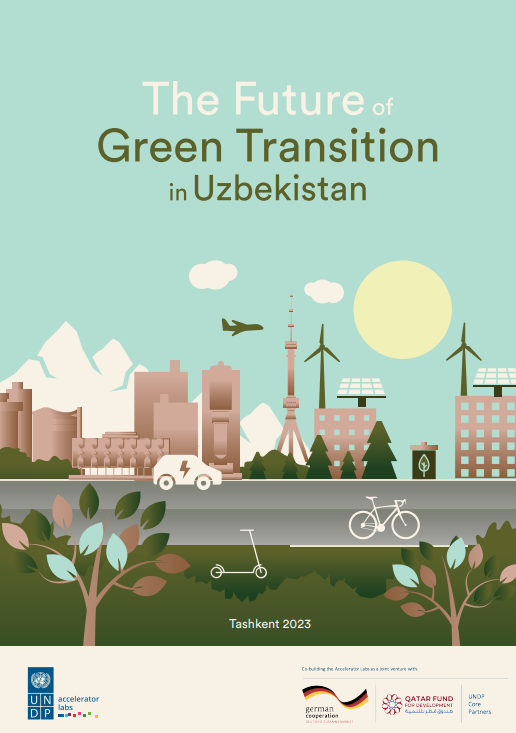 Будущее зелёного перехода в Узбекистане Year of publication: 2023 Corporate author: UNDP Uzbekistan При поддержке правительства ПРООН в Узбекистане применила инструменты совместного будущего и прогнозирования для изучения возможностей зеленого перехода в Узбекистане. В результате был получен ряд результатов, включая базу данных сигналов, драйверы, нарративы сценариев и систему изучения произвольных сценариев. Они использовались для разработки идей политик, в которых изложены инновационные подходы.
  Report on Improving the Care System in the Republic of Uzbekistan: A Path to Economic Growth, Poverty Reduction and Improved Quality of Life Year of publication: 2024 Author: Maigul Nugmanova | Adiba Nuruddinova Corporate author: UNDP Uzbekistan This Report explores the crucial role of care system policies in sustainable equitable economic growth, poverty reduction, and improved quality of life, aligning with UN Sustainable Development Goals. Conducted within the framework of the initiative of UNDP in Uzbekistan, the study aims to analyze current care provision, identify critical points, and propose recommendations for an inclusive and sustainable care economy, contributing to overall economic growth and reducing regional inequalities. Отчет по совершенствованию системы ухода в Республике Узбекистан: Путь к Экономическому Росту, Борьбе с Бедностью и Повышению Качества Жизни Year of publication: 2024 Author: Maigul Nugmanova | Adiba Nuruddinova Corporate author: UNDP Uzbekistan В этом докладе исследуется решающая роль политики системы ухода в устойчивом справедливом экономическом росте, сокращении бедности и повышении качества жизни в соответствии с Целями ООН в области устойчивого развития. Исследование, проведенное в рамках инициативы ПРООН в Узбекистане, направлено на анализ текущего предоставления медицинской помощи, определение критических точек и предложение рекомендаций для инклюзивной и устойчивой экономики ухода, способствующей общему экономическому росту и снижению регионального неравенства. The Future of Green Transition in Uzbekistan Year of publication: 2023 Corporate author: UNDP Kazakhstan In support of the government, UNDP Uzbekistan applied participatory futures and foresight tools to explore possibilities for a Green Transition in Uzbekistan. The process produced a range of outputs, including a signals database, drivers, narrative scenarios, and a custom scenario exploration system. They were used to develop policy ideas, which outline innovative approaches.
  학교 평화·통일교육 내실화를 위한 교육과정 개선 방향 탐색 Year of publication: 2020 Author: 김상범 Corporate author: 한국교육과정평가원 본 연구의 목적은 학교 평화·통일교육의 개념을 정립하여 핵심역량, 목표를 설정하고 이에 근거하여 평화·통일교육의 현황 및 요구를 심층 분석함으로써 학교 평화·통일교육 내실화를 위한 교육과정 개선 방향을 탐색하며 향후 교육과정 개정 시 평화·통일교육이 일부 교과에만 집중되지 않고 전 교과 교육과정을 통해 체계적이고 지속적으로 구현될 수 있도록 실질적이고 종합적인 정책 구상을 제시하는 것이다.