
Resources
Explore a wide range of valuable resources on GCED to deepen your understanding and enhance your research, advocacy, teaching, and learning.
1,448 Results found
 Time to Reach for the Moon: The EU Needs to Step up Action and Lead the Transformation to Sustainability; Civil Society SDG Monitoring Report Year of publication: 2020 Author: Sylvia Beales | George Gelber Corporate author: SDG Watch Europe | Make Europe Sustainable for All This report explains why the EU’s SDG reporting creates an illusion of sustainability and makes concrete proposals for meaningful monitoring to become a stronger foundation for transformative policies. The report flags up serious gaps, bringing them to life with 17 individual stories. It also offers 17 solutions, real-life examples of progressive policies, innovative initiatives and truly sustainable business models.
 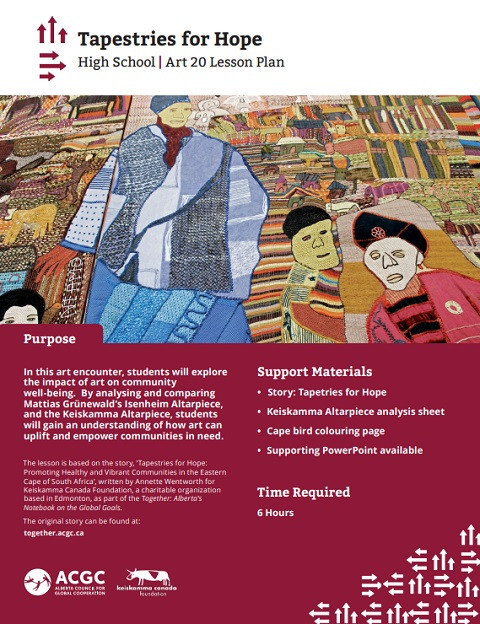 Tapestries for Hope: High School Art 20 Lesson Plan Year of publication: 2018 Corporate author: Alberta Council for Global Cooperation (ACGC) | Keiskamma Canada Foundation In this art encounter, students will explore the impact of art on community well-being. By analysing and comparing Mattias Grünewald’s Isenheim Altarpiece, and the Keiskamma Altarpiece, students will gain an understanding of how art can uplift and empower communities in need. The lesson is based on the story, ‘Tapestries for Hope: Promoting Healthy and Vibrant Communities in the Eastern Cape of South Africa’, written by Annette Wentworth for Keiskamma Canada Foundation, a charitable organization based in Edmonton, as part of the Together: Alberta’s Notebook on the Global Goals.
  Pointed: High School Poetry Lesson Plan Year of publication: 2019 Corporate author: Alberta Council for Global Cooperation (ACGC) In this lesson, students will read and analyse the poem “Pointed” by Edmonton-based poet and scientist, Nermeen Youssef. Students will extend their learning through creating their own piece exploring inequities they see or face in health care services locally and globally.
 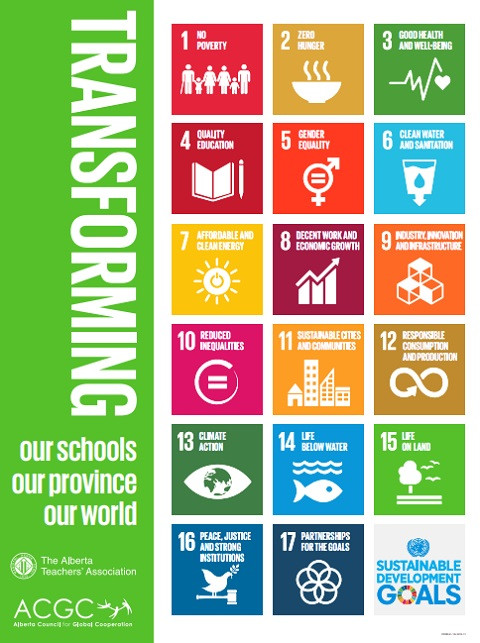 Transforming Our Schools, Our Province, Our World Year of publication: 2015 Corporate author: Alberta Council for Global Cooperation (ACGC) | The Alberta Teachers' Association (ATA) This is a poster about the SDGs for classrooms, made by ACGC and the Alberta Teachers’ Association. Transformons Nos Ecoles, Notre Province, Notre Monde Year of publication: 2015 Corporate author: Alberta Council for Global Cooperation (ACGC) | The Alberta Teachers' Association (ATA) C'est une affiche scolaire sur les ODD réalisée par l’ACGC et l’Alberta Teachers ’Association.
 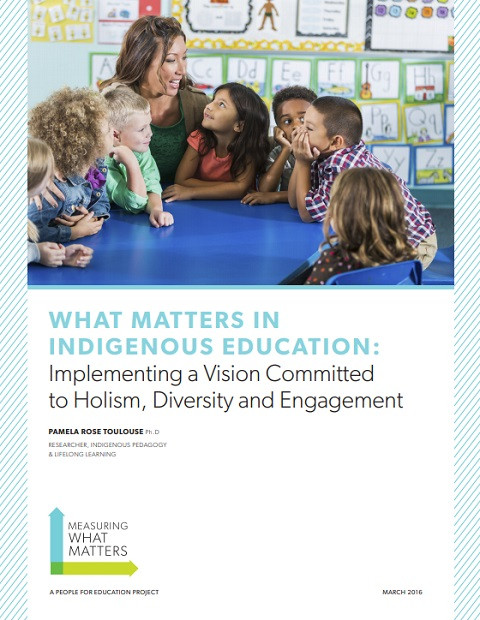 What Matters in Indigenous Education: Implementing a Vision Committed to Holism, Diversity and Engagement Year of publication: 2016 Author: Pamela R.Toulouse Corporate author: Measuring What Matters | People for Education This paper, What Matters In Indigenous Education: Implementing A Vision Committed To Holism, Diversity And Engagement, explores an Indigenous approach to quality learning environments and relevant competencies/skills. It focuses on select work from People for Education and draws out the research, concepts and themes that align with Indigenous determinants of educational success. This paper also expands on this work by offering perspectives and insights that are Indigenous and authentic in nature.
  Aboriginal Worldviews and Perspectives in the Classroom: Moving Forward Year of publication: 2015 Corporate author: Province of British Columbia This resource presents how the BC Ministry of Education is embedding Aboriginal perspectives into all parts of the curriculum in a meaningful and authentic manner. It will also help educators to move ahead with transformative practice in relation to Aboriginal education. Visions du monde et perspectives autochtones dans la salle de classe : Aller de l’avant Year of publication: 2015 Corporate author: Province of British Columbia Cette ressource présente comment le Ministère de l’Éducation de la Colombie-Britannique se propose d’intégrer, de manière significative et authentique, des perspectives autochtones à toutes les parties du programme d’études. Cela aidera également les éducateurs à essayer des pratiques transformatrices en matière d’éducation autochtone.
 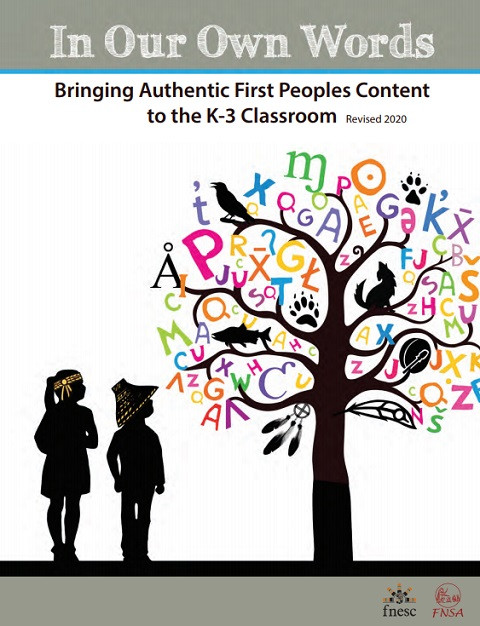 In Our Own Words: Bringing Authentic First Peoples Content to the K-3 Classroom Year of publication: 2020 Author: Jo Chrona | Heather Froste | Nadine McSpadden | Trena Lynn Sutton | Heidi Wood Corporate author: First Nations Education Steering Committee (FNESC) | First Nations Schools Association (FNSA) This teacher resource guide has been developed to offer teachers information and guidance about how to incorporate authentic First Peoples materials into their instruction and assessment practices. Inside, you will find lesson plans, curriculum connections, assessment resources and suggested texts.
  Éducation à la citoyenneté mondial Year of publication: 2020 Author: Vincent Plourde-Lavoie Corporate author: Association québécoise des organismes de coopération internationale (AQOCI) Cette capsule vidéo a été produite pour présenter les grandes lignes de cette définition de l’ECM et les principaux éléments du Cadre de référence de l’AQOCI. Cette vidéo permettra à la fois aux organismes de coopération internationale membres de l’AQOCI de s’approprier notre vision commune de l’ECM et aux partenaires et autres personnes intéressées à mieux comprendre le travail important en ECM.