
Resources
Explore a wide range of valuable resources on GCED to deepen your understanding and enhance your research, advocacy, teaching, and learning.
1,405 Results found
 The Relevance and Contributions of Education for Health and Well-Being to the Advancement of Human Rights, Sustainable Development & Peace: Thematic Paper Year of publication: 2022 Corporate author: UNESCO This document is part of the thematic papers developed by UNESCO to inform the Revision of the 1974 Recommendation concerning education for international understanding, co-operation and peace. This paper aims to provide a few recommendations for revising the 1974 Recommendation.
  Berlin Declaration on Education for Sustainable Development Year of publication: 2022 Corporate author: 유네스코 In light of the dramatic challenges the world is facing today there is urgent need to transform learning and redesign our societies for the survival of our planet. Education for Sustainable Development (ESD) is key in achieving this change. In May 2021 Ministers of Education from around the world, youth, teachers, scientists and civil society, came together virtually at the UNESCO World Conference on Education for Sustainable Development. They adopted the Berlin Declaration for Sustainable Development, expressing their commitment to harness the power of ESD to build a more just, equal, equitable and sustainable world.The purpose of this online publication is to contextualize the promises made in the Berlin Declaration and explain complex terms and concepts contained in the document, thus rendering its content easily accessible to the wider public. The main body of the text presents the Declaration itself, while the explanatory boxes provide practical background information about sustainable development, Sustainable Development Goal target 4.7 as well as interesting links to find more information about ESD, climate change, green technologies and other related issues.
 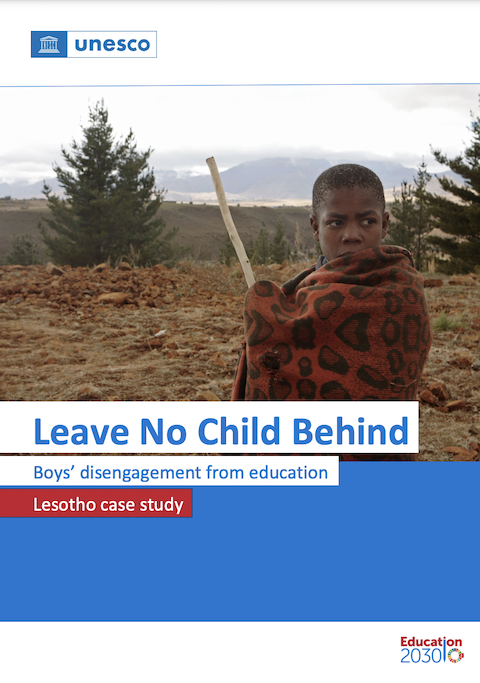 Leave No Child Behind: Boys’ Disengagement From Education; Lesotho Case Study Year of publication: 2022 Author: Paseka A. Mosia Corporate author: 유네스코 In the framework of its work gender equality in and through education better understand boys’ disengagement from education, UNESCO commissioned five country case studies to inform the publication “Leave no child behind: Global report on boys’ disengagement from education”. National research teams examined the situation in five countries – Fiji, Kuwait, Lesotho, Peru and the United Arab Emirates.This case study presents the results from Lesotho.
 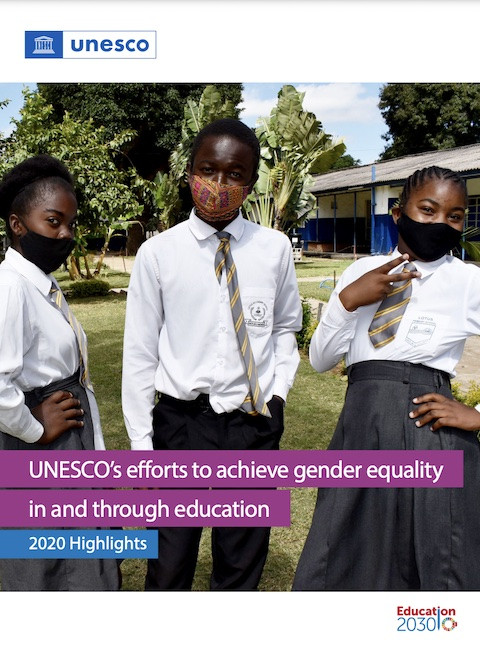 UNESCO’s Efforts to Achieve Gender Equality in and Through Education: 2020 Highlights Year of publication: 2022 Corporate author: UNESCO This report presents highlights of UNESCO’s work in 2020 to advance gender equality in and through education.UNESCO's work in this area is guided by the UNESCO strategy for gender equality in and through education 2019–2025, and supported by Her Education, Our Future, which was launched in parallel with the strategy, to leverage political and financial commitments, cooperation and joint action for girls’ and women’s education.
 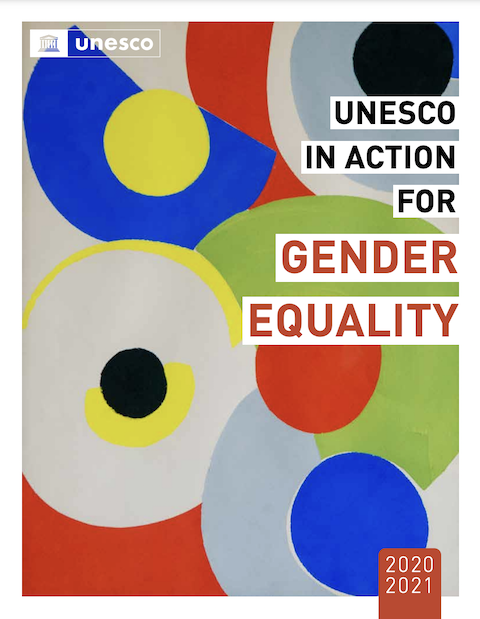 UNESCO in Action for Gender Equality: 2020-2021 Year of publication: 2022 Corporate author: 유네스코 UNESCO’s global priority gender equality took on new meaning over the past biennium. The years 2020 and 2021 have been marked by dramatic social, political, environmental, and economic changes across countries resulting from an unprecedented pandemic: COVID-19. The COVID-19 pandemic magnified deep rooted structural gender inequalities across societies and forced the world to question the degree to which advances towards achieving gender equality had been made since the first UN World Conference on Women held in Beijing. This publication shows how a collective work by all structures of UNESCO has mobilized an extraordinary effort to go beyond a necessary adaptation to a multi-faceted crisis and counter backlashes and strengthen the resilience of women and girls and the systems which protect and empower them around the world through education, sciences, culture, communication, and information.
 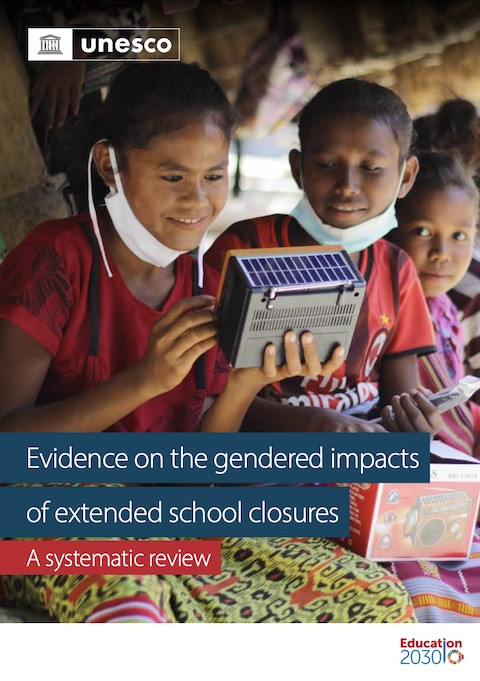 Evidence on the Gendered Impacts of Extended School Closures: A Systematic Review Year of publication: 2022 Corporate author: UNESCO School closures to mitigate the spread of COVID-19 have affected nearly 1.6 billion learners across the globe. While the scale of these closures is unprecedented, in recent decades children in many contexts have been out of school for long periods due to other pandemics, disruptions and disasters such as floods, earthquake and conflicts – with marked gender effects.Building on the findings of 154 studies from every region of the world, this study investigates the evidence on the gendered impacts of extended school closures and periods out of school. Through a systematic review of the evidence, it highlights how these can deepen gendered exclusions and vulnerabilities – with the poorest children being the most affected.Undertaken by a team of leading academic experts on gender equality and education, Evidence on the gendered impacts of extended school closures: A systematic review aims to prevent and mitigate adverse outcomes arising from extended periods of time out of school, by ensuring that responses to current and future crises are informed by a solid understanding of their effects on children’s education, health, well-being and protection.
  Los actores no estatales en la educación superior: ¿Una visión compartida de la calidad y la asequibilidad? (Policy Paper 47) Year of publication: 2022 Corporate author: UNESCO Los actores no estatales acogen a más de un tercio del alumnado de educación superior en todo el mundo, un porcentaje considerablemente más elevado que en la educación primaria o secundaria. Los proveedores son diversos y responden a una variedad de necesidades, y a menudo no hay una división clara entre los sectores estatal y no estatal. Los actores no estatales son además protagonistas importantes en la financiación de la educación superior a través de los hogares, los mecanismos de mercado y las alianzas público-privadas. A raíz de ello, estos actores desempeñan un papel significativo e influyen en la elaboración de normativas y políticas, así como en la configuración del sistema de educación superior en su conjunto. Los gobiernos deben garantizar la calidad y equidad —las dimensiones clave de la meta 4.3 de los Objetivos de Desarrollo Sostenible (ODS)—, independientemente del modo en que los actores estatales y no estatales compartan responsabilidades.
  Transforming Education Summit 2022: Futures of Education Briefing Notes Year of publication: 2022 Corporate author: UNESCO National consultations that aim at developing a shared vision, commitment, and alignment of action across constituencies are one of the key TES workstreams. The Reimagining our futures together report is proposed as a framework for examining how education systems need to change to better serve learners and societies into the future.A series of briefing notes have been prepared in alignment with the summit's five action tracks:o Inclusive, equitable, safe and healthy schoolso Learning and skills for life, work and sustainable developmento Teachers, teaching and the teaching professiono Digital learning and transformationo Financing of education Cumbre 2022 sobre la Transformación de la Educación: Notas sinópticas sobre los Futuros de la Educación Year of publication: 2022 Corporate author: UNESCO Las consultas nacionales que apuntan a desarrollar una visión compartida, un compromiso y una alineación de la acción entre los grupos constituyen uno de los flujos de trabajo clave de TES. El informe Reimaginando juntos nuestro futuro se propone como un marco para examinar cómo deben cambiar los sistemas educativos para servir mejor a los estudiantes y las sociedades en el futuro. Se ha preparado una serie de notas informativas en consonancia con las cinco vías de acción de la cumbre: o Escuelas inclusivas, equitativas, seguras y saludableso Aprendizaje y habilidades para la vida, el trabajo y el desarrollo sostenibleo Docentes, docencia y profesión docenteo Aprendizaje y transformación digitalo Financiamiento de la educación Sommet 2022 sur la Transformation de l’Education: Notes de synthèse sur Les futurs de l’éducation Year of publication: 2022 Corporate author: Organisation des Nations Unies pour l'éducation, la science et la culture (UNESCO) Les consultations nationales qui visent à développer une vision, un engagement et un alignement des actions partagés entre les groupes constitutifs sont l'un des principaux axes de travail de la TES. Le rapport Reimagining our futures together est proposé comme un cadre pour examiner comment les systèmes éducatifs doivent changer pour mieux servir les apprenants et les sociétés à l'avenir. Une série de notes d'information a été préparée conformément aux cinq pistes d'action du sommet : o Des écoles inclusives, équitables, sûres et saineso Apprentissage et compétences pour la vie, le travail et le développement durableo Enseignants, enseignement et profession enseignanteo Apprentissage et transformation numériqueso Financement de l'éducation