
Resources
Explore a wide range of valuable resources on GCED to deepen your understanding and enhance your research, advocacy, teaching, and learning.
2,199 Results found
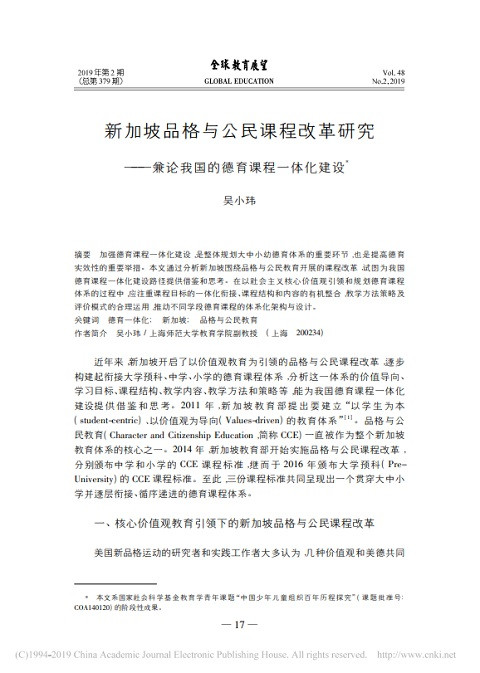 新加坡品格与公民课程改革研究: —兼论我国的德育课程一体化建设 (全球教育展望; Vol. 48, No. 2) Year of publication: 2019 Author: Wu Xiaowei Corporate author: East China Normal University 加强德育课程一体化建设,是整体规划大中小幼德育体系的重要环节,也是提高德育实效性的重要举措。本文通过分析新加坡围绕品格与公民教育开展的课程改革,试图为我国德育课程一体化建设路径提供借鉴和思考。在以社会主义核心价值观引领和规划德育课程体系的过程中,应注重课程目标的一体化衔接、课程结构和内容的有机整合,教学方法策略及评价模式的合理运用,推动不同学段德育课程的体系化架构与设计。
 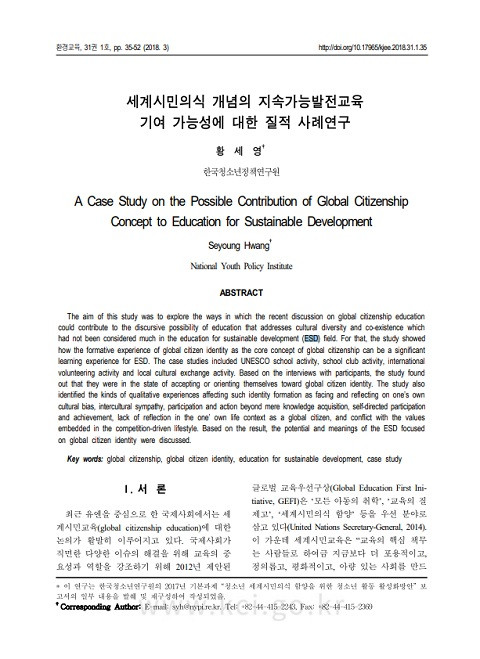 A Case Study on the Possible Contribution of Global Citizenship Concept to Education for Sustainable Development (Environmental Education; Vol. 31, No.1) Year of publication: 2018 Author: Seyoung Hwang Corporate author: Korean Society for Environmental Education The aim of this study was to explore the ways in which the recent discussion on global citizenship education could contribute to the discursive possibility of education that addresses cultural diversity and co-existence which had not been considered much in the education for sustainable development (ESD) field. For that, the study showed how the formative experience of global citizen identity as the core concept of global citizenship can be a significant learning experience for ESD. The case studies included UNESCO school activity, school club activity, international volunteering activity and local cultural exchange activity. Based on the interviews with participants, the study found out that they were in the state of accepting or orienting themselves toward global citizen identity. The study also identified the kinds of qualitative experiences affecting such identity formation as facing and reflecting on one’s own cultural bias, intercultural sympathy, participation and action beyond mere knowledge acquisition, self-directed participation and achievement, lack of reflection in the one’ own life context as a global citizen, and conflict with the values embedded in the competition-driven lifestyle. Based on the result, the potential and meanings of the ESD focused on global citizen identity were discussed. 세계시민의식 개념의 지속가능발전교육 기여 가능성에 대한 질적 사례연구 (환경교육; Vol. 31, No. 1) Year of publication: 2018 Author: Seyoung Hwang Corporate author: Korean Society for Environmental Education 본 연구의 목적은 최근 세계시민교육에 대한 활발한 논의와 실천이 그간 지속가능발전교육에서 간과되어왔던 문화 다양성 존중과 공존과 관련된 교육적 논의를 확산하는데 어떻게 기여할 수 있는지를 탐색하는 데 있다. 이를 위해 본 연구에서는 세계시민의식의 핵심 개념인 세계시민 정체성(global citizen identity)의 형성이 지속가능발전교육의 중요한 학습 경험이 될 수 있다는 것을 연구 사례를 통해 보여주고자 하였다. 이를 위해 유네스코학교활동, 동아리, 해외자원봉사활동, 지역문화교류활동 등의 4가지프로그램 사례에 대한 질적 연구를 수행하였다. 연구 결과, 참여자들은 세계시민 정체성을 수용 또는 지향하는 과정에 있었으며, 이에 영향을 주는 질적 경험에는 문화적 편견에 대한 직시와 성찰, 타문화권 사람들과의 정서적 교감, 지식만이 아닌 참여와 실천, 자기 주도적 참여와 성취, 개인 관심사와 연결, 내 삶 안에서 세계시민으로서의 성찰 부족, 경쟁위주의 삶의 양식과의 가치 충돌 등이 있음을 파악하였다. 이러한 분석 결과를 바탕으로, 지속가능발전교육에서 세계시민의식의 형성을 핵심 목표로 삼는 교육적 접근의 가능성과 의미를 논의하였다.
 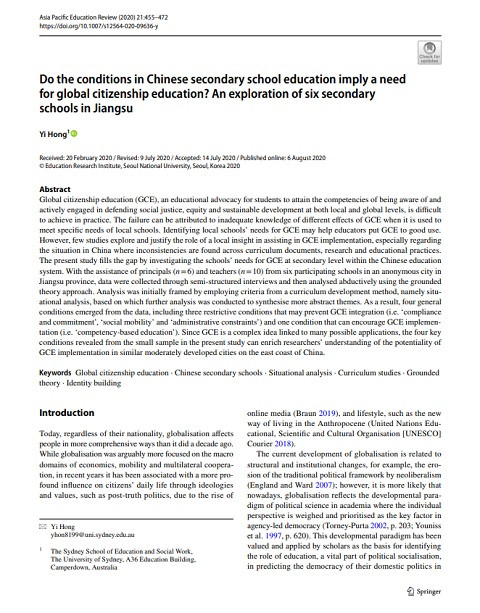 Do the Conditions in Chinese Secondary School Education Imply a Need for Global Citizenship Education? an Exploration of Six Secondary Schools in Jiangsu (Asia Pacifc Education Review; Rev. 21) Year of publication: 2020 Author: Yi Hong Corporate author: Seoul National University. Education Research Institute Global citizenship education (GCE), an educational advocacy for students to attain the competencies of being aware of and actively engaged in defending social justice, equity and sustainable development at both local and global levels, is difficult to achieve in practice. The failure can be attributed to inadequate knowledge of different effects of GCE when it is used to meet specific needs of local schools. Identifying local schools’ needs for GCE may help educators put GCE to good use. However, few studies explore and justify the role of a local insight in assisting in GCE implementation, especially regarding the situation in China where inconsistencies are found across curriculum documents, research and educational practices. The present study fills the gap by investigating the schools’ needs for GCE at secondary level within the Chinese education system. With the assistance of principals (n = 6) and teachers (n = 10) from six participating schools in an anonymous city in Jiangsu province, data were collected through semi-structured interviews and then analysed abductively using the grounded theory approach. Analysis was initially framed by employing criteria from a curriculum development method, namely situational analysis, based on which further analysis was conducted to synthesise more abstract themes. As a result, four general conditions emerged from the data, including three restrictive conditions that may prevent GCE integration (i.e. ‘compliance and commitment’, ‘social mobility’ and ‘administrative constraints’) and one condition that can encourage GCE implementation (i.e. ‘competency-based education’). Since GCE is a complex idea linked to many possible applications, the four key conditions revealed from the small sample in the present study can enrich researchers’ understanding of the potentiality of GCE implementation in similar moderately developed cities on the east coast of China.
 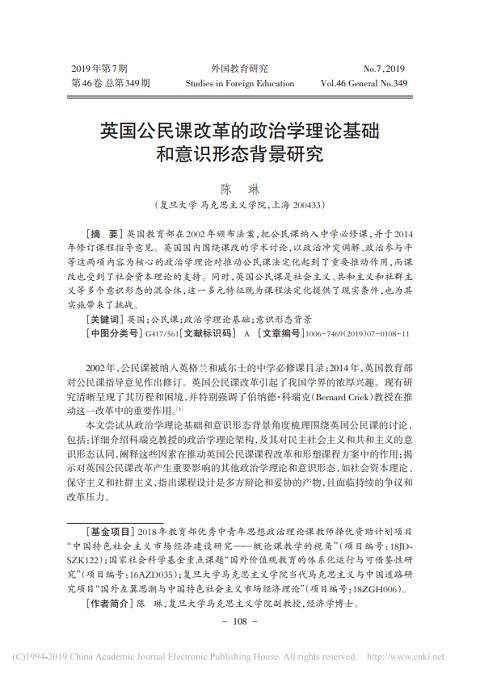 The Theoretical Foundation and Ideological Background of the Citizenship Curriculum Reform in England (Studies in Foreign Education; Vol. 46, No. 7) Year of publication: 2019 Author: Chen Lin Corporate author: Northeast Normal University Citizenship became part of the compulsory courses of secondary schools in England in 2002. The guideline was revised in 2014. Fierce academic debates shaped the curriculum reform. Political theory of political conflict mediation and political participative equality played an important role in promoting the legalization of Citizenship education. The wide acceptance of social capital theory also helps to win the necessary support. The current curriculum is a mixture of various ideologies such as socialism, republicanism and communitarianism. This multi-feature provides both pragmatic conditions for the curriculum’s legalization and challenges for its implementation.
  International Exchange and Cooperation Programs as Global Citizenship Education: A Case Study of the Gyeonggi Provincial Office of Education (Journal of Education for International Understanding; Vol. 14, No. 2) Year of publication: 2019 Author: Inyoung Lee | Youyeon Kim | Jeongmin Moon | Kyubin Lee | Sungsang Yoo Corporate author: Korean Society of Education for International Understanding (KOSEIU) This study examines the implementation of international exchange programs conducted within public education, focusing on the Gyeonggi Provincial Office of Education from the standpoint of global citizenship education. It also proposes the feasibility and direction of international exchange programs based on the analytical framework that analyses the global citizenship education as the competency-based approach, moral approach, and critical approach. The research questions are: first, 'what is the aspects of the implementation of international exchange programs in terms of global citizenship education?' and second, 'what is the possibility of implementing international exchange programs as global citizenship education?' To find the answer to the questions, documents related to the international exchange program and data from interviews with the person in charge and the participants of programs were analyzed. This paper found that there is a feasibility for implementing the competency-based approach and moral approach in the international exchange programs. However, in order to invigorate international exchange as the practice of global citizenship education, it is recommended that: first, international exchange from the viewpoint of critical approach should be developed. Second, every student should have the opportunity to participate in the programs regardless of their economic status. Lastly, target nations for international exchange should be chosen not only from the competency-based approach but from the various perspective of global citizenship education. 세계시민교육으로서의 국제교류협력 프로그램: 경기도교육청 사례연구 (국제이해교육연구; Vol. 14, No. 2) Year of publication: 2019 Author: 이인영 | 김유연 | 문정민 | 이규빈 | 유성상 Corporate author: 한국국제이해교육학회 이 연구는 경기도교육청을 중심으로 하여 공교육 내에서 이루어지고 있는 국제교류협력 프로그램의 시행 양상을 세계시민교육 관점에서 검토한다. 능력 기반 접근, 도덕적 접근, 비판적 접근으로 분류되는 세계시민교육 분석틀을 바탕으로 국제교류협력 프로그램 관련 문서 및 담당자, 참여자와의 면담자료를 분석하고, 세계시민교육으로서의 국제교류협력 실천 가능성과 방향을 제안한다. 연구 질문은 첫째, ‘세계시민교육 관점에서 국제교류협력 프로그램의 시행 양상은 어떠한가?’, 둘째, ‘세계시민교육으로서의 국제교류협력 프로그램의 실천 가능성은 어떠한가?’이다. 연구 결과, 경기도교육청 국제교류협력 프로그램은 능력 기반 접근과 도덕적 접근에서 세계시민교육으로서의 실천 가능성을 보였다. 그러나 향후 세계시민교육의 실천으로서 국제교류협력을 활성화하기 위해서는 다음과 같은 개선방안을 제안한다. 첫째, 비판적 접근에서의 세계시민교육에 기반한 국제교류협력을 강화해야 한다. 둘째, 국제교류협력에 가정의 경제적 배경과 관심에 상관없이 모든 학생이 참여할 수 있도록 운영되어야 한다. 셋째, 능력 기반 접근에 한정되지 않고 다양한 관점에서 세계시민교육에 접근하여 교류 대상 국가를 선정할 필요가 있다.
  Global Citizenship Education: Critical and International Perspectives Year of publication: 2020 Author: Abdeljalil Akkari | Kathrine Maleq Corporate author: Springer Nature | Swiss National Science Foundation This open access book takes a critical and international perspective to the mainstreaming of the Global Citizenship Concept and analyses the key issues regarding global citizenship education across the world. In that respect, it addresses a pressing need to provide further conceptual input and to open global citizenship agendas to diversity and indigeneity.Social and political changes brought by globalisation, migration and technological advances of the 21st century have generated a rise in the popularity of the utopian and philosophical idea of global citizenship. In response to the challenges of today’s globalised and interconnected world, such as inequality, human rights violations and poverty, global citizenship education has been invoked as a means of preparing youth for an inclusive and sustainable world.In recent years, the development of global citizenship education and the building of students’ global citizenship competencies have become a focal point in global agendas for education, international educational assessments and international organisations. However, the concept of global citizenship education still remains highly contested and subject to multiple interpretations, and its operationalisation in national educational policies proves to be challenging.This volume aims to contribute to the debate, question the relevancy of global citizenship education’s policy objectives and to enhance understanding of local perspectives, ideologies, conceptions and issues related to citizenship education on a local, national and global level. To this end, the book provides a comprehensive and geographically based overview of the challenges citizenship education faces in a rapidly changing global world through the lens of diversity and inclusiveness.
  Instructional Design Based on Ecological Multiple Citizenship for Elementary Social Studies Classroom: Focusing on National Citizenship, Global Citizenship and Sustainable Development Education (Social studies education; Vol. 55, No. 1) Year of publication: 2016 Author: Kwangtaek Sim Corporate author: Korean Social Studies Association An instructional model for national citizenship, global citizenship, and sustainable development education was developed. Four lesson plans in the elementary 5thgrade social studies were suggested to show the practice of the instructional model. Three outcomes are reported. First, identity as a citizen of a nation, global citizenship, communications are interrelated. National citizenship and communications in the network society can result in a stronger vision of one’s global citizenship. This is especially the case when the wellbeing and happiness of people in neighboring countries who live across the national boundary are viewed within the domain of community- economy- ecology. Each prepares citizens through knowledge and skills that enable them to empathize, criticize constructively, and live together sustainably. The educational methods recommended to attain global citizenship perspectives are critical thinking, comparative studies, and teaching controversial issues. Those methods tend to result in a commitment to guarantee of non-domination freedom and tolerance of others. Second, discussions regarding sustainable development focused largely on deliberative engagement as a teaching method. Issues discussed were: speculative banking and its regulation; medical treatment and education as value goods; the steps necessary for households and businesses to attain sustainability; and environmental justice and social equity. The educational methods recommended to live together sustainably are planning and practice for grassroots democratic communities’ solidarity by applying back-casting strategy and systematic thinking. Thirdly, social studies classrooms intent on to enhance national citizenship, global citizenship, and sustainable development have a five step task. They, should emphasize comparison and critique→ discussion→ empathy→ planning and lastly the engagement of learners in content critical to ecological multiple citizenship. 생태적 다중시민성에 기반한 초등사회과 교실수업 설계: 국가시민성, 세계시민성, 지속가능발전 교육을 중심으로 (사회과교육; Vol. 55, No. 1) Year of publication: 2016 Author: 심광택 Corporate author: 한국사회과교육연구학회 본 연구에서는 생태적 다중시민성에 기반하여 국가시민성, 세계시민성, 지속가능발전 교육을 논의하고, 개발한 수업모형에 초등사회 5-1 학습내용을 적용하여 교재분석 및 수업안을 예시하였다. 첫째, 국가시민성, 세계시민성과 의사소통에 관해 논의한 결과, 네트워크시대의 국가시민성으로서 개인정체성은 지역 사회-경제-생태 영역에서 민족과 국경을 넘어 이웃의 안녕과 행복을 담보하려는 세계시민적 정체성으로 발전할 수 있다. 교육내용으로서 공감하는 시민, 비판적 시민, 생태적 시민과 관련된 지식이해, 기능, 가치태도 영역을 선정하고, 교육방법으로서 비지배자유 보장을 위한 토론, 관용과 비판적 사고, 비교와 논쟁을 권장할 수 있다. 둘째, 지속가능한 발전과 사회참여숙의에 관해 논의한 결과, 교육내용으로서 통치체제는 투기성 금융활동을 규제하고, 의료와 교육을 가치재로 인정하며, 가계와 기업은 지속가능한 경제활동을 추구하고, 지역사회를 중심으로 시민 간 연대하여 환경정의와 사회적 형평성을 실천해야 할 것이다. 교육방법으로서 학습자는 파리협정관련 백캐스팅 전략과 지 구촌 사회의 정치, 경제, 사회, 환경 간 시스템적 사고에 토대하여 풀뿌리 민주공동체 간 상호연대를 계획하고 실천할 수 있다. 셋째, 생태적 다중시민성에 기반한 국가시민성, 세계시민성, 지속가능발전 교육을 위한 사회과 교실수업은 학문적 접근이 아니라, 생태적 다중시민성을 지향하는 학습내용을 중심으로 일상생활에서 학습자의 비판적 시민성과 관련하여 비교와 비판→ 토론→ 공감→ 계획과 실천 순으로 설계할 수 있다.