
Resources
Explore a wide range of valuable resources on GCED to deepen your understanding and enhance your research, advocacy, teaching, and learning.
1,322 Results found
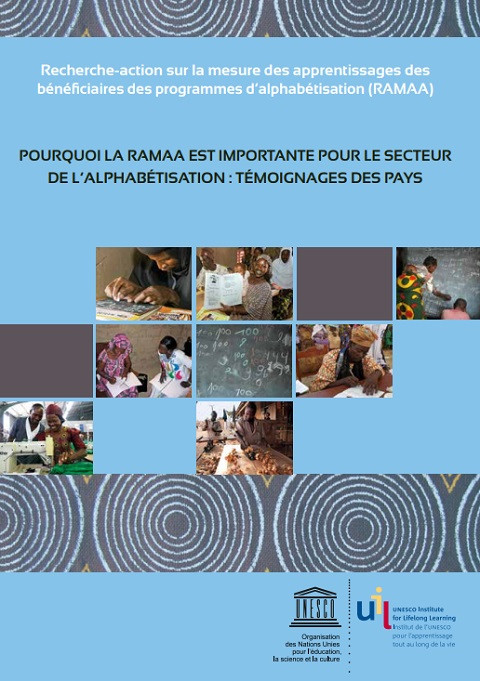 Pourquoi la RAMAA est importante pour le secteur de l'alphabétisation: Témoignages des pays; Recherche-action sur la mesure des apprentissages des bénéficiaires des programmes d'alphabétisation (RAMAA) Year of publication: 2016 Corporate author: UNESCO Institute for Lifelong Learning (UIL) La Recherche-action RAMAA, lancée à l’initiative de l’Institut de l’UNESCO pour l’apprentissage tout au long de la vie (UIL), et pilotée en partenariat avec les bureaux UNESCO répond à ce besoin vital d’évaluer la qualité des programmes d’alphabétisation en prenant comme variable objective les apprentissages réellement acquis par les bénéficiaires à la sortie de leur formation.La première phase de la RAMAA comptait cinq pays, douze pays sont désormais engagés dans la deuxième phase de la RAMAA - Bénin, Burkina Faso, Cameroun, Côte d’Ivoire, République centrafricaine, République démocratique du Congo, Maroc, Mali, Niger, Sénégal, Tchad et Togo. L’engagement des pays tout au long de la mise en œuvre de la deuxième phase de la RAMAA et l’intégration des résultats dans les dispositifs nationaux deviennent impératifs.
 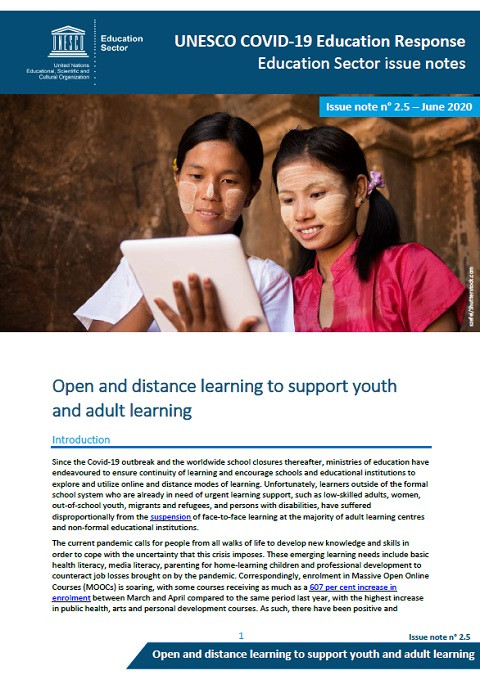 UNESCO COVID-19 Education Response: Open and Distance Learning to Support Youth and Adult Learning (Education Sector Issue Note; No. 2.5 – June 2020) Year of publication: 2020 Corporate author: UNESCO Institute for Lifelong Learning (UIL) A new UNESCO issue note, produced by the UNESCO Institute for Lifelong Learning (UIL), aims to support education policy-makers and planners in ensuring open and distance learning to support youth and adult learning in the context of the current pandemic, now and in its aftermath.Since the COVID-19 outbreak and the worldwide school closures that followed, ministries of education have endeavoured to ensure continuity of learning and encourage schools and educational institutions to explore and utilize online and distance modes of learning. Unfortunately, learners outside of the formal school system who are already in need of urgent learning support, such as low-skilled adults, women, out-of-school youth, migrants and refugees, and persons with disabilities, have suffered disproportionally from the suspension of face-to-face learning at the majority of adult learning centres and non-formal educational institutions.The current pandemic calls for people from people from all socio-economic backgrounds, wherever they live in the world, to develop new knowledge and skills in order to cope with the uncertainty that this crisis imposes. These learning needs include basic health literacy, media literacy, parenting for home-schooling children and professional development to counteract job losses brought on by the pandemic. Correspondingly, enrolment in massive open online courses (MOOCs) is soaring. As such, there have been positive and demand-driven trends in exploring alternative options, such as open and distance learning (ODL), to ensure the continuity and expansion of non-formal education and adult learning.This issue note takes stock of opportunities and challenges in using ODL, both online and offline as defined in the UNESCO Issue Note on Distance Learning Strategies, for youth and adult learners outside the formal education system. After examining key issues and illustrating promising cases from public and private sectors, it provides key messages for policy interventions to support inclusive lifelong learning for youth and adults during and after the current pandemic.UNESCO Education Sector’s issue notes cover key topics related to the COVID-19 education response.
  Curriculum GlobALE: Competency Framework for Adult Educators Year of publication: 2021 Corporate author: DVV International | German Institute for Adult Education, Leibniz Centre for Lifelong Learning | International Council for Adult Education | UNESCO Institute for Lifelong Learning (UIL) This publication introduces Curriculum globALE, a basic com- petence framework for the training of adult educators worldwide. By providing a modular, competency-based framework and cross-curricular approach, Curriculum globALE is unique in its aim to professionalize adult learning and education (ALE) on an international scale, via the competencies that support adult educators to work in any educational setting, field or form.It strives to ensure that educators’ knowledge, competencies, skills and attitudes are of a professional standard.Curriculum globALE is suitable to different contexts and its character and structure enables its inclusion in diverse national education systems.Curriculum globALE aims to: enhance the professionalization of ALE by providing a common reference framework for adult learning programmes and a suggested standard of competencies for adult educators; support ALE providers in the design and implementation of ‘train-the-trainer’programmes; foster knowledge exchange and mutual understanding between adult educators worldwide. Curriculum GlobALE: Un curriculum mondial sur l’apprentissage et l’éducation des adultes Year of publication: 2021 Corporate author: DVV International | German Institute for Adult Education, Leibniz Centre for Lifelong Learning | International Council for Adult Education | Institut de l’UNESCO pour l’apprentissage tout au long de la vie (UIL) Cette publication présente Curriculum globALE, un cadre de compétences de base pour la formation des éducateurs d'adultes dans le monde. En fournissant un cadre modulaire basé sur les compétences et une approche interdisciplinaire, Curriculum globALE est unique dans son objectif de professionnaliser l'apprentissage et l'éducation des adultes (ALE) à l'échelle internationale, via les compétences qui aident les éducateurs d'adultes à travailler dans n'importe quel cadre éducatif, champ ou formulaire. Il s'efforce de veiller à ce que les connaissances, les compétences, les aptitudes et les attitudes des éducateurs soient d'un niveau professionnel. Curriculum globALE est adapté à différents contextes et son caractère et sa structure permettent son inclusion dans divers systèmes éducatifs nationaux. Curriculum globALE vise à : améliorer la professionnalisation de l'AEA en fournissant un cadre de référence commun pour les programmes d'apprentissage des adultes et une proposition de norme de compétences pour les éducateurs d'adultes soutenir les prestataires d'AEA dans la conception et la mise en œuvre de programmes de « formation des formateurs » favoriser l'échange de connaissances et la compréhension mutuelle entre les éducateurs d'adultes du monde entier.
  Analysis of the 2015 Revised Korean Languages Curriculum in Terms of the OECD Education 2030 Competencies (Journal of Curriculum and Evaluation; Vol. 23. No. 3) Year of publication: 2020 Author: Jongyun Kim | Hyounjin Ok | Jaeyoon Cho Corporate author: Korea Institute for Curriculum and Evaluation (KICE) The purpose of this study is to analyze the characteristics of the Korean language curriculum through curriculum content mapping (CCM) in the OECD Education 2030 project, which is later compared with the international curricular of the national languages. The CCM framework consists of a “competency code” that presents OECD competencies and a “content code” that contains the content of the curriculum. In this study, the degree of the competencies in the Korean language curriculum is analyzed and compared with the international curricular in terms of the OECD perspective. The result is analyzed as follows. First, foundational literacies of Korean were similar to the international national language curricular. Second, in the competencies of skills, attitudes and values, “problem-solving” and “learning about learning” were higher in the Korean language curriculum than the OECD average, “critic thinking” was similar to, and “persistence” was lower than the OECD average. Third, in terms of key concepts, both “student agency” and “co-agency” were higher in the Korean language curriculum. Fourth, “creating values” and “solving dilemmas” in terms of the degree of reflection of CCM framework competency related to transformational competencies, the Korean Language was higher than the average of OECD member countries in terms of “creating new values” and “resolving tensions and dilemmas” were higher but “taking responsibilities” were lower than the OECD countries. Fifth, the competencies in the compound literacies were also compared. These comparison results provide as reference materials that describes the suitability of the Korean language curriculum and contributes to future revisions of the Korean language curriculum for the students in 2030s. 2015 개정 국어과 교육과정의 OECD Education 2030 역량 반영 양상 분석 (교육과정평가연구; Vol. 23, No. 3) Year of publication: 2020 Author: 김종윤 | 옥현진 | 조재윤 Corporate author: 한국교육과정평가원 본 연구는 2015 개정 국어과 교육과정과 OECD가 새롭게 제안한 Education 2030 역량틀을 비교하는 교육과정 매핑(curriculum mapping)을 통해 우리 국어과 교육과정의 특성을 분석하고, OECD Education 2030 프로젝트로부터 향후 국어과 교육과정의 설계 및 실행을 위한 시사점을 파악하는 데 목적이 있다. 이를 위해 OECD 교육과정 내용 매핑(CCM) 프레임워크에 반영된 국어과와 OECD 참여국의 자국어 교과의 역량 반영 정도를 비교하였으며, 그 결과는 다음과 같다. 첫째, 기초 소양은 국어과와 OECD 2030 역량 반영 정도가 유사하였다. 둘째, 기능, 태도, 가치 중 국어과는 ‘문제해결력’과 ‘학습에 대한 학습’에서는 OECD 참여국 평균보다 높으나, ‘비판적 사고’는 유사하게, ‘끈기/회복력’은 OECD 참여국 평균보다 낮게 나타났다. 셋째, 주요 개념 측면에서 국어과는 ‘학생 주도성’과 ‘협력적 주도성’에서 모두 OECD 참여국 평균보다 높았다. 넷째, 변혁적 역량에서 국어과는 ‘새로운 가치 창조하기’와 ‘긴장과 딜레마 해소하기’에서는 OECD 참여국 평균보다 높으나 ‘책임감 가지기’는 낮게 나타났다. 다섯째, 복합 소양 반영 정도에서 국어과는 ‘미디어 리터러시, 컴퓨팅 사고력/프로그래밍/코딩’에서 OECD 참여국 평균보다 높게 나타났으나, ‘기업가 정신, 금융 소양, 글로벌 역량, 지속 가능한 발전을 위한 소양’은 OECD 참여국 평균보다 낮았다. 이러한 비교는 추후 국어과 적용(활용)의 적합성과 정합성을 검토할 근거 자료, 현장교사들의 교육과정 재구성의 타당성 근거, 타 교과와의 융합 교육을 실시할 때의 근거, 교육과정을 개정할 때 추구하는 인재상, 핵심역량, 목표와 내용(성취기준) 등을 구체화하여 문서화하는 참고 자료가 된다는 점에서 시사하는 바가 있다.
  미래교육 전망: UNESCO 교육의 미래와 OECD 교육 2030을 중심으로 Year of publication: 2022 Author: 김미경 Corporate author: 한국교육과정평가원 본 연구는 변화하는 미래 사회를 대비하기 위해 UNESCO 교육의 미래와 OECD 교육 2030을 비교하여 미래 교육을 전망하고, 이에 따른 향후 우리나라 교육의 방향을 모색하고 정책을 제언하는 것을 목적으로 한다. 이를 위해 2021년 발간된 UNESCO 교육의 미래 보고서의 주요 내용을 살펴보고, OECD 교육 2030과 미래 학교교육 시나 리오에서 제시한 미래 교육 내용을 UNESCO 교육의 미래와 비교 분석하여 시사점을 도출하였다. 또한 이를 토대로 한국의 미래 교육이 나아가야 할 방향과 제언을 제시하였다.
  Towards CONFINTEA VII: adult learning and education and the 2030 Agenda Year of publication: 2019 Corporate author: UNESCO Institute for Lifelong Learning (UIL) The CONFINTEA VI Mid-Term Review (MTR) Conference took place in Suwon and Osan, Republic of Korea, in October 2017. Stakeholders from 95 UNESCO Member States assessed progress in implementing the Belém Framework for Action (BFA) and discussed the next steps. The BFA, which was adopted by delegates at the Sixth International Conference on Adult Education (CONFINTEA VI) in Belém, Brazil, in December 2009, records the commitments of Member States and presents a strategic guide for the future development of adult learning and education (ALE) within the perspective of lifelong learning. This publication constitutes the third outcome document of the conference. It provides an overview of the main thematic debates. The chapters follow the conference themes and aim to illustrate or underpin the main arguments and way forward set out in the Suwon-Osan Statement.
  Guidelines on Open and Distance Learning for Youth and Adult Literacy Year of publication: 2022 Corporate author: UNESCO Institute for Lifelong Learning (UIL) | Commonwealth of Learning Guidelines on open and distance learning for youth and adult literacy addresses a gap in literacy provision by presenting open and distance learning (ODL) principles and practices to illustrate how learning and education can be delivered at a distance.This publication is divided into two main parts. Part 1 presents practical guidance in four areas—planning, development, implementation, and monitoring and evaluation—and part 2 considers the various technologies that are used for ODL programmes and could support youth and adult literacy learning.Policy-makers, literacy providers and educators will benefit from understanding and applying the concept and principles of ODL in designing and delivering effective, inclusive and sustainable literacy programmes and learning opportunities— strengthening the resilience of their literacy programmes and expanding outreach and participation in the process. Apprentissage libre et à distance pour l’alphabétisation des jeunes et des adultes: lignes directrices Year of publication: 2022 Corporate author: Institut de l’UNESCO pour l’apprentissage tout au long de la vie (UIL) | Commonwealth of Learning Les lignes directrices sur l'apprentissage ouvert et à distance pour l'alphabétisation des jeunes et des adultes comblent une lacune dans l'offre d'alphabétisation en présentant des principes et des pratiques d'apprentissage ouvert et à distance (ODL) pour illustrer comment l'apprentissage et l'éducation peuvent être dispensés à distance. Cette publication est divisée en deux parties principales. La partie 1 présente des conseils pratiques dans quatre domaines—la planification, le développement, la mise en œuvre et le suivi et l'évaluation—et la partie 2 examine les diverses technologies qui sont utilisées pour les programmes ODL et qui pourraient soutenir l'apprentissage de l'alphabétisation des jeunes et des adultes. Les décideurs politiques, les prestataires d'alphabétisation et les éducateurs bénéficieront de la compréhension et de l'application du concept et des principes de l'ODL dans la conception et la prestation de programmes d'alphabétisation et d'opportunités d'apprentissage efficaces, inclusifs et durables - renforçant la résilience de leurs programmes d'alphabétisation et élargissant la portée et la participation au processus.