
Resources
Explore a wide range of valuable resources on GCED to deepen your understanding and enhance your research, advocacy, teaching, and learning.
3,446 Results found
 Modalities of School Education on the Values of Citizenship in Light of the Principles Carried by Arab Countries Moving Towards Democracy in Order to Achieve Societal Integration (Herodote Journal; vol. 6, no. 1) Year of publication: 2022 Author: Zahya Shuashi | Noura Diradi Corporate author: Herodotus Foundation for Scientific Research and Training This research paper discusses the topic of citizenship education through the roles played by the educational and educational systems in the Arab world, and our topic will focus on the idea of valuing and promoting the integration and consolidation of the culture of citizenship in the educational field, especially since it has become one of the demands of democracy that Arab countries are trying to engage in. The challenges posed by the new world order, which is an attempt to be used on the level of educational curricula to respond to the social requirements, cultural values and aspirations of citizens, by consolidating the culture of citizenship through comprehensive education, while framing all of this within the societal cultural space called the school, but in order to achieve this. The school in the Arab countries must rely on an educational philosophy based on live programs and curricula aimed at consolidating ethics and true citizenship behaviors, which show their positive effects on the lives of community members, and we seek here to clarify the relationship between the idea of citizenship education by using curricula that are in line with the scientific development paths to advance the citizen's humanity The learner, so did the educational curricula in the Arab countries really contribute to achieving citizenship education?
  Education and Cultural Diversity Lessons from Innovative Practice in Latin America Year of publication: 2008 Author: Carolina Hirmas R. Corporate author: UNESCO Santiago This publication, which is the second volume of the collection, is the result of analysis and reflection on a series of innovative educational experiences from several Latin American countries, which respond with pedagogical relevance to the students' cultural context and offer an education oriented towards knowledge, understanding and dialogue between people of different cultures. The significant contribution of the aforementioned experiences lies in the recognition and appreciation of the ethnic and cultural diversity of its students and communities, as a starting point for the development of new learning and affirmation of their identity. In turn, life in educational centers promotes intercultural relations of respect and fraternity in a local and subregional sociogeographic context, characterized by multiculturalism.
  Education for a Democratic Citizenship in the Countries of Latin America: A Critical Look Year of publication: 2007 Author: Bradley A.U. Levinson | Juan G. Berumen This report is a contribution to the discussion of the Regional Policy Dialogue on training for democracy and secondary education in Latin America. In this text, we present an analysis of the results of a survey on education for democracy carried out as part of the activities of the Education Network, which was sent by the Bank to the member countries of the Dialogue. We frame these results in a conceptualization of what it means to educate for democracy. We complement the discussion with information from additional sources that illuminate different aspects of the conceptual framework proposed here. Educación para una Ciudadanía Democrática en los Países de América Latina: Una Mirada Crítica Year of publication: 2007 Author: Bradley A.U. Levinson | Juan G. Berumen Este informe es un aporte a la discusión del Diálogo Regional de Política sobre la formación para la democracia y la educación secundaria en América Latina. En este texto presentamos un análisis de los resultados de una encuesta sobre la educación para la democracia realizada como parte de las actividades de la Red de Educación, que fue enviada por el Banco a los países miembros del Diálogo. Enmarcamos estos resultados en una conceptualización sobre qué significa educar para la democracia. Complementamos la discusión con información de fuentes adicionales que iluminan distintos aspectos del marco conceptual que aquí proponemos.
 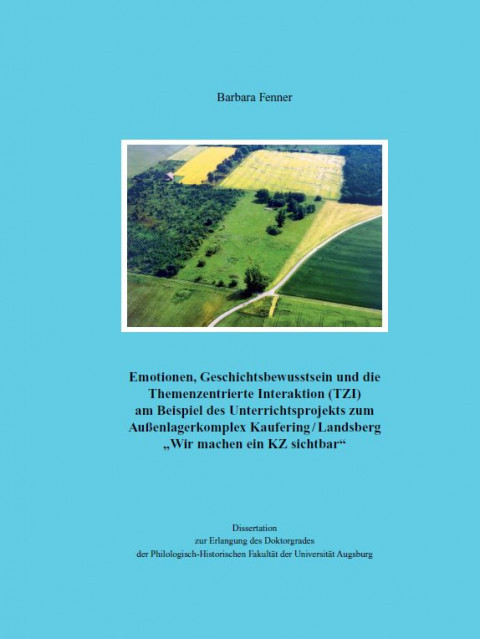 Emotionen, Geschichtsbewusstsein und die Themenzentrierte Interaktion (TZI) am Beispiel des Unterrichtsprojekts zum Außenlagerkomplex Kaufering/Landsberg: “Wir machen ein KZ sichtbar” Year of publication: 2012 Author: B. Fenner Corporate author: University of Ausgsburg Based on theme-centred interaction theory, the authors analyse a project in which a group of German 9th and 10th grade students participate in a project, “We make a Concentration Camp visible,” aimed at recreating the history of the so called Lager XI, one of the eleven satellite camp complexes of Dachau concentration camp, and make an exhibition about the camp. The above abstract is taken from the International Holocaust Remembrance Alliance Education Research Project. Please also consult the full list of abstracts in 15 languages and the accompanying publication Research in Teaching and Learning about the Holocaust: A Dialogue Beyond Borders. Ed: IHRA, Monique Eckmann, Doyle Stevick, Jolanta Ambrosewicz-Jacobs, 2017, Metropol Verlag at http://www.holocaustremembrance.com/publications.
 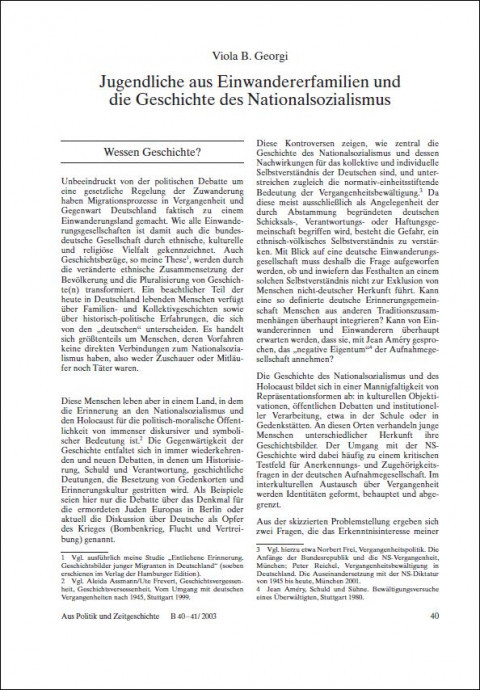 Jugendliche aus Einwandererfamilien und die Geschichte des Nationalsozialismus Year of publication: 2003 Author: V. B. Georgi Based on 55 interviews with young Germans with immigrant family background from the age of 15–20, Giorgi constructs a typology of how they position themesleves to the German Nazi past.
  Nationalsozialismus im Geschichtsunterricht: Beobachtungen unterrichtlicher Kommunikation Year of publication: 2002 Corporate author: Johann Wolfgang Goethe University This is a pilot study about the potential of history education about Nazism and the Holocaust. The aim is, 1) to establish whether it is possible to conduct empirical analysis about “Education after Auschwitz,” and 2) based on empircal observation improve the theoretical assumptions about the relationship between education and the specific theme of Nazism and the Holocaust. The empirical part consists of five case studies about different aspects of “Holocaust education” in two Upper Secondary schools in Frankfurt.The above abstract is taken from the International Holocaust Remembrance Alliance Education Research Project. Please also consult the full list of abstracts in 15 languages and the accompanying publication Research in Teaching and Learning about the Holocaust: A Dialogue Beyond Borders.Ed: IHRA, Monique Eckmann, Doyle Stevick, Jolanta Ambrosewicz-Jacobs, 2017, Metropol Verlag at http://www.holocaustremembrance.com/publications.
 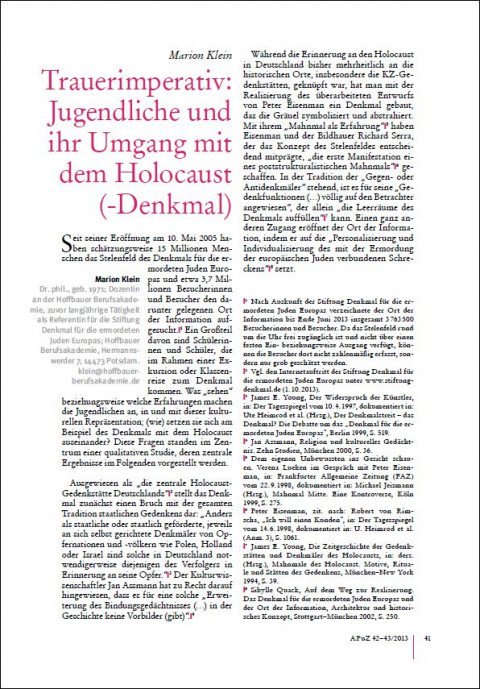 Trauerimperativ: Jugendliche und ihr Umgang mit dem Holocaust (-Denkmal) Year of publication: 2013 Author: M. Klein Corporate author: Bundeszentrale für politische Bildung The author analyzes German student’s visit at the memorial for the murdered Jews in Berlin. Empirical qualitative study.The above abstract is taken from the International Holocaust Remembrance Alliance Education Research Project. Please also consult the full list of abstracts in 15 languages and the accompanying publication Research in Teaching and Learning about the Holocaust: A Dialogue Beyond Borders.Ed: IHRA, Monique Eckmann, Doyle Stevick, Jolanta Ambrosewicz-Jacobs, 2017, Metropol Verlag at http://www.holocaustremembrance.com/publications.
  Zwischen Vermittlungsanspruch und emotionaler Wahrnehmung: Die Gestaltung neuer Dauerausstellungen in Gedenkstätten für NS-Opfer in Deutschland und deren Bildungsanspruch Year of publication: 2009 Author: Thomas Lutz Over the last decade, as part of the federal concept for memorial sites, twenty new permanent exhibitions were developed. This dissertation undertakes to examine exhibitions created at memorial sites for victims of the Nazi regime from an educational and museological viewpoint. Expert interviews with exhibition curators serve as the basis for the empirical study. The author has worked for many years in the field of memorial museums education. He applied “action research,” developed in German-speaking countries under the term “Handlungsforschung.” The study analyzes the specific characteristics of the work conducted in museums, memorial sites and educational centres and also addresses the strained connection between commemoration and learning in the educational work of the memorial museums for the Nazi victims. The study also evaluates the practical impact of these aims. The very intense form of commemorative work that is conducted in Germany is justified by the nature of its subject matter: the stigmatization of specific victim groups during the Nazi era according to a system of political, racist-biological and social characteristics and the vast dimensions of the genocide. The socially and politically explosive nature of this task is manifested by the commemoration of the “other” victims as well as by the responsibility that Germany bears for addressing its “own” perpetrators in society. The central findings of the study show that the new exhibitions embrace a much more comprehensive foundation of historical material (historical knowledge, building history and archeological significance of the crime sites, written and audio-visual survival testimony and artifacts) as was previously the case. The professionalization of the “field of memorial museums” has led to a more intensively reflected and sensitive approach to handling documents, illustrations and objects on display in a museum. In particular, the significance of the relationship between the artifacts and their location, their sources, an appreciation for their origins and a critical reflection of what it is they convey is achieved. This also applies to photography. (Written by author) The above abstract is taken from the International Holocaust Remembrance Alliance Education Research Project. Please also consult the full list of abstracts in 15 languages and the accompanying publication Research in Teaching and Learning about the Holocaust: A Dialogue Beyond Borders.Ed: IHRA, Monique Eckmann, Doyle Stevick, Jolanta Ambrosewicz-Jacobs, 2017, Metropol Verlag at http://www.holocaustremembrance.com/publications.
 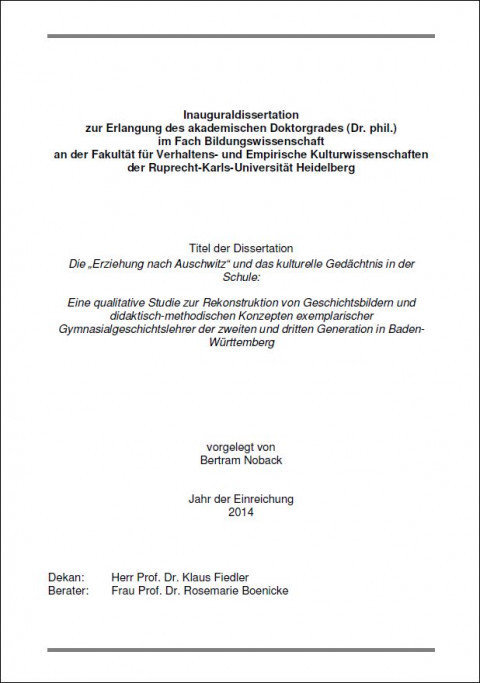 Die “Erziehung nach Auschwitz” und das kulturelle Gedächtnis in der Schule: Eine qualitative Studie zur Rekonstruktion von Geschichtsbildern und didaktisch-methodischen Konzepten exemplarischer Gymnasialgeschichtslehrer der zweiten und dritten Generation in Baden-Württemberg Year of publication: 2014 Author: Bertram Noback This is a qualitative study based on interviews with 56 German history teachers working in different upper secondary schools in Baden-Württemberg. The author asks whether the theme of National Socialism is considered to be a normal topic in history teaching for contemporary German teachers or if they view it as key problem for education in schools. He therefore tries to reconstruct teachers’ images of history and their subjective theories concerning the treatment of National Socialism in history education. Among history teachers of the third generation the author distinguishes between three ideal types which he believes reflect different attitudes to society’s and the schools’ treatment of the Nazi period. He also identifies six different ideal types in terms of educational concepts concerning teaching about the Holocaust. The above abstract is taken from the International Holocaust Remembrance Alliance Education Research Project. Please also consult the full list of abstracts in 15 languages and the accompanying publication Research in Teaching and Learning about the Holocaust: A Dialogue Beyond Borders.Ed: IHRA, Monique Eckmann, Doyle Stevick, Jolanta Ambrosewicz-Jacobs, 2017, Metropol Verlag at http://www.holocaustremembrance.com/publications.