
Resources
Explore a wide range of valuable resources on GCED to deepen your understanding and enhance your research, advocacy, teaching, and learning.
1,451 Results found
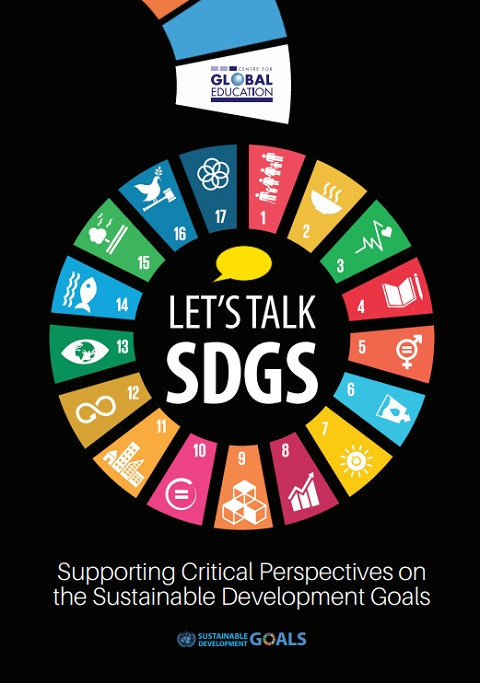 Let’s Talk SDGs: Supporting Critical Perspectives on the Sustainable Development Goals Year of publication: 2020 Author: Caroline Murphy Corporate author: Centre for Global Education (CGE) This resource is an invitation to development educators to critically interrogate the Sustainable Development Goals and discuss their capacity to deliver upon their intended outcomes. It invites users to ask if the SDGs can support effective global learning and represent a sound critique of the international system. The resource is a useful starting point for a critical discussion on the Goals' capacity for effective advocacy and education toward the eradication of poverty and inequality.
 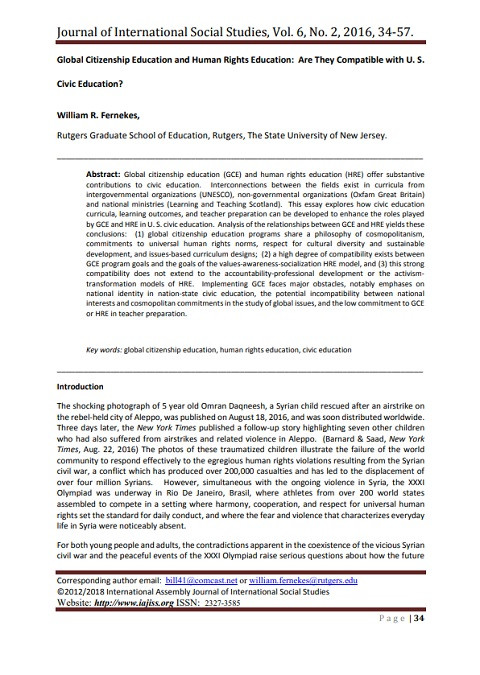 Global Citizenship Education and Human Rights Education: Are They Compatible With U. S. Civic Education? (Journal of International Social Studies; Vol. 6, No. 2) Year of publication: 2016 Author: William R. Fernekes Corporate author: International Assembly of the National Council for the Social Studies Global citizenship education (GCE) and human rights education (HRE) offer substantive contributions to civic education. Interconnections between the fields exist in curricula from intergovernmental organizations (UNESCO), non-governmental organizations (Oxfam Great Britain) and national ministries (Learning and Teaching Scotland). This essay explores how civic education curricula, learning outcomes, and teacher preparation can be developed to enhance the roles played by GCE and HRE in U. S. civic education. Analysis of the relationships between GCE and HRE yields these conclusions: (1) global citizenship education programs share a philosophy of cosmopolitanism, commitments to universal human rights norms, respect for cultural diversity and sustainable development, and issues-based curriculum designs; (2) a high degree of compatibility exists between GCE program goals and the goals of the values-awareness-socialization HRE model, and (3) this strong compatibility does not extend to the accountability-professional development or the activismtransformation models of HRE. Implementing GCE faces major obstacles, notably emphases on national identity in nation-state civic education, the potential incompatibility between national interests and cosmopolitan commitments in the study of global issues, and the low commitment to GCE or HRE in teacher preparation.
  Putting the Voice of Young People at the Heart of Global Citizenship Education Year of publication: 2014 Author: Douglas Bourn Corporate author: UCL Institute of Education | Erasmus+ This briefing is aimed at policy-makers across Europe who are engaged with, or interested in ensuring that education and international development programmes give consideration to the voices of young people. It also aims to contribute to policy-makers responses to how they are implementing the Sustainable Development Goals.
  La famille Tout-Écran: Conseils en éducation aux médias et à l’information Year of publication: 2019 Corporate author: Centre pour l’éducation aux médias et à l’information (CLEMI) | Réseau Canopé L’Éducation aux Médias et à l'Information (EMI) devient une exigence républicaine au cœur du Parcours citoyen, un enjeu éducatif et sociétal incontournable dans un environnement où le numérique est omniprésent.Dans un monde globalisé et complexifié, la définition et la compréhension de la source de l’information constituent une priorité pour déjouer les tentatives de manipulation et de désinformation.Les enjeux sociétaux de l’EMI dépassent les murs de l’école et doivent mobiliser tous les acteurs pour renforcer le continuum entre temps scolaire et hors temps scolaire.Ce guide bénéficie de l’expertise des professionnels du CLEMI et de son réseau de pédagogues, de partenaires institutionnels, associatifs et médiatiques. Issu de cette mobilisation, cet ouvrage est le produit d’un groupe de travail dédié aux pratiques informationnelles des jeunes, composé de membres représentant du ministère de l’Éducation nationale et de la Jeunesse, du ministère de la Culture, France Télévisions, Radio France, le CSA, CNRS Images, Ceméa, la Ligue de l’enseignement, la CNAF, Jets d’encre et l’Icem-Pédagogie Freinet.
  Research in Teaching and Learning About the Holocaust: A Dialogue Beyond Borders Year of publication: 2017 Author: Monique Eckmann | Doyle Stevick | Jolanta Ambrosewicz-Jacobs Corporate author: International Holocaust Remembrance Alliance (IHRA) | Metropol A multilingual expert team of the International Holocaust Remembrance Alliance (IHRA) collected and reviewed research on teaching and learning about the Holocaust in fifteen languages identified nearly 400 studies resulting in more than 600 publications.This systematic review includes research conducted in most IHRA Member Countries as well as several non-member countries. The multilingual focus of the project enables cross-cultural analyses and the transfer of knowledge between various regions and countries. The book’s two parts present the research first by language and then by selected themes. This innovative transnational, trans-lingual study reflects IHRA’s core mission: to shape and advance teaching and learning about the Holocaust worldwide.The second outcome is a set of bibliographies in fifteen languages. These bibliographies comprise references to empirical research on teaching and learning about the Holocaust. They also include abstracts or summaries of most of publications. Each bibliography includes research from a single language or related group of languages.
  Teaching about the Holocaust in English Secondary Schools : An empirical study of national trends, perspectives and practice Year of publication: 2009 Author: Alice Pettigrew | Stuart Foster | Jonathan Howson | Paul Salmons | Ruth Anne Lenga | Kay Andrews The aims were to examine when, where, how and why the Holocaust is taught in state-maintained secondary schools in England, and to inform the design and delivery of a continuing professional development (CPD) programme for teachers who teach about the Holocaust. A two-phase mixed methodology was employed. This comprised an online survey which was completed by 2,108 respondents and follow-up interviews with 68 teachers in 24 different schools throughout England. The research reveals that teachers adopt a diverse set of approaches to this challenging and complex subject. In the report, teachers’ perceptions, perspectives and practice are presented and a range of challenges and issues encountered by teachers across the country are explicitly identified. The research shows that, although most teachers believe that it is important to teach about the Holocaust, very few have received specialist professional development in this area. It also shows that many teachers find it a difficult and complicated subject to teach, and that they both want and need support to better equip them to teach about the Holocaust effectively.(By the author)
  Indicators for evaluating municipal policies aimed at fighting racism and discrimination Year of publication: 2005 Author: Jean Claude Icart | Micheline Labelle | Rachad Antonius Corporate author: Centre de recherche sur l'immigration, l'ethnicité et la citoyenneté (Canada). Observatoire international sur le racisme et les discriminations Ethnocultural diversity increasingly constitutes an important characteristic of major cities around the world. As the primary centres for national, ethnic and cultural intermixing, cities are becoming laboratories for new ways of “living together” (UNESCO, 2004). However, when this diversity is accompanied by inequalities, racism and discrimination, it can increase the social divide. Therefore, in order to benefit from the true advantages of the ethnocultural diversity that makes up the fabric of contemporary societies, it has become increasingly necessary to employ methods to correct social injustices, and to ensure the equality and the full exercise of citizens’ rights. Accordingly, the last few years have seen true efforts to conceptualize interventions by cities to manage ethnocultural diversity. These efforts rely on ideologies controlled by the state and on the values of equality, social justice, and respect for pluralism that are endorsed by different international organizations such as the UN and UNESCO, or by national organizations such as human rights commissions.To promote and reinforce municipal anti-discriminatory policies, UNESCO supported the launching of the International Coalition of Cities Against Racism1. The initial framework for this Coalition was the proposal of the Ten-Point Action Plan, which was adopted in December 2004 in Nuremburg.The present research report relating to the development of a series of indicators for evaluating municipal policies to fight racism and discrimination should be situated in this context. It was carried out with the goal of assisting cities that want to adopt public policies of diversity management and to fight racism and discrimination, and to evaluate the impact of such policies. The goal is to equip cities with tools that make it possible to evaluate, in quantitative and/or qualitative terms, whether their actions produce results that correspond to the major goals of adopted policies. Indicateurs pour l'évaluation des politiques municipales visant à contrer le racisme et la discrimination Year of publication: 2005 Author: Jean Claude Icart | Micheline Labelle | Rachad Antonius Corporate author: Centre de recherche sur l'immigration, l'ethnicité et la citoyenneté (Canada). Observatoire international sur le racisme et les discriminations Ethnocultural diversity increasingly constitutes an important characteristic of major cities around the world. As the primary centres for national, ethnic and cultural intermixing, cities are becoming laboratories for new ways of “living together” (UNESCO, 2004). However, when this diversity is accompanied by inequalities, racism and discrimination, it can increase the social divide. Therefore, in order to benefit from the true advantages of the ethnocultural diversity that makes up the fabric of contemporary societies, it has become increasingly necessary to employ methods to correct social injustices, and to ensure the equality and the full exercise of citizens’ rights. Accordingly, the last few years have seen true efforts to conceptualize interventions by cities to manage ethnocultural diversity. These efforts rely on ideologies controlled by the state and on the values of equality, social justice, and respect for pluralism that are endorsed by different international organizations such as the UN and UNESCO, or by national organizations such as human rights commissions.To promote and reinforce municipal anti-discriminatory policies, UNESCO supported the launching of the International Coalition of Cities Against Racism1. The initial framework for this Coalition was the proposal of the Ten-Point Action Plan, which was adopted in December 2004 in Nuremburg.The present research report relating to the development of a series of indicators for evaluating municipal policies to fight racism and discrimination should be situated in this context. It was carried out with the goal of assisting cities that want to adopt public policies of diversity management and to fight racism and discrimination, and to evaluate the impact of such policies. The goal is to equip cities with tools that make it possible to evaluate, in quantitative and/or qualitative terms, whether their actions produce results that correspond to the major goals of adopted policies.
  Référentiel des compétences développées en éducation à la citoyenneté mondiale et solidaire à l’âge de l’obligation scolaire Year of publication: 2017 Corporate author: Annoncer la Couleur (ALC) | La coopération belge au développement | Centre de Connaissances en Éducation à la Citoyenneté Mondiale (WikiCM) Ce référentiel de compétences ECM(Éducation à la citoyenneté mondiale) a été élaboré par WikiCM, le centre de connaissances en éducation à la citoyenneté mondiale coordonné par Annoncer la Couleur a réuni des professionnels de l’enseignement (administration, réseaux, inspection) et de l’éducation à la citoyenneté mondiale (ONG, ALC). Il présente dans un premier temps les repères sur les stades de développement de l’enfant et, dans un deuxième temps, les 7 compétences de l’ECM en milieu scolaire.
  Orientaciones para los profesores: Cómo detectar y combatir la desinformación Year of publication: 2021 Corporate author: European Commission Este kit está concebido para presentar a los jóvenes el fenómeno de la desinformación, dándoles a conocer las amenazas que plantea, explicando de qué modo los alumnos pueden averiguar más al respecto y protegerse de este fenómeno, y brindándoles la oportunidad de examinar detalladamente ejemplos concretos. El kit está disponible para utilizarse libremente en cualquier centro de enseñanza. Aunque puede adaptarse y personalizarse a cualquier grupo de edad, el grupo destinatario principal es el de adolescentes de entre quince y dieciocho años.